

 Brazil
 Antarctica
 Argentina
 Bolivia
 Chile
 Colombia
 Ecuador
 Falkland Islands (Malvinas)
 French Guiana
 Guyana
 Paraguay
 Peru
 Suriname
 Uruguay
 Venezuela
 Albania
 Austria
 Belgium
 Croatia
 Denmark
 Finland
 France
 Germany
 Greece
 Hungary
 Iceland
 Ireland
 Italy
 Luxembourg
 Norway
 Poland
 Portugal
 Slovakia
 Slovenia
 Sweden
 Switzerland
 the Czech Republic
 the Netherlands
 the United Kingdom
 Turkey
 Bermuda
 Canada
 Greenland
 Mexico
 Saint Pierre and Miquelon
 the United States
 the Dominican Republic
 Japan
 Egypt
 South Africa
 Australia
 Fiji
 New Zealand
 Papua New Guinea
Cathedral · Córdoba, Spain
Mosque-Cathedral of Córdoba
Mosque begun in 785 by the emirs and caliphs of Córdoba, with a forest of columns and bicoloured arches, which received a Renaissance cathedral in the centre from 1523.
Illustrative images. The pictures in this guide are illustrations based on the real place, not photographs, and may differ from it.

Discover
About Mosque-Cathedral of Córdoba
The Mezquita began to be built in 785 by order of Abd al-Rahman I. It was enlarged three times: by Abd al-Rahman II, from 836; by Al-Hakam II, from 961; and by Almanzor, in 987 and 988. The result is a prayer hall with hundreds of columns and arches of stone and brick, in white and red bands.
The highlight is the mihrab of Al-Hakam II, a small octagonal room with a shell-shaped dome. The golden mosaics were made with the help of Byzantine craftsmen and were completed around 970.
After the Christian conquest in 1236, the building became a cathedral. In 1523, Bishop Alonso Manrique began the Renaissance nave in the middle of the old mosque, designed by Hernán Ruiz I. The work took 84 years, and the crossing dome was made between 1599 and 1607.
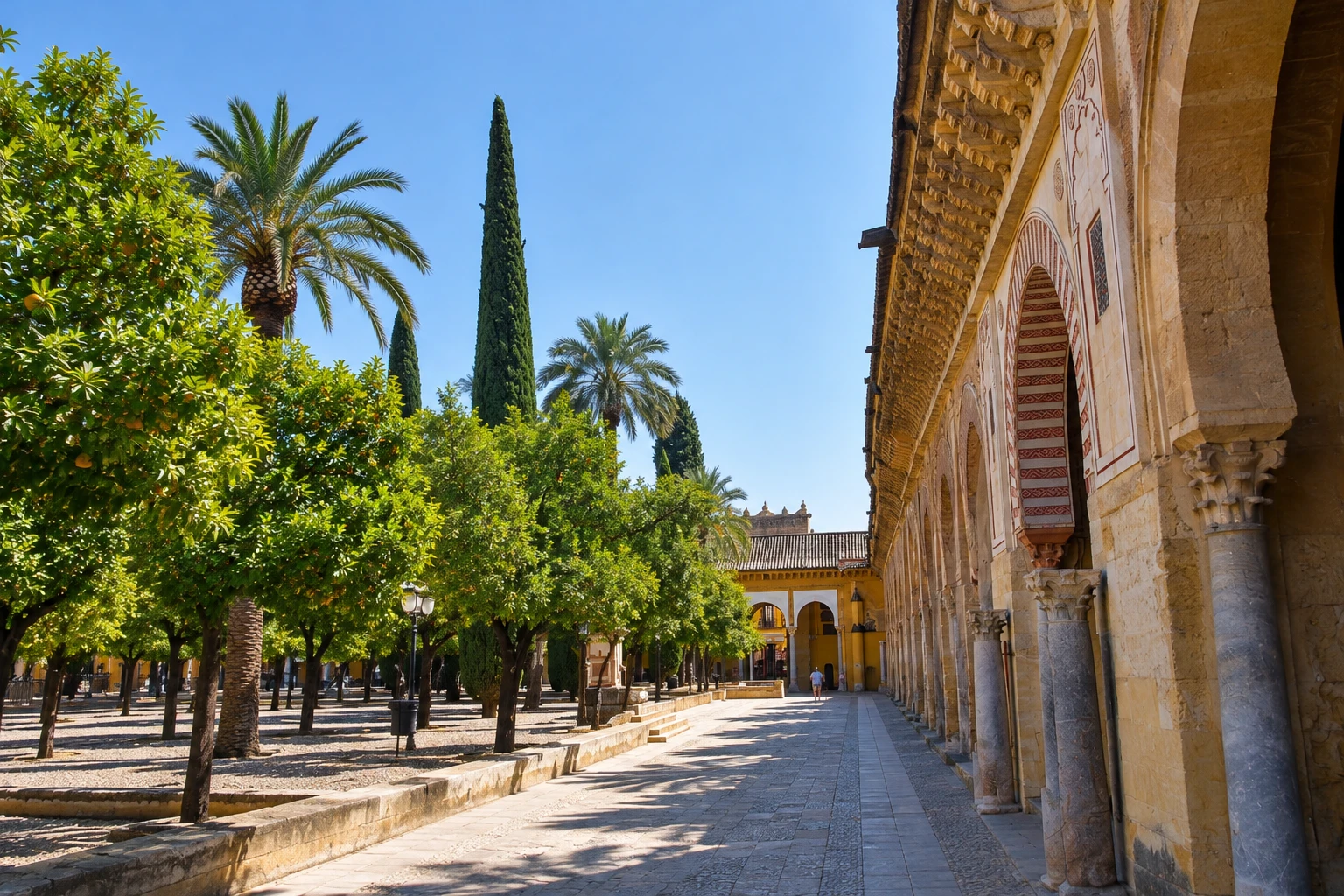
The entrance is through the Patio de los Naranjos, the former ablutions courtyard, measuring 130 by 50 metres, with orange trees, palm trees and cypresses. Beside it stands the bell tower, which surrounds the old minaret of Abd al-Rahman III: the Renaissance tower was started in 1593 by Hernán Ruiz III and reaches 54 metres, the highest point of the city. At its base is the Puerta del Perdón, from 1377.
The complex has been a UNESCO World Heritage Site since 1984 and continues to function as the cathedral of the diocese of Córdoba.
Before you go
Practical information
Cidade Turismo reviews its information regularly, but something may have changed. Check with the place before planning your trip.
How much time to set aside
From 1 h 30 to 2 hours for the general visit. The ascent to the bell tower and the night visit are separate.
Best time
Right at opening, before the groups. From June to August, prefer the morning, when the Patio de los Naranjos still has shade and lower temperatures. The days and times of the night visit vary by month.
How to get there
It lies at the heart of the historic centre, about 2 km from the train station, around a 20-minute walk. From the Plaza de las Tendillas it's about 10 minutes walking downhill towards the river.
Tip
Buy the ticket on the official website or at the reception centre on the Patio de San Eulogio. The ascent to the bell tower has its own ticket, is not permitted for children under 7 and has narrow stairs. The night visit also has a separate ticket and requires reservation. Opening hours change due to religious services: check before you go. Dress appropriately for a place of worship.
Official website
Your questions
Frequently asked questions about Mosque-Cathedral of Córdoba
Can you go up the tower of the Mezquita-Catedral?
Yes. The bell tower has its own visit, with a separate ticket. The climb is about 40 meters up narrow stairs and is not permitted for children under 7 or for those with mobility problems or vertigo. From the top you can see the Patio de los Naranjos, the river, and the roofs of the historic center.
Is there a night visit at the Mezquita-Catedral?
Yes. The night visit, called El Alma de Córdoba, lasts about 1 hour and tours the interior with special lighting and commentary via headphones in nine languages, including Portuguese. Photography is not allowed. Days and times change depending on the month. Book in advance.
Why is there a cathedral inside the mosque?
After the Christian conquest of 1236, the building came to be used as a cathedral. In 1523, Bishop Alonso Manrique began the construction of a Renaissance nave in the center of the former prayer hall, completed 84 years later.
What is the Patio de los Naranjos?
It is the entrance courtyard, where the mosque's ablution area was located. It measures 130 by 50 meters, and orange trees appear in documents as early as 1512.