Kranjska Gora and the Vršič Pass

Gorenjska

Kranjska Gora and the Vršič Pass

Alpine valley of the upper Sava, next to Italy and Austria: Lake Jasna, the Planica ski jumps, the Zelenci spring and the Vršič pass road.

Alpine Slovenia

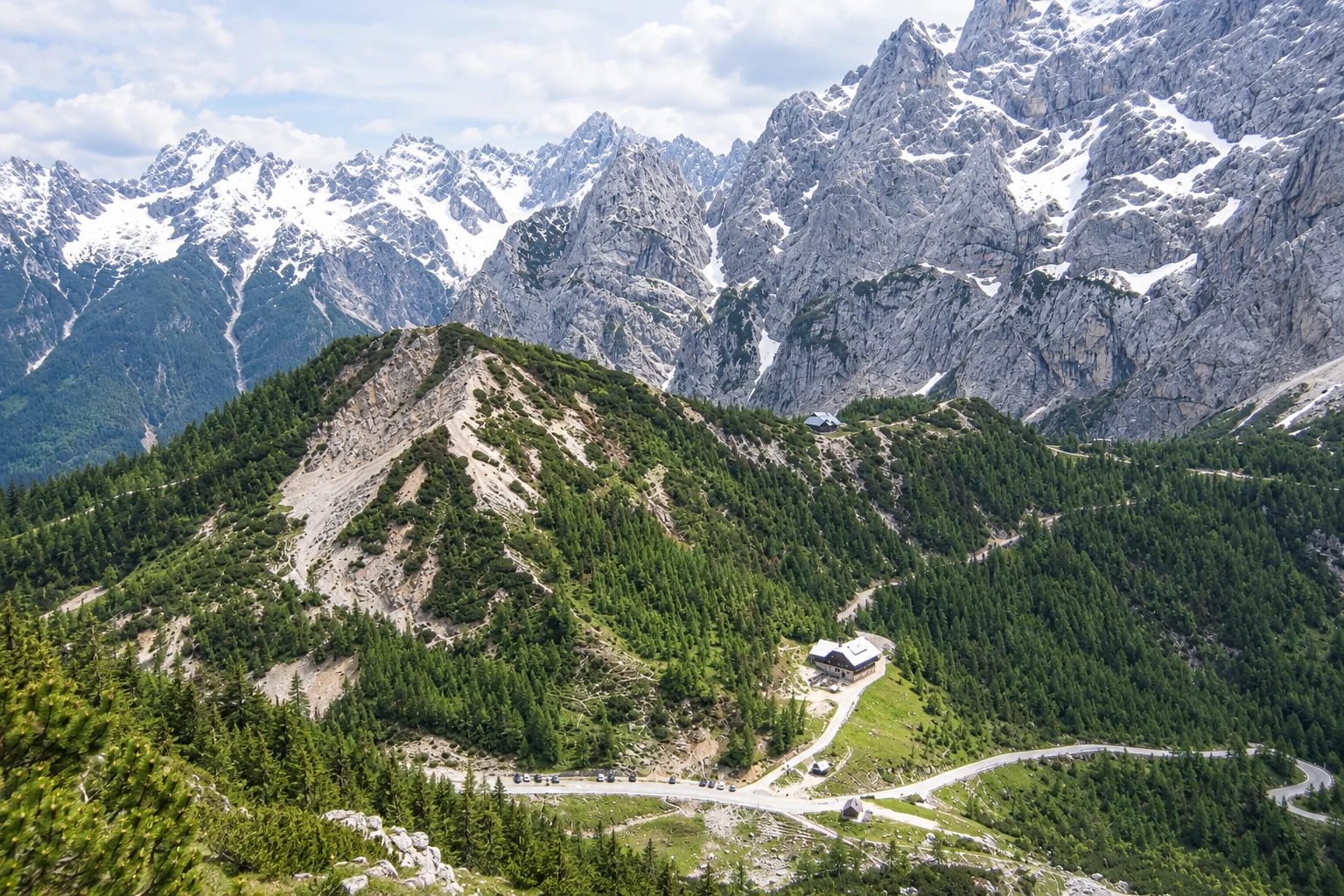
In the photo: Mountains and slopes of the Vršič pass

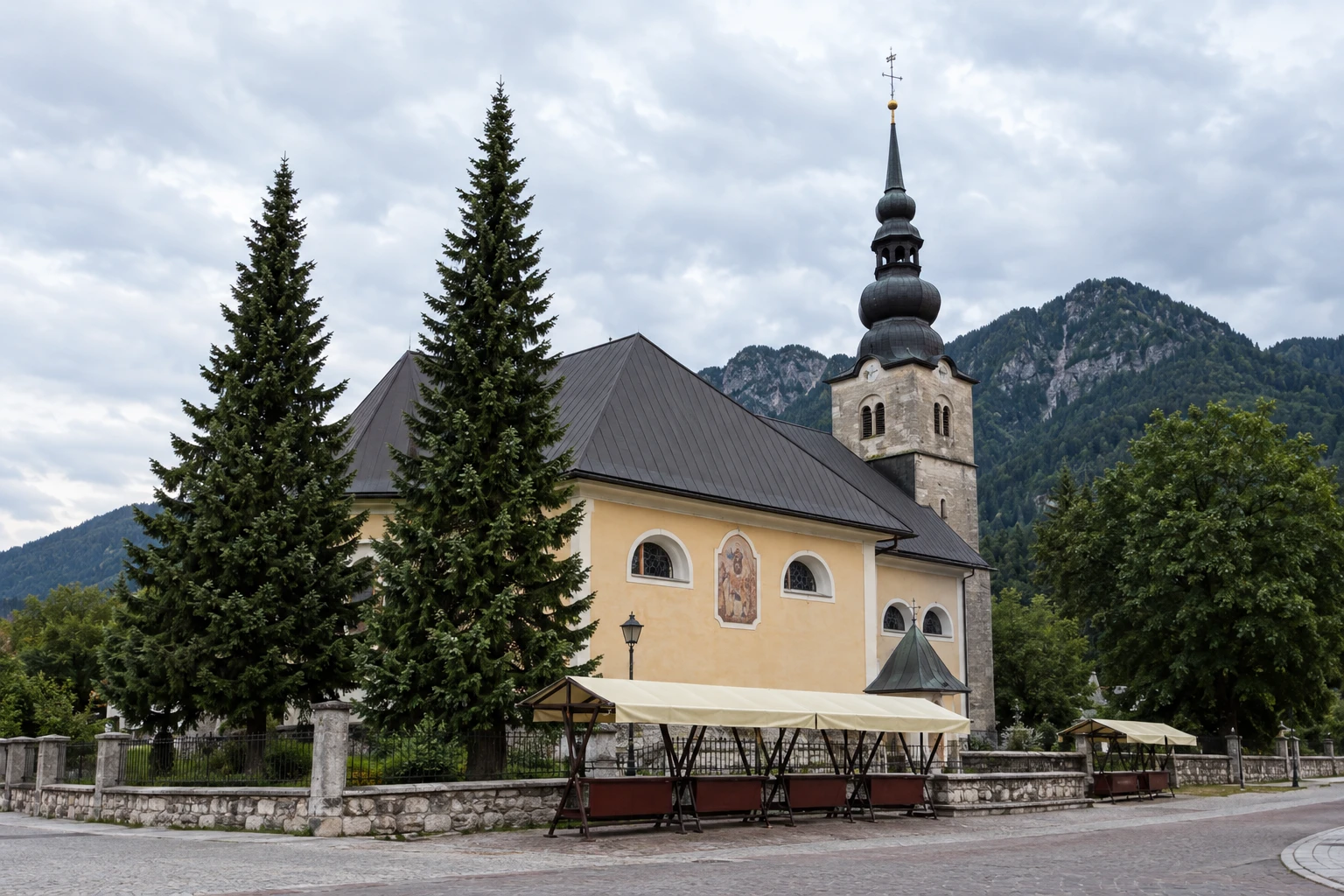
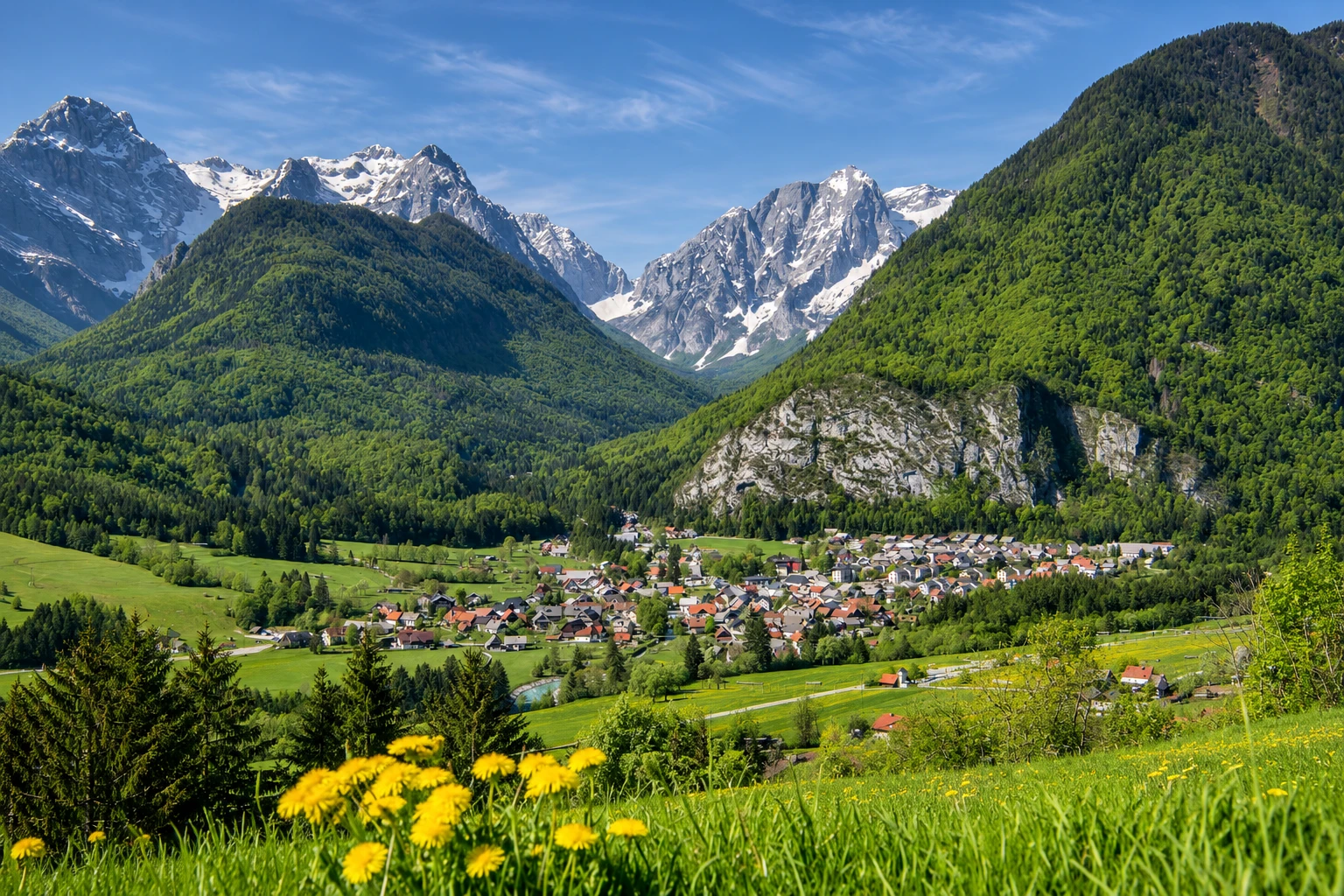
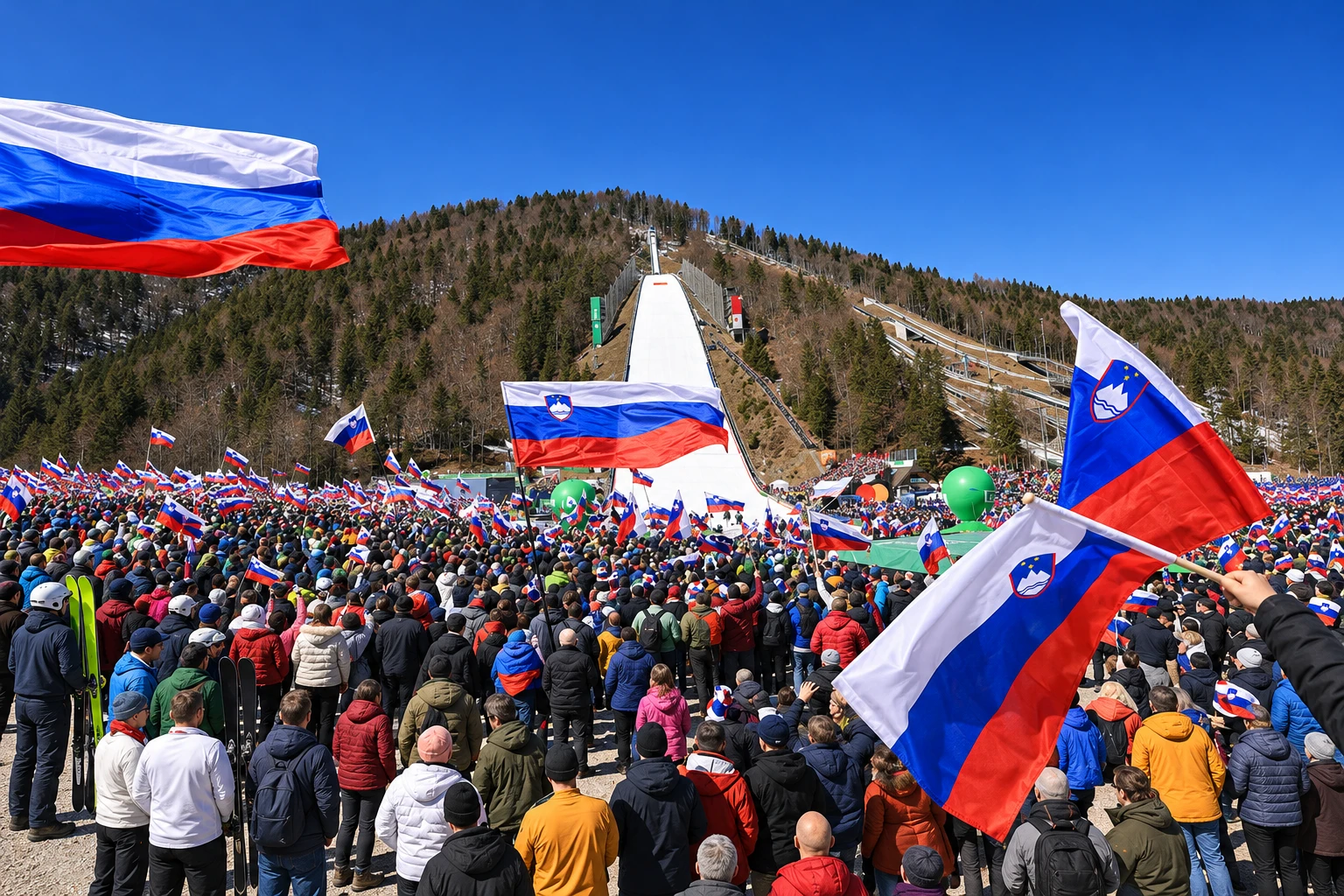
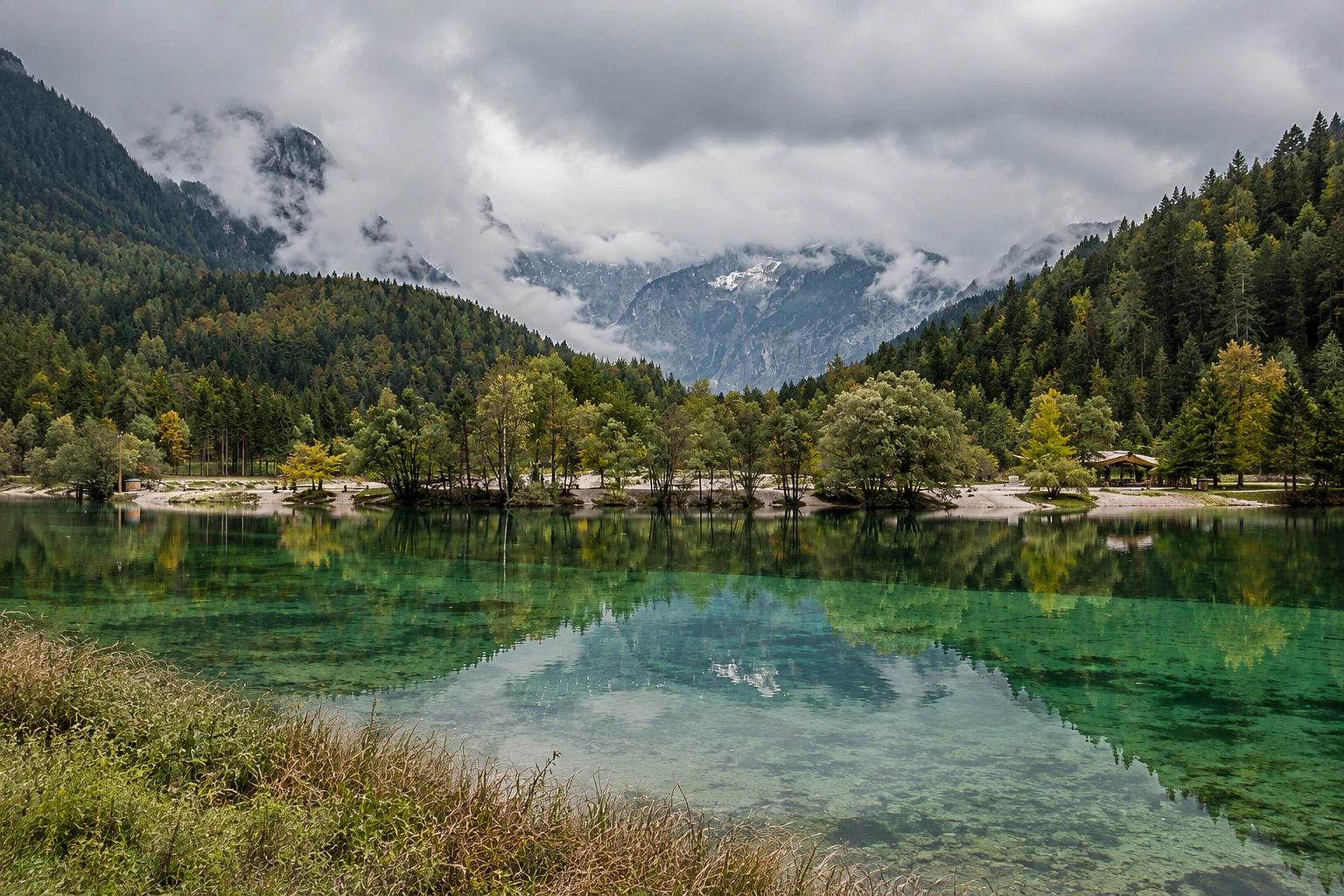
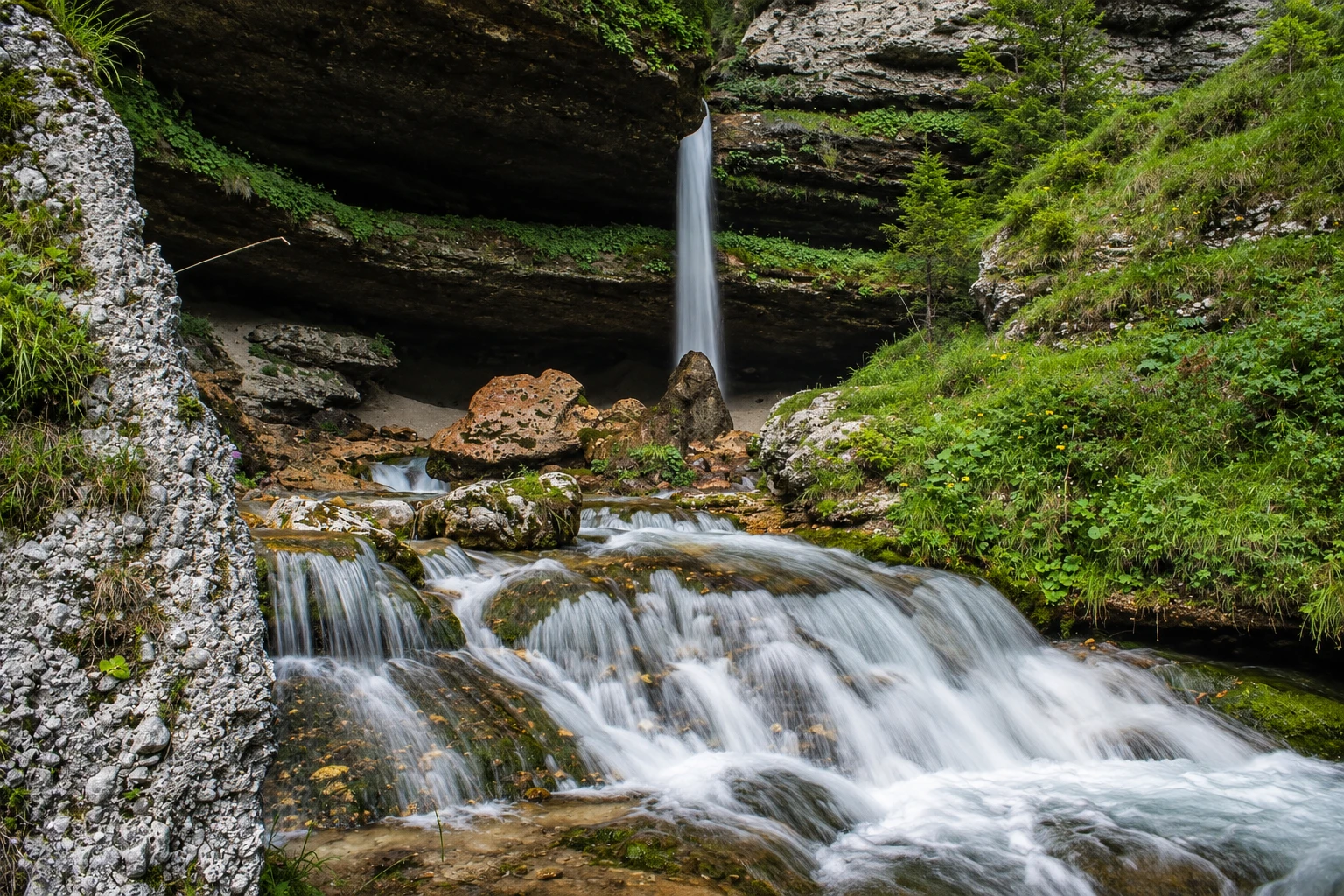
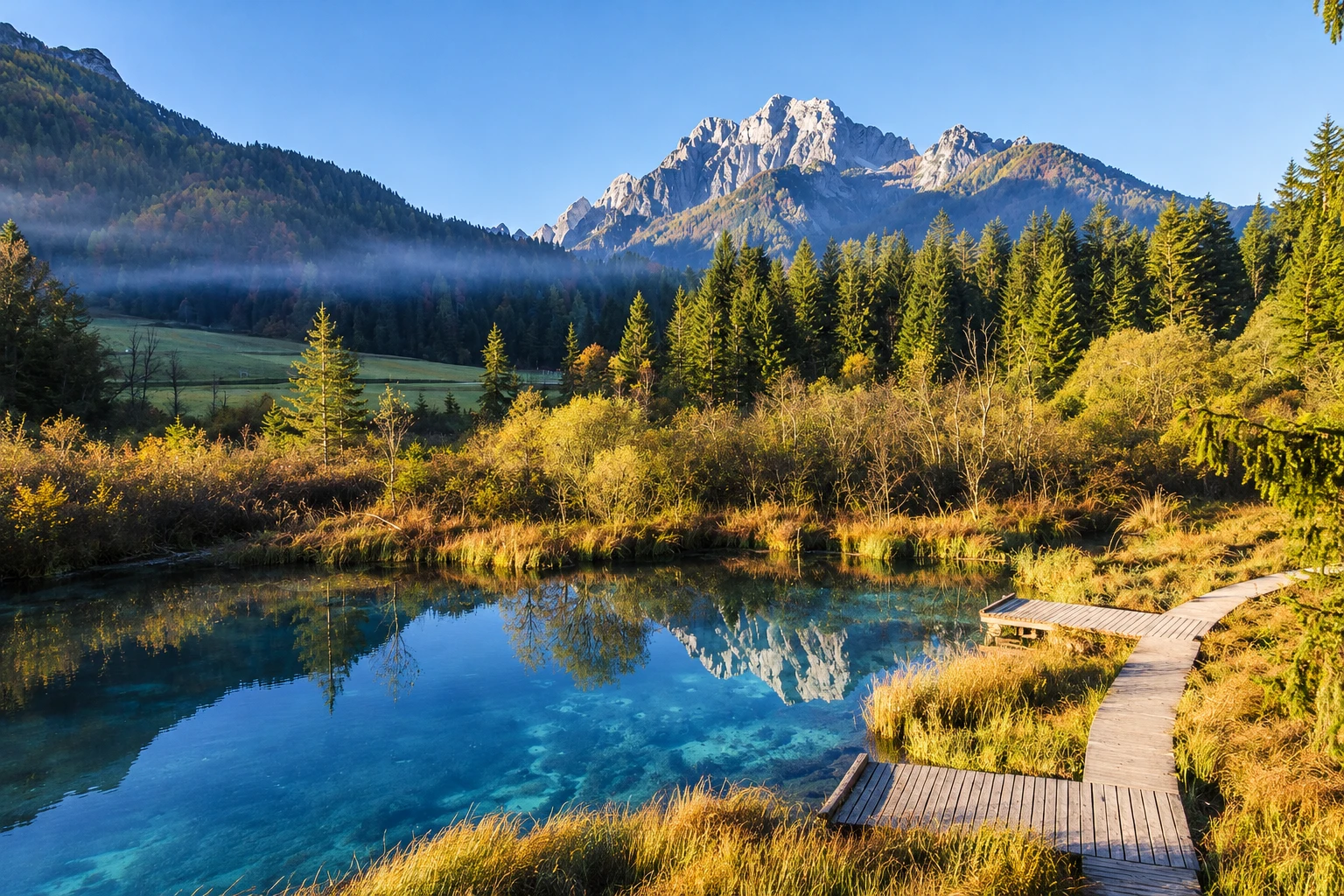
Illustrative images. The pictures in this guide are illustrations based on the real place, not photographs, and may differ from it.

Get it on Google Play

Get to know the place

A region to enjoy
at your own pace.

Kranjska Gora lies in the far northwest of Slovenia, in the upper Sava valley (Zgornjesavska dolina), a few kilometers from the borders with Italy and Austria. To the south the Julian Alps rise, with Prisank and Razor; to the north, the Karavanke range. The village is the country’s main mountain resort and usually hosts Alpine Ski World Cup events in winter on the Vitranc slope.

A few minutes from the center are Lake Jasna, at the foot of the Prisank and Razor peaks, and the Zelenci nature reserve, where underground water resurfaces and gives rise to the Sava Dolinka. To the west, after the village of Rateče, the Planica valley concentrates the ski jumping ramps that have made the region famous since the 1930s.

From Kranjska Gora starts the Vršič pass road, which climbs to 1,611 meters. Built during World War I by Russian prisoners of war, it leads, on the other side of the pass, to the Trenta valley and the Soča. Along the way is the wooden Russian Chapel, erected by the prisoners in memory of comrades killed in an avalanche in 1916.

In summer, the region serves as a base for trails in Triglav National Park and for bike rides on the flat valley cycle path that reaches Rateče. In winter, the Vitranc slopes and the cross-country ski tracks of Planica and Rateče occupy the valley.

This destination brings together 2 cities: Kranjska Gora, Mojstrana.

Share: WhatsApp
Traveler, share your experiences through photos Up to 5 photos of each place you visited.

One destination, many paths

The cities on this trip

Start with one city or combine several in your itinerary.

Where Kranjska Gora and the Vršič Pass is The star marks the nearest capital, Kranj.
KranjKranjska GoraMojstrana

Boundaries: Geodetska uprava Republike Slovenije (GURS), Register prostorskih enot, 28/02/2024, license CC BY 4.0. Adapted by Cidade Turismo.

How to get there: Kranjska Gora and the Vršič Pass

Letališče Jožeta Pučnika Ljubljana (LJU), in Brnik · 67 km to Kranjska Gora

The arrival town is Kranjska Gora, about 85 km from Ljubljana via the A2 motorway and the valley road. By road, Ljubljana Airport (LJU) is about 65 km away. The nearest train station is Jesenice, about 25 km away, with buses to Kranjska Gora.

Suggested arrival point: Kranjska Gora

Festivals and events

Festivals Kranjska Gora and the Vršič Pass

Dates change every year: check this year's date before you travel.

Festival calendar in Slovenia

The local experience

Things to do in Kranjska Gora and the Vršič Pass

Kranjska Gora · Gorenjska · Lake

Lake Jasna

Two artificial lakes at the confluence of the Velika and Mala Pišnica streams, south of Kranjska Gora, with a bronze statue of Zlatorog and views of Prisank and Razor.

Explore Lake Jasna

Kranjska Gora · Gorenjska · Nature reserve

Zelenci Springs

Small wetland reserve near Podkoren where groundwater springs into an emerald-green lake and forms the Sava Dolinka. Wooden boardwalks and an observation tower cross the area.

Explore Zelenci Springs

See 3 more places in Kranjska Gora and the Vršič Pass

To choose before you go

Tours in Kranjska Gora and the Vršič Pass

Where each tour starts, how long it takes, how it is done, what is included and the price range.

Lake Jasna: the two lakes, the bronze ibex and the Prisank view

From Kranjska Gora center Short walk from the town center about 1 h 30 morning or late afternoon easy

Lake Jasna lies at the exit of Kranjska Gora, before the first curves of the Vršič Pass road. It consists of two linked artificial lakes at the confluence of the Velika Pišnica and Mala Pišnica streams, covering 2.2 hectares of emerald-green water with the Razor and Prisank walls behind. From the center, a pedestrian path reaches the lake in a few minutes; visitors by car find two parking lots near the shore. Maintained trails circle both lakes, with wooden piers for swimming in summer. The second lake has an observation tower. On a rock stands the bronze statue of the ibex, the most photographed spot, and nearby a wooden frame featuring Kosobrin, a character from the Kekec stories, frames the mountains. Beside the lake, a Kneipp path lets you walk barefoot on stones in cold mountain water, and a small lakeside free-exchange library operates on a leave-a-book, take-a-book basis. The lake is a fishing area, fly fishing only. Summer nights often feature live music at the shore.

Stops: Lake Jasna, Velika Pišnica, Mala Pišnica.

Includes: Free self-guided visit. Drinks and ice cream at the lakeside are extra.

Tip: Walk from the center: it’s close and saves the trouble of finding parking. The lake pairs well with the climb to Vršič Pass, which begins just beyond it.

Best time: All year; from June to August you can enter the water; in winter the landscape is covered in snow.

Vršič Pass road: 50 hairpins, the Russian Chapel and the summit at 1,611 m

From Kranjska Gora (car or seasonal bus) Car or bus via the mountain road about 4 hours (round trip, with stops) morning easy (narrow, steep road)

The Vršič Pass, at 1,611 m, is the highest paved mountain pass in Slovenia and in the eastern Julian Alps. The road runs from Kranjska Gora to Log in the Trenta Valley, connecting Gorenjska to Primorska with 50 tight hairpin turns: 24 on the Kranjska Gora side and 26 on the Trenta side. It is paved, with some sections cobbled, narrow and steep in the upper part, and lies inside Triglav National Park. It was built by Russian prisoners of war during World War I, which is why it is also called the Russian Road. On the ascent, after Lake Jasna, stands the wooden Russian Chapel, dedicated to Saint Vladimir and erected in 1915 by the prisoners themselves; inside there is an altar with an iconostasis, and beside it a stone tomb shaped like a pyramid. It is a monument of national importance. Higher up, on the Prisank face, you can see the mountain’s natural window and the Ajdovska deklica, a woman’s face drawn on the rock. At the top, near the Tičarjev dom shelter at 1,620 m, a vista opens onto the peaks around Kranjska Gora and Trenta. The slopes change with altitude, from beech and fir to larch and, finally, bare rock. Trails start from the pass to Slemenova špica, at 1,911 m, popular with families, and to Mala Mojstrovka, at 2,332 m.

Stops: Vršič Pass, Russian Chapel, Lake Jasna, Ajdovska deklica, Prisank.

Includes: Passage on the road is free. Seasonal bus service and parking follow current year rules. Check the current schedule.

Tip: Parking spots at the top are few and parking there is restricted: in summer, prefer the bus that links Kranjska Gora to Bovec via the pass. Drive slowly, watching for cyclists and walkers. In winter the road closes because of snow; check the official traffic service before leaving.

Best time: From June to September, when the bus runs; the road is often closed in winter.

Vršič on foot or by bike: the climb via the old Russian Road

From Kranjska Gora Tourist Information Centre Hike or cycle up on the paved road 13 km on foot or 12.2 km by bicycle (uphill only) full day difficult (13 km, 880 m ascent)

Those who prefer to earn the pass under their own power have two options. On foot, the marked trail leaves from the Kranjska Gora tourist information centre, passes Lake Jasna and follows a cart track along the Pišnica River toward the Krnica valley. After the memorial park for those who died on the mountain at Mali Tamar, it climbs through the forest up to the road and uses the shortcuts of the old Russian Road, passing the Russian Chapel; it crosses the asphalt a few times and reaches the Vršič Pass at 1,611 m. It’s 13 km with about 880 m of elevation gain, for well-prepared hikers. By bicycle, the climb is entirely on asphalt, alongside cars: 12.2 km and about 811 m of elevation gain from Kranjska Gora, with 24 tight hairpins up to the top. It is the country’s best-known cycling climb, and cyclists often compare times. Return is the same way back.

Stops: Vršič Pass, Lake Jasna, Krnica, Russian Chapel.

Includes: Free route, no fee. Rental of regular or electric bicycles in Kranjska Gora, paid separately.

Tip: Bring a warm layer and a rain jacket even in summer: temperature drops with altitude and the weather changes quickly. A helmet is mandatory when cycling. In summer you can hike up and return on the seasonal bus; confirm the schedules beforehand.

Best time: June to September; outside this period there may be snow at the top.

Zelenci: the emerald-green spring of the Sava Dolinka

From Rateče bus station or roadside parking Short walk on trail and wooden boardwalk about 1 h 30 (3.8 km from Rateče) morning or afternoon easy

Zelenci is a nature reserve just after the village of Podkoren, on the south side of the main road, on the northern edge of Triglav National Park, between Vitranc and the Karavanke. It is one of the two springs of the Sava Dolinka; the other is the Nadiža waterfall near Tamar. The marsh, with the Drni fen, is about 1,200 m long and on average 150 m wide. At the western end there is an emerald-green pool: the very clean, cold water wells up from the bottom through a layer of lacustrine marl, which gives the bluish-green colour that gives the place its name (zelen means green). The temperature stays between 5 and 6 °C year-round, so the pool does not freeze in winter. The area was declared a nature reserve in 1992 and is part of the Natura 2000 network, with rare plant and animal species. A well-maintained forest trail leads there, and a wooden boardwalk allows you to reach the water without stepping on the bog; beside it, an observation tower shows the pool from above with the Ponce mountains in the background. The English naturalist Humphry Davy visited in 1819, 1827 and 1828 and wrote that there was nothing more beautiful in Europe.

Stops: Zelenci, Rateče, Podkoren, Sava Dolinka.

Includes: Self-guided visit, no entrance fee.

Tip: From the car park it’s five minutes on foot. For a longer outing, leave from Rateče bus station via the old road or come by bike on the Kranjska Gora cycle path. Stay on the boardwalk: the bog is fragile.

Best time: All year; in summer the lake’s color is stronger, in autumn the woods change color and in winter the mountains in the background are white.

Planica and the Tamar Valley: the ski jumping hills, the museum and the walk

From Rateče or Kranjska Gora Car, bus or bicycle to Planica; walk in the valley about 5 hours full day easy to moderate

Planica is the valley of ski jumping hills, south of Rateče. The first jump of over 100 m happened there, and it hosts the world’s largest ski flying hill, where the 250 m mark was surpassed for the first time; overall the valley has seen more than 40 world records. The Planica Nordic Centre brings together the jumping hills, the cross-country tracks and, in the main building, the Planica museum, which tells the story of Slovenian Nordic skiing, the technical evolution of the ramps and equipment, and includes two jumping simulators and a station where visitors act as judges. The centre also has a wind tunnel, a zipline that descends along the ramp and a disc golf park. Beyond the jumping hills, a gravel road and a trail lead into the Tamar Valley, whose floor is covered by glacial moraines and scree: you walk first through meadows and then through forest, with walls up to 2,500 m high on both sides, including the Mojstrovka, the Ponce and the Jalovec. The walk ends at the Tamar mountain hut. From Kranjska Gora, the complete trail via Podkoren, Planica and Tamar totals 10 km, of moderate difficulty.

Stops: Planica, Tamar, Rateče, Ponce, Jalovec.

Includes: Free hiking in the valley. Museum, simulators, wind tunnel and zipline have separate paid tickets. Check the current schedule.

Tip: You can combine Planica and Zelenci in the same day: both are beside Rateče and connected by the bike path. In winter, the Tamar trail becomes a cross-country ski track. In March, during the World Cup ski jumping finals, the valley is crowded: check access before you go.

Best time: From May to October for hiking; from December to March for cross-country skiing; in March, the World Cup ski jumping finals.

Kranjska Gora center: the Liznjekova domačija and the world of Kekec

From Kranjska Gora center Walk around the town center; minibus to Kekec Land around 3 hours morning or afternoon easy

Kranjska Gora’s center can be explored on foot in a short time. The most interesting house is the Liznjekova domačija, a farmhouse over 300 years old, restored in 1983 and turned into a museum that shows how a prosperous alpine farming family lived: the wooden house with the black kitchen and open hearth, the wide entrance hall and the small bedroom; in the attic two wooden dormitories, and below, the cellar. On the outside, the façade has paintings, a stone arched portal and a wooden balcony. The cellar houses the permanent exhibition about Josip Vandot, a writer born in Kranjska Gora in 1884, who created in 1918 the little shepherd Kekec, one of the best-known characters of Slovenian children’s literature. The three stories are set in the surrounding mountains and inspired three films, the first from 1951, awarded in Venice. Children meet the characters again in Kekec Land, a two-hour guided tour with minibus transport from the center, in which Kekec, aunt Pehta, the villain Bedanec and the kind Kosobrin appear.

Stops: Liznjekova domačija, Kranjska Gora, Kekec Land.

Includes: Unguided walk; Kekec Land museum and guided tour have separate paid tickets. Check the current schedule.

Tip: Kekec Land operates on selected days and by reservation, especially in spring, when it opens only on weekends: check before you go. The museum is a good option for a rainy day.

Best time: Museum open year-round; Kekec Land opens on selected days from May.

See 4 more tours

Vrata Valley and the Peričnik waterfall, from Mojstrana

From Slovenski planinski muzej, in Mojstrana Hiking, cycling or seasonal bus about 4 hours morning moderate (4.7 km to the waterfall)

Mojstrana is the gateway to the Vrata Valley, the largest glacial valley on the northern side of the Julian Alps, which stretches from the village to the foot of the north face of Triglav, Slovenia’s highest point at 2,864 m. The outing starts at the Slovenski planinski muzej, the Slovenian Alpine Museum, with an eleven-part exhibition on the history of mountaineering, alpinism and mountain rescue in the country, plus an information point for Triglav National Park. From there, a marked trail follows the Triglavska Bistrica river to the Peričnik waterfall: it’s 4.7 km and about 210 m of ascent. Peričnik has two drops, the upper one of 16 m and the lower one of 52 m, one of Slovenia’s highest. The water has changed course several times and left grooves in the conglomerate rock; a notable feature is that you can walk behind the lower fall, via a wet and slippery path. From the shelter by the road it’s a ten-minute walk to it. Higher up, the path passes under the Galleries, conglomerate rock carved by water, and reaches the Aljažev dom, the starting point for climbs of Triglav, Škrlatica and Stenar.

Stops: Mojstrana, Slovenski planinski muzej, Peričnik waterfall, Vrata Valley, Triglav.

Includes: Trails are free, no charge. Museum requires a separate ticket. In summer, a seasonal bus runs between Mojstrana and the valley floor.

Tip: Leave the car in the Mojstrana parking lot and go up by bus, on foot or by bicycle: parking spaces inside the valley are few. Bring a rain cape to go behind the waterfall and footwear with good grip.

Best time: In spring, during the thaw, the waterfall usually has more water; from mid-June until the end of September the valley bus operates.

Martuljek Waterfalls: the gorge and the fall beneath Špik

From Gozd Martuljek Hiking trail through the gorge and the forest about 3 hours morning or afternoon moderate to difficult (2.9 km, steep)

The Martuljek waterfalls lie in the heart of the Martuljek mountain group, above the village of Gozd Martuljek, beneath the Špik peak. The area was declared a landscape park in 1949 and became part of Triglav National Park in 1981. There are two drops on the same stream. The upper one descends in three steps over a 110 m vertical wall; the path close to it is only for well-equipped mountaineers. After crossing the Jasenje pasture, the stream falls again at the lower waterfall, 50 m high, inside a narrow limestone gorge 400 m long, the Martuljek Gorge. The marked trail starts in Gozd Martuljek, passes the traditional charcoal-making site and enters the gorge via wooden boardwalks and bridges along the stream up to the first waterfall; from there it climbs in under half an hour to the Jasenje pasture, where a hut serves homemade food. It is 2.9 km with about 200 m of ascent, including steep sections, for hikers in good shape.

Stops: Gozd Martuljek, Martuljek Waterfalls, Martuljek Gorge, Špik.

Includes: Free trail, no fee.

Tip: Stay at the lower waterfall and the Jasenje pasture if you lack mountain experience and equipment. Wear hiking footwear; on the return you can descend via the forest path instead of repeating the gorge.

Best time: Late spring, when the thaw usually makes the falls stronger; May to October for the trail.

Valley bike path: from Kranjska Gora to Rateče along the former railway

From Kranjska Gora (bike rental in the village) Biking on a paved, flat bike path about 2 hours (5.7 km one way, with stops) morning or afternoon easy (flat)

The bed of the old valley railway has become a wide, flat paved bike path that connects Kranjska Gora to Rateče on one side and continues toward Jesenice on the other. It is used by cyclists, skaters and walkers, and many local children learn to ride there. Heading toward Rateče, the path runs past Podkoren on the opposite bank of the Sava Dolinka, along the sunny side of the glacier-shaped valley, and by the World Cup ski slope. Just after Podkoren you reach the Zelenci reserve, with the emerald-green lake where the river springs. A little further the valley opens and to the south the branch to Planica, with the ski flying hills, leaves the route. One more stretch and you arrive at Rateče, the last village before the Italian border and one of the coldest places in the country. It is 5.7 km from Kranjska Gora to Rateče, with less than 60 m of elevation change.

Stops: Kranjska Gora, Podkoren, Zelenci, Planica, Rateče.

Includes: Free route, no fee. Rental of standard or electric bikes is paid separately.

Tip: Cyclists are the fastest on the trail: slow down near children and pedestrians. You can lock your bike and visit Zelenci on foot via the boardwalk.

Best time: From May to October; in winter the valley is used for cross-country skiing.

Skiing in Kranjska Gora: the Vitranc alpine slopes and cross-country in Planica

From Base of the slopes, next to the village of Kranjska Gora Chairlifts and surface tows; cross-country ski trails about 6 hours full day for all levels

In winter, Kranjska Gora becomes a ski resort. Slopes and lifts extend along the Vitranc slopes, from Kranjska Gora to Planica, between 800 m and 1,215 m altitude: there are 21 runs of varied difficulty served by five chairlifts and eight surface tows, with sections also in Podkoren and Mojstrana. The slopes reach the edge of the village, and the lower slopes are suitable for first-time skiers, with schools and instructors available. In Podkoren is the Vitranc World Cup slope, a stage of the Alpine Ski World Cup with slalom and giant slalom. For cross-country skiing, groomed trails are prepared daily in the centers of Rateče and Planica, from where you can continue to the Tamar mountain hut; with sufficient natural snow, trails also open in Gozd Martuljek and Mojstrana, and in Kranjska Gora there is a circuit lit at night. Sledding, ice skating, snowshoe walks and ski touring complete the winter offerings. In summer, Vitranc trails lead to a viewpoint over the Karavanke and Austria, and the summit serves as a paragliding launch site.

Stops: Vitranc, Kranjska Gora, Podkoren, Planica, Tamar.

Includes: Ski pass, equipment rental and lessons are paid separately. Check the current price list.

Tip: Check the operating bulletin for the lifts and the cross-country trails before you go: openings depend on the snow. On Vitranc World Cup days the village fills up.

Best time: From December to March, generally, depending on snow.

Day by day

1, 2 and 4-day itinerary in Kranjska Gora and the Vršič Pass

Suggestions to plan the trip. Change the order of the days according to the weather and tour availability.

1 day · Kranjska Gora in 1 day: Lake Jasna, Zelenci and Planica

For For those spending the day from Ljubljana or Bled. · Based in Kranjska Gora (round trip in one day)
  1. Day 1 · From the lake to the ski jumps

    Start at Lake Jasna, a few minutes’ walk from town: the circuit around the two lakes, the bronze ibex statue and the viewing tower. Return to the village to see Liznjekova domačija and continue to Zelenci by car, bus or bike along the bike path; the boardwalk and tower take less than an hour. In the afternoon, Planica: view the ski jumps from below, visit the museum with the jump simulators and, if time allows, start the Tamar trail. The Vršič pass road is for those staying overnight in the area.

2 days · Kranjska Gora in 2 days: the valley and the Vršič pass road
For For those who want the essentials, with time to climb to the pass. · Based in Kranjska Gora (1 night)
  1. Day 1 · Jasna, Zelenci and Planica

    Lake Jasna in the morning, with the walking loop around the two lakes. Then cycle along the bike path of the former railway, 5.7 km flat to Rateče, with a stop at Zelenci to see the Sava Dolinka spring. In the afternoon, Planica: museum, jumps and a walk up the Tamar valley as far as time permits. In winter, swap the bike for cross-country skis, which use the same valley.

  2. Day 2 · Vršič pass

    Drive up early along the Road of 50 Turns, by car or the seasonal bus: stop at the Russian Chapel, see Ajdovska deklica on the Prisank wall and reach the top of the pass at 1,611 m. In good weather, do the Slemenova špica hike from the pass. On the way back, visit Liznjekova domačija and the village centre. If the road is closed by snow, spend the day on the Vitranc slopes.

4 days · Kranjska Gora in 4 days: Vršič, Planica, Vrata and Martuljek
For For those who like hiking and want to explore the valleys of Triglav National Park. · Based in Kranjska Gora (3 nights)
  1. Day 1 · The village and Lake Jasna

    Arrival, Kranjska Gora town centre and Liznjekova domačija, with the exhibition about Josip Vandot. In the afternoon, Lake Jasna on foot: the two lakes, the Kneipp path and the viewing tower. With children, fit the guided Kekec Land tour into one of the days when it runs.

  2. Day 2 · Vršič pass

    A day for the pass road: Russian Chapel, the curves up to 1,611 m and a walk at the summit. Fit people can walk up from the village, 13 km along the old Russian Road, and return by bus in summer; cyclists have 12.2 km of asphalt and 24 hairpin turns.

  3. Day 3 · Zelenci, Planica and Tamar

    By bike along the bike path to Zelenci and Rateče. In Planica, the museum, the simulators and, for those who want, the zip line or the wind tunnel. Then the hike up the Tamar valley to the mountain hut, between the walls of Ponce and Jalovec.

  4. Day 4 · Mojstrana, Peričnik and Martuljek

    In the morning, Mojstrana: the Slovenski planinski muzej and the trail, or the seasonal bus, to Peričnik waterfall in the Vrata valley, with the passage behind the fall. On the return, stop in Gozd Martuljek for the gorge trail to the lower waterfall and the Jasenje pasture.

Best time to go

When to go: Kranjska Gora and the Vršič Pass month by month

From June to September, when the Vršič road is open, mountain huts operate and trails are free of snow. The pass road usually closes in winter, generally from late autumn to spring. From December to March, skiing is generally possible on the Vitranc and cross-country ski trails in Planica and Rateče.

The seasons shown are the most usual ones; nature doesn't always follow the calendar.

January Low rain

winter · skiing at Vitranc · Vitranc Cup in early January 2027

Winter. In Rateče, at 864 m, average highs are near 2 °C and lows around -8 °C, with about 58 mm of precipitation, almost all snow; on average, 29 days of the month have snow on the ground. It is alpine ski season at Vitranc and cross-country skiing in Planica and Tamar. In 2027, the Vitranc Cup, a stage of the Alpine Ski World Cup, takes place the first weekend of the year. The Vršič pass road is often closed. Full snow gear recommended.

February Low rain

winter · highest snow of the year

Winter. Average highs of 5 °C and lows of -7 °C, with about 57 mm of precipitation and, on average, 25 days with snow on the ground; this is the month when the snowpack is usually at its deepest. Days get longer and there is more sun on the slopes. Good time for skiing, sledding, snowshoeing and to see Zelenci, which does not freeze, with the white mountains in the background. The Vršič pass remains closed to cars.

March Some rain

late winter · Planica World Cup ski flying finals

Late winter. Average highs of 9 °C and lows of -3 °C, with about 85 mm of precipitation and still 21 days on average with snow on the ground. Planica hosts the Ski Flying World Cup finals, four days of competitions on the flying hill, with the valley packed: book accommodations well in advance. Skiing continues while there is snow.

April Some rain

spring · thaw · end of the ski season

Spring. Average highs of 12 °C and lows near 0 °C, with about 107 mm of precipitation; it still snows occasionally and there are on average 7 days with snow on the ground. The ski season ends and the thaw swells streams and waterfalls. High trails remain snowy. Check whether the Vršič pass road has reopened before planning the crossing.

May Some rain

spring · waterfalls swollen with meltwater

Spring. Average highs of 18 °C and lows of 5 °C, with about 121 mm of rain. The valley meadows bloom, the bike path returns to use and Peričnik and Martuljek waterfalls usually carry more water. The Land of Kekec opens on weekends. On the high Vršič and the trails above it there may still be snow: get information before you climb.

June High rain

start of summer · seasonal buses begin running

Start of summer. Average highs around 21 °C and lows of 9 °C, with about 141 mm of rain, part of it in afternoon thunderstorms. The days are the longest of the year. Seasonal buses start to run: the one that crosses the Vršič Pass between Kranjska Gora and Bovec, the Vrata Valley bus from Mojstrana, and the tourist shuttle between the villages. Good time for low and mid-level hikes.

July High rain

summer · high season for trails and cycling

Summer. Average highs around 24 °C and lows of 11 °C, with about 144 mm of rain, much of it in late-afternoon thunderstorms; start hikes early. It’s the warmest and sunniest month, with cool nights. High season: the Vršič road and valley parking lots fill up in the morning, and the bus is the simplest way to reach the pass and the Vrata Valley. Lake Jasna allows swimming.

August High rain

summer · high-mountain trails

Summer. Average highs around 23 °C and lows of 10 °C, with about 151 mm of rain, with frequent afternoon thunderstorms. This is the most popular month for mountain trails around Vršič and the Vrata Valley. High traffic throughout the month; book accommodation in advance. Bring warm clothing: at the pass, at 1,611 m, it’s much colder than in the village.

September High rain

start of autumn · last seasonal buses

Start of autumn. Average highs around 19 °C and lows of 7 °C, with about 160 mm of rain, concentrated in fewer days than in summer. Visitor numbers drop after the summer holidays. The seasonal buses for Vršič and the Vrata Valley usually run until the end of the month, and the village tourist shuttle until mid-month.

October High rain

autumn · golden larches

Autumn. Average highs of 14 °C and lows of 3 °C, with about 164 mm of rain: it is the wettest month by volume. The larches on the slopes turn golden, especially along the Slemenova špica route, and the Zelenci woods change color. Days shorten and the first snow can reach the pass: check the situation of the Vršič road before you go.

November High rain

late autumn · first snows · start of Advent

Late autumn. Average highs of 7 °C and lows of -2 °C, with about 159 mm of precipitation and, on average, 9 days with snow on the ground. It is the quietest month: seasonal buses do not run and the Vršič road can close because of snow. At the end of the month, the Mojstrana alpine museum opens its Advent market.

December Some rain

winter · alpine Christmas village · start of the ski season

Winter. Average highs of 2 °C and lows of -6 °C, with about 111 mm of precipitation, much of it snow; on average, 25 days with snow on the ground. Kranjska Gora sets up the alpine Christmas village with a market and lights, and Mojstrana’s Advent market continues into early January. The ski season at Vitranc and cross-country season in Planica generally start this month, depending on snow.

Plan the journey

How to get there: Kranjska Gora and the Vršič Pass

By plane: via Ljubljana, Klagenfurt or Trieste

Kranjska Gora has no airport. The most used is Ljubljana (Jože Pučnik), 66 km away, about 45 minutes by car. Klagenfurt, in Austria, is about 40 minutes away, and Trieste, in Italy, about an hour’s drive. Salzburg, Venice, Zagreb and Maribor are more distant alternatives. Shared shuttle companies, by reservation, run from the airports to the village; the other option is the regular bus from Ljubljana. From Brazil there are no direct flights to Slovenia: travel requires a connection at a European city. Confirm routes and schedules before booking.

By bus: from Ljubljana via Kranj and Jesenice

Buses coming from inland Slovenia follow the Ljubljana, Kranj, Jesenice and Kranjska Gora axis. From Jesenice, where the nearest train station is, the bus takes about half an hour. In summer, a seasonal bus connects Kranjska Gora to Bovec in the Soča Valley via the Vršič Pass, generally from June to September. Check schedules on the operators’ websites before traveling.

By train: to Jesenice, then by bus

There is no train to Kranjska Gora. The closest station is Jesenice, 20 km away, on the line that links Ljubljana to Austria; from there buses reach the village in about half an hour. There are also stations in Tarvisio, Italy, and Villach, Austria, from which the final leg is often done by taxi. Check timetables on the Slovenian, Austrian and Italian railway websites before traveling.

By car: on the motorway and via the border crossings

From Ljubljana it’s about 85 km via Ljubljana, Kranj, Jesenice and Kranjska Gora, just over an hour. From Austria you can arrive via the Karavanke Tunnel or the Korensko sedlo pass coming from Villach; from Italy via the Rateče border coming from Tarvisio. In about half an hour’s drive you can reach a motorway in any of the three countries. Slovenian motorways require an electronic vignette, purchased in advance and linked to the car’s plate. In the village, parking is paid by SMS, app or meter, and meters only accept card. The road over the Vršič Pass to the Soča Valley closes when there is snow: in winter, by car you can only get as far as the Koča na Gozdu shelter. Check Slovenia’s official traffic service before planning the crossing.

Getting around: on foot, by bike and by seasonal bus

The town center and Lake Jasna are walkable. The paved bike path on the former railway links Kranjska Gora to Podkoren, Zelenci, Planica and Rateče on one side, and to Gozd Martuljek and Mojstrana on the other; there are rentals for regular and electric bikes in the village. In summer, generally from mid-June to mid-September, a tourist shuttle runs between the municipality’s villages. At the same time operate the Vršič Pass bus, between Kranjska Gora and Bovec, and the Vrata Valley bus, which leaves Mojstrana, passes the Peričnik waterfall and goes to the Aljažev dom, with some seats reservable. The rules and dates of these services change each season: confirm before you go. In winter, the Vitranc chairlifts start at the edge of the village. For Planica, Mojstrana and the pass outside the seasonal bus period, a car is useful.

Your base to explore

Where to stay and where to eat

Before you go

Practical information

A little planning leaves more time to enjoy the journey.

When to go

From June to September, when the Vršič road is open, mountain huts operate and trails are free of snow. The pass road usually closes in winter, generally from late autumn to spring. From December to March, skiing is generally possible on the Vitranc and cross-country ski trails in Planica and Rateče.

The seasons shown are the most usual ones; nature doesn't always follow the calendar.

How many days to stay

Two days cover the essentials: one for Jasna, Zelenci and Planica, another for the Vršič pass road and the Russian Chapel. Those coming for trails in Triglav or to ski usually stay four days to a week.

Which city to stay in

Most accommodations are gathered in the center of Kranjska Gora, near the Vitranc slopes and the starting point of the Vršič road. The area by Lake Jasna has chalets and guest houses in a quieter setting. Rateče, to the west, is convenient for Planica and the cross-country ski trails; Gozd Martuljek and Mojstrana, to the east, serve those prioritizing Triglav trails.

Respect the place

Take your trash with you, follow the signs and support local businesses. In natural areas, follow the visiting guidelines.

Beyond the guide

Your questions

Frequently asked questions about Kranjska Gora and the Vršič Pass

How many days to stay in Kranjska Gora?

Two days for Lake Jasna, Zelenci, Planica and the Vršič Pass road. For trails in Triglav National Park or for skiing, four days to a week.

Do you need a car in Kranjska Gora?

Not for the town center, Lake Jasna and Zelenci, which are reachable on foot or by bike. For Planica and the Vršič Pass, a car helps; in summer a seasonal bus links Kranjska Gora to Bovec via the pass.

When is the Vršič Pass road open?

The road usually opens in spring when snow conditions allow, and closes in late autumn. Check the official Slovenian traffic service before you set out.

Can you visit Kranjska Gora on a day trip from Ljubljana?

Yes — about 85 km each way by road, just over an hour’s drive. In a single day you can see Jasna, Zelenci and Planica; to include the Vršič Pass, it’s worth staying overnight in the area.

What is the best time to visit Kranjska Gora?

June to September for hiking and the Vršič road. December to March, generally, for alpine skiing at Vitranc or cross-country skiing in Planica.

How to get to Kranjska Gora from Brazil?

There are no nonstop flights from Brazil to Slovenia. Travelers from Brazil typically connect through a European city to Ljubljana (the airport is 66 km from Kranjska Gora), or fly to Klagenfurt (Austria) or Trieste (Italy) and continue by road. Check routes before buying tickets.

How to go from Ljubljana to Kranjska Gora without a car?

By bus along the Ljubljana–Kranj–Jesenice–Kranjska Gora corridor. By train you go to Jesenice (20 km away) and take a bus from there to the village in about half an hour. Check timetables before you travel.

Can you cross the Vršič Pass by bus?

In summer, yes. A seasonal bus connects Kranjska Gora with Bovec in the Soča valley via the pass, generally from June to September, with more departures in high summer. Dates and rules change each year: confirm before you go. Outside the season there is no bus, and in winter the road closes due to snow.

What is the Vršič Pass road like?

It’s a paved mountain road, narrow and steep in the upper section, with 50 hairpin bends: 24 on the Kranjska Gora side and 26 on the Trenta side. It reaches 1,611 m, the highest road pass in Slovenia. Drive slowly and watch for cyclists and hikers. There are few spaces at the top, and parking there is restricted.

Can you walk from Kranjska Gora center to Lake Jasna?

Yes. A pedestrian path takes you from the centre to the lake in a few minutes. Maintained trails circle the two lakes. If you go by car, there are two parking areas near the shore.

Can you swim in Lake Jasna?

In summer, yes: the lake has piers and is used to cool off on hot days. The water comes from mountain streams and is cold.

Does Zelenci Lake freeze in winter?

No. The water springs from the bottom at a constant temperature, between 5 and 6 °C year-round, so the lake stays green even with snow around it. The wooden boardwalk and the observation tower are about a five-minute walk from the roadside parking.

What to do in Kranjska Gora with children?

The flat bike path to Zelenci and Rateče, the Zelenci boardwalk, Lake Jasna, the ski-jump simulators at the Planica museum and the guided Kekec Land tour with characters from Josip Vandot’s stories. In winter, the lower slopes of Vitranc are suitable for first ski lessons, and there is sledding and ice skating.

Can you visit Planica outside of competitions?

Yes. The Planica Nordic Centre welcomes visitors year-round: there is the museum with jump simulators, a wind tunnel, the zip line that runs along the jump, and, in winter, cross-country ski trails. Tickets are paid separately. The trail to the Tamar Valley starts from the centre.

How do you get to Peričnik Waterfall?

The waterfall is in the Vrata Valley, above Mojstrana. A marked trail of 4.7 km starts at the Slovenian Alpine Museum in the village. In summer, generally from mid-June to the end of September, a seasonal bus goes up the valley; from the roadside stop it’s a ten-minute walk to the lower fall, 52 m high. You can go behind it via a wet, slippery path.

Routes in Slovenia

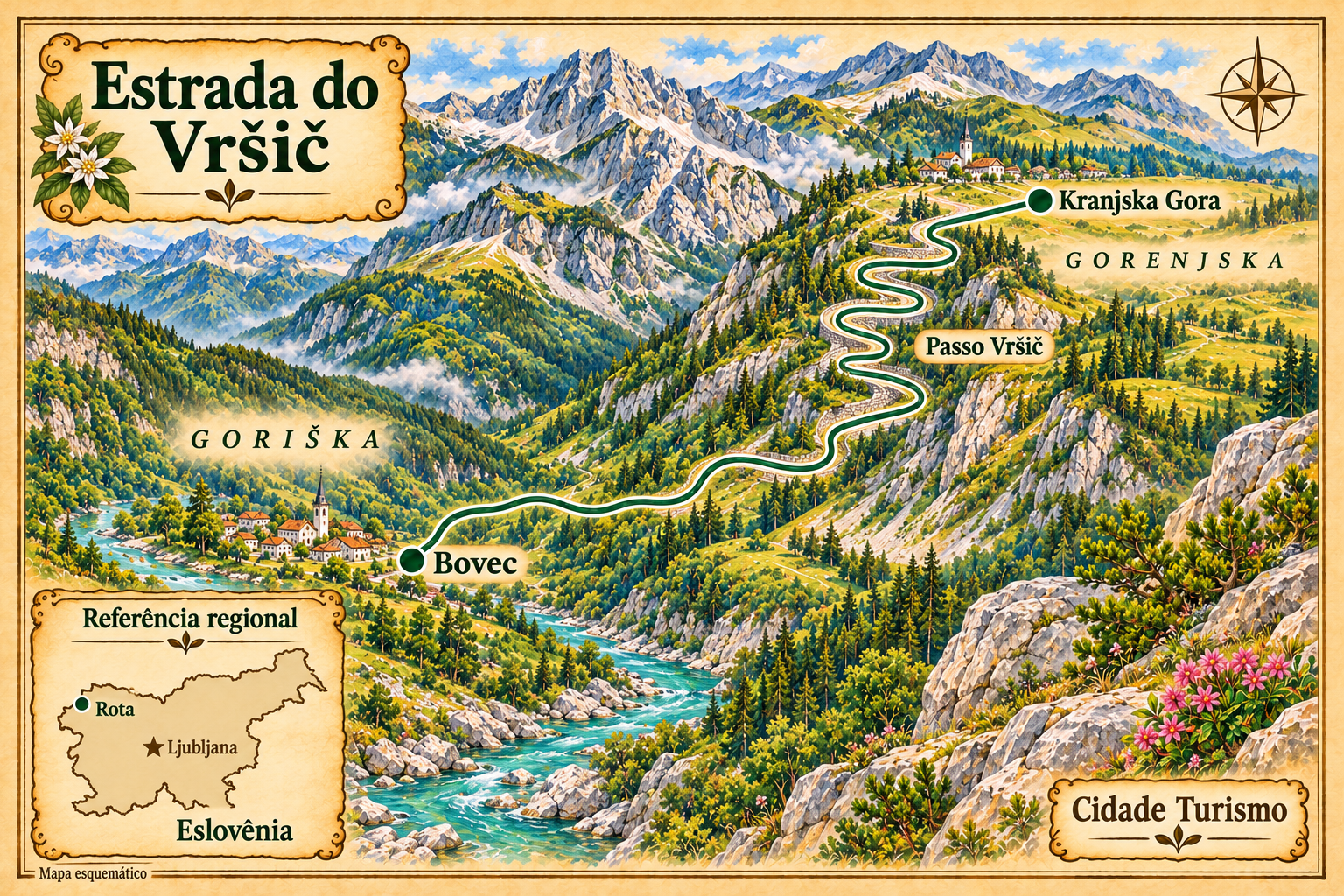
Kranjska Gora and the Vršič Pass is on the Vršič Road

From Kranjska Gora to Bovec on the road that crosses Slovenia’s highest drivable mountain pass, between the Julian Alps and the Soča Valley.

Illustrative map, not to scale. Tap a city to open its page.
Illustrated map of Vršič Road
Explore the Vršič Road
Explore other destinations Search by state and city