

 Brazil
 Argentina
 Bolivia
 Chile
Chile Colombia
 Ecuador
 Guyana
 French Guiana
 Falkland Islands (Malvinas)
 Paraguay
 Suriname
 Uruguay
 Venezuela
 Germany
 Belgium
 Spain
Spain France
 Greece
 the Netherlands
 Ireland
 Italy
Italy Luxembourg
 Portugal
 the United Kingdom
 Switzerland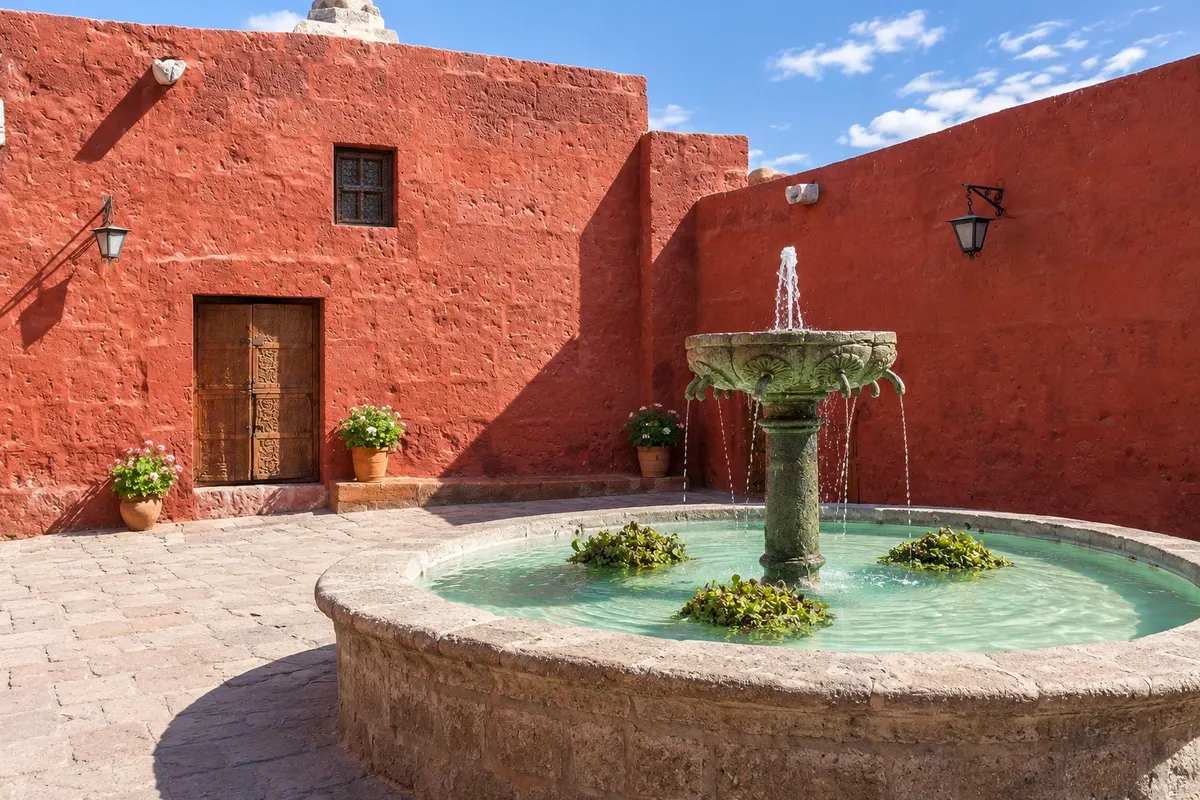
Convent · Arequipa, Arequipa
Monasterio de Santa Catalina
Cloistered monastery founded in 1579, covering 20,000 m² of streets, plazas, cloisters and cells painted blue and red — a walled city in the center of Arequipa open to visitors since 1970.
Illustrative images. The pictures in this guide are illustrations based on the real place, not photographs, and may differ from it.

Discover
About Monasterio de Santa Catalina
The Monastery of Santa Catalina de Siena was founded in 1579 and occupies an entire block in downtown Arequipa, about 20,000 square meters enclosed by high walls. For almost 400 years, the Dominican nuns lived there in cloister, with no contact with the city. Many came from wealthy families, brought servants and lived in private houses inside the monastery. It was opened to visitors in 1970, and a small community of nuns still lives in an isolated part.
The monastery feels like a small town. The streets are named after Spanish cities such as Málaga, Córdoba, Toledo, Sevilla and Granada, and the sillar walls are painted indigo blue and ochre red, with pots of geraniums. The visit goes through the Novices' Cloister, the Orange Trees Cloister and the Main Cloister, with mural paintings, the laundry with large clay jars and the cells, with kitchens, beds and objects of the former residents.
The picture gallery houses paintings from the Cusco school and religious art from the 17th and 18th centuries. The cell of Sor Ana de los Ángeles Monteagudo, a nun beatified in 1985, is one of the most visited spots.
The monastery often opens at night on certain days of the week, with the streets lit by candles and lanterns. You can visit on your own or with a guide hired at the entrance. Confirm opening hours before you go.
Before you go
Practical information
Cidade Turismo reviews its information regularly, but something may have changed. Check with the place before planning your trip.
How much time to set aside
From 1h30 to 2 hours; with a guide, about 1h30.
Best time
In the morning, when sunlight brings out the colors of the walls, or on nights with extended opening hours, when the streets are lit by candles. Confirm days and times before you go.
How to get there
Located on Santa Catalina Street, two blocks north of the Plaza de Armas, a 5‑minute walk.
Tip
Hire a guide at the entrance to understand the nuns' life and the meaning of each cloister. Then get lost in the streets on your own: the best parts of the monastery are the corners and courtyards.
Official website
Get your questions answered
Frequently asked questions about Monasterio de Santa Catalina
Are there still nuns at Santa Catalina?
Yes, a small community continues to live in an isolated part of the monastery, closed to visitors.
Why are the walls painted in colors?
The sillar walls were painted indigo blue and ochre red, colors that identify the monastery's sectors and were emphasized during restorations after it opened in 1970.
Is the night visit worth it?
Yes. On some nights the monastery usually opens in the evening, with the streets lit by candles and lanterns. Check the days before you go.
Do you need a guide at Santa Catalina?
It's not mandatory, but the guide hired at the entrance helps to understand the history and the nuns' way of life.