

 Brazil
 Argentina
 Bolivia
 Chile
 Colombia
 Ecuador
 Guyana
 French Guiana
 Falkland Islands (Malvinas)
 Paraguay
 Peru
 Suriname
 Uruguay
 Venezuela
 Germany
 Belgium
 Denmark
 Spain
 France
 the Netherlands
 Ireland
 Italy
 Luxembourg
 Norway
 Portugal
 the United Kingdom
 Sweden
 Switzerland
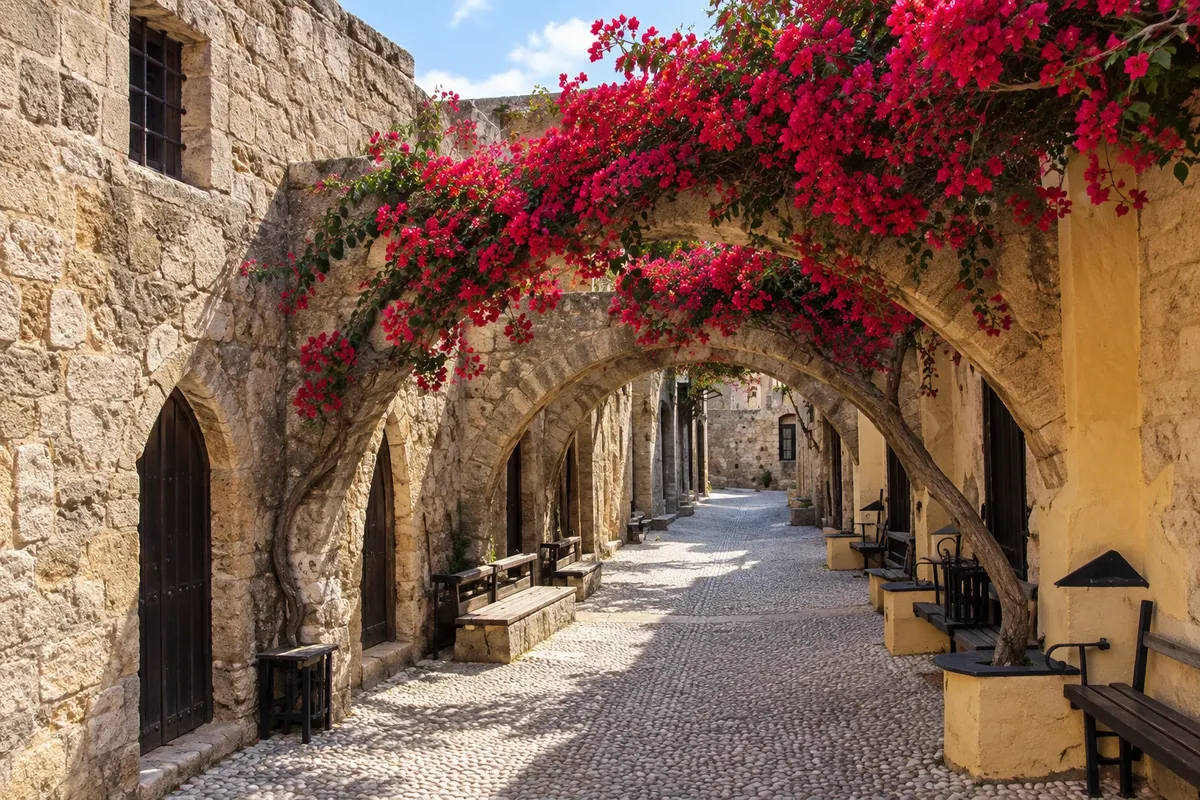
Neighborhood · Rodes, Egeu Meridional
Cidade Medieval de Rodes
Walled city built by the Knights of Saint John between 1309 and 1522, a World Heritage Site. About 4 km of walls, a dry moat, monumental gates, the knights' quarter and Ottoman streets with minarets and wooden balconies.
Illustrative images. The pictures in this guide are illustrations based on the real place, not photographs, and may differ from it.

Discover
About Cidade Medieval de Rodes
The medieval city of Rodes is one of the most intact walled ensembles in Europe. The Knights Hospitaller of Saint John took the island in 1309 and, until they lost Rodes to the Ottomans in 1522, surrounded the town with about 4 km of walls, bastions and a wide dry moat. The complex has been a World Heritage Site since 1988 and covers roughly 66 hectares, with people living there and shops and restaurants lining the stone streets.
The upper part, to the north, was the Collachium, the quarter reserved for the knights: there are the Palace of the Grand Master, the Street of the Knights with the hostels of each langue of the order, the old hospital that became the Archaeological Museum and the church of Panagia tou Kastrou. The lower part, called the Burgo (Bourgos), was home to the Greek and Jewish population. After 1522 the Ottomans added mosques, public baths and the enclosed wooden balconies that are still visible on the facades. The Suleiman mosque, with its pinkish minaret, dominates Sokratous street, the main shopping street; it does not open to the public and can be seen from outside.
A walk along the moat, now a linear park between the two lines of fortification, demonstrates the scale of the defense: you can walk at the foot of the bastions for almost the entire perimeter and enter and exit through the gates, such as the d'Amboise gate next to the palace and the Marinha (Thalassini) gate facing the commercial harbor. In some sections it is possible to climb to the top of the wall on timed visits; check locally.
The streets are of smooth, irregular stone, with slopes and steps, and cars do not circulate inside the walls. Ippokratous square, with the fountain and the Castellania staircase, is the meeting point of the commercial quarter; Evreon Martyron square, of the Jewish Martyrs, is immediately beyond, in the old Jewish quarter.
Before you go
Practical information
Cidade Turismo reviews its information regularly, but something may have changed. Check with the place before planning your trip.
How much time to set aside
Half a day to walk the streets, the moat and the squares; a full day if you include the palace and the museum.
Best time
Early morning and late afternoon, when cruise groups have left and the stone cools. In the evening the main streets are lit and restaurants set tables in the squares. In July and August midday is very hot inside the walls, with little shade in the squares.
How to get there
On foot from the port of Mandraki or from the cidade nova: the Liberty gate (Eleftherias) is in front of the port, and the d'Amboise gate, near the palace, is ten minutes away. Taxis and buses stop outside the walls. Ferry arrivals enter through the Marinha gate, at the commercial harbor.
Tip
Wear closed shoes with firm soles: the stone is smooth and slippery when wet. Enter via the side streets, off Sokratous, to see the houses and courtyards away from the shop bustle. The walk along the moat is flat and shaded by trees along parts of the route.
Official website
Get your questions answered
Frequently asked questions about Cidade Medieval de Rodes
Is the medieval city of Rodes a World Heritage Site?
Yes. It was inscribed by UNESCO in 1988 as the Medieval City of Rodes, for the ensemble of the walls, the Knights' quarter and the streets from the Ottoman period.
Can you walk on top of the walls?
On some sections, during visits scheduled on specific days and times, starting from the palace. The walk along the dry moat, between the two lines of wall, is open and does not depend on a schedule. Check locally.
Can I enter the mesquita de Suleiman?
No. The mosque is not open to the public and is seen from outside, on Rua Sokratous. It only opens on special occasions.
Do cars enter the medieval city?
No. The streets are pedestrian. Visitors staying inside the walls leave their car in parking areas outside and carry their luggage on foot.