JulyPula Film Festival
For about a week in July.
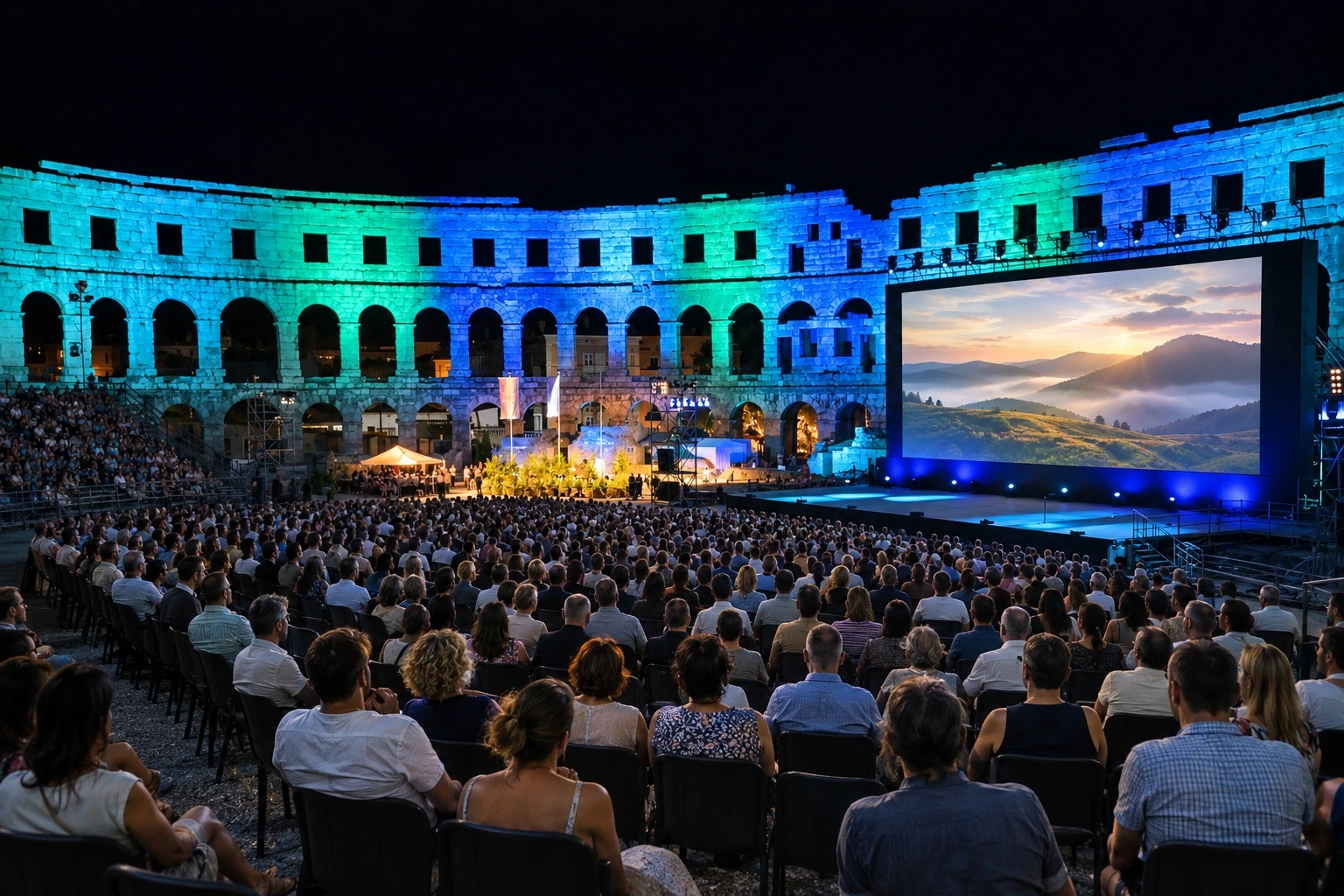
Every July, Pula’s Roman arena becomes an open-air cinema for Croatia’s oldest film festival. Founded in 1954, the festival is where the Golden Arenas, Croatia’s national film awards, are presented.
Antarctica
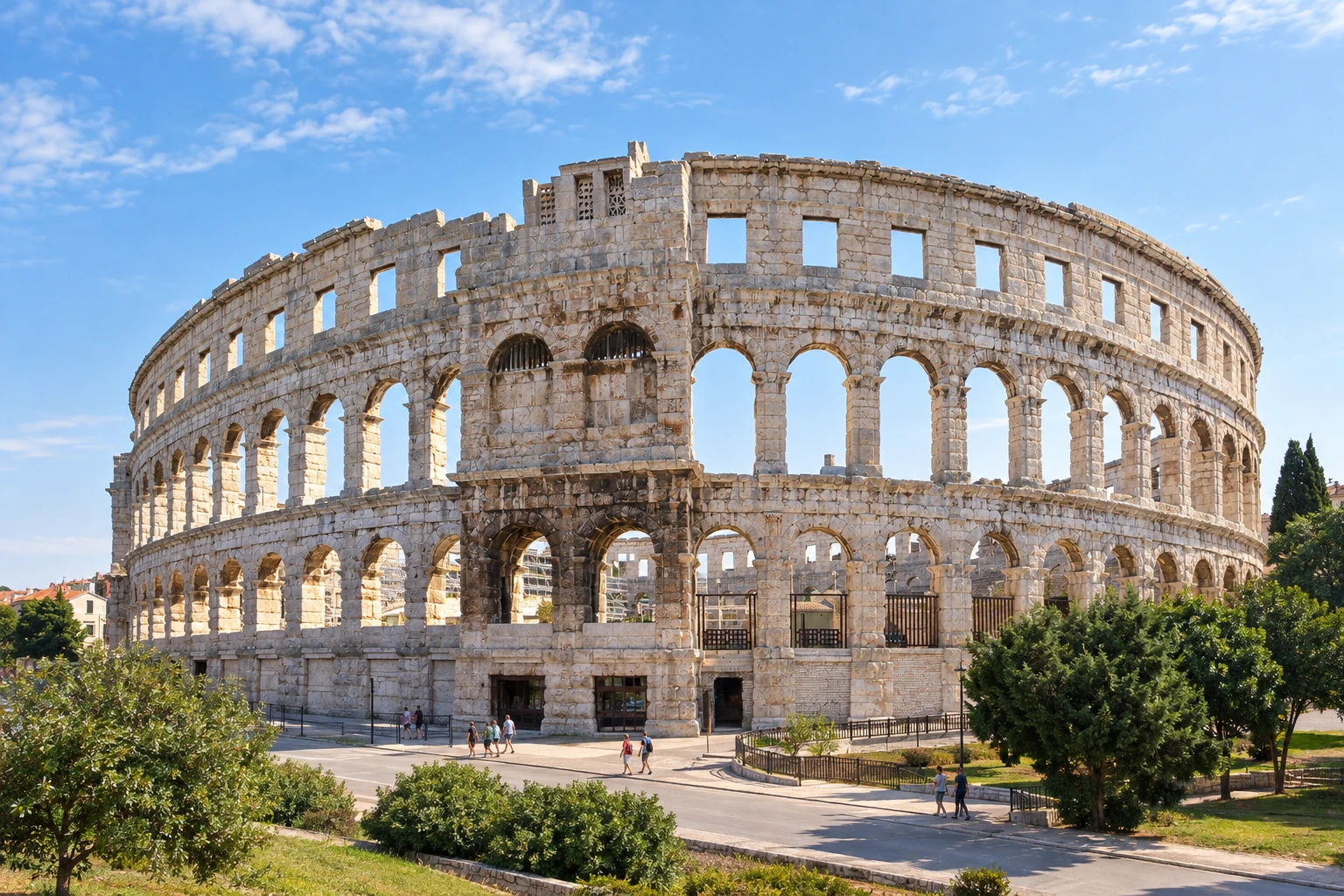
In the photo: Arena u Puli
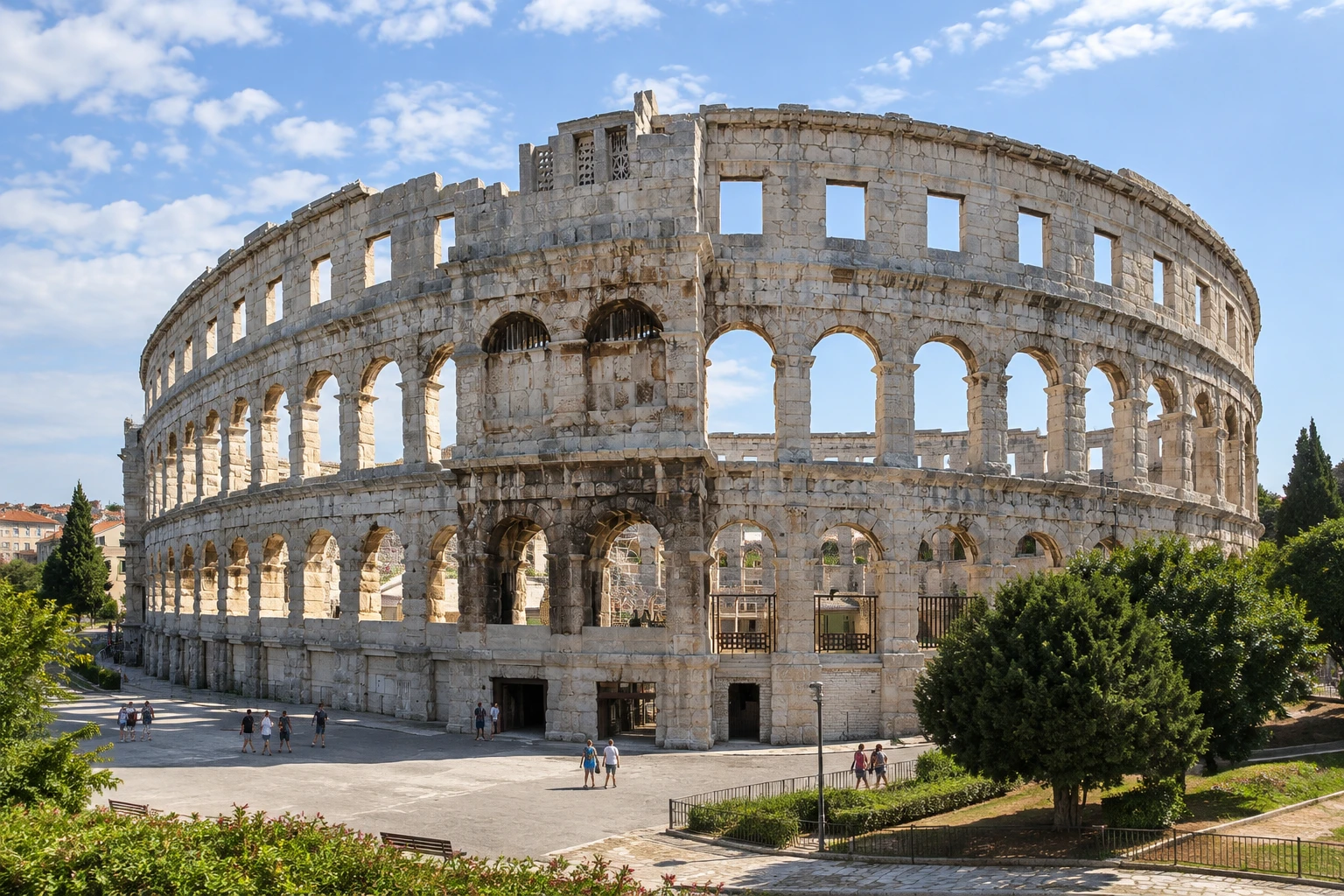
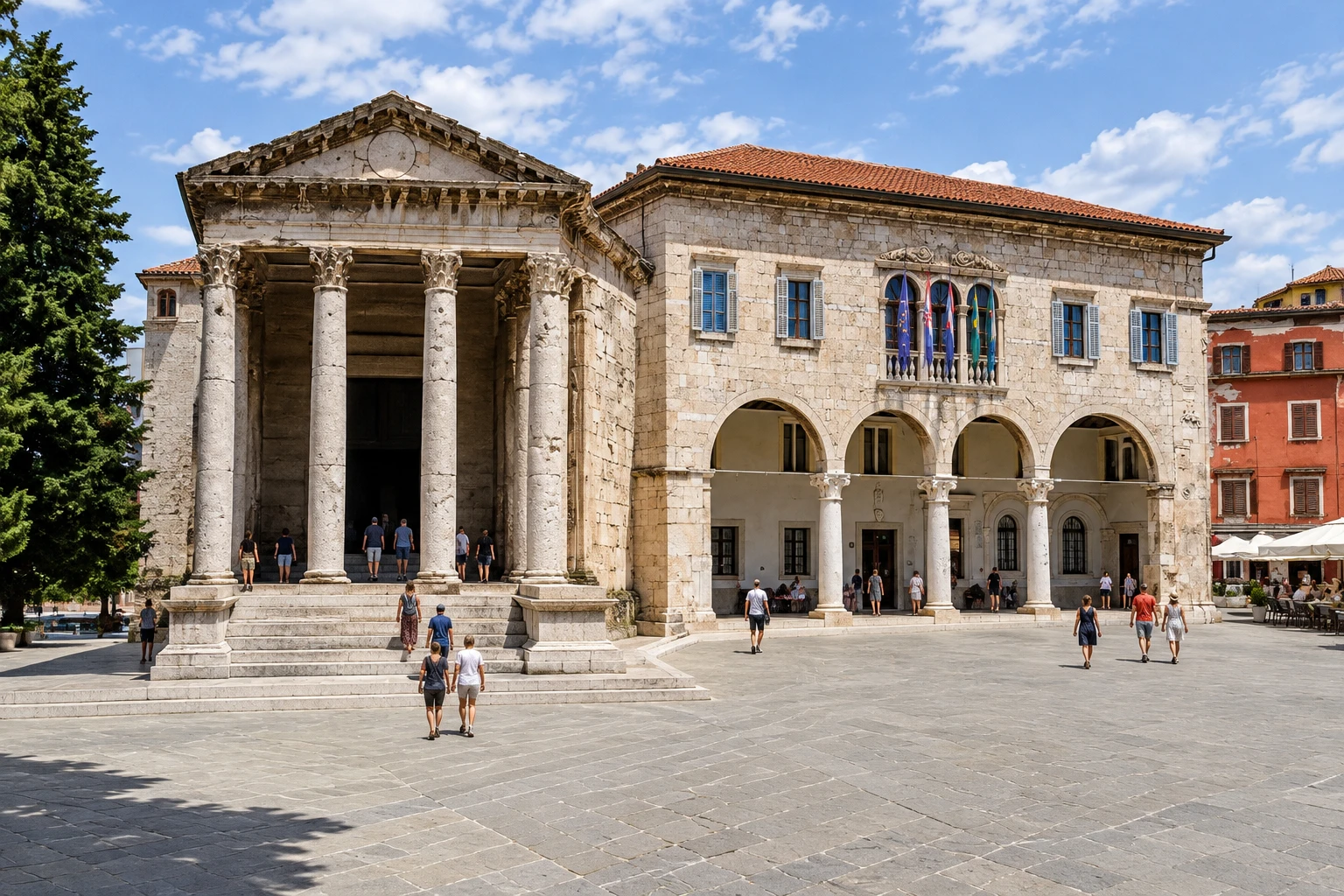
Illustrative images. The pictures in this guide are illustrations based on the real place, not photographs, and may differ from it.
The city
Pula arranges visits to Istria around Roman monuments: the Arena, the Temple of Augustus and the Arch of the Sergii. The amphitheatre is near the waterfront, while the other remains appear in the streets of the old town. The city has an airport and serves as an arrival point for onward travel to the other bases on the peninsula.
Pula stands at the southern tip of the Istrian peninsula, at the head of an inlet that has sheltered its harbor for around 3,000 years. It is the region’s main gateway, with Istria’s largest international airport 5 kilometers from downtown. Side by side are a Roman city, a 19th-century naval port and a coastline of coves and pine woods.
The Roman colony was founded between 47 and 44 BC. The imperial period, from the first to the third centuries AD, left the monuments that define a visit. The largest is the first-century amphitheater, known as the Arena, built outside the old walls. Within the old center are the Forum with the Temple of Augustus, the Arch of the Sergii, the Twin Gates, the Gate of Hercules and the Small Roman Theater. Names appear in Croatian and often in Italian.
The old town wraps around a central hill. At the top stands the Kaštel, a star-shaped Venetian fortress built in 1630, overlooking the bay. Streets curve around the slope. Below, beside the sea, are the Forum and the Riva harbor promenade. You can walk between them all in a short time.
Then there is Austro-Hungarian Pula. After the Arsenal was founded in 1856, the city became the monarchy’s main naval port, acquiring a system of 27 forts, barracks, the Naval Cemetery, parks and neighborhoods of villas in the Vienna Secession style. The iron-and-glass covered market dates to 1903 and is still the center of the city’s morning life. In the bay, the cranes of the Uljanik shipyard light up in color every night.
The southern and northern neighborhoods are where you go for the sea. The Verudela peninsula, 3 kilometers from downtown, has hotels, coves and an aquarium inside a fort. The Lungomare promenade follows four kilometers of rocky coastline to Gortan Cove. Stoja and Štinjan have more swimming areas. Beaches are rocky, pebbly or equipped with concrete platforms, usually with pine trees nearby. Offshore from neighboring Fažana are the Brijuni Islands, a national park 6 kilometers from Pula.
The climate is Mediterranean. Summer is hot and dry, with highs around 28°C in July and August and sea temperatures near 24°C. Spring and fall are mild, and winters are gentle, with highs near 10°C and more rain, especially in November. From June through September the Arena hosts concerts, the film festival and reenactments of gladiator fights. Outside summer the city is quieter and the monuments are uncrowded.
Rovinj and Poreč, separate towns on Istria’s west coast, are accessible from Pula by bus or car.
30 places to stay in Pula.
30 places to eat in Pula.
Hotéis e restaurantes da cidade no mapa.
Festivals and events
Dates change every year: check this year's date before you travel.
The local experience
The Arena u Puli is Pula’s Roman amphitheatre. The limestone ring preserves a sequence of arcades that reveal the structure of an ancient entertainment building. The sloping ground explains why the façades do not have the same height on all sides.
The Augustov hram occupies one side of Pula’s ancient forum. The Roman temple has a raised portico on a podium and columns on the façade. Its position by the square allows you to appreciate its scale relative to the buildings that formed around it over the centuries.
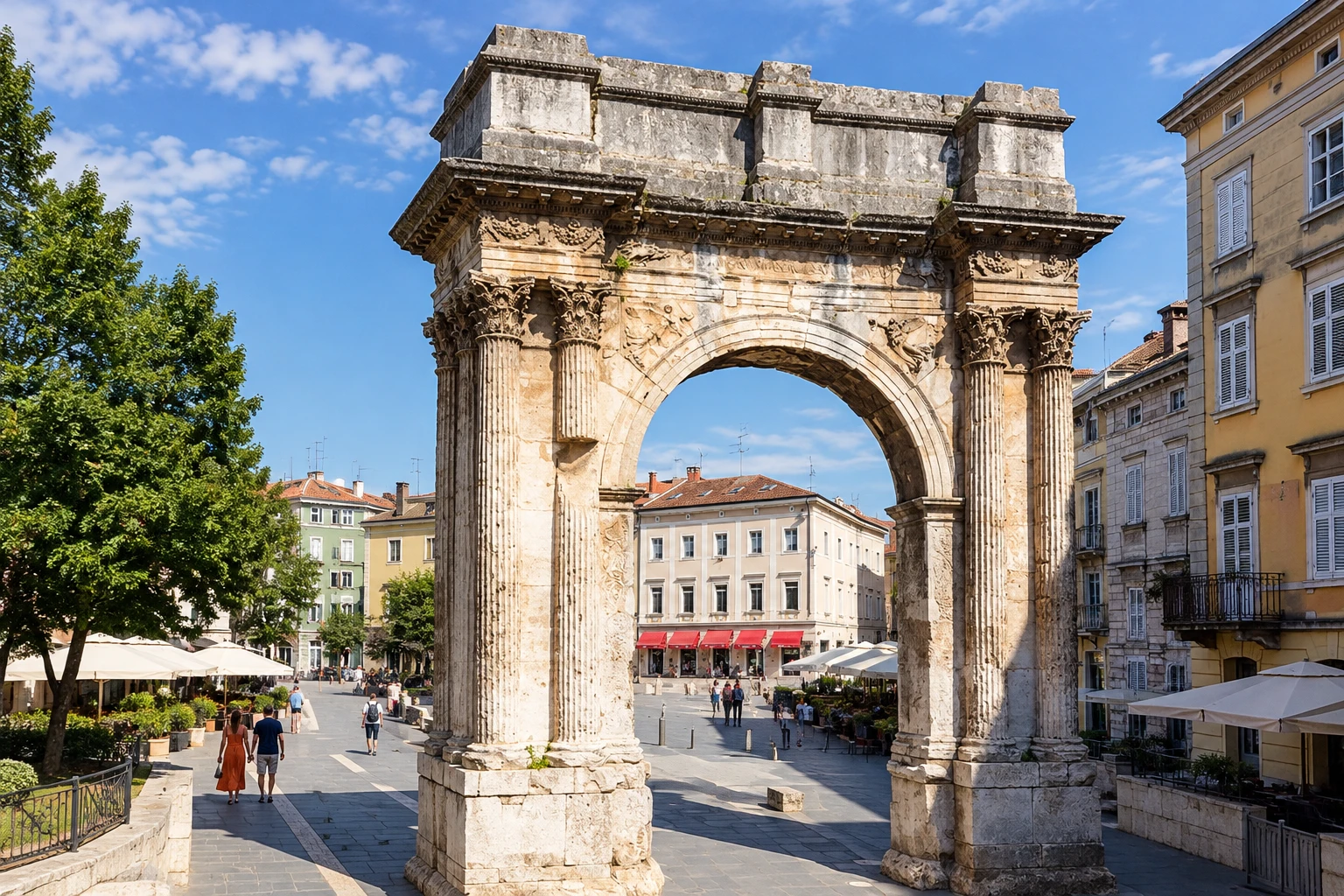
The Slavoluk Sergijevaca is the Roman Arch of the Sergii, located on the edge of Pula’s old town. The structure marks a passage between the historic city and the streets leading to the surrounding neighbourhoods. Its decorated façade contrasts with the scale of nearby buildings.
To choose before you go
Where each tour starts, how long it takes, how it is done, what is included and the price range.
The Arena is Pula’s best-known monument and the usual starting point for a visit. Built of local limestone in the first century during Emperor Vespasian’s reign, it dates to the same period as Rome’s Colosseum. The elliptical building measures around 130 meters on its long axis and rises to 32 meters. It is estimated to have held around 20,000 spectators. Its size and the local terrain placed it outside the old walls. The road linking it with the center, laid out under Vespasian, was named Via Flavia and is still one of the city’s main streets. Gladiatorial fights took place on the flat central floor, with spectators in the stone stands and gallery. In the Middle Ages it hosted knights’ tournaments and fairs. Today it stages concerts, opera, ballet and the city’s film festival for audiences of around 5,000. You can explore the inside of the ring, the arena floor and the underground passages used by gladiators. The passages house a permanent exhibition on wine and olive oil in ancient Istria, including reconstructed mills and presses and transport amphorae. From June through September, Spectacvla Antiqva stages gladiatorial contests in the Arena, with commentary on life in the Roman Empire, replica weapons and period costumes.
Stops: Pula Arena, Underground galleries of the Arena.
Includes: Arena admission, shows, and concerts are ticketed separately. Check current prices and opening days.
Tip: You can view the outer ring from every side at any time. Concerts or stage setup may restrict access to parts of the interior.
Best time: Year-round. Evening shows run from June to September. Outside summer, visits are quieter.
The Arch of the Sergii, also called the Golden Gate, was erected between 29 and 27 BC by the Sergii family to honor three of its members who held important city offices. It stood against the city gate, demolished in the early 19th century, so only the side facing town is richly decorated. In the adjoining square, a bronze sculpture commemorates James Joyce, who taught English in Pula in 1904–1905. From the arch, the former Via Sergia leads to the Forum and is now a shopping street. A detour takes you to the Punishment of Dirce mosaic, the floor of a Roman house probably dating to the third century. It remains where it was found, two meters below street level. Nearby is the sixth-century Chapel of Santa Maria Formosa, a surviving part of a Benedictine abbey built in the manner of Ravenna’s churches. The Forum has been the main square since the first century BC and remains the seat of city government. The Temple of Augustus, dedicated to the goddess Roma and the emperor, was built between 2 BC and AD 14. Bombed in 1944 and subsequently rebuilt, it holds ancient stone and bronze sculpture. Beside it, the Communal Palace bears an inscription from 1296, incorporates the back wall of a second temple and mixes styles from Romanesque to Renaissance. Follow the main street to the cathedral, which took its present form in the fifth century and preserves fragments of fifth- and sixth-century mosaics. Its separate bell tower was built in the 17th century from stone blocks taken from the amphitheater. The walk ends at the surviving gates in the walls: the Gate of Hercules, with the hero’s head and club carved into the arch, and the Twin Gates, dating to the second and third centuries, beside a preserved stretch of wall.
Stops: Slavoluk Sergijevaca, The Punishment of Dirce mosaic, Chapel of Santa Maria Formosa, Forum, Temple of Augustus, Communal Palace, Pula Cathedral, Gate of Hercules, Twin Gates.
Includes: The streets, Forum, and areas around the gates are free. The Temple of Augustus charges admission for the interior and opens seasonally. Check ahead.
Tip: In summer, walk early before it gets hot. From the Twin Gates, the Arena is a few minutes' walk away, and a path climbs to Kaštel.
Best time: Year-round. During May's Days of Antiquity, figures in Roman dress appear between the Arena, the Forum, and the arch.
Pula’s central hill is the highest point in the old town. The Kaštel at the top is a star-shaped fortress with four bastions, built in 1630. The Venetians commissioned French military architect Antoine de Ville to protect the city and port. A Histri hillfort stood here earlier, followed by a small Roman garrison. The fortress houses the Historical and Maritime Museum of Istria, with more than 40,000 objects. Highlights include old postcards and maps and collections of arms, uniforms and naval equipment. The walls overlook the city and bay. On the slope below the Kaštel, the first-century Small Roman Theater held 3,000 to 5,000 spectators. A renovation added steel and white concrete structures that leave the Roman remains untouched. The theater again stages concerts and plays, now for around 1,250 people. Beneath the hill runs Zerostrasse, one of the underground galleries excavated in the Austro-Hungarian period. The tunnel open to visitors is about 400 meters long with a central hall, and the temperature inside stays at or below 20°C. The entrance is near the Twin Gates. On the descent toward the Forum, the 1314 Church and Monastery of St. Francis combine late Romanesque architecture with Gothic ornament in finely dressed stone.
Stops: Kaštel, Historical and Maritime Museum of Istria, Zerostrasse, Small Roman Theater, Church and Monastery of St. Francis.
Includes: The fortress with its museum and Zerostrasse charge separate admission. Check current prices and opening days. Walking up the hill is free.
Tip: In summer, save Zerostrasse for the hottest hours. The tunnel stays cool. At St. Francis's Church, ring the bell for someone to open the door.
Best time: Year-round. In summer, the theater puts on evening performances.
After the Arsenal was founded in 1856, Pula saw decades of building as the Austro-Hungarian monarchy’s main naval port. The works included a naval hospital and cemetery, barracks, the Hydrographic Institute, the Naval Casino and entire residential neighborhoods. The railway arrived in 1876 and an electric tram began operating in 1904. Start with the covered market, built in 1903. It was the city’s first building with an exterior wall entirely of iron and glass. Inside are the fish market, fruit and vegetable stalls and a café terrace. This is the center of morning life in Pula. Nearby, the Giardini is an avenue shaded by around eighty hackberry trees planted in the early 20th century at the foot of the old Kaštel. Farther south, Monte Zaro, the city’s largest park, climbs the hill of the former Hydrographic Institute and its astronomical observatory. Symmetrical stairs and fountains lead through cypresses, pines and cedars. In the Sv. Polikarp neighborhood, former officers’ and officials’ villas have Vienna Secession ornament. The Naval Cemetery in Stoja, near Valkane Cove, opened in 1862. It occupies more than 22,000 square meters and is planted like a park. Austro-Hungarian admirals, Italian and German soldiers and victims of the sinking of the Baron Gautsch are buried here. The cemetery is protected under the Hague Convention. Back downtown, the Riva is the harbor promenade. From here you can see the Uljanik shipyard cranes on the islet opposite, lit in colors after sunset in a work by lighting designer Dean Skira.
Stops: Pula Market, Giardini, Monte Zaro Park, Naval Cemetery, Riva, Lighting Giants.
Includes: The market, parks, and cemetery are free to visit.
Tip: Visit the market in the morning, as trading ends in the early afternoon. Save the Riva and the illuminated cranes for evening.
Best time: Year-round.
Verudela is a pine-covered peninsula south of Pula, about 3 kilometers from the center, with hotels, coves and seaside paths. Aquarium Pula occupies Fort Verudela, part of the former Austro-Hungarian harbor defenses, about 130 years old. It holds around 200 species from the northern Adriatic, the Mediterranean and freshwater habitats. Sharks, jellyfish and seahorses are especially popular, and the sea turtle rehabilitation center is its main conservation project. The fort terrace, with a steel dome over the old artillery block, overlooks Pula and the open sea. Between the parking lot and Ambrela beach, Verudela Art Park covers 5,000 square meters. Steel lines in the ground, illuminated at night, connect seven sculptures by eight artists. Punta Verudela has an indented coast of pebble coves and rocky stretches shaded by pines, with sports and recreation areas. Ambrela beach sits beside the art park.
Stops: Aquarium Pula, Fort Verudela, Verudela Art Park, Ambrela Beach, Punta Verudela.
Includes: The aquarium charges admission. Check current prices. The art park and beaches are free, though loungers and parking may cost extra.
Tip: With children, visit the aquarium during the strongest sun and head down to the beach in late afternoon. Bring shoes for rock and pebbles.
Best time: June to September for swimming, with sea temperatures of 21–25°C. The aquarium is open year-round.
The Lungomare is one of Pula’s favorite waterfront walks for residents and visitors alike. It follows four kilometers of coast from the Valkane swimming area to Gortan Cove and on to Valsaline. Most of the shore is rocky, with direct water access popular with younger swimmers. Gortanova uvala, or Gortan Cove, has pebbles and a gentle slope into the water, making it a favorite for families with small children. The adjoining pine woods provide shade on hot days. For more swimming, continue to Stoja on the neighboring peninsula. It is one of the city’s two organized bathing areas. A concrete platform gives easy access to the sea, the grounds are fenced and traffic-free, and the 1936 bathing facility is protected as cultural heritage. Valkane lies near the Naval Cemetery, and you can visit both on the same outing.
Stops: Lungomare, Valkane, Gortanova uvala, Valsaline, Stoja.
Includes: The Lungomare and its coves are free to use.
Tip: Bring shoes suitable for rocky shores, water, and sunscreen.
Best time: May to October for walking, June to September for swimming.

Pula’s transformation into an Austro-Hungarian naval port in the 19th century surrounded the city with a system of 27 forts and dozens of batteries built over nearly a hundred years. The easiest to visit are in Štinjan, north of the bay. Fort Monte Grosso preserves the only Martello tower remaining from the first works of the 1820s. The circular fort built around it in midcentury defended the entrance to the bay. An observation tower overlooks the city, harbor defenses and Brijuni Islands. On clear days you can see as far as Rovinj and the Kvarner islands. South of the fort, a woodland path leads to the Valmaggiore battery and farther on to circular Fort Munida. Several city forts can be seen only from outside. Some stand abandoned and overgrown, while others have new uses, such as Verudela, home to the aquarium. A historian leads a guided tour of the Štinjan forts by military truck and on foot through the pines. In the same area, pebbly Hidrobaza beach runs for 700 meters with views of Brijuni. It has a promenade with a bike path, playgrounds, sports courts, beach bars and a section for visitors with dogs.
Stops: Fort Monte Grosso, Valmaggiore Battery, Fort Munida, Hidrobaza Beach, Štinjan.
Includes: The area around the forts and the beach are free to explore. The guided tour costs extra.
Tip: Wear sneakers and bring water. Dirt paths link the forts. Stay out of abandoned buildings.
Best time: April to October. In summer, walk in the morning and spend the afternoon at the beach.
The Brijuni Islands form an archipelago off Istria’s west coast, 6 kilometers from Pula, separated from the mainland by the Fažana Channel. Two larger islands, Veliki Brijun and Mali Brijun, and twelve smaller ones have deeply indented shores and have been inhabited since prehistoric times. The islands and surrounding sea became a national park in 1983. The park boat leaves daily from the port of Fažana, Pula’s neighboring town. The crossing takes a few minutes. Visits focus on Veliki Brijun. A sightseeing train passes ancient olive groves, remains of Roman villas and the safari park. You can also walk, cycle or rent an electric cart to explore paths through the woods and along the shore. The island’s recent history began in the late 19th century when Paul Kupelwieser bought the archipelago, then abandoned because of malaria. With help from scientist Robert Koch, malaria was eliminated and Brijuni became a retreat for Europe’s elite. The climate is mild year-round and vegetation is dense. In summer the sea ranges from 22°C to 25°C.
Stops: Brijuni National Park, Veliki Brijun, Fažana.
Includes: The national park ticket and boat from Fažana cost extra. Check current prices, departure times, and whether reservations are needed.
Tip: Book ahead in summer. Arrive in Fažana with time to park and collect your ticket. Bring a hat, water, and swimwear.
Best time: April to October. Boats run daily from Fažana. Check the seasonal schedule before leaving.
Day by day
Suggestions to plan the trip. Change the order of the days according to the weather and tour availability.
Start early at the Arena and explore the interior and underground galleries. Walk to the Twin Gates and the Gate of Hercules, then on to the Arch of the Sergii. Follow the old Via Sergia, detouring to the Dirce mosaic, and reach the Forum with the Temple of Augustus and Communal Palace. Have lunch nearby. In the afternoon, pass the cathedral and climb the slope to the Kaštel, stopping at the Church of St. Francis. View the bay from the walls and descend via Zerostrasse or the Small Roman Theater. Toward evening, walk along the Riva and wait for sunset to see the shipyard cranes light up. In summer, check for a performance at the Arena.
Devote the first day to the old town. Visit the Arena in the morning and then follow the Roman route past the Twin Gates, Gate of Hercules, Arch of the Sergii, Dirce mosaic, Forum and Temple of Augustus. After lunch, visit the cathedral and climb to the Kaštel and the Historical and Maritime Museum of Istria. Descend through Zerostrasse. Spend the evening on the Riva with the illuminated cranes.
Start at the 1903 market with its fish, fruit and vegetable stalls and have coffee on the terrace. Walk through the Giardini and continue to Verudela for the aquarium in the fort, Verudela Art Park and a swim in a cove. In the late afternoon, follow the Lungomare from Valkane to Gortan Cove. Outside the swimming season, replace the beach with the Naval Cemetery and Monte Zaro park.
Visit the Arena and its underground galleries in the morning. Then walk through the old center to the Twin Gates, Gate of Hercules, Arch of the Sergii, Dirce mosaic, Chapel of Santa Maria Formosa, Forum, Temple of Augustus and cathedral. In the afternoon visit the Kaštel, museum and Zerostrasse. Spend the evening on the Riva.
Set out early for neighboring Fažana and take the national park boat to Veliki Brijun. Explore by sightseeing train or bicycle, passing olive groves, Roman remains, the safari park and the coast. Return in midafternoon. Back in Pula, relax in a Verudela cove or visit the aquarium in the fort. Book Brijuni tickets ahead in summer.
Spend the morning at the market, the Giardini, Monte Zaro park and the Naval Cemetery in Stoja. Head to Štinjan for Fort Monte Grosso, with its observation tower overlooking the bay and Brijuni, and walk to the Valmaggiore battery. End the day at Hidrobaza beach or on the Lungomare. If you prefer woodland, choose the shaded paths of Šijana forest, two kilometers from the center.
Best time to go
The seasons shown are the most usual ones; nature doesn't always follow the calendar.
Winter · Start of Pula Carnival
Mild winter weather brings highs around 9°C, lows near 2°C and sea temperatures near 11°C. Few visitors come and you can see the monuments without lines. In mid-January the symbolic handover of the city key to the Carnival Master opens the masquerade season. Some monuments and boat trips have reduced hours or close, so check ahead.
Pula Carnival · Masked parade
It is still winter, with highs around 10°C and lows near 2°C. Carnival before Lent brings a masked parade through the streets and ends on Shrove Tuesday with the burning of Pust, a straw figure. Visit the museums, market and Zerostrasse. Swimming can wait, with the sea around 10°C.
Early spring · Quiet city
Spring begins slowly, with highs around 13°C, lows near 4°C, some sunny days and others with wind and rain. Days grow longer and the parks bloom. With a jacket in your bag, it is a good month for the Roman route and the forts without the heat. The sea is still cold at around 10°C.
Spring · Longer opening hours at monuments
Mild weather brings highs around 16°C and lows near 7°C. Monuments extend their hours and the Temple of Augustus usually opens for the visitor season. Green vegetation makes this a good time for the Lungomare, the Štinjan forts and a trip to Brijuni. At around 13°C, the sea is still cold for most swimmers.
Days of Antiquity · Start of beach season
One of the most pleasant months brings highs around 21°C, lows near 11°C and little rain. The Days of Antiquity fill the area between the Arena, Forum and Arch of the Sergii with people in Roman dress, music and workshops. Visitors begin returning to the beaches. The sea is around 17°C.
Summer · Gladiator fights in the Arena · Concerts
Early summer brings long days, highs around 25°C, lows near 15°C and sea temperatures around 21°C. The Arena opens its concert season and the Spectacvla Antiqva gladiator reenactments, which run through September. Verudela, Stoja and Hidrobaza beaches are in full use before the peak summer crowds.
Pula Film Festival in the Arena · High season
High season brings highs around 28°C, lows near 18°C, little rain and sea temperatures around 24°C. The Pula Film Festival takes place in July with evening screenings in the Arena. The city and beaches fill up. Book accommodations and the Brijuni boat ahead, visit monuments early and spend afternoons by the sea.
High season · Concerts in the Arena · Warmest sea temperatures
Summer peaks with highs around 28°C, lows near 17°C and sea temperatures at their warmest, around 25°C. Concerts and gladiator shows continue at the Arena and the illuminated cranes stay lit later. Beaches and parking lots fill up, so take the city bus or cycle to Verudela. Brief storms are possible.
Late summer · Final gladiator fights
The heat eases, with highs around 24°C and lows near 15°C. The sea is around 22°C and still good for swimming. Crowds thin and Spectacvla Antiqva ends its season. It is one of the best-balanced months for monuments, Brijuni and the beach. Rain gradually returns.
Fall · A quieter city
Mild fall weather has highs around 19°C and lows near 11°C. The sea is about 19°C and only keen swimmers venture in. Monuments shorten their hours, and the Temple of Augustus usually closes for the season at the end of the month. It is a good time for the Roman route, the forts and Šijana forest. Pack an umbrella.
Wettest month · Start of Advent
The wettest month of the year has highs around 14°C and lows near 6°C. The city settles back into its local rhythm. Plan for museums, Zerostrasse, the aquarium and the market, and use breaks in the rain for the Arena and Forum. Pula Advent begins late in the month with concerts in front of the Arena.
Advent in Pula · Concerts outside the Arena
Mild winter days are short, with highs around 10°C and lows near 3°C. Advent continues into early January with music and end-of-year events downtown. The shipyard cranes light up early at sunset. Some beach and boat services close. Check monument opening hours.
Plan the journey
Pula Airport (PUY) is Istria’s largest international airport, only 5 kilometers from the center. In summer, scheduled and charter flights connect Pula with many European cities. Services decrease outside the season. Domestic flights run from Zagreb.
Reach downtown by bus, transfer or taxi. The airport’s own bus connects it to the city. Another transfer service continues to Verudela, Medulin, Štinjan, Fažana, Rovinj and Poreč. Check schedules, which follow flight times.
If there is no suitable flight to Pula, use a regional airport and continue by road. Rijeka Airport on Krk is 135 kilometers away, Trieste 164, Ljubljana 221, Zagreb 268 and Venice 275.
Pula’s bus station stands on Trg I. istarske brigade. Scheduled buses leave for other towns in Istria and across Croatia. Check destinations and times on the ticket search service.
By road, Pula is 102 kilometers from Rijeka, 126 from Trieste and 288 from Zagreb. In summer, buy tickets ahead, including the return.
City and suburban buses also operate. Check the municipal transit company’s website for routes to Verudela, Stoja, Štinjan and Fažana, where boats leave for Brijuni.
Three routes lead to Pula. From the west, travel via Trieste, Koper and Buje. From the north, come via Villach, Ljubljana, Koper and Buje. From the east, the route goes through Zagreb, Rijeka, the Učka Tunnel and Pazin. Road distances are 102 kilometers from Rijeka, 126 from Trieste, 288 from Zagreb, 535 from Milan, 593 from Vienna and 607 from Munich.
Part of the route through Istria has tolls. Check conditions before traveling.
Downtown, use paid lots such as Karolina between the Arena and Riva and continue on foot. A car is useful for trips to Štinjan, Fažana and other Istrian towns.
Pula has a maritime border crossing and receives passenger services. One route connects Pula with Zadar, stopping at the islands of Unije, Susak, Mali Lošinj, Ilovik and Silba. Another connects Pula with Venice.
Both generally operate seasonally, with departure days varying through the year. Check operator timetables before planning. Boarding is at the port beside the Riva. Confirm the quay.
Water taxis also serve the bay, and the national park boat to the Brijuni Islands departs from Fažana.
Pula has a railway station, and rail service reached the city in 1876. Check with the Croatian railway company for connections on your travel date. For most routes, the bus is the practical option.
Explore the old town on foot. The Arena and Forum are only a few minutes apart. For Verudela, 3 kilometers away, Stoja and Štinjan, use a city bus, taxi or bicycle. You can rent bicycles, scooters, cars and boats, or join a guided e-bike tour.
In summer, parking near the beaches fills early.
Your questions
Two days allow you to see the Roman ensemble without squeezing everything into a quick stop.
Walk between the monuments and use buses for the more distant neighborhoods.
Pula can be included in an itinerary with the other bases on the peninsula. Check road connections and allow time for its historic centre.
Look for Pula; in Istria Italian names also appear on signs and in local references.
May, June and September bring warm weather and fewer crowds than peak summer, with swimming generally comfortable from June. July and August have the warmest sea, the film festival and concerts in the Arena, and the city is busy. October through April is mild and wetter, a time to focus on monuments and museums.
The airport is 5 km from downtown. Its own shuttle runs into town on a schedule tied to flights, and taxis and transfers are available. A separate transfer service serves Verudela, Medulin, Fažana, Rovinj and Poreč. Check schedules before traveling.
The visit takes you around the inside of the stone ring, across the central area where the fights took place and through the gladiators’ underground passages. The passages host an exhibition on winemaking and olive oil production in ancient Istria, with presses, mills and amphorae. You can also walk around the entire amphitheater from outside.
Spectacvla Antiqva takes place on selected evenings each week from June through September. The reenactment includes narration about life in the Roman Empire, with replicas of period weapons and clothing. Visitors can take pictures with the gladiators afterward. Check dates and buy tickets in advance.
They’re the cranes at the Uljanik shipyard on a small island in the bay, near the Arena and the end of the Riva. A lighting system by designer Dean Skira illuminates them in color each evening from sunset, with special displays on holidays and dates important to the city. The Riva has a good view.
The national park boat leaves from neighboring Fažana, which you can reach by suburban bus, taxi or car. The crossing takes a few minutes. On Veliki Brijun, explore by sightseeing train, on foot, by bike or by electric cart. Book your ticket ahead in summer.
Popular choices include the pebble and rock coves among the pines at Verudela and the rocky Lungomare coast, where Gortan Cove has pebbles and a gentle entry into the water. Stoja has a managed bathing area with a concrete platform. In Štinjan, Hidrobaza Beach has 700 meters of pebbles. Bring water shoes.
A passenger boat links Pula and Venice, usually seasonally, with departures on selected days. Check the operator’s calendar and times before building your itinerary, and bring your travel document. Entry requirements depend on nationality and may change, so check before traveling.
Zerostrasse, an underground passage beneath Kaštel Hill, the Historical and Maritime Museum of Istria, the aquarium in Fort Verudela, the Temple of Augustus in season, and the covered market built in 1903 can fill a rainy day. The underground galleries at the Arena are sheltered as well.
Yes. Children often enjoy the aquarium’s sea turtles, sharks and seahorses, the Arena and the summer gladiator shows. For swimming, Gortan Cove has pebbles and a gentle entry, Stoja is enclosed and traffic-free, and Hidrobaza Beach has playgrounds. On Brijuni, the sightseeing train passes through the safari park.
The Irish writer arrived in October 1904 and stayed until March 1905, teaching English at the Berlitz school, mainly to Austro-Hungarian naval officers. A bronze sculpture by Mate Čvrljak commemorates his stay by a café beside the Arch of the Sergii.