The Roman Forum, St. Donatus, and St. Anastasia's Cathedral
From Roman Forum, in Zadar's Old Town On foot 2 to 3 hours, including the museum Morning Easy
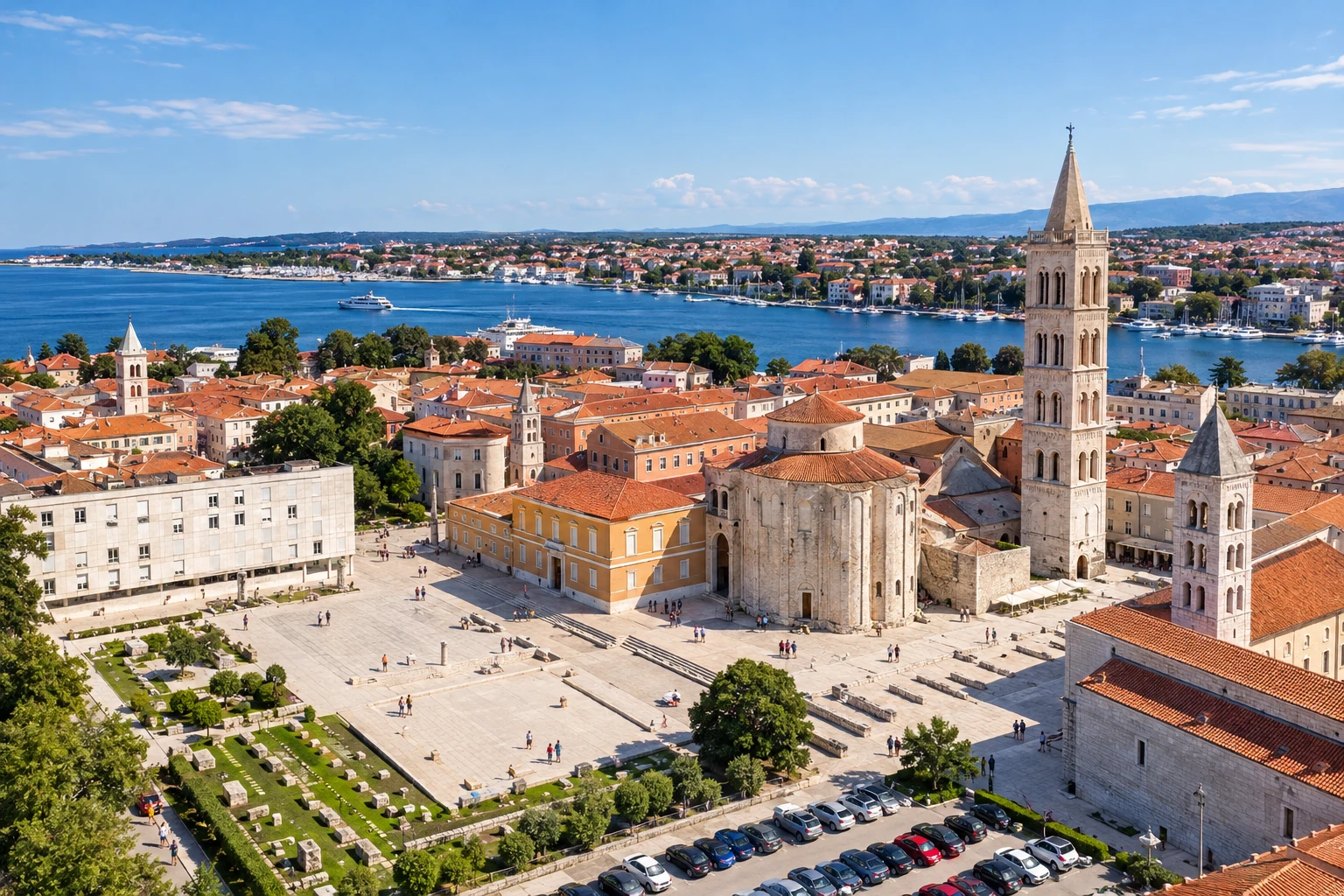
The Forum is the ancient heart of Zadar. Stone inscriptions show that work on the Roman square began under Augustus, the first emperor. It was completed in the third century. A portico enclosed three sides, with galleries upstairs and shops below. Soldiers, priests, officials, merchants and residents gathered here. Today the open square is a city landmark that everyone walks through.
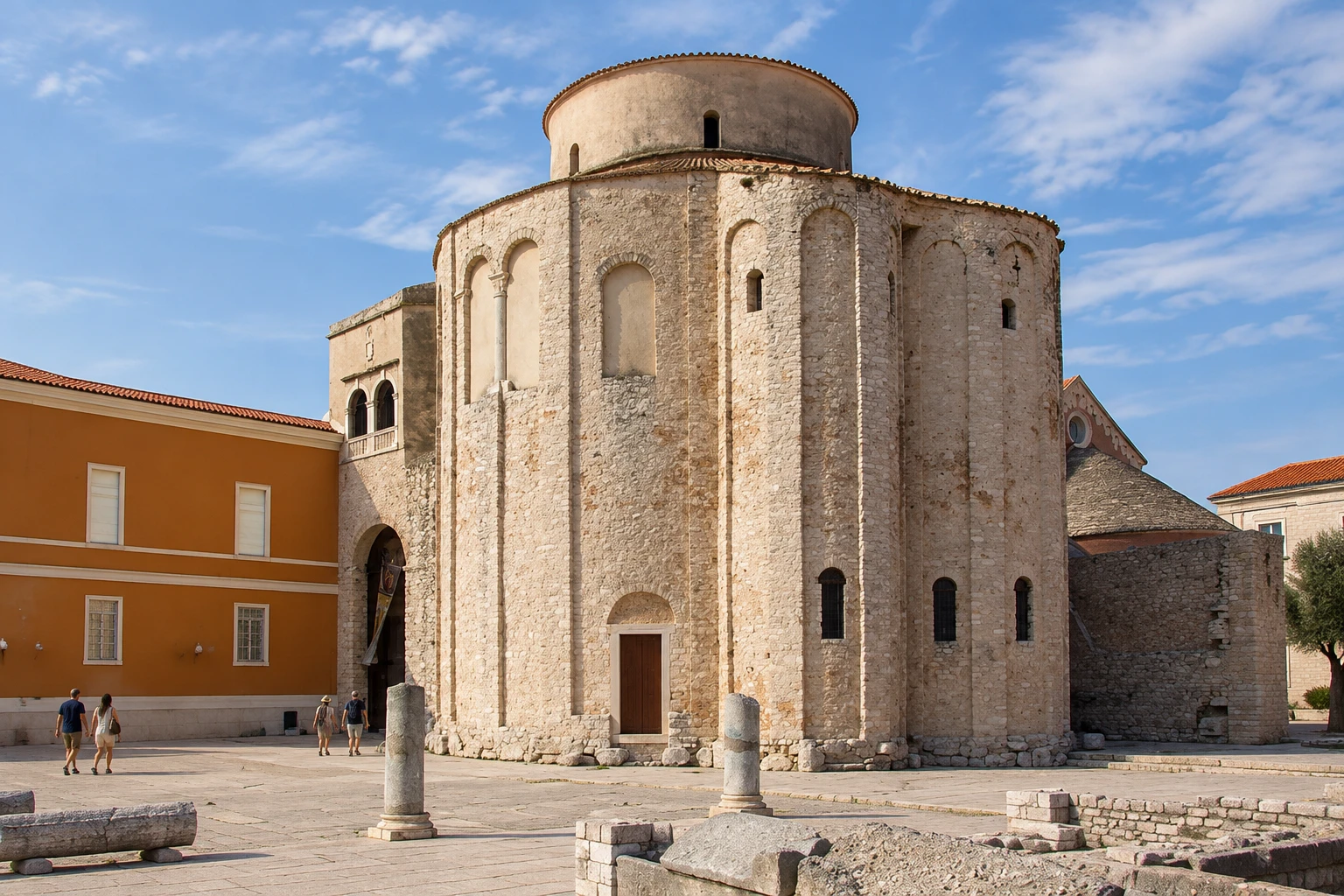
In its midst stands Zadar’s best-known monument, the Church of St. Donatus. Tall and round, this ninth-century building follows Byzantine architectural models. Originally the Church of the Holy Trinity, it later took the name of Bishop Donatus, who commissioned it. Religious services ceased long ago. It housed the archaeological museum from the late 19th century to 1954, and its acoustics make it a venue for concerts and a summer music festival.
Beside it is the Cathedral of St. Anastasia, a large Romanesque church from the 12th and 13th centuries. Earlier buildings stood on the site, beginning with an early Christian basilica from the fourth and fifth centuries. The cathedral takes its name from the martyr of Sirmium, known in Zadar as Stošija. Bishop Donatus received her relics in the early ninth century.
Across from the Forum, the Archaeological Museum rounds out the visit. Founded in 1832, it is Croatia’s second-oldest museum and holds more than 100,000 objects dating from the Paleolithic era to the late 11th century. Its windows reflect the Roman ruins and the church.
Stops: Roman Forum, Church of St. Donatus (Crkva sv. Donata), Cathedral of St. Anastasia (Katedrala sv. Stošije), Archaeological Museum.
Includes: Self-guided outing. The Forum is an open square. St. Donatus and the museum charge separate admission.
Tip: Go early before tour groups or in late afternoon, then walk a few minutes to the Riva for sunset. Dress for a place of worship in the cathedral. Check opening days at St. Donatus outside summer.
Best time: Year-round. In July the church and the Forum host concerts for Musical Evenings in St. Donatus.
Sea Organ and Greeting to the Sun: sunset on the Riva
From Riva, the old town waterfront On foot 1 to 2 hours Late afternoon Easy
The Riva is the old town waterfront facing the Zadar Channel. It took shape after 1868, when Emperor Franz Joseph ended Zadar’s status as a fortress city. A few years later the walls on this side came down, opening the city to the sea with palaces, a pier for passenger steamers and gardens. Today the promenade, lined with palms and old holm oaks, looks out to Ugljan and Pašman and, to the northwest, the open sea.
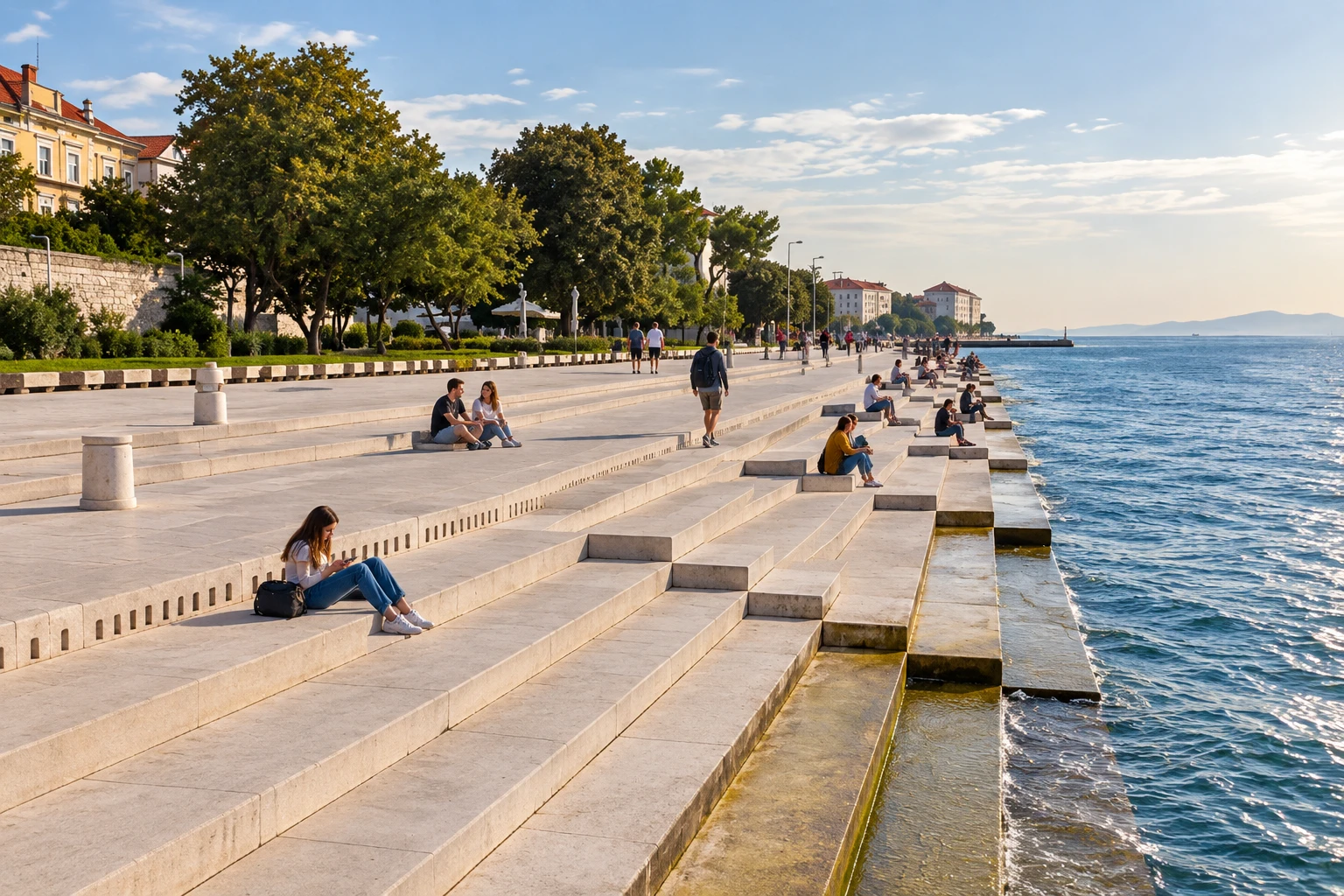
At the western tip of the peninsula, stone steps descend to the water. Here the Sea Organ has 35 pipes of different lengths, diameters and slopes beneath some 70 meters of steps. Waves and tides push air through the pipes, producing sounds that change with the movement of the water. Sit on the steps to listen.
Beside it is the Greeting to the Sun, by the same architect, Nikola Bašić. Set into the ground, this circle measures 22 meters across and consists of 300 layered glass plates with solar panels. It collects solar energy during the day and releases it after dark in a light display that follows the rhythm of the waves and the organ.
Come in the late afternoon. The sun sets over the channel and the islands, drawing locals and visitors. In 1964 Alfred Hitchcock rated this sunset above any other he had seen.
Stops: Riva, Sea Organ (Morske orgulje), Greeting to the Sun (Pozdrav suncu).
Includes: Self-guided outing with free admission.
Tip: Arrive just before sunset to find a seat on the steps, and stay until dark when the Greeting to the Sun lights up. The sound of the organ depends on the sea. When the water is still, it is faint.
Best time: Year-round, in the late afternoon. Summer is busy, while spring and fall are quieter.
Zadar's walls: the Land Gate, Foša, and Five Wells Square
From Land Gate (Kopnena vrata), next to Foša harbor On foot About 2 hours Morning or afternoon Easy
Zadar’s walls defended the city for centuries and became a UNESCO World Heritage Site in 2017. Built in the 12th and 13th centuries, they were strengthened in the 16th century when Venice prepared the city for the Ottoman advance. Residents call them the Muraj, and the top of the harbor-facing section is now a public promenade.
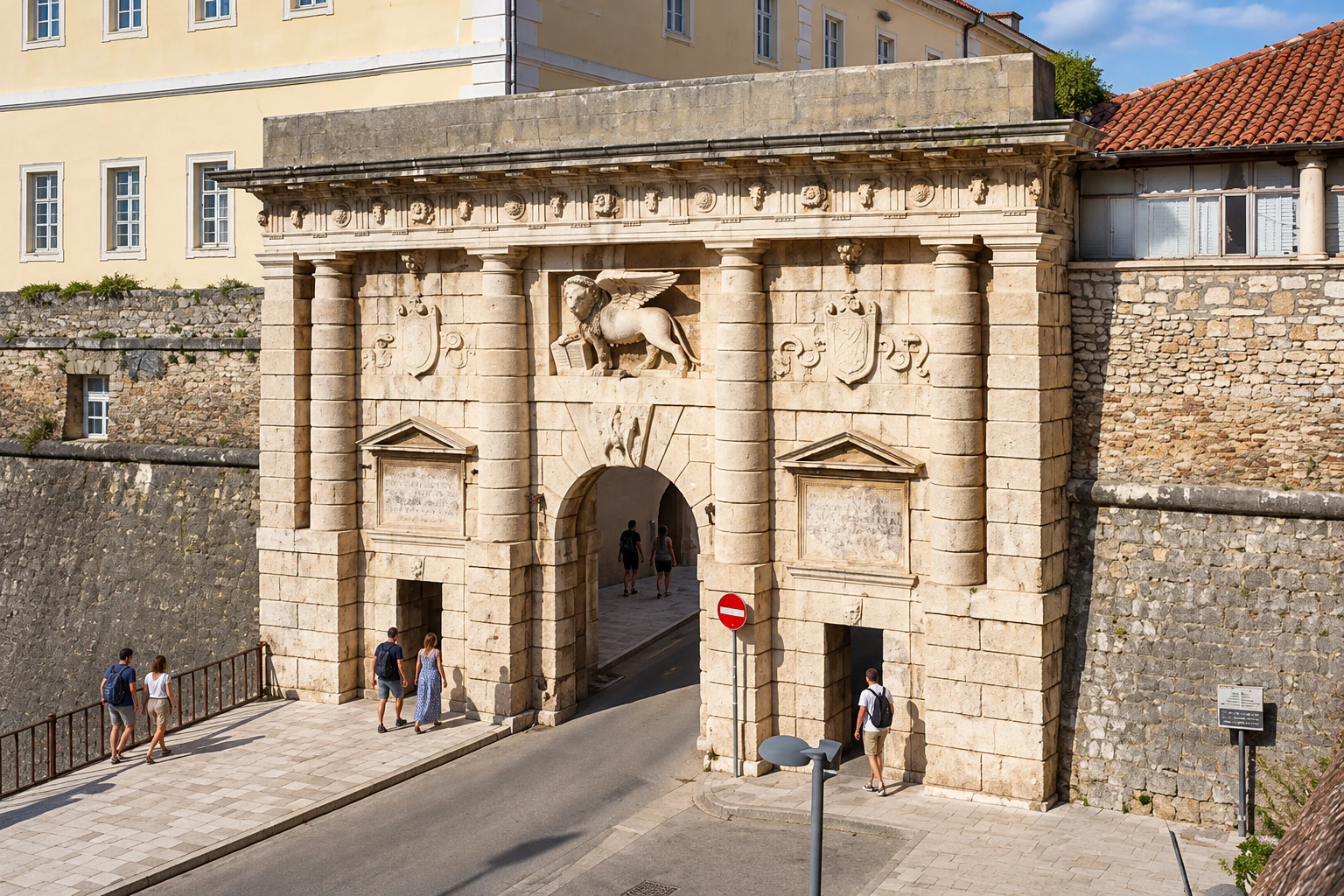
Begin at the Land Gate, the monumental entrance from the mainland, built in 1543 and among the most admired Renaissance works in Dalmatia. Look up to see carvings of the city’s patron saint, St. Chrysogonus, on horseback and the winged lion of St. Mark, the emblem of Venice. The gate faces Foša, the little harbor beneath the 16th-century bastions. Filled with boats, it is one of Zadar’s most photographed spots.
Five Wells Square is a few steps away. In 1574, under threat from the Ottomans, the city covered the medieval moat and built a large drinking-water cistern in its place, with five decorated wellheads. The medieval wall and the 26-meter Captain’s Tower enclose the square. From here you can enter Queen Jelena Madijevka Park, the city’s first public park, planted on the Grimaldi Bastion.
Follow the top of the Muraj along the harbor. Between the ferry quay and the market is the Sea Gate, also called St. Chrysogonus’s Gate. Built in 1573 to honor the victory at Lepanto, it incorporates pieces of a Roman arch. Another gate, St. Roch’s, leads into the market. The walk ends near the Sea Organ at the Arsenal, a 16th-century Venetian port warehouse enlarged in 1752 and now used for concerts and exhibitions.
Stops: Land Gate (Kopnena vrata), Foša, Five Wells Square (Trg pet bunara), Queen Jelena Madijevka Park, Muraj, Sea Gate, Arsenal.
Includes: Self-guided outing. The gates, squares, and wall walk are free to visit.
Tip: Walk the upper section of the Muraj in late afternoon, when the harbor is backlit. In summer St. Roch's Bastion hosts outdoor concerts and a craft market.
Best time: Year-round. In summer, go early or late in the afternoon to avoid the heat.
Kalelarga, Narodni trg, and the churches of the Old Town
From Narodni trg, in the center of the peninsula On foot 2 hours Morning or afternoon Easy
Kalelarga has been Zadar’s main street since antiquity. Its official name is Široka ulica, meaning “wide street,” or Calle Larga to the Venetians. It crosses the peninsula from the Forum to Narodni trg. People come here for their morning coffee, to catch up on the news and to celebrate. The street even has its own anthem.
Narodni trg, or People’s Square, was the medieval Platea Magna and remains the administrative center. On one side is the City Loggia, where residents gathered from the 13th century onward to discuss public affairs. Across from it stands the City Guard building from the second half of the 16th century. Its clock tower has kept time continuously since 1803. Streets lead from the square to the Riva, Five Wells Square and the market.
Two churches nearby are worth stepping inside. St. Simeon’s began as an early Christian basilica, later became Gothic and finally Baroque. On the high altar is the silver chest containing the saint’s relics. Queen Elizabeth commissioned it in 1380 from Francis of Milan, a goldsmith who lived in Zadar. It is considered the most valuable work of medieval silverwork in Croatia. A Roman column beside the church was brought from the Forum in 1729.
The Church of St. Chrysogonus, dedicated to one of the city’s patron saints and consecrated in 1175, is all that remains of a large Benedictine monastery. Together with the cathedral, it forms Dalmatia’s most important ensemble of Romanesque art.
Varoš is a neighborhood of narrow streets and houses built close together, with cafés, restaurants and craft shops. It is where the old town comes to life at night.
Stops: Kalelarga (Široka ulica), Narodni trg, City Loggia, City Guardhouse, Church of St. Simeon (Crkva sv. Šime), Church of St. Chrysogonus (Crkva sv. Krševana), Varoš.
Includes: Self-guided visit. Church donations and admission fees, where requested, are separate.
Tip: The churches have short visiting hours and close during services. If St. Simeon's is closed, return later in the day. In Varoš, plan dinner after watching the sunset on the Riva.
Best time: Year-round. In February the Carnival parade follows Kalelarga to Narodni trg. At year's end the squares host Advent festivities.
The Gold and Silver of Zadar and the Museum of Ancient Glass
From St. Mary's Monastery, opposite the Roman Forum On foot 2 to 3 hours Morning or afternoon Easy
Three indoor sights within easy walking distance of one another show the wealth Zadar accumulated over two millennia. They make good stops on a rainy day or during the hottest hours.
The noblewoman Čika founded the Benedictine Convent of St. Mary opposite the Forum in 1066. Its three-aisled church dates to 1091, and the Romanesque bell tower is the most admired part of the complex. The convent houses the Permanent Exhibition of Religious Art, known as the Gold and Silver of Zadar. The writer Miroslav Krleža proposed the first exhibition, and the permanent collection opened in 1976. Eight rooms covering around 1,200 square meters display about 200 works from the eighth through the 18th centuries, from ninth-century reliquaries to paintings by Vittore Carpaccio and Palma the Younger. Benedictine nuns care for the collection.
The Museum of Ancient Glass is a specialist institution with few counterparts in the world. It holds more than 5,000 ancient glass objects from the first century BC to the fifth century AD. Alongside the permanent exhibition is a workshop where glassblowers make replicas of ancient pieces by hand.
The Church and Monastery of St. Francis date to 1283, making this the oldest Gothic church in Dalmatia. In 1358 the Republic of Venice and King Louis I of Hungary and Croatia signed the Peace of Zadar in its sacristy. The adjacent treasury holds a painted wooden crucifix from the 12th century, and the Renaissance cloister dates to 1556.
Stops: St. Mary’s Church and Monastery (Sv. Marija), Permanent Exhibition of Religious Art, Museum of Ancient Glass, St. Francis Church and Monastery (Sv. Frane).
Includes: Self-guided visits. Each site charges separate admission. Check current prices.
Tip: Opening days and seasons vary by site and are more limited outside summer. Check ahead. If time is short, focus on the Gold and Silver of Zadar.
Best time: Year-round. A good option on rainy days or at midday in summer.
Pijaca: the market, fish hall and a crossing with the barkajoli
From St. Roch’s Gate at the city harbor On foot and by rowboat 1 to 1½ hours Morning Easy
The old town market has the longest unbroken history of any place in Zadar. Locals call it Pijaca. Smaller markets serve the newer neighborhoods, but when someone says they are going to Pijaca, everyone knows which one they mean. You can reach it through the narrow streets of the peninsula or, more easily, from the harbor through St. Roch’s Gate in the city walls.
At the outdoor stalls, women from the surrounding villages and islands sell vegetables, fruit, cheese and eggs. Next door, the covered fish market sells the day’s fish and shellfish. The market is also a meeting place where people from the city, the hinterland and the archipelago exchange news. It runs year-round but is at its most colorful from spring to fall, starting when the first wild asparagus appears on the stalls.
Walk out toward the harbor to see a local tradition. Small rowboats ferry passengers between the peninsula and the opposite shore, a shortcut that saves walking around by the bridge. The boatmen, known as barkajoli, have made the crossing in all weather since the 14th century, passing the trade from father to son. The ride takes just a few minutes.
Stops: Zadar Market (Pijaca), Fish market, St. Roch’s Gate, City harbor, Barkajoli.
Includes: Self-guided outing. Purchases and the boat crossing cost extra.
Tip: Visit in the morning. The stalls and fish market quiet down before lunch. Take small change for shopping and the boat operator.
Best time: Year-round, in the morning. The market has more variety from spring through fall.


 Brazil
 Antarctica
 Argentina
 Bolivia
 Chile
 Colombia
 Ecuador
 Falkland Islands (Malvinas)
 French Guiana
 Guyana
 Paraguay
 Peru
 Suriname
 Uruguay
 Venezuela
 Austria
 Belgium
 Denmark
 Finland
 France
 Germany
 Greece
 Hungary
 Iceland
 Ireland
 Italy
 Luxembourg
 Norway
 Poland
 Portugal
 Slovakia
 Slovenia
 Spain
 Sweden
 Switzerland
 the Czech Republic
 the Netherlands
 the United Kingdom
 Turkey
 Bermuda
 Canada
 Greenland
 Mexico
 Saint Pierre and Miquelon
 the United States
 the Dominican Republic
 Japan
 Egypt
 South Africa
 Australia
 Fiji
 New Zealand
 Papua New Guinea