Maragogi
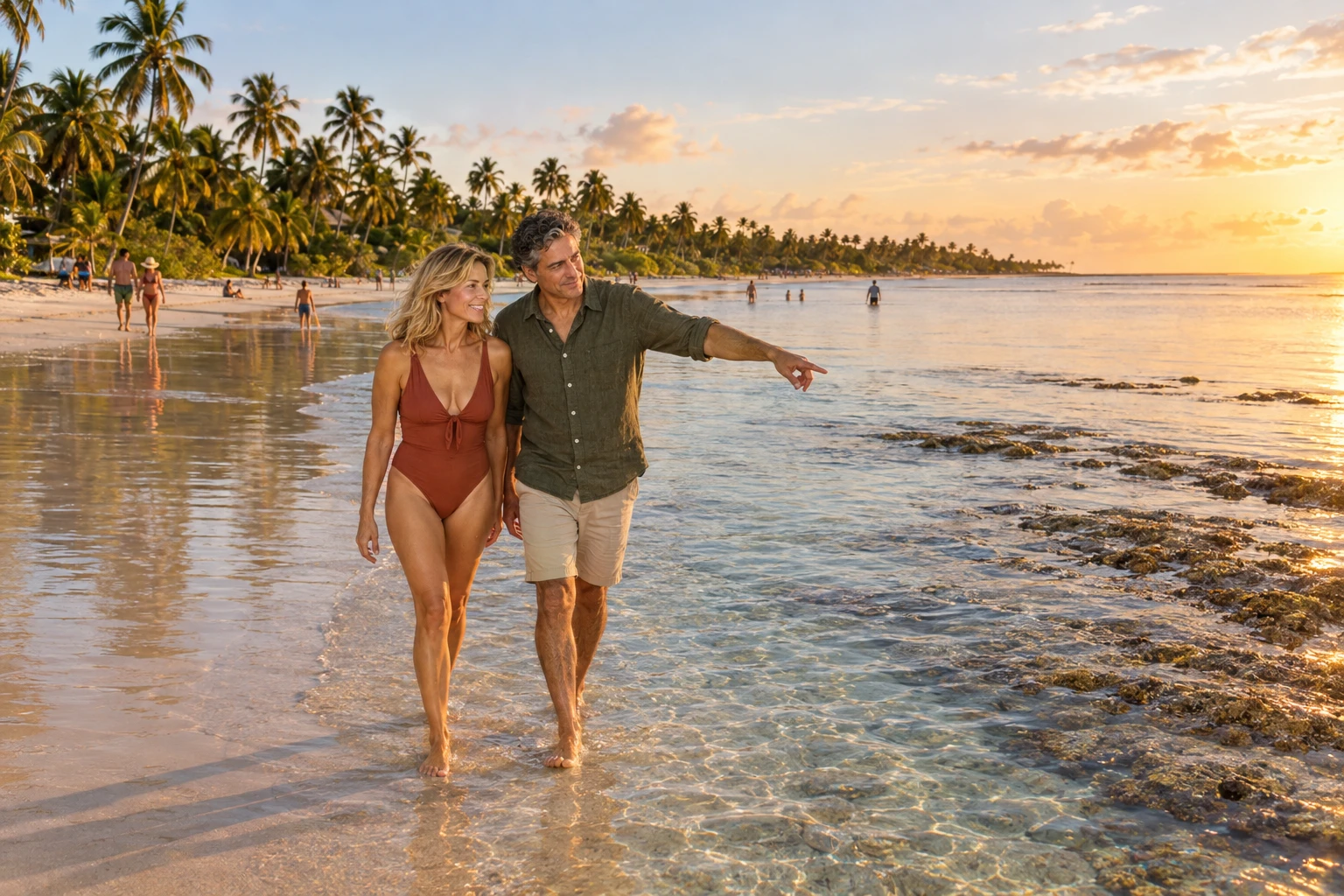
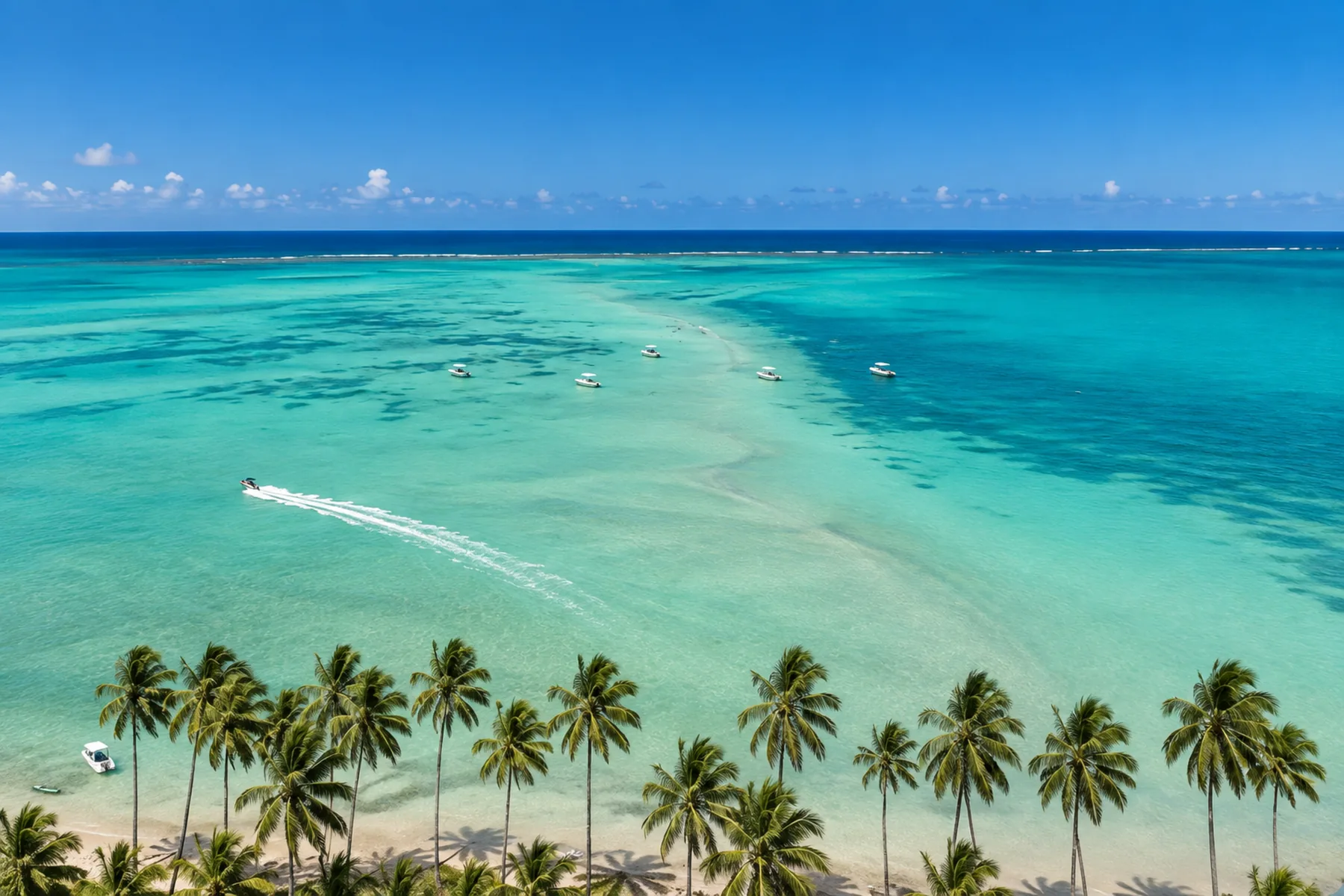
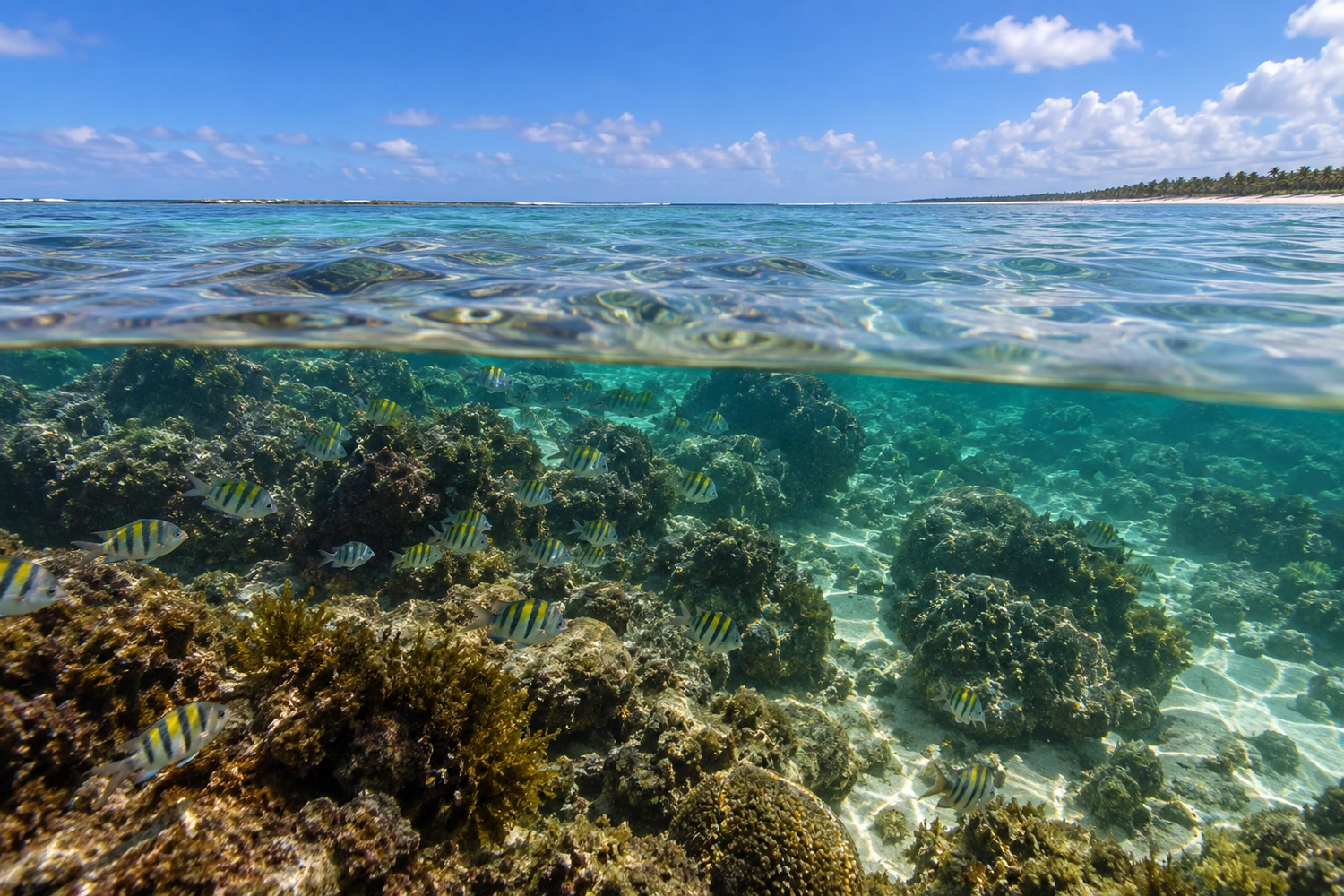
Maragogi reúne praias de águas claras e recifes no litoral norte de Alagoas. A maré transforma a paisagem de Barra Grande e das piscinas naturais, entre passeios pelo mar e caminhadas à beira da praia.
Antarctica
AL · PE
Piscinas naturais de água morna entre Alagoas e Pernambuco.
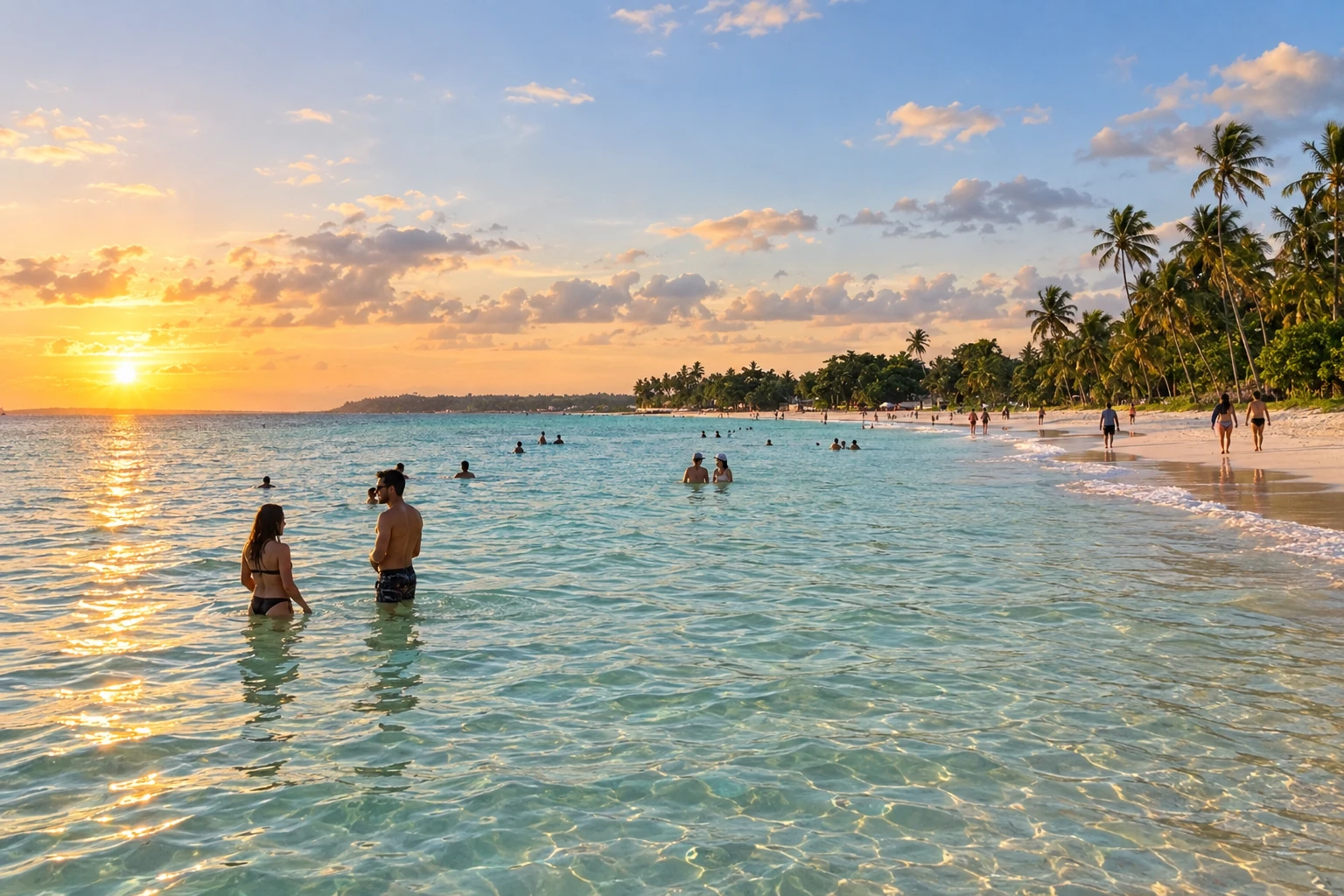
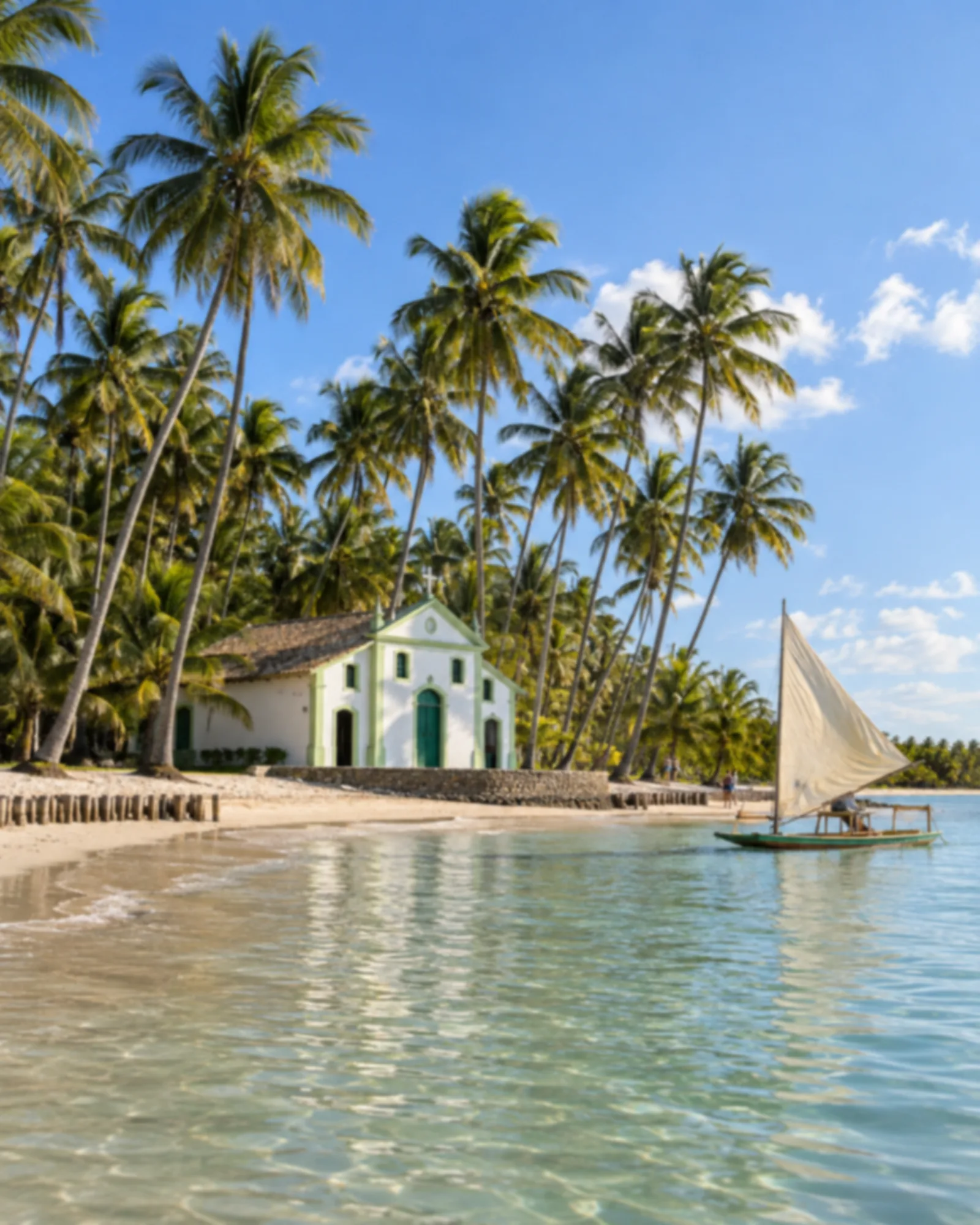
In the photo: Praia de Antunes, Maragogi
Illustrative images. The pictures in this guide are illustrations based on the real place, not photographs, and may differ from it.
Get to know the place
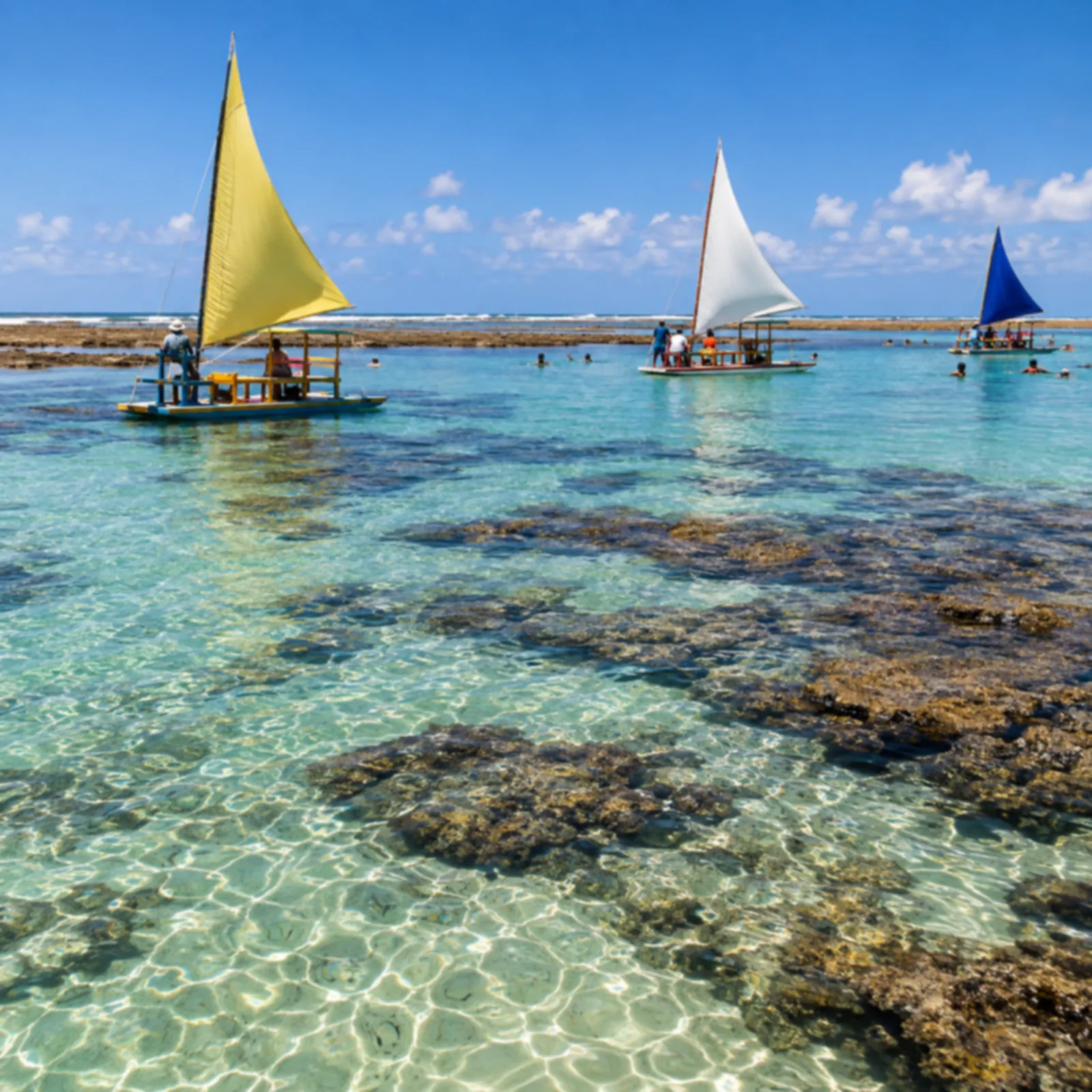
São mais de 100 km de litoral protegidos pela maior barreira de corais do Atlântico Sul, entre Alagoas e Pernambuco. Na maré baixa, o mar recua e abre piscinas naturais mornas, cheias de peixes coloridos, a quilômetros da praia. Em terra, a chamada Rota Ecológica emenda vilas tranquilas, coqueirais e pousadas pé na areia onde o programa é não ter programa.
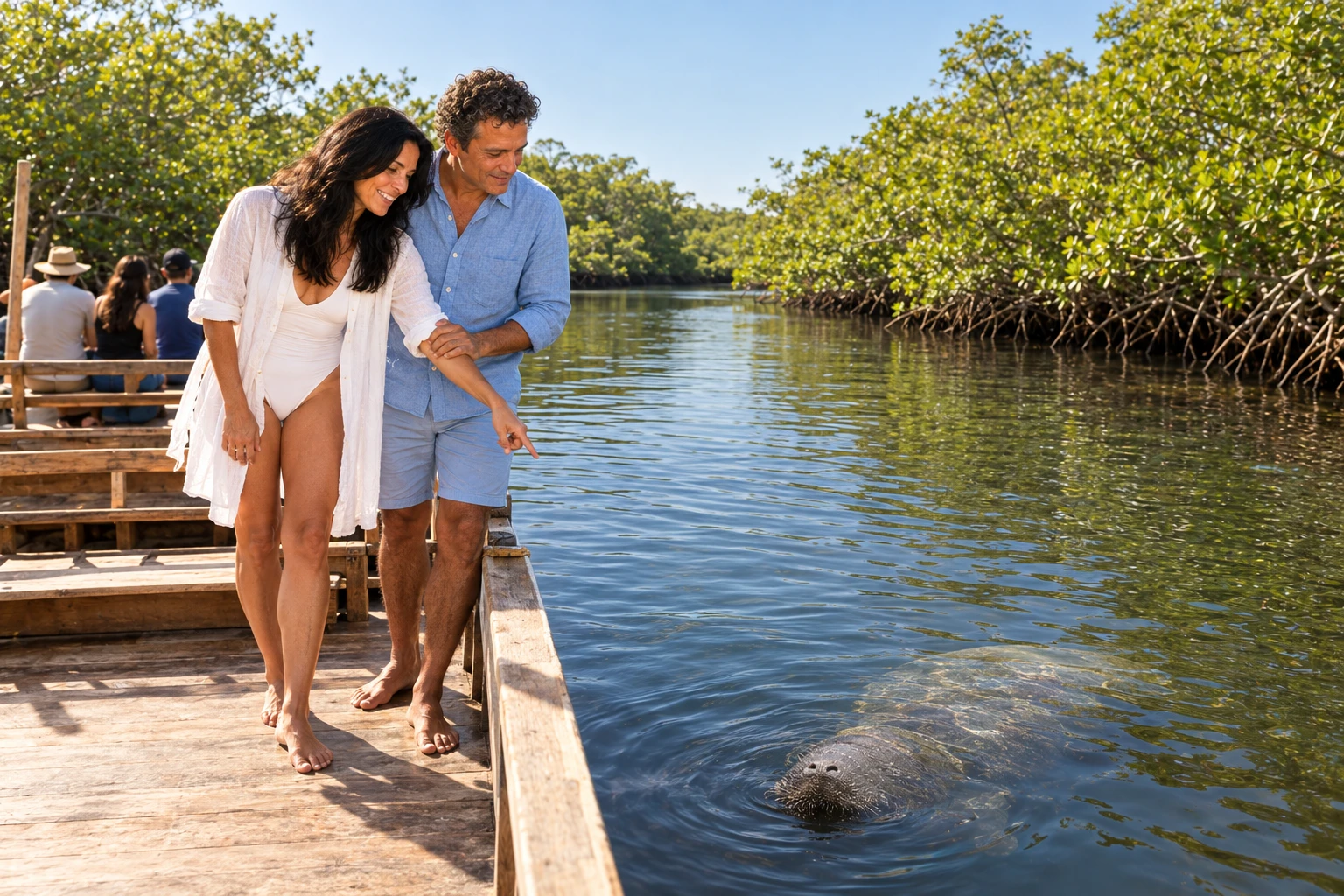
Maragogi é a porta de entrada mais conhecida, com as galés, as piscinas naturais em alto-mar alcançadas de catamarã, e praias como Antunes e Barra Grande. Japaratinga tem mar calmo e praias tranquilas. Em Porto de Pedras, a Praia do Patacho é uma das mais bonitas do Nordeste, e no Rio Tatuamunha fica o santuário onde se observa o peixe-boi-marinho, em passeios de jangada a remo. São Miguel dos Milagres reúne as pousadas de charme da Rota Ecológica.
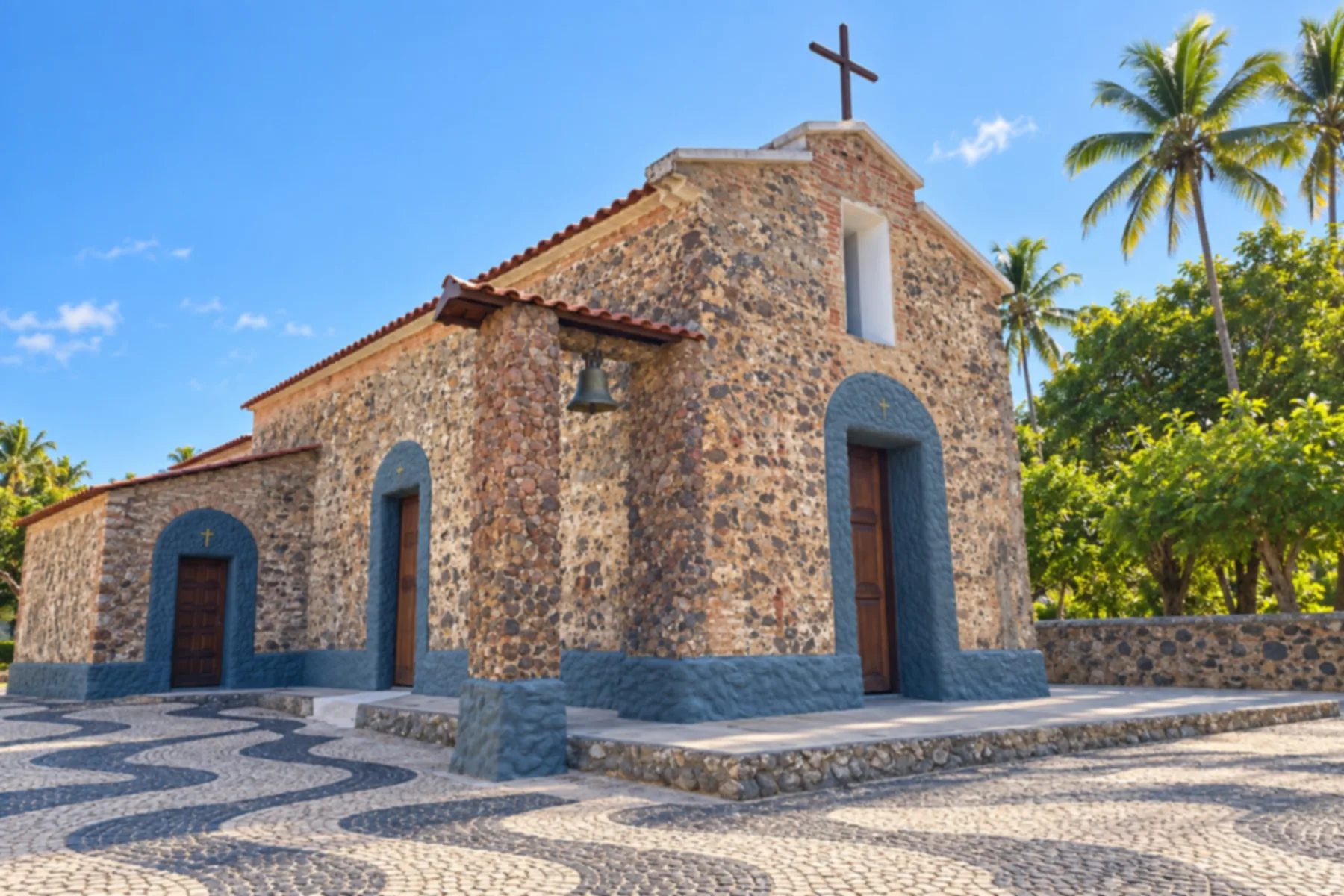
Do lado pernambucano, Tamandaré tem o Forte de Santo Inácio e suas piscinas naturais, e a Praia dos Carneiros, com a igrejinha de São Benedito à beira-mar, é cartão-postal do estado. Barreiros e Passo de Camaragibe completam a costa com praias menos movimentadas. É o destino para quem quer mar calmo, sol e água transparente, sem pressa.
This destination brings together 7 cities: Maragogi, Japaratinga, Porto de Pedras, São Miguel dos Milagres, Passo de Camaragibe, Tamandaré, Barreiros.
A look at the place
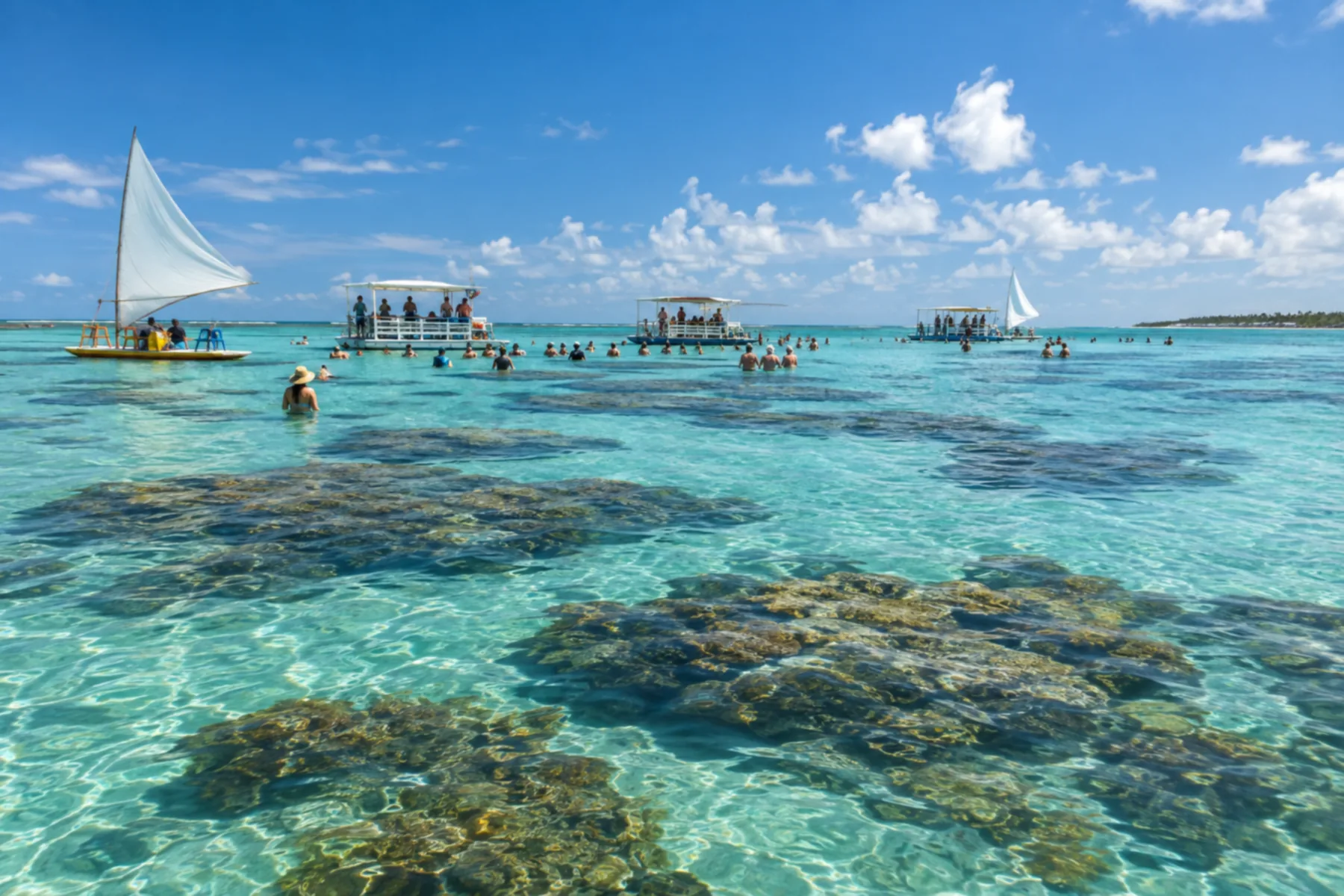
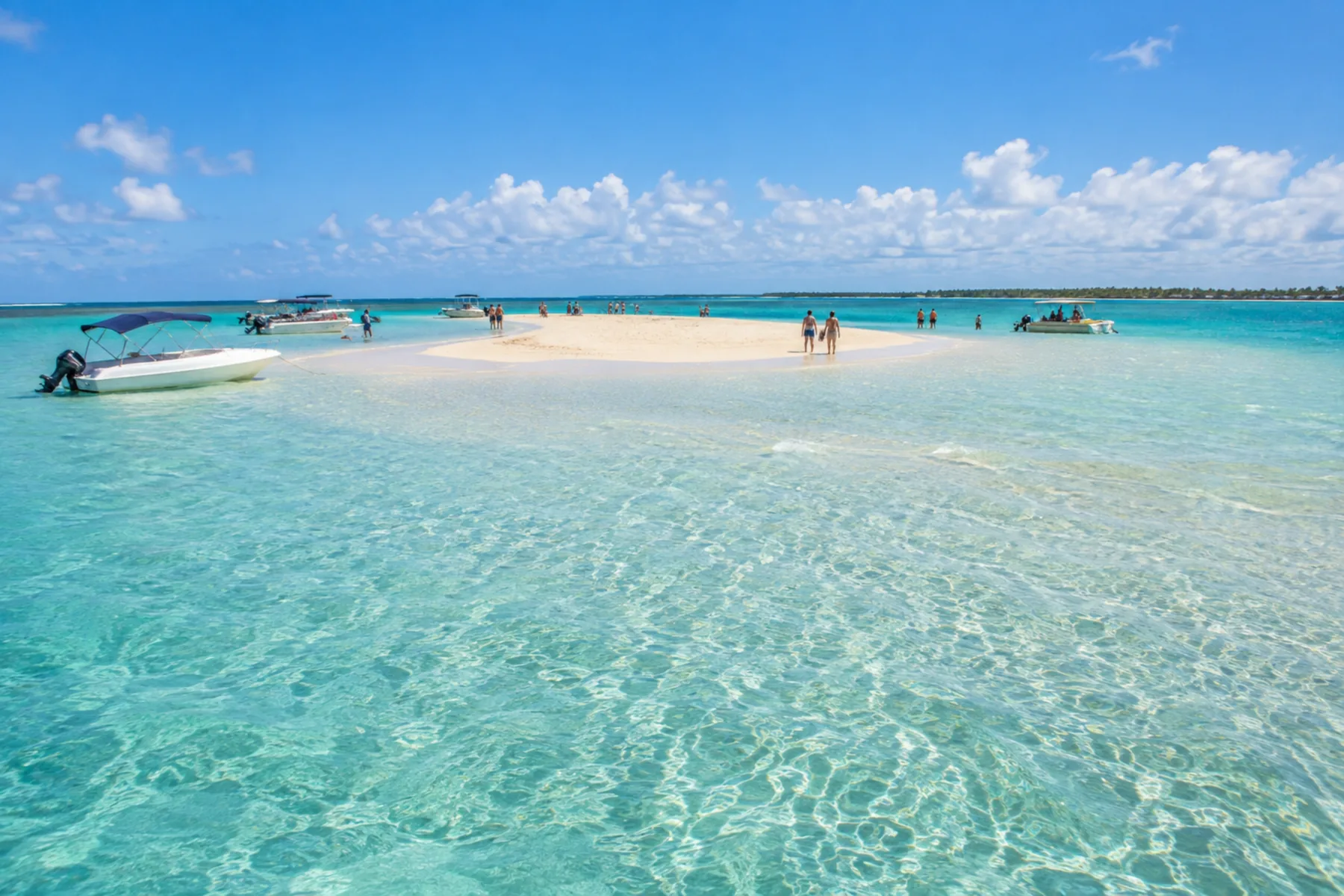
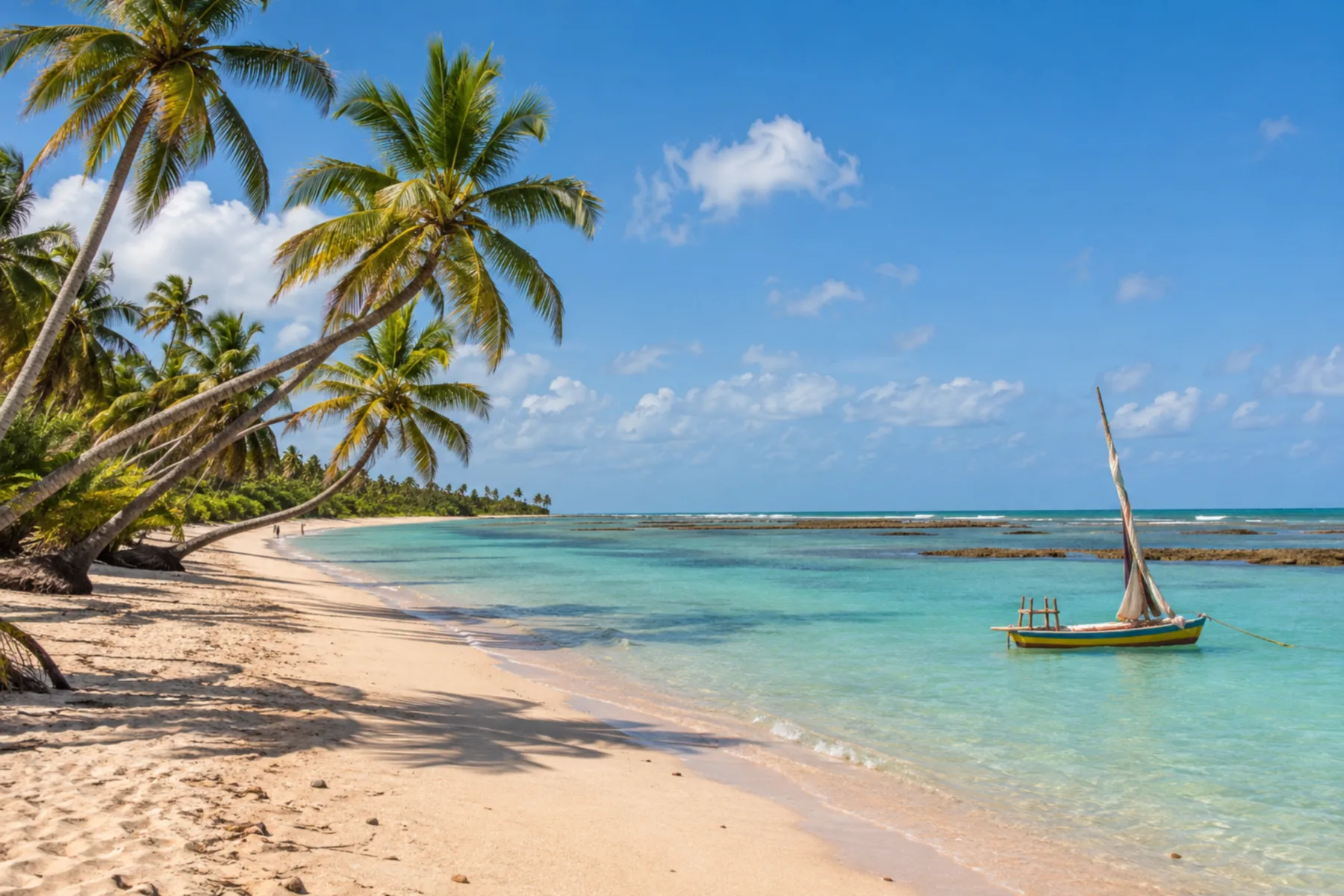
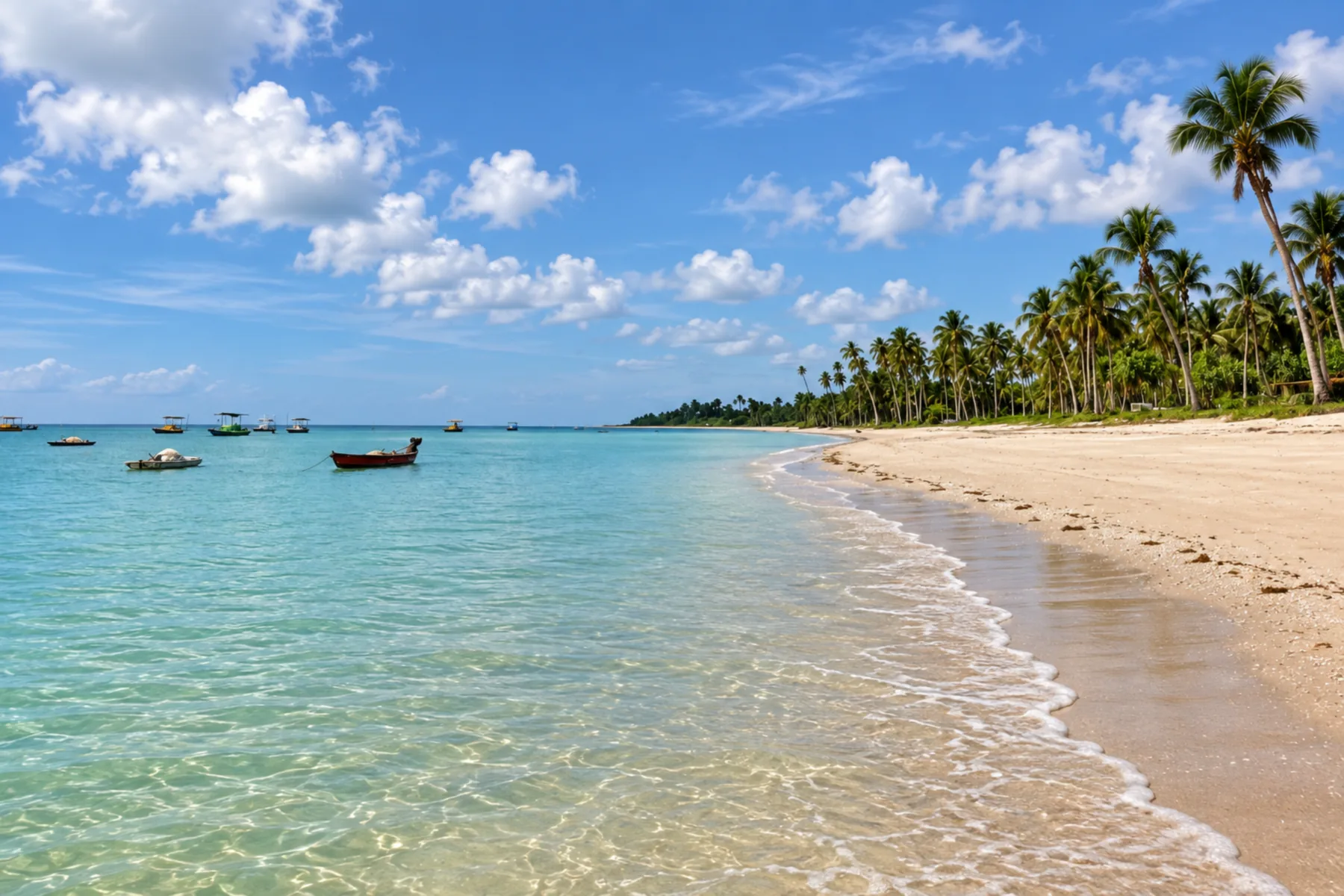
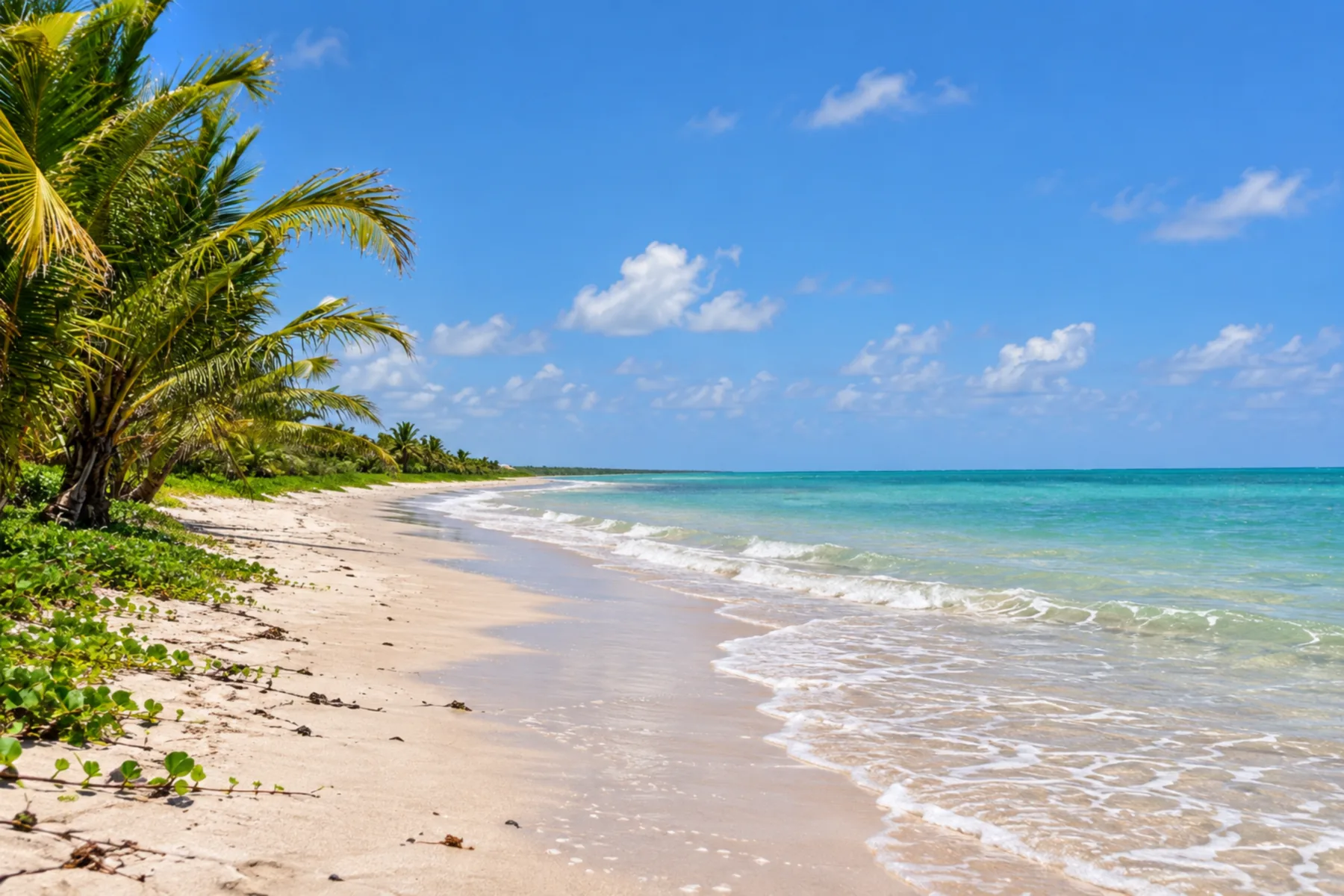
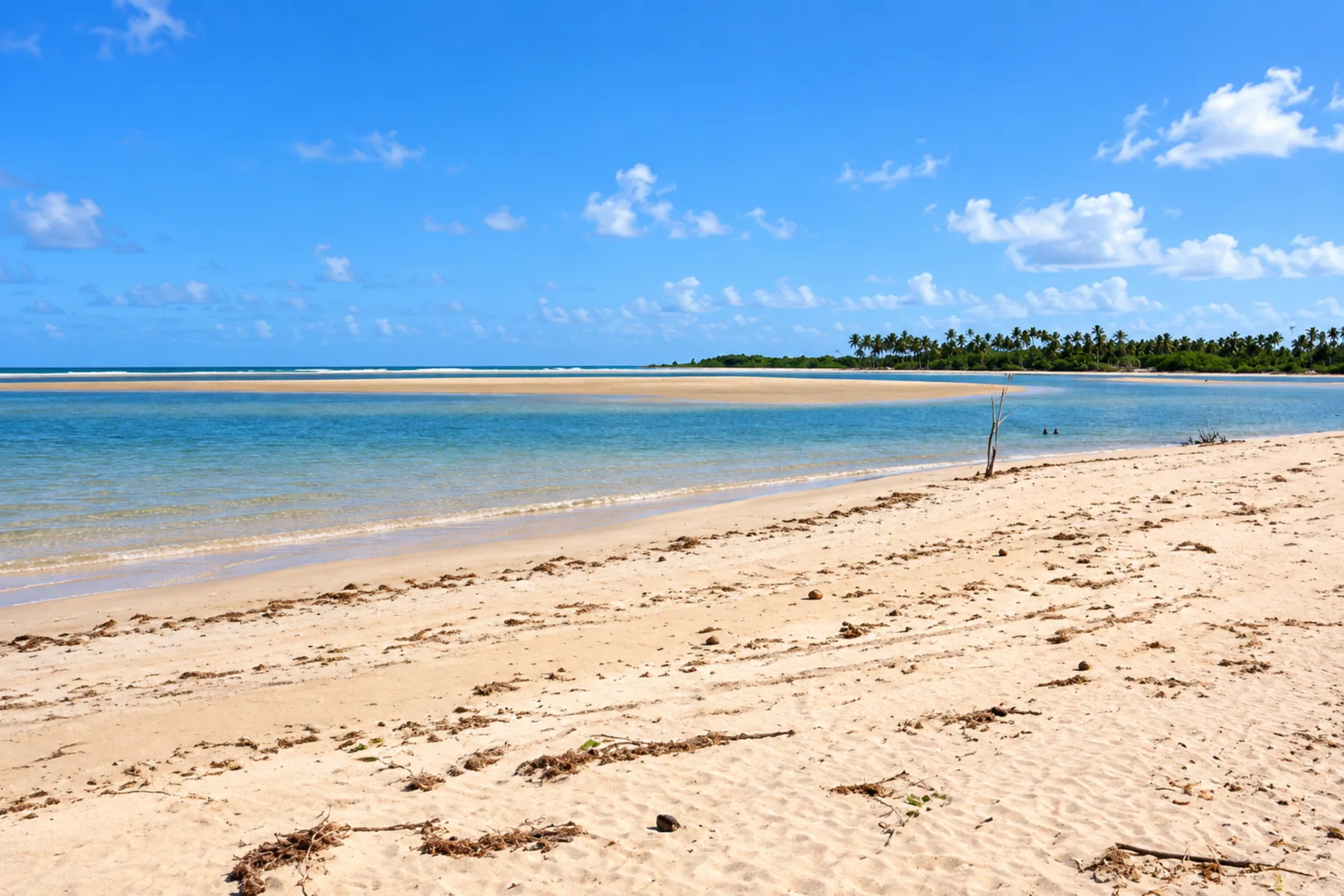
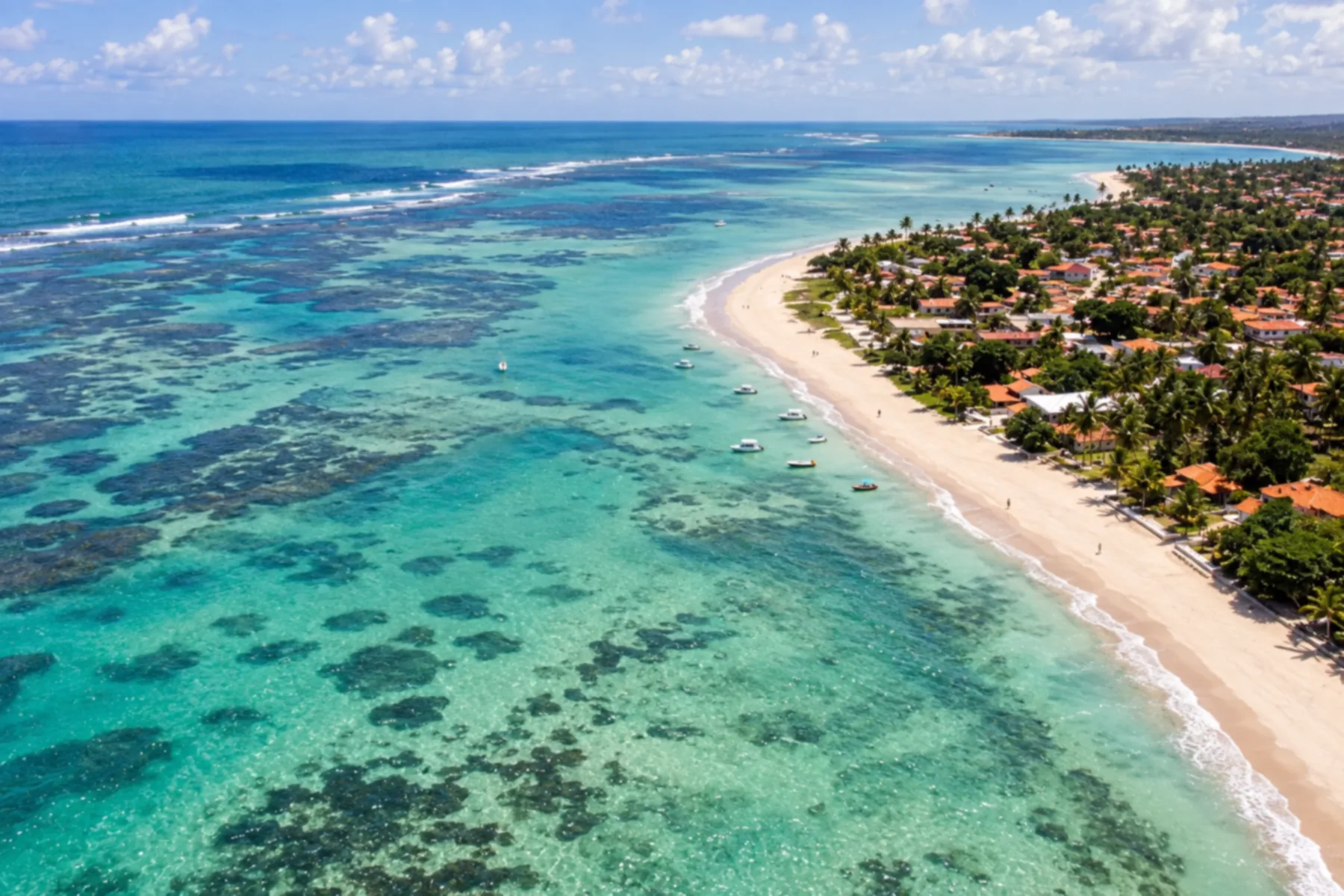
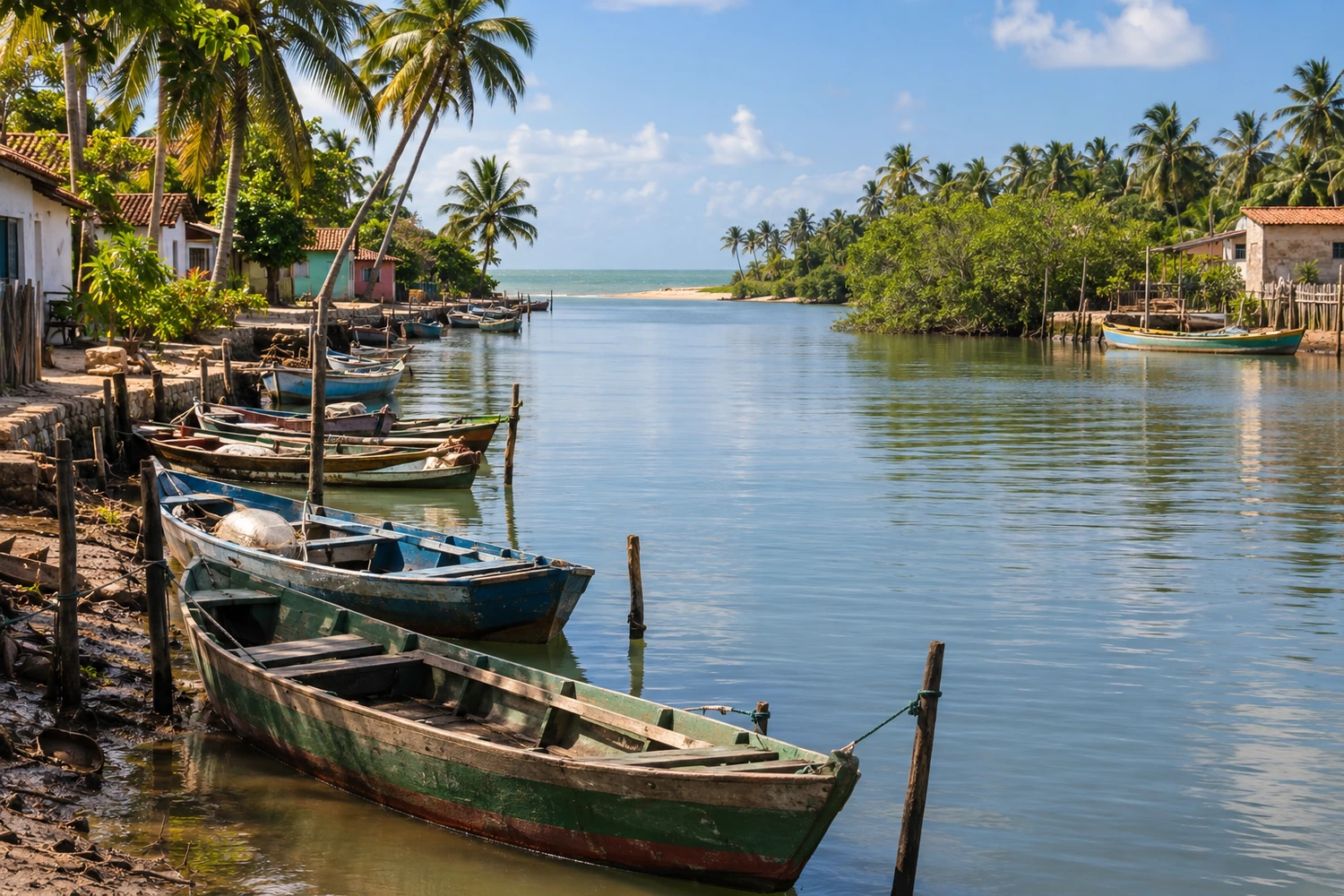
These pictures are illustrations based on the real place, not photographs. They may differ from the place.
Click the picture to enlarge it.
Travelers' photos
One destination, many paths
Start with one city or combine several in your itinerary.
Mapa: @svg-maps/brazil, CC BY 4.0
Aeroporto Internacional de Maceió (MCZ), in Rio Largo · 128 km to Maragogi
Aeroporto Internacional do Recife (REC), in Recife · 124 km to Maragogi
Aeroporto de Maceió (MCZ), a cerca de 130 km de Maragogi pela AL-101 Norte, ou Aeroporto do Recife (REC), a cerca de 130 km pela BR-101 e PE-060. Tamandaré e a Praia dos Carneiros ficam mais perto do Recife; São Miguel dos Milagres e Porto de Pedras, de Maceió.
Suggested arrival point: Maragogi

Maragogi reúne praias de águas claras e recifes no litoral norte de Alagoas. A maré transforma a paisagem de Barra Grande e das piscinas naturais, entre passeios pelo mar e caminhadas à beira da praia.

Japaratinga combina praias, coqueirais e patrimônio histórico na Costa dos Corais. A Igreja das Candeias e os caminhos à beira-mar revelam a ligação da cidade com a vida costeira do norte alagoano.

Porto de Pedras reúne praias de coqueirais e paisagens junto à foz do Rio Manguaba. A Praia do Patacho e o casario da sede convidam a combinar caminhadas pela areia com passeios pela Rota Ecológica.

São Miguel dos Milagres tem praias de coqueirais e piscinas naturais moldadas pelos recifes. Caminhadas pela Praia do Toque e passeios de jangada aproximam o visitante da paisagem do litoral alagoano.

Passo de Camaragibe reúne praias, rios e manguezais no litoral norte de Alagoas. Na Barra de Camaragibe, o encontro do rio com o mar e os coqueirais revelam as paisagens da Costa dos Corais.

Tamandaré combina praias protegidas por recifes e patrimônio histórico no litoral sul de Pernambuco. As piscinas naturais e a Praia dos Carneiros convidam a explorar o mar e os coqueirais da região.

Barreiros reúne paisagens de rios, coqueirais e praias no litoral sul de Pernambuco. A Praia do Porto e o patrimônio religioso do centro permitem combinar passeios pela costa com a história local.
The local experience
Distrito praiano a cerca de 80 km ao norte de Maceió, na foz do Rio Camaragibe, onde o rio encontra o mar de águas claras e coqueirais. É o trecho mais urbanizado do litoral do município, com passeios de barco pelo rio.
Piscinas naturais formadas sobre os recifes a cerca de 6 km da costa, alcançadas de catamarã na maré baixa. A água é rasa, transparente e cheia de peixes acostumados a gente.
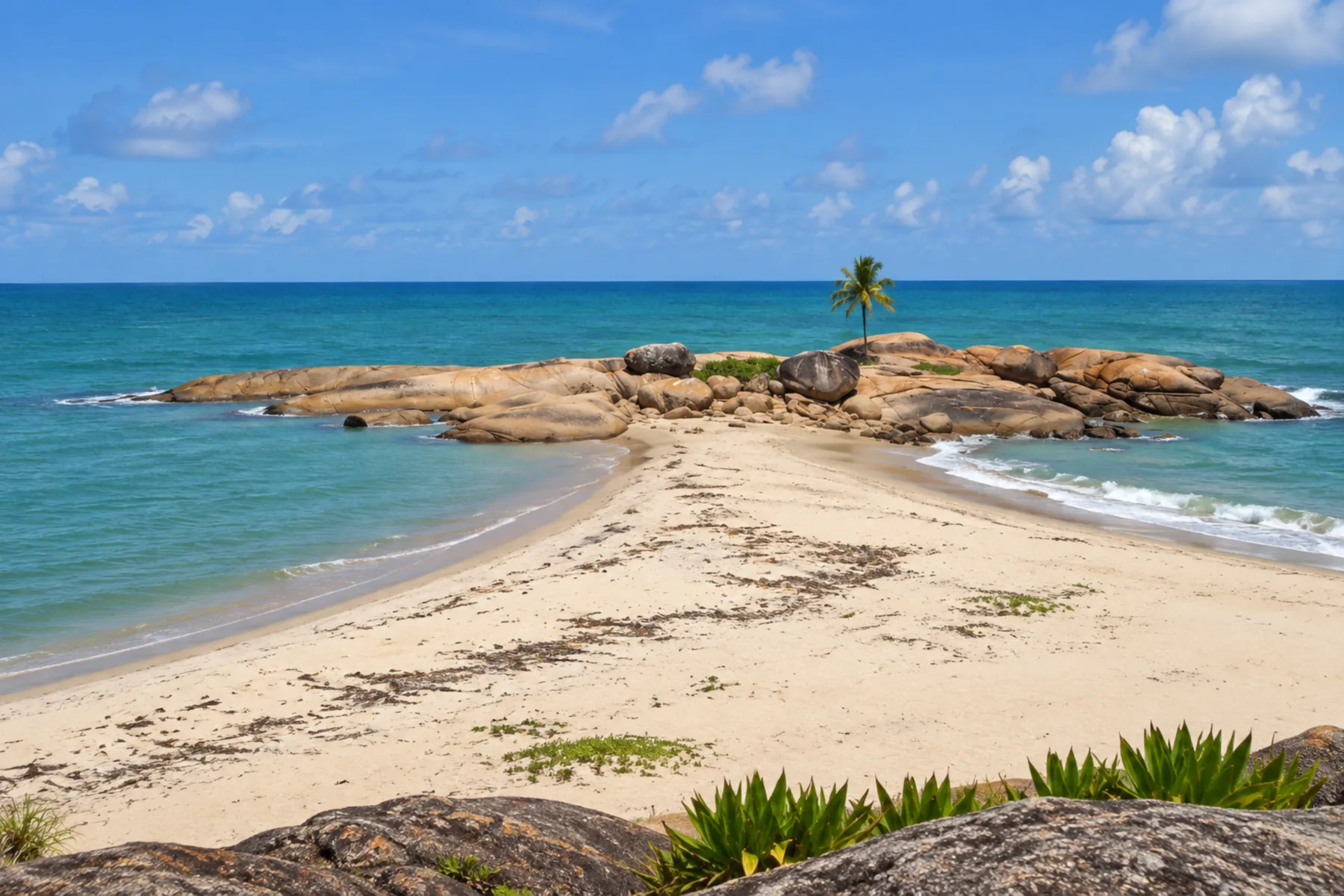
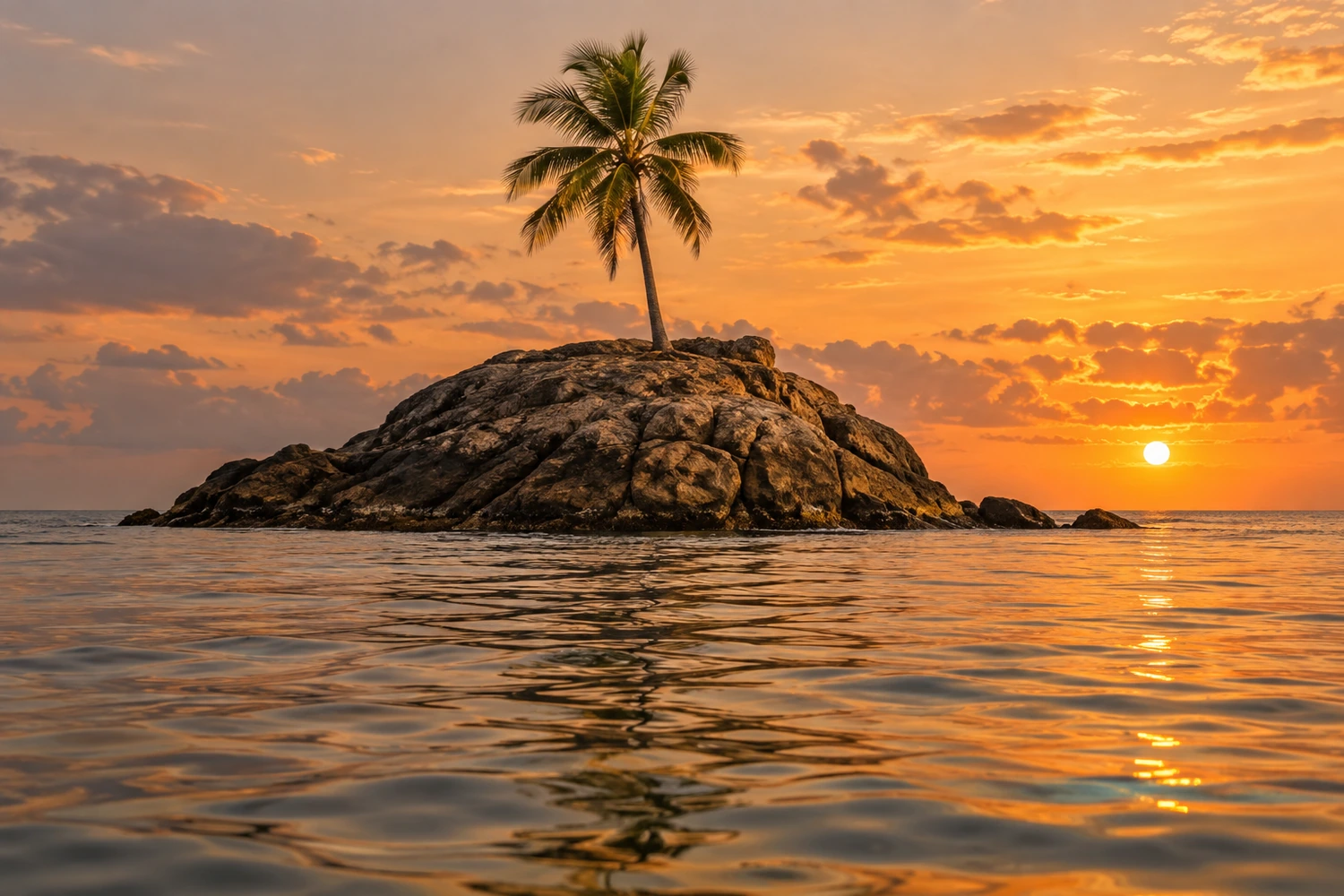
A cerca de 7 km do centro, é conhecida pela pequena ilha rochosa com um único coqueiro, que dá nome ao lugar. A praia pouco ocupada serviu de cenário para a novela A Indomada, exibida em 1997.
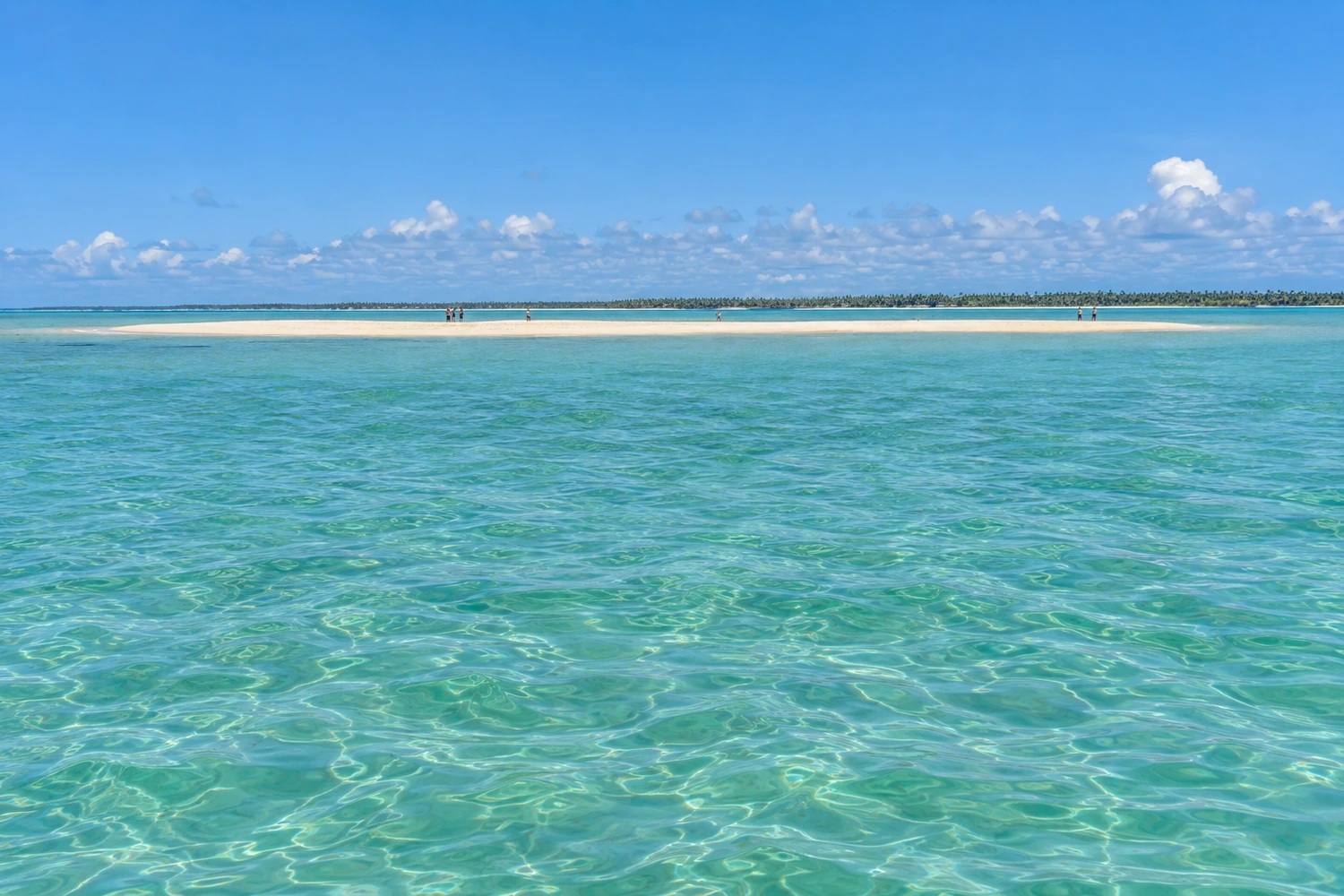
Um banco de areia que aparece no meio do mar quando a maré baixa, a pouco mais de um quilômetro da costa. Vira uma ilha temporária de água morna e rasa.
To choose before you go
Where each tour starts, how long it takes, how it is done, what is included and the price range.
The pools form over the coral barrier, about 6 km from the coast, and can only be reached by boat. Boarding is at Praia de Barra Grande or Maragogi's central waterfront, by catamaran, motorboat or schooner, roughly an hour before the lowest tide. The crossing takes 15 to 40 minutes, depending on the pool. Upon arrival, the vessel anchors and the group enters the water: you can stand in the shallow sections and snorkel over the reefs, seeing fish and corals. Galés has deep sections up to 5 m. Taocas has intermediate depth. The Barra Grande pool is located in front of the boarding point. Under the rules of the APA Costa dos Corais, each boat visits only one pool per day, in a rotation system, and stays a maximum of 1h30 at the site. The tour only runs with tides up to 0.6 m and there is a daily visitor limit. In the pools it is forbidden to consume food and drink, except water.
Stops: Galés, Taocas, Natural pool of Barra Grande, Praia de Barra Grande.
Includes: Round-trip water transport and a credentialed crew member. Paid separately: mask and snorkel, underwater photos, scuba diving, food and drinks. The APA does not charge a visitation fee; the cost is only for the boat. Check the operator's current price list, as children usually have a reduced rate.
Tip: Book in advance and check the tide table (Porto de Maceió or Suape) before setting the day. Choose a vessel authorized by the environmental agency and buy through an agency with a fixed address. If the tide doesn't allow it, the tour won't run. Bring a towel, sunscreen and water.
Best time: September to March, with more sun and clearer water. Lower tides occur around the full and new moons.
It is the most sold combined itinerary in Maragogi, known as the 3-in-1. The shared boat carries 6 to 12 people and departs from the central waterfront or from Barra Grande, at a time set by the tide. The first stop is at a natural pool, where you snorkel among the reefs. The second is at the Caminho de Moisés, a sandbank that appears perpendicular to Praia de Barra Grande at low tide and can be crossed on foot, with water on both sides. The last is Praia de Antunes, with white sand, calm water and leaning coconut trees, with kiosks. Because the boat is smaller than the catamaran, the group is smaller. Like the pool tour, it only works at low tide. At a slightly higher tide the Caminho de Moisés may be covered by water, and the stop still takes place.
Stops: Natural pool (Galés, Taocas or Barra Grande), Caminho de Moisés, Praia de Antunes, Praia de Barra Grande.
Includes: Boat, certified crew member and, typically, life jackets. Paid separately: transport to the embarkation point, snorkel, underwater photos, scuba diving with tank, food and drink. In the pools only water is allowed. Check the operator's current price list.
Tip: Book in advance and confirm the time with the tide table. Ask the agency for the name of the day's pool, because each boat visits only one. Bring footwear that can get wet for the sandbank and sunscreen.
Best time: September to March. Look for low-tide days, generally near the full and new moons.
Agencies that run it: Tour Maragogi, PorMaragogi.
R$130 to R$180 · per person, shared boatThe meeting point is the headquarters of Associação Peixe-Boi in Tatuamunha, about an hour's drive from Maragogi and around 15 minutes from São Miguel dos Milagres. From there the group is taken to the banks of the Rio Tatuamunha and boards rowing jangadas, without a motor, so as not to disturb the animals. A community guide explains how the APA Costa dos Corais works and the life of the peixe-boi-marinho, an endangered species. The river runs through mangroves and the navigation is quiet. With luck, the manatees appear near the jangadas, but sightings are not guaranteed. It is forbidden to touch or feed the animals. Part of the income supports the association and provides work for families in the community. Departures are in groups and the tour does not depend on the tide.
Stops: Associação Peixe-Boi, Rio Tatuamunha, Manguezal do Tatuamunha.
Includes: Guided jangada ride along the river. Souvenirs and other items from the association's shop are paid separately. Official price on the table beside.
Tip: Book through the association's official channel, especially in high season, because there is a daily visitor limit. Arrive with plenty of time for the transfer to the river embarkation point. Bring a hat, sunscreen and insect repellent.
Best time: All year round, not dependent on the tide. Mornings tend to have more active animals; sighting is not guaranteed.
R$100 · per person · official pricePraia dos Carneiros is about 5 km from downtown Tamandaré, where the Formoso and Ariquindá rivers meet the sea, with an extensive coconut grove and reefs that extend over the water. The catamaran embarks on the beach itself and sails in calm waters. Stops vary according to the operator and the tide, but usually include the natural pools, the clay bath, the sandbank and the view of the igrejinha de São Benedito on the seafront. Some operators embark in Guadalupe, on the other side of the river. In the pools you can swim with a mask and see fish. On the beach, hospitality operators sell day use with tables, showers and parking, and rent kayaks and stand-up paddle.
Stops: Praia dos Carneiros, Igreja de São Benedito, Natural pools of Carneiros, Sandbank of Guadalupe, Rio Formoso.
Includes: Catamaran trip with crew. Paid separately: day-use at the visitor reception, kayak, stand-up paddle (SUP), private motorboat, food and drinks. Small children usually have a reduced rate. Check each operator's current price list.
Tip: Set the time according to the tide table, because the pools require low tide. Confirm the departure time on the day, as it may change. Those staying in Recife or Porto de Galinhas can find packages with transport. Book the transfer before you arrive.
Best time: September to March. Prefer low-tide days, when the pools appear.
The buggy leaves from Centro de Maragogi, where it can also pick up the group at the hotel or pousada, and heads north. The route goes along the town's waterfront, past the sign, and usually climbs to the town's lookout, with an entrance fee charged separately. Then come the beaches of Burgalhau, Barra Grande, Antunes and Xaréu. In Barra Grande the stop is at the Caminho de Moisés, the sandbank that appears at low tide. In Antunes the buggy stops by the leaning coconut trees. Longer itineraries continue to Ponta de Mangue, Dourado and Peroba, on the border with Pernambuco. Because it is inside a conservation unit, the buggy does not drive on the beach sand: the route skirts the coast, between coconut groves and dirt roads. The tour does not depend on the tide table, and swimming and photo stops are arranged with the driver.
Stops: Mirante de Maragogi, Praia do Burgalhau, Praia de Barra Grande, Caminho de Moisés, Praia de Antunes, Praia de Xaréu, Praia de Ponta de Mangue.
Includes: Exclusive buggy with a licensed driver. Paid separately: food, drinks, viewpoint entrance fee, pickup fee in neighboring villages and optional tours. The price is per buggy, not per person; check the current rate.
Tip: Ask how long the route lasts, because offers vary from 1h30 to 3 hours. Arrange with the driver if you want to include the beaches of Ponta de Mangue and Peroba. To see the Caminho de Moisés with exposed sand, choose a day and time of low tide.
Best time: All year. September to March has more sun; for the sandbank, low tide.
Agencies that run it: Tour Maragogi, PorMaragogi.
R$240 to R$350 · per buggy, up to 4 peopleThis is the full-day tour that links Maragogi to the beaches of the Rota Ecológica. The buggy departs from Centro de Maragogi, follows the southern coastline, passes Japaratinga and crosses the river by ferry to reach Porto de Pedras. Waiting time at the ferry varies by season. Then it enters the Túnel Verde, a stretch where tree canopies cover the road, and arrives at Praia do Patacho. The following stops are usually Praia da Laje, the Mirante de São Miguel, Fonte Milagrosa and Praia de São Miguel dos Milagres. The buggy does not go on the sand because of the environmental protection area. The tour does not depend on the tide, but you can arrange a stop at the natural pools with jangadeiros on the beaches, paid separately. Lunch and swimming time are arranged with the driver.
Stops: Japaratinga, Barreiras do Boqueirão, Porto de Pedras, Túnel Verde do Patacho, Praia do Patacho, Praia da Laje, Mirante de São Miguel, Fonte Milagrosa, Praia de São Miguel dos Milagres.
Includes: Exclusive buggy and licensed driver. Paid separately: lunch, drinks, jangada rides to the pools, ferry fees if any. The price is per buggy; check the current rates, which vary by operator and route.
Tip: Book in advance and leave early because of the ferry line. Bring cash for the jangadeiros and kiosks, as not all accept cards. If you want to include a visit to the Peixe-Boi, arrange it with the driver beforehand.
Best time: September to March, with less rain. From April to July, dirt roads can become difficult.
Agencies that run it: Tour Maragogi.
The pools are about 2 km from the shore, almost in a straight line, and the crossing takes about 20 minutes. Boarding is on a beach in the village, by shared catamaran, motorboat or jangada, the latter being the slowest option. At low tide the group stops over the reefs to swim with a mask and snorkel among corals and fish. The activity is usually less crowded than the pools in Maragogi. Some operators serve drinks on board and lend snorkels. The trip depends on the low tide, so the schedule changes daily. Resorts and pousadas in the area usually sell the tour and have fixed boat crews in front of the beach.
Stops: Natural pools of Japaratinga, Praia de Japaratinga.
Includes: Water transport. Depending on the operator, drinks and mask with snorkel. Paid separately: underwater photos, snorkel rental when not included, food and transport to the beach. Check the current price list.
Tip: Ask the type of vessel and what's included before paying. In groups, it's worth negotiating the motorboat. Book with the guesthouse or directly with the boatman and check the tide table.
Best time: September to March, on days of low tide and little wind.
The crôas are a sandbank that appears at low tide, amid clear waters and reefs. Access is only by jangada: catamarans and speedboats cannot enter. Boarding is at Praia de São Bento, a fishing village about 5 km from downtown Maragogi. The motorized jangada carries up to 6 people and covers about 2.5 km in roughly 20 minutes. The tour makes two stops: the sandbank, to walk and stay in shallow water, and a deeper area for snorkeling. Because it is controlled and departs in small groups, it usually has fewer people than Maragogi's larger pools. The tour only runs at low tide, up to about 0.7 m.
Stops: Crôas de São Bento, Lagoa Azul, Praia de São Bento.
Includes: Jangada and a licensed boatman. Paid separately: mask and snorkel, transport to the boarding point, food, drinks, photos and drone. Check the current price table; small children usually have a reduced fare.
Tip: Check the tide table and book in advance. In São Bento, the village has the ruins of the Mosteiro de São Bento and a kiosk known for its bolo de goma, good options to complete the day. Bring water, sunscreen and an extra swimsuit.
Best time: September to March, on low-tide days.
R$90 to R$110 · per person, shared jangadaJangadeiros operate from Praia do Patacho and Praia da Laje, in Porto de Pedras. At low tide, the reefs form pools of shallow, calm, warm water. The jangada carries up to 6 people and goes to the pools, where the group snorkels. The itinerary usually includes stops at the sandbank, where the jangadeiros hang hammocks and take photos with a float, and at a deeper spot for jumping off the jangada. There is no ticket office or single price list: the tour is arranged directly with the jangadeiros or through agencies. The access road passes through the Túnel Verde do Patacho, a stretch covered by tree canopies. On the beach, a beach club charges day use separately.
Stops: Praia do Patacho, Praia da Laje, Natural pools of Praia do Patacho, Sandbank of Praia do Patacho.
Includes: Jangada and jangadeiro. Generally, mask and watermelon float for photos, depending on the provider. Paid separately: day use, food and drinks. Check the current price list with the operator.
Tip: Check the tide table: the tour depends on low tide, up to about 0.8 m. Book in advance in high season. Confirm beforehand what is included and the duration of the tour.
Best time: September to March, on days of low tide and calm seas.
There are natural pools in front of the Praias do Toque, Porto da Rua and São Miguel dos Milagres. The jangadeiros gather on the beaches, and the Associação dos Jangadeiros de Porto da Rua is located on the seafront. The crossing takes 10 to 15 minutes. At low tide the group stops over the reefs, where people snorkel among fish and corals. The pools are smaller than those in Maragogi and can get crowded when near the receptive operators. Generally one pool is chosen per trip. Praia do Toque is accessed via pousadas and beach clubs, and the tour operator's day-use is charged separately. The tour has no fixed price, so agree on the price before boarding.
Stops: Natural pools of Toque, Natural pools of Porto da Rua, Natural pools of São Miguel dos Milagres, Praia do Toque, Praia de Porto da Rua.
Includes: Jangada and jangadeiro, with capacity for up to 6 people. Mask and snorkel are not always included. Day use and food are paid separately. Check the current price list with the operator.
Tip: If there is no jangadeiro on the beach, book in advance through the pousada. Bring your own mask. Check the tide table and prefer early morning, when it's less crowded.
Best time: September to March, at low tide.
Agencies that run it: Milagres Transparente, Milagres Beach.
The south route leaves from Centro de Maragogi and follows the beaches of Camacho and São Bento, where the ruins of the Mosteiro de São Bento are located. Next it passes the beaches of Salgado, Japaratinga and Bitingui. The last stop is usually the Barreiras do Boqueirão, with the bica of fresh water, a natural spring for bathing. There are stops at viewpoints for photos and time to swim in the sea. The buggy does not drive on the sand because of the environmental protection area. The tour does not depend on the tide. It is also possible to combine the south and north routes into a longer tour of about 5 hours.
Stops: Praia de Camacho, Praia de São Bento, Mosteiro de São Bento, Praia do Salgado, Japaratinga, Praia de Bitingui, Barreiras do Boqueirão.
Includes: Exclusive buggy and licensed driver. Paid separately: food, drinks, pickup fee in neighboring villages and optional excursions. Price is per buggy; check the current rate.
Tip: If you are staying in a neighboring village, arrange the pickup point beforehand, as there may be a pickup fee. Ask the driver for a stop at the Mosteiro de São Bento and bring swimwear for the bica (freshwater spring).
Best time: All year. September to March is drier.
Agencies that run it: Tour Maragogi.
The natural pools lie in front of Tamandaré's central waterfront and form over the reefs at low tide. There are jangadas, some with sails, that take groups in just a few minutes, leaving time to swim with a mask and snorkel. There are also boat or catamaran trips that embark on the Rio Ariquindá within the town. Some go only to the pools. Others make the full circuit, passing the little church at Carneiros and returning to the center. The city monitors marine tourism, with rules that limit the number of visitors and the time spent in the pools. The jangada trip can be run by a community-based cooperative.
Stops: Tamandaré natural pools, Praia de Tamandaré, Rio Ariquindá.
Includes: Water transport. On some tours, mask and snorkel are provided. Paid separately: food, drinks, photos and extras. Check the current price list of the operator.
Tip: Check the tide table and choose the low-tide time. Outside holidays and weekends the beach is less crowded. Ask the itinerary before paying, because tours range from only the pools to the full circuit.
Best time: September to March, at low tide.
The fort is in the center of Tamandaré, facing Praia do Forte, also called Pontal do Lira. It was built at the end of the 17th century to defend the port from Dutch invasions. It has a quadrangular plan with pentagonal bastions at the corners. Today it operates as a municipal park, open daily. The entrance is via rua do forte, on a paved street. Guides tell the history of the fort and the region. On the terrapleno, reached by ramps, there is a view of the beach and the coconut trees. The complex also has a lighthouse, a chapel and a craft area.
Stops: Forte de Santo Inácio de Loyola, Praia do Forte (Pontal do Lira).
Includes: Admission with a symbolic fee and guided accompaniment when available. There is reduced admission for students, teachers and children. Check the park's current fee table.
Tip: Go in the morning, before the heat, and bring water. Confirm schedules in advance, as they vary between weekdays, weekends and holidays. Coordinate with Tamandaré's waterfront and the catamaran to Carneiros.
Best time: All year round. Prefer sunny mornings; on rainy days the visit is less pleasant.
The introductory dive is for people who have never used a tank. The boat departs from Praia de Barra Grande or Maragogi town center at a time set by the tide. The route includes a stop at Caminho de Moisés and a natural pool used for the dive. Some operators indicate their own meeting point in Barra Grande. Before entering the water, the instructor explains the equipment and the rules. The dive is conducted by a professional, in shallow water, and lasts 15 to 40 minutes, depending on the operator. Underwater photos are usually included. Those who only want to snorkel can book the snorkel-only option, which is simpler.
Stops: Natural pool for diving, Caminho de Moisés, Praia de Barra Grande.
Includes: Speedboat, diving equipment, instructor and usually photos. Paid separately: food, drinks and transfer to the embarkation point. Price varies by operator; check the current rate table.
Tip: Book in advance, as the schedule depends on the tide. Inform the instructor of any health conditions and whether you can swim. Look for an operator with certified instructors.
Best time: September to March, with clearer water and less rain.
Agencies that run it: Tour Maragogi.
Praia dos Morros is on the other side of the Rio Camaragibe, near the mouth, and can only be reached by water. The crossing is done by canoe or jangada, operated by local residents, departing from Barra de Camaragibe. On the other side, the landscape differs from the region's reefs: the beach is dominated by a cliff, lacks reef protection and receives small waves, good for surfing. Activity is low and facilities are basic. The last return crossing leaves in mid-afternoon, regardless of the tide. At Barra de Camaragibe, the river has freshwater pools near the mouth, and the meeting with the sea creates shades of blue and green.
Stops: Rio Camaragibe, Barra de Camaragibe, Praia dos Morros.
Includes: Round-trip crossing, paid directly to the operator. Food, drinks and boat rides on the river are paid separately. Check the current price with the person who collects payment.
Tip: Arrive early to make the most of the day and confirm with the operator the time of the last return. Bring water, sunscreen and a snack, as beach facilities are limited. Preferably go on a day without rain.
Best time: September to March, with less rain and calmer seas.

Prices are estimates, checked in October 2026 with local operators, and may change with the season and the type of tour. Confirm with the operator before booking.
Day by day
Suggestions to plan the trip. Change the order of the days according to the weather and tour availability.
Reach Maragogi via Maceió, along the AL-101 Norte, about 130 km. Before traveling, check the tide table and book the tour for the morning, during low tide. Take the trip to the natural pools of Maragogi: Galés, Taocas and Barra Grande. The pools only appear at low tide. If the low tide falls in the afternoon, swap with day 3. After the trip, have lunch on the seafront and spend the afternoon at Praia de Antunes or Praia de Barra Grande. Bring biodegradable sunscreen, required because of the APA Costa dos Corais.
Set aside a full day for the buggy ride along the Rota Ecológica, from Maragogi to São Miguel dos Milagres. The route passes through Japaratinga, crosses by ferry to Porto de Pedras and continues along beaches such as Patacho and Lages to São Miguel dos Milagres. Ferry queues vary a lot during the day; check the current fare table for the crossing. Arrange the return point to Maragogi with the agency and bring water and sunscreen.
If day 1 went well, use the morning for another excursion. One option is the buggy ride along Maragogi's southern coast to Japaratinga, with beaches, viewpoints and the natural pools of Japaratinga. The other is an introductory scuba dive with tanks in Maragogi, with an instructor and no prior experience required. Both depend on the tide. In the late afternoon, head to Maceió airport with plenty of time via the same stretch of the AL-101 Norte. Prices are paid separately; check the current table for each operator.
Arrive in Maragogi coming from Maceió or Recife, both about 130 km away. If the morning low tide allows, take the trip to the natural pools of Maragogi: Galés, Taocas and Barra Grande. If the tide time is in the afternoon, swap with day 2. The rest of the day is free for Maragogi's seafront and Praia de Antunes. Check the tide table days before booking.
Choose two outings according to the tide. One is the jangada to the Crôas de São Bento. The other is the trip to the natural pools of Japaratinga, Maragogi's neighboring village with calm seas. In the afternoon, walk along Japaratinga beach and have lunch at one of the beach stalls. Those seeking more action can swap one of the trips for an introductory scuba dive with tanks in Maragogi. All activities are paid separately; check the current rates.
Leave Maragogi early, pass through Japaratinga and cross the Rio Manguaba by ferry to Porto de Pedras. Ferry lines change throughout the day; the alternative via Porto Calvo is longer. In Porto de Pedras, take the jangada to the natural pools of Praia do Patacho, depending on the tide. In the afternoon, continue to São Miguel dos Milagres and check in.
In the morning, go to the Rio Tatuamunha for the rowed jangada trip to the marine manatee sanctuary with the local association. Sightings depend on the day. Then, at low tide, take the jangada to the natural pools of São Miguel dos Milagres. End the day on the village waterfront, with seafood restaurants and bars. Check the current schedule/rates for each tour; they are paid separately.
Before heading to Maceió, cross the Rio Camaragibe to Praia dos Morros in Passo de Camaragibe, in the southern Rota Ecológica. Book the tour in advance and return to your accommodation in time to hit the road. From São Miguel dos Milagres, Maceió airport is reached via the AL-101 Norte. Allow extra time before your flight.
Arrive at Recife airport and head to Tamandaré, about 100 km to the south. Book your transfer or car in advance. In the afternoon, visit the Forte de Santo Inácio de Loyola, a 17th-century structure. Then walk along Praia de Tamandaré, where the reefs form pools at low tide. Check the current schedule for visiting the fort.
Full day on the catamaran from Praia dos Carneiros, which usually departs in the morning and returns late afternoon. The itinerary goes through the estuary of the Rio Formoso, sandbanks and natural pools. Many tours include a stop in Guadalupe for a clay bath. Stop at the igrejinha de São Benedito on the seafront. Access to the beach is usually via the parking lots of bars and pousadas, which charge separately. Check the current rates.
In the morning, visit the natural pools of Tamandaré by jangada or boat at low tide. After lunch, drive to Maragogi, now in Alagoas. Reserve the afternoon to arrive calmly and walk along the waterfront. Arrange your accommodation's check-in time in advance.
Take the trip to Maragogi's natural pools: Galés, Taocas and Barra Grande at low tide. Prefer the morning, when the water is usually calmer. Those who want to see the corals up close can book an introductory scuba dive with tanks in Maragogi. In the afternoon, go to Praia de Antunes. Tours are paid separately; check the current rates.
Take the buggy ride along the Rota Ecológica, from Maragogi to São Miguel dos Milagres, for a full day. The route goes through Japaratinga, crosses the Rio Manguaba by ferry to Porto de Pedras and continues via Patacho and Lages. Arrange with the agency how your luggage will get to São Miguel dos Milagres, where you'll sleep. The ferry queue varies; check the current timetable.
In the morning, take a paddle jangada ride on the Rio Tatuamunha to see the marine manatee at the sanctuary. Afterwards, take the jangada to the natural pools of São Miguel dos Milagres. If you prefer, swap it for the jangada to the pools at Praia do Patacho. Both depend on the tide, so confirm times the day before. Tours are paid separately; check the current schedule.
Cross the Rio Camaragibe to Praia dos Morros, in Passo de Camaragibe, then return to the road. From there, follow the AL-101 Norte to Maceió airport. Book your transfer in advance and allow extra time before the flight. Since you entered via Recife and will depart from Maceió, check the rental car's one-way return fee beforehand.
Best time to go
From September to March, with more sunny days and clearer water. The natural pools depend on low tide, so check the tide table before booking tours: around the full and new moons, the tides are lowest. From April to July it rains more and the water can get murky.
The seasons shown are the most usual ones; nature doesn't always follow the calendar.
Dry summer · High season
Sunny month, with around 70 mm of rain and highs near 29 °C. The sea is usually calm and the natural pools are accessible at low tide. Visitor numbers are high because of school holidays, and catamaran, jangada and buggy tours sell out—book in advance. Check the tide table, as times change daily.
Low rainfall · High visitor numbers
It's still the dry period, with about 75 mm of rain and short showers. Clear water and calm seas favor Galés, Taocas and the pools of Tamandaré. Visitor numbers remain high, especially if Carnival falls in the month, and accommodations and tours need to be booked. Prefer morning tours, when the pools tend to be less crowded.
Rain returns gradually · Sea still clear
Rain increases to around 100 mm and showers become more frequent, especially in the second half of the month. There are still many sunny days and the natural pools remain good at low tide. Visitor numbers fall compared to January and February, except during long holidays. Bring a lightweight raincoat and leave a free day in your itinerary.
Frequent rain · Water may become turbid
The rainy season begins, with about 120 to 130 mm and several rainy days. The water over the reefs can become turbid, reducing visibility in the natural pools. boat, catamaran and jangada tours may be rescheduled due to the weather or sea conditions. There is less activity and flexible dates help. Check the forecast the day before each tour.
Heavy rain · Tours subject to rescheduling
One of the rainiest months, with an average near 155 mm and temperatures between 24 and 27 °C. The water tends to become turbid and the natural pools lose clarity. Tours depend on the day's conditions and, when rescheduling occurs, it's advisable to have extra days. Visitor numbers are low. If you travel at this time, prefer short itineraries and land-based excursions, such as forts, the waterfront and villages.
Rain peak · Low tourist traffic
This is the rainiest month on the coast, with around 170 mm in Maragogi and Tamandaré, and cooler nights with lows of 23 °C. Water turbidity is common and trips to the natural pools are less regular. There are fewer tourists and the villages are quieter. Book tours with flexible cancellation and monitor the forecast and the tide table.
Still high rainfall · School holidays
Rainfall decreases slightly, to around 150 mm, but is still frequent. Highs are around 26 °C. School holidays increase activity in Maragogi and Tamandaré, so book catamarans and jangada tours in advance. On clear days, the natural pools operate at low tide, but the water may be less clear. Have a plan B for rainy days.
Rainfall decreasing · Transition phase
Rainfall drops to around 100 mm and sunny days increase, but showers can still occur and the water may be less clear early in the month. The tide becomes the main factor for planning visits to the natural pools. Activity is moderate. This is a transition period, with the sea becoming more regular toward the end of the month. Check the forecast before booking full-day trips, such as buggy and catamaran tours.
Dry season begins · Clearer water
Rainfall falls to about 60 to 70 mm and sunny days become established. The water tends to be clearer and the sea calmer for boat, jangada and catamaran trips. Generally prices and crowds are lower than in summer. Still, trips to the natural pools only take place at low tide; check the tide table and book in advance.
Little rain · Start of high season
One of the driest months, with about 50 mm of rain and highs around 27 °C. The waters are usually clear and the sea calm, which favors Galés, Patacho and Carneiros. Visitor numbers gradually rise toward the end of the year. Book popular tours such as the catamaran and the buggy along the Rota Ecológica, and plan using the tide table.
Driest month · Calm sea
It's one of the driest months on the coast, with less than 45 mm and few rainy days. The sea is calm, the water clear and the sun strong; use biodegradable sunscreen in the pools. Visitor levels are moderate, with holidays that increase demand. It's a good window to combine the three areas of the itinerary: Tamandaré, Maragogi and the Rota Ecológica.
Dry and hot · Year-end crowds
Dry month, with about 45 mm of rain and highs around 29 °C. The sun is intense and the sea is usually calm, favoring all tours to the natural pools. Crowds increase during the weeks around Christmas and New Year, and spots on catamarans, jangadas and buggies sell out early. Book in advance and schedule tours according to each day's low tide.
Plan the journey
There is no airport in Maragogi. Those flying in use Maceió/Zumbi dos Palmares International Airport (MCZ) or Recife/Guararapes International Airport (REC). Both receive flights from various parts of Brazil, so it's worth comparing schedules and fares at both.
Maragogi is about 124 km from Maceió and about 130 km from Recife. Japaratinga is about 120 km from Maceió. Tamandaré is about 110 km from Recife, and Praia dos Carneiros about 90 km. São Miguel dos Milagres is about 35 km from Maragogi.
For Porto de Pedras and São Miguel dos Milagres, Maceió is usually more practical. For Tamandaré and Praia dos Carneiros, Recife. If your route includes other beaches on the Alagoas coast, flying into Maceió avoids retracing your steps.
From the airport to the coast the leg is by road: rental car, transfer, taxi, ride-hailing app or bus. Book the transfer or car before arrival.
There is no direct bus from the airport to the beaches. In Maceió, urban lines connect the airport to the bus station, from where intercity buses depart.
For Maragogi, Real Alagoas operates from the Maceió and Recife bus stations, with limited schedules and lines. From Maceió the trip takes between 2h30 and 3h. From Recife there is a reported Viação Progresso line to Maragogi, taking about 3 hours.
For Tamandaré, Viação Progresso departs from Recife, with few daily departures. Buses do not leave from the airport: confirm the departure terminal and schedules before traveling. Buses do not go to Praia dos Carneiros; from Tamandaré the final leg is by taxi, mototaxi, van or app ride.
In Maragogi, local vans connect the center to villages like Ponta de Mangue.
Because the bus offer is small and schedule-dependent, many visitors prefer a shared or private transfer booked before arrival. Prices vary by company, vehicle and season; check with operators and consult the current table.
From Maceió: exit the airport onto the BR-101 and take the AL-105. Near Porto Calvo, follow the AL-465, which connects to the AL-101 North and leads to Maragogi. It's between 124 and 130 km, about 2 hours.
From Recife: take the BR-101 South and then the PE-060. For Tamandaré, the final access is via the PE-076. It's about 110 km and around 2 hours. Praia dos Carneiros is about 90 km from Recife; the entrance is via a local road from Tamandaré, following the signs. From Praia dos Carneiros to Maragogi is about 52 km.
Near the beaches there are few parking spaces and parking is usually paid. Check whether the pousada has a spot before you go.
Maragogi and Tamandaré charge visitor vehicle fees; see the section on municipal fees.
Maragogi: renting a car gives you more freedom to reach beaches that are far from the center and other points along the coast. If you have only a few days and only take agency tours, you can do without a car, because operators usually pick up and drop off passengers at hotels. Those staying at a resort generally book tours on-site.
Taxis, ride-hailing apps and local vans run between the center and the villages. buggy tours are a municipality-regulated service with limited permits.
Tamandaré: Praia dos Carneiros is outside the town center. Without a car you get there by taxi, mototaxi or shared van. App coverage in Tamandaré is limited, so arrange your return in advance. A car is helpful for daily needs, since intercity transport is infrequent.
At the beaches parking is paid in most places and spaces are scarce. If you rent a car, confirm parking at your accommodation and book in advance for high season.
With a package: agencies and operators sell the trip with the airport transfer already arranged. The transfer can be shared, in a vehicle with other travelers and group schedules, or private, in a car or van just for your group. There are also day tours, such as the round-trip to Praia dos Carneiros, departing from Recife or Porto de Galinhas. Those staying at a resort usually book tours on site.
On your own: you organize each leg. You can rent a car at the airport, hire an individual transfer, or use taxi, ride-hailing app or bus. This gives more freedom in your itinerary, but requires checking the tide table, boat schedules and parking availability.
In both cases, book the transfer or the car before arrival, especially on holidays and in high season. Prices vary by company, vehicle type and time of year; ask for a quote and check the current table.
Maragogi: the municipality charges a tourist fee per vehicle for visitors who do not stay in the city, such as on day trips. The charge is per vehicle, not per person, and the amount depends on the type (van, minibus, bus). The municipal ordinance that sets prices for nautical tours also provides for an environmental contribution per person for the preservation of visitation areas. Ask the operator if it is already included in the tour.
Tamandaré: the city charges the Preservation and Environmental Protection Fee (TPAT) to drivers of leisure vehicles. It is established in municipal law and linked to the management plan of the Parque Natural Municipal do Forte de Tamandaré. The funds go to preservation and environmental protection services.
Fees, exemptions and payment methods change over time. Check the current table on the municipalities' websites before you travel and ask the agency whether the fee is included in the package.
Who takes you
Only agencies with an active registration in Cadastur, the official registry of Brazil's Ministry of Tourism, are listed. The order is not a ranking: compare the tours and book directly with the agency.
Cidade Turismo reviews its information regularly, but something may have changed. Check with the place before planning your trip.
Maragogi tour agency. Sells private or shared boat trips to the natural pool, Caminho de Moisés and Praia de Antunes; scuba diving with tanks; buggy tours along the north coast; buggy tours along the south coast (Mosteiro de São Bento, Japaratinga and Barreira do Boqueirão); and full-day buggy trips to São Miguel dos Milagres.
Tours: Boat: natural pools, Caminho de Moisés and Praia de Antunes, Buggy along the northern coast of Maragogi, Buggy along the Rota Ecológica: from Maragogi to São Miguel dos Milagres, Buggy along the south coast of Maragogi to Japaratinga, Introductory scuba dive with tank in Maragogi.
Cadastur checked in October 2026
Tour agency in Maragogi, operating since 2020, which presents itself as a specialist in boat and buggy tours. Reservations via the WhatsApp number listed on the Instagram profile.
Tours: Boat: natural pools, Caminho de Moisés and Praia de Antunes, Buggy along the northern coast of Maragogi.
Cadastur checked in October 2026
Local agency in São Miguel dos Milagres. Sells jangada trips to the natural pools, which depend on low tide, and also offers stand up paddle, buggy, boat and quad bike tours. The website states it is registered with Cadastur.
Tours: Jangada to the natural pools of São Miguel dos Milagres.
Cadastur checked in October 2026
São Miguel dos Milagres agency that sells jangada trips to the natural pools of Praia do Toque, including late-afternoon departures. Reservations via the agency's website and Instagram.
Tours: Jangada to the natural pools of São Miguel dos Milagres.
Cadastur checked in October 2026
Your base to explore
Before you go
A little planning leaves more time to enjoy the journey.
From September to March, with more sunny days and clearer water. The natural pools depend on low tide, so check the tide table before booking tours: around the full and new moons, the tides are lowest. From April to July it rains more and the water can get murky.
The seasons shown are the most usual ones; nature doesn't always follow the calendar.
Plan 4 to 6 days: one for the galés (offshore reef pools) of Maragogi, one for the manatees and Praia do Patacho, one for Praia dos Carneiros and the rest to enjoy the natural pools as the tide allows. The most popular tours depend on low tide, and a few spare days in your itinerary help you fit them in.
Maragogi has the widest choice of hotels, resorts and tours, and sits in the middle of the coast. São Miguel dos Milagres and Porto de Pedras have the boutique pousadas, quieter and more expensive. On the Pernambuco side, Tamandaré is the base for Praia dos Carneiros. If you want to see both states, you can split your stay between Maragogi and Tamandaré.
Take your trash with you, follow the signs and support local businesses. In natural areas, follow the visiting guidelines.
Beyond the guide
Your questions
São piscinas naturais formadas pelos recifes de corais a cerca de 6 km da costa, alcançadas de catamarã ou lancha. Na maré baixa, a água fica rasa e transparente, e dá para mergulhar com máscara e snorkel entre os peixes. A visitação tem limite diário de pessoas e horário definido pela maré.
As piscinas naturais só aparecem na maré baixa, e os melhores dias são os de maré mais baixa, perto das luas cheia e nova. Os horários mudam todos os dias, e os barcos saem conforme a tábua de marés. Por isso, confira a tábua antes de marcar os passeios e deixe dias livres no roteiro.
No Rio Tatuamunha, em Porto de Pedras, onde fica a base do Projeto Peixe-Boi. O passeio é feito em jangada a remo, sem motor, para não assustar os animais, e o número de visitantes é controlado. É possível ver os peixes-bois em recuperação e, às vezes, os que já vivem soltos no rio.
Ajuda, porque as praias ficam espalhadas pela AL-101 e pela PE-060, e o transporte público é limitado. Sem carro, dá para contratar transfers a partir de Maceió e do Recife e fazer os passeios com agências e bugueiros, que buscam nas pousadas.
Em Pernambuco, no município de Tamandaré, a cerca de 100 km do Recife. É conhecida pela água calma, pelos coqueirais e pela Igreja de São Benedito, uma capela à beira-mar. Pode ser visitada num passeio de catamarã a partir de Tamandaré ou num bate-volta de Maragogi.
Para Maragogi e São Miguel dos Milagres, com passeios às piscinas naturais, o roteiro costuma ter de 3 a 5 dias. Com uma semana sobra tempo para incluir Japaratinga e Porto de Pedras. Quem quer percorrer a costa inteira, de Tamandaré (PE) até Maceió (AL), geralmente reserva de 7 a 15 dias. Maragogi e São Miguel dos Milagres ficam a cerca de 1h30 de carro. Bate-volta entre as duas cidades deixa pouco tempo para os passeios e para as vilas. Como as piscinas dependem da maré baixa, deixe dias de folga no roteiro para remarcar passeios.
Use só protetor solar biodegradável, também vendido como "reef safe". As Galés ficam dentro da APA Costa dos Corais, e filtros comuns prejudicam os corais. Outra opção é passar o protetor na sombra da embarcação antes e depois do mergulho e entrar na água sem ele. Não pise nem toque nos corais e não alimente os peixes. Leve o protetor adequado de casa: nem todo ponto de venda na orla tem a versão biodegradável.
Sim, principalmente no verão e em feriados prolongados. O acesso às piscinas naturais tem limite diário de visitantes e embarcações, definido para proteger os corais. Em datas de alta procura, pode não haver vaga para o mesmo dia. Os passeios só saem com a maré dentro das condições ideais, então a operadora confirma o horário de embarque conforme a tábua de marés. Reserve antes e peça a confirmação por escrito.
Sim. Nos passeios de lancha e catamarã, todos usam colete salva-vidas, conforme as normas da Marinha. Quem não sabe nadar pode ir com o colete. Algumas operadoras avisam que crianças e idosos precisam de mais atenção nas piscinas mais fundas, como Galés e Taocas, porque pode ser preciso descer da lancha e caminhar até uma área mais rasa. Roteiros que combinam várias paradas, como Caminho de Moisés e Praia de Antunes, têm trechos de água mais rasa. A política para crianças varia: muitas operadoras não cobram de crianças pequenas, e a idade-limite muda de uma para outra. Confira na hora de reservar.
Tem. Ônibus e vans intermunicipais saem da rodoviária de Maceió, e as vans funcionam como lotação, com paradas pelo caminho. Não há ônibus direto do Aeroporto de Maceió: é preciso ir antes à rodoviária. Pela rodovia, são cerca de 130 km, e a viagem leva de 2h30 a 3h de carro ou transfer. De ônibus ou van, conte com mais tempo, podendo chegar a 4h. Quem prefere mais conforto pode reservar transfer privativo ou compartilhado, de preferência antes de embarcar. Confira horários e tarifas atuais com as empresas.
A praia é pública, mas é quase toda cercada por pousadas e restaurantes. Muitos acessos passam por esses estabelecimentos, que costumam cobrar estacionamento, day use ou consumação mínima. Existem também acessos a pé por caminhos de terra, a partir da estrada, com caminhada de algumas centenas de metros até a areia. Para chegar à Capela de São Benedito, as opções são o passeio de barco, a entrada pelo Sítio Igrejinhas de Carneiros ou a caminhada pela praia a partir dos estacionamentos. Os valores mudam por estabelecimento: pergunte antes de entrar.
Leve protetor solar biodegradável, tênis aquático ou sandália antiderrapante, toalha, chapéu e roupa de banho. O colete salva-vidas costuma ser fornecido pela operadora. Máscara e snorkel nem sempre estão incluídos: confirme na reserva e, se for o caso, alugue ou leve os seus. Fotos subaquáticas, mergulho com cilindro e alguns passeios opcionais costumam ser pagos à parte, e algumas operadoras pedem pagamento em espécie no local. Algumas empresas também proíbem comida, bebida e aparelho de som a bordo, então confira as regras do passeio.
O buggy leva até 4 passageiros. Em operadoras de Maragogi, o valor do passeio é por buggy completo, e o grupo divide o custo entre os ocupantes. Crianças também contam no limite de 4 pessoas. Os passeios saem de Maragogi para praias do litoral norte e do litoral sul, e há roteiros mais longos pela Rota Ecológica. Peça à operadora o roteiro, a duração e as paradas antes de fechar.
Dá para aproveitar a região mesmo sem as piscinas naturais. Visitantes citam as praias da orla norte de Maragogi como boas em qualquer maré. A Praia dos Carneiros, em Tamandaré, e as praias do Patacho e de Lages, na Rota Ecológica, também são opções. Outras ideias: o passeio de jangada ao Rio Tatuamunha para ver o peixe-boi-marinho, as vilas de São Miguel dos Milagres e a visita ao Forte de Santo Inácio de Loyola, em Tamandaré. Em viagens longas pela costa, dificilmente todos os destinos coincidem com a maré baixa. Consulte a tábua de marés ao montar o roteiro e reserve os passeios de piscina para os dias mais favoráveis.
Brazilian routes
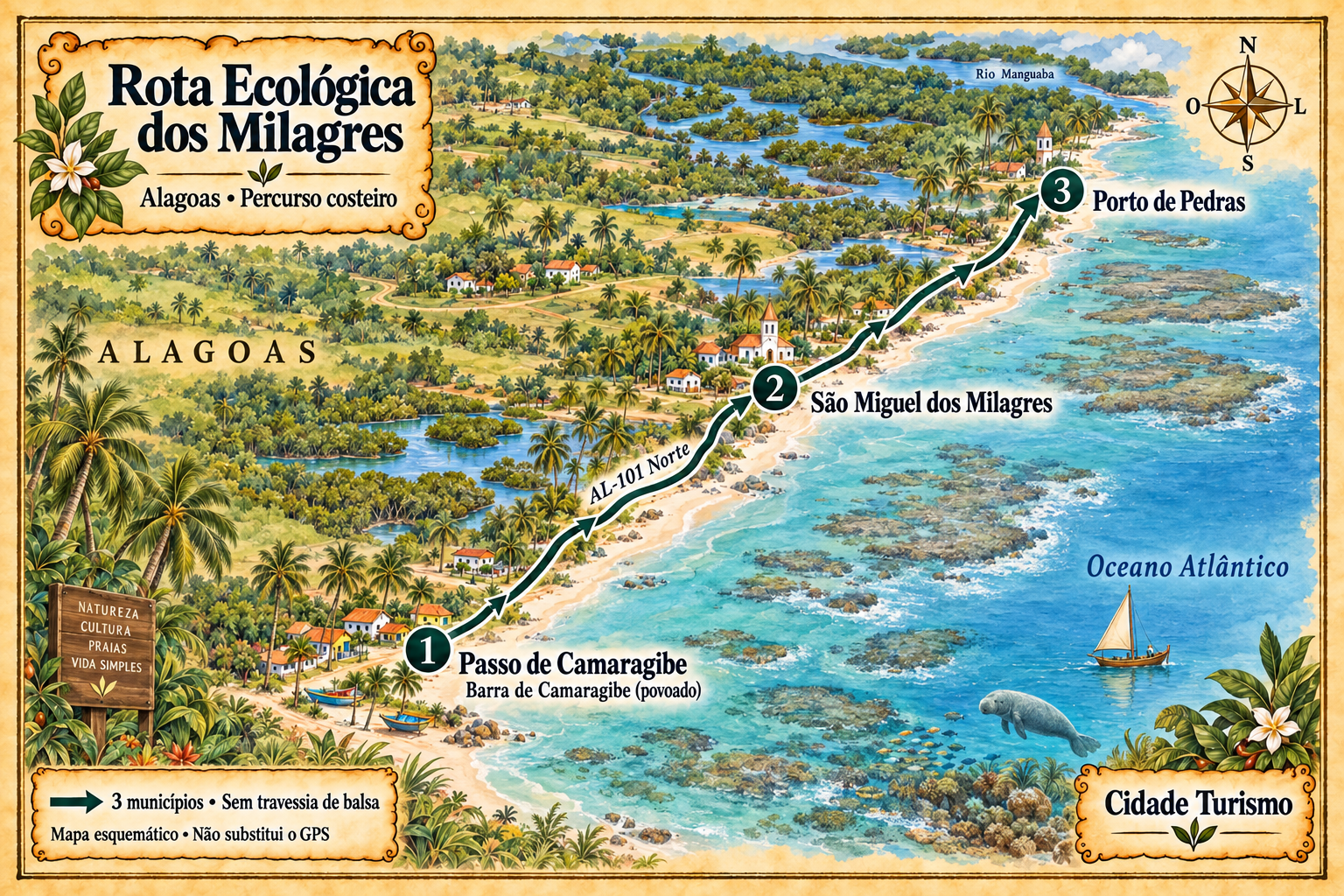
Barra de Camaragibe, Milagres beaches and mangroves of Porto de Pedras on a coastal route through three municipalities of Alagoas.
Brazilian routes
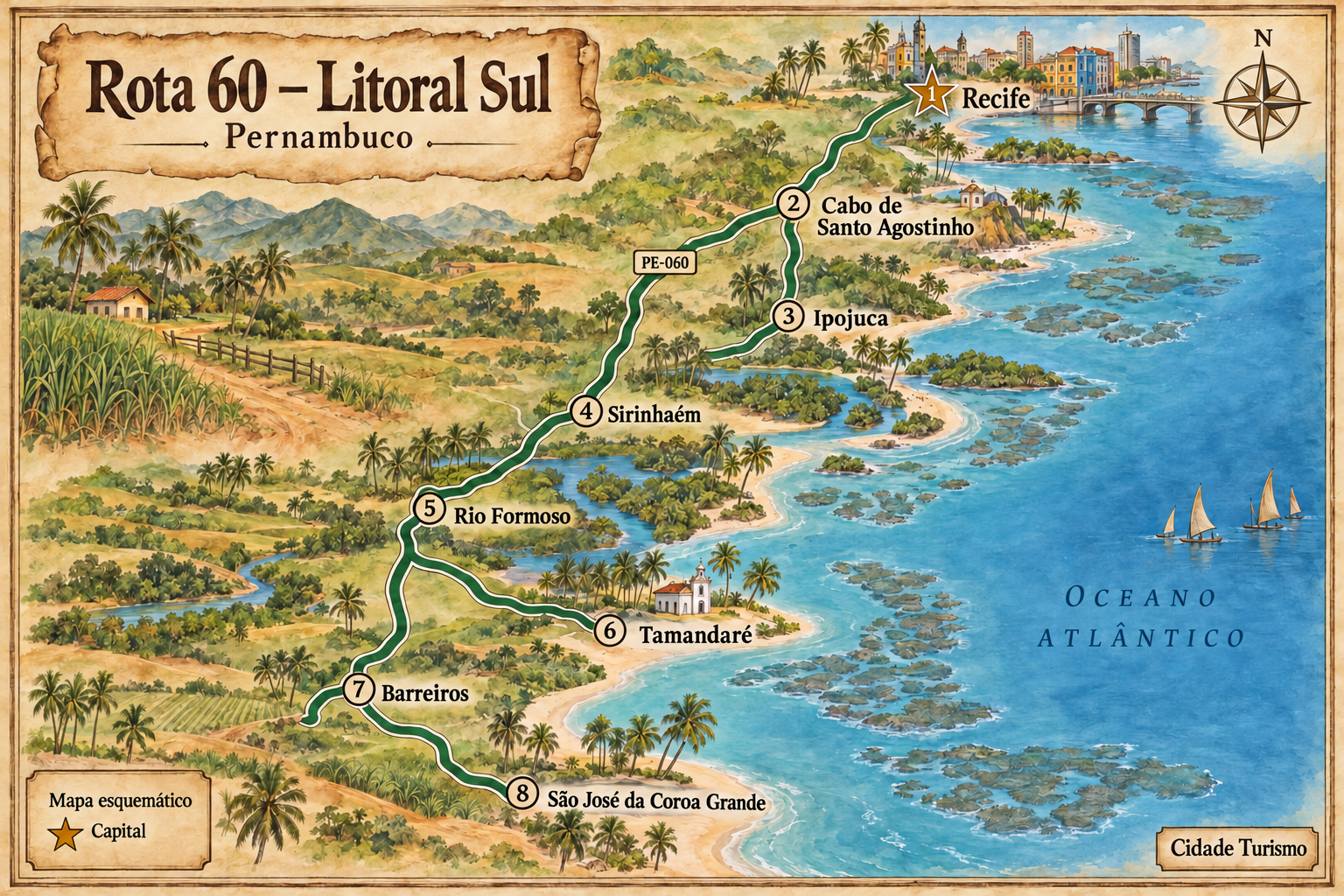
Beaches, reefs and estuaries between Recife and the far south of Pernambuco’s coast.