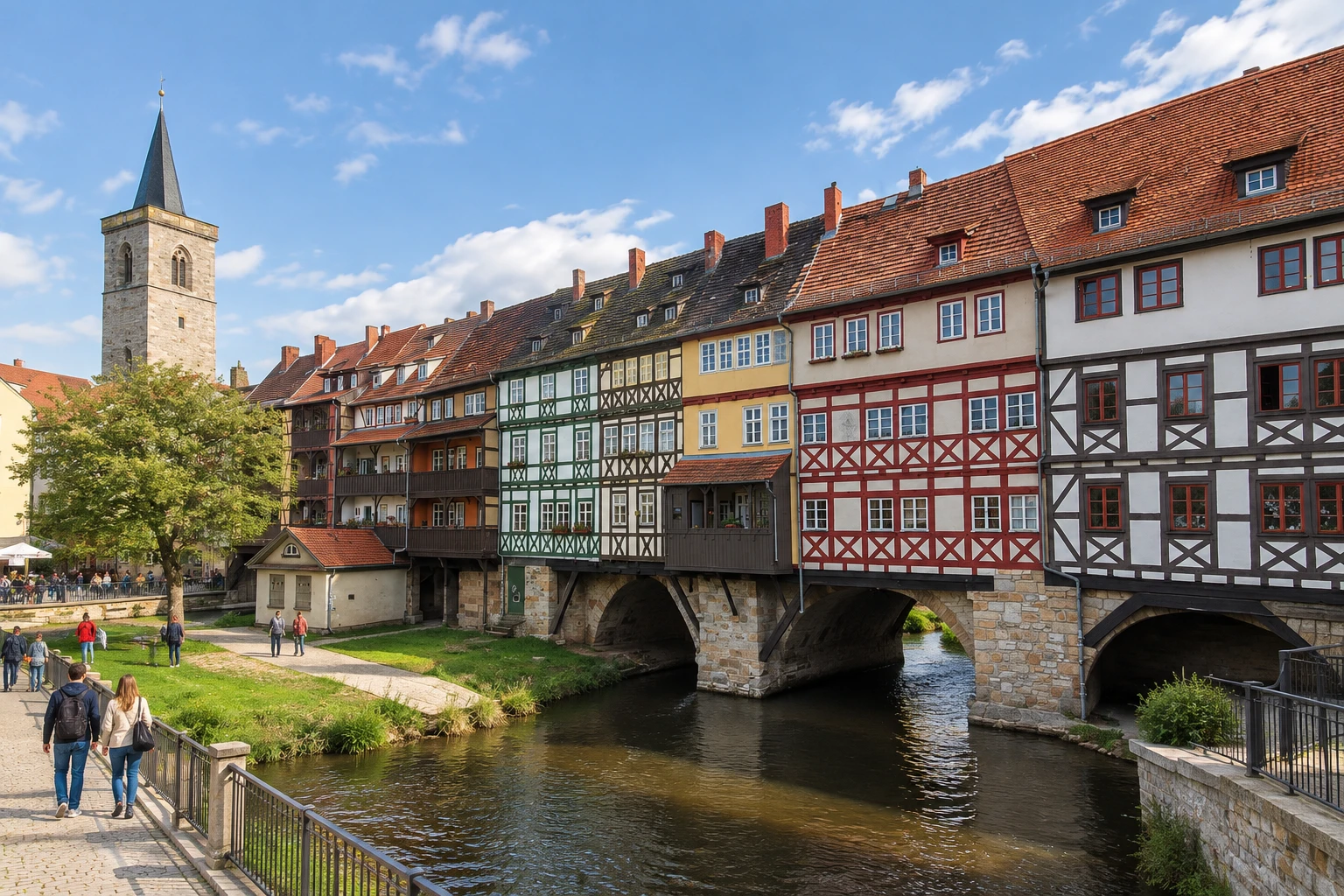
Illustrative images. The pictures in this guide are illustrations based on the real place, not photographs, and may differ from it.
The city
What to expect from Erfurt.
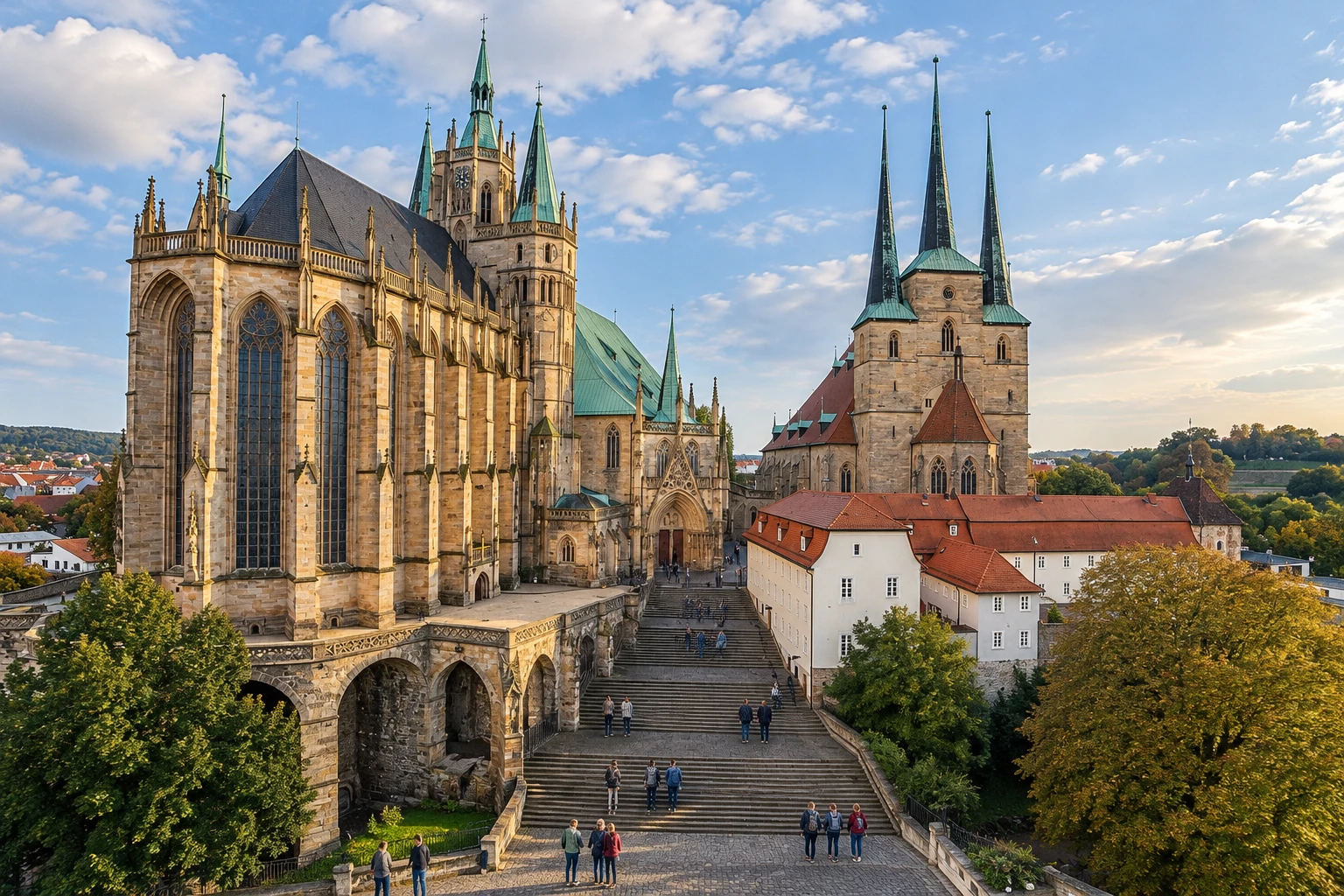
Capital of Turíngia, Erfurt has one of Germany’s most complete medieval centres. The cathedral (Dom) and the Church of St Severus dominate the Domplatz from the top of a 70-step staircase, the Krämerbrücke is lined with half-timbered houses, and the baroque Petersberg fortress watches over the city. Luther was a monk at the Augustinerkloster, and the medieval Jewish ritual bath (Mikwe) is a World Heritage site. The ICE links the city with Berlin, Munich and Frankfurt.
The Gothic cathedral of Santa Maria sits atop the steps of the Domplatz. It houses the Gloriosa, dating from 1497, the largest medieval bell still in use in the world, choir stained glass and the place where Luther was ordained as a priest.
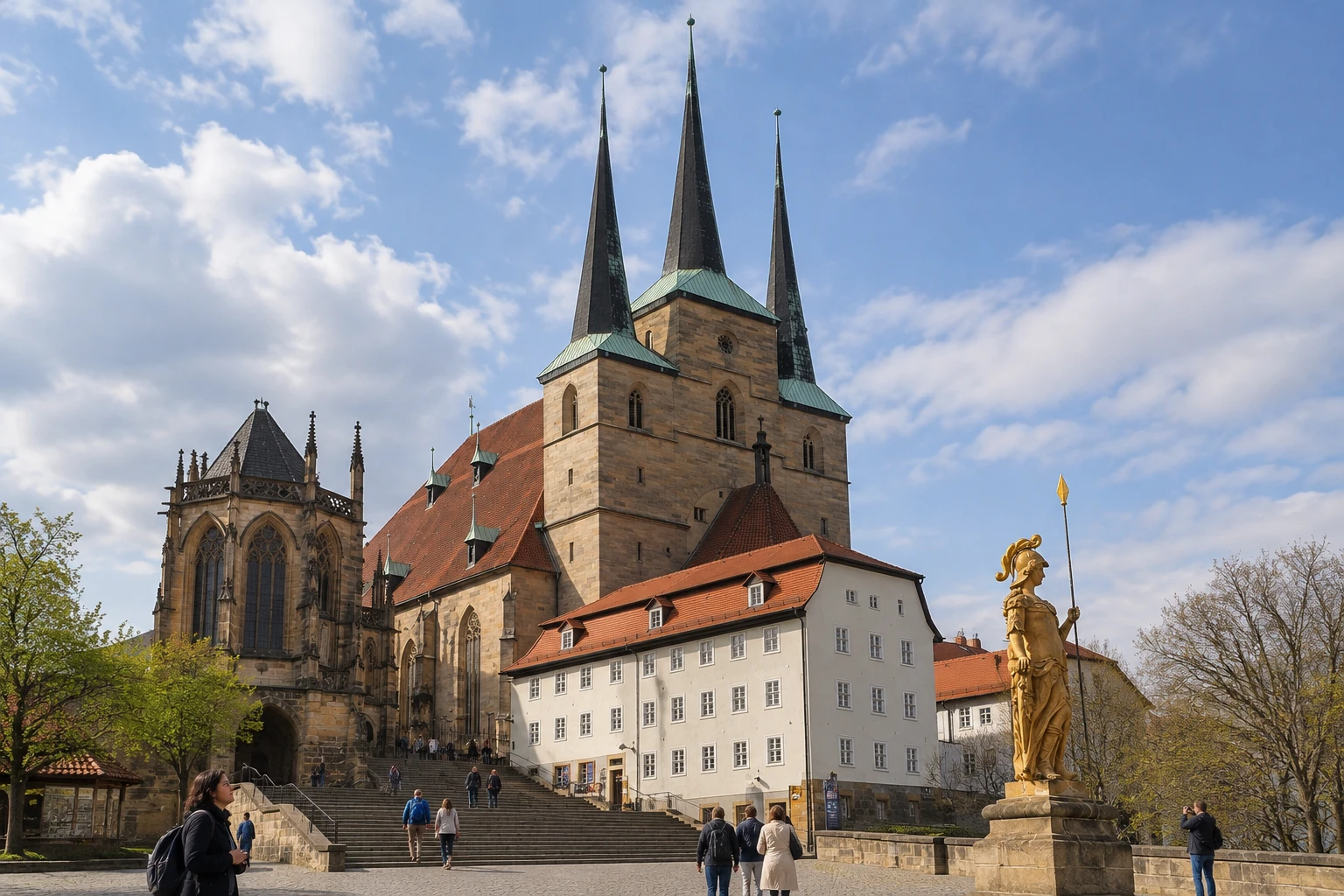
Gothic church next to the cathedral, at the top of the Domberg. It is a five-aisled hall church with an almost square plan, three pointed towers and the sarcophagus of São Severo with 14th-century reliefs.
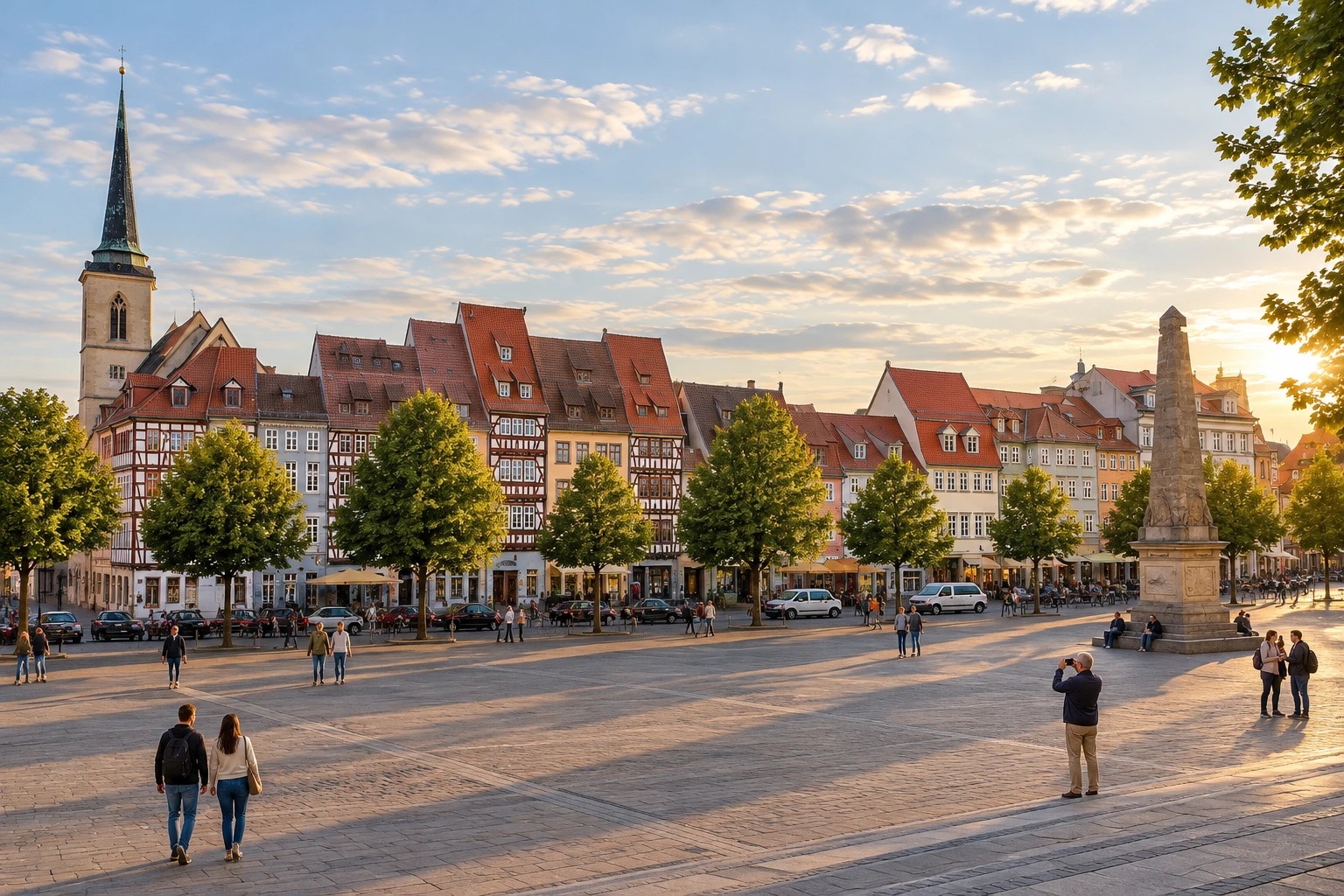
One of the largest squares in Germany, at the foot of the cathedral and São Severo. It features old houses, a market, summer performances and a Christmas market at the end of the year.
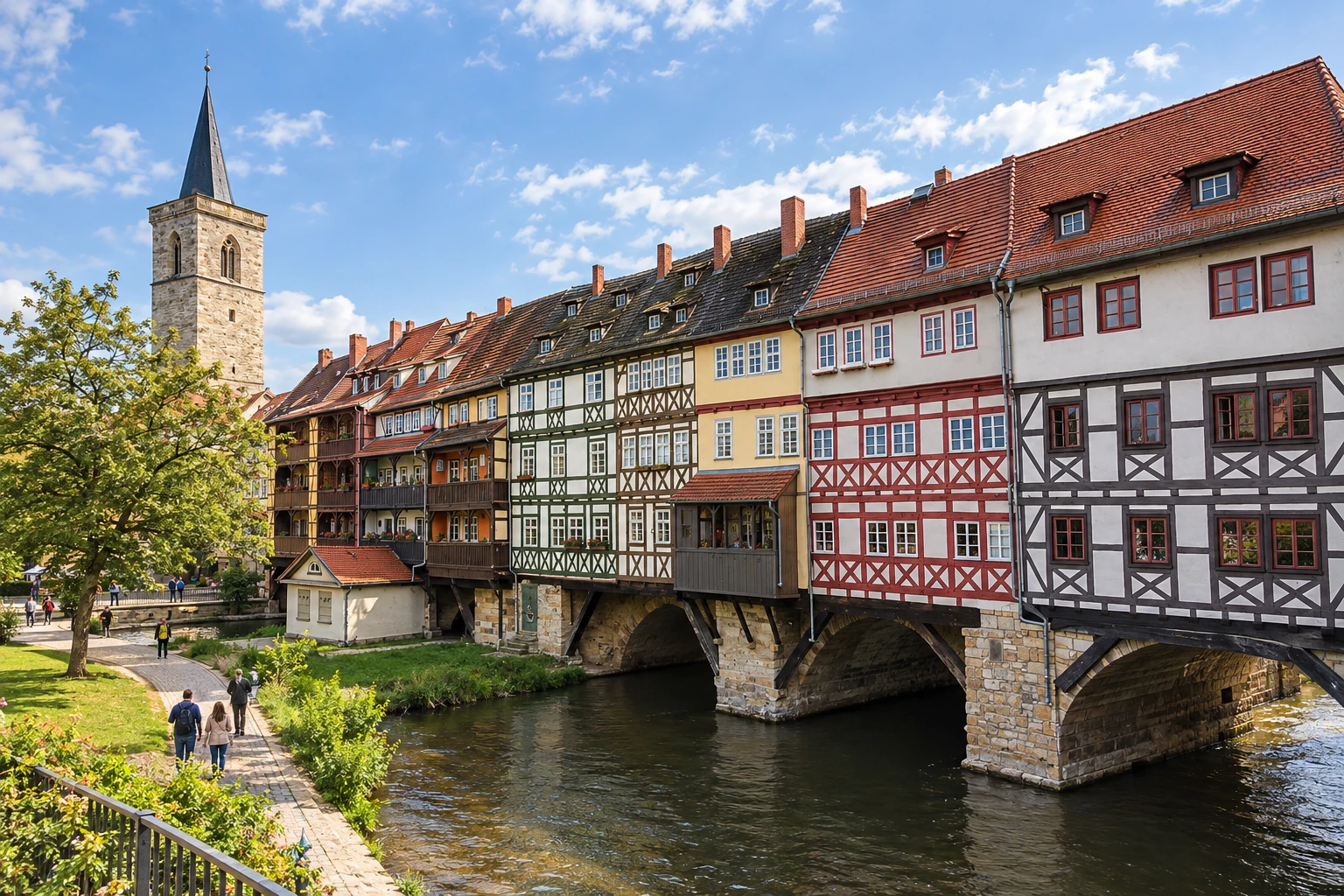
Stone bridge dating from 1325 over the river Gera, lined on both sides with half-timbered houses. With 32 houses, it is the longest bridge in Europe with houses along its entire length.
Flughafen Frankfurt am Main (FRA)Frankfurt am Main · 270 km
Erfurt Hauptbahnhof1 km
Approximate distances. Check flights and bus, train or boat schedules before you travel.
Connections from Brazil usually require a stopover in another city. Check before buying. The most common route is to arrive in Frankfurt and take an ICE to Erfurt Hauptbahnhof (Hbf, the main station), in about 2 hours. There are direct ICE trains from Berlin (about 1 h 35), Munich (about 2 h 20) and Leipzig (about 40 minutes). From the station to the old town it’s a 10–15 minute walk, or a few minutes by tram.
How many days
A full day is enough for the Domplatz, the cathedral, the Krämerbrücke, the Fischmarkt and the Petersberg. With two days you can also include the Augustinerkloster at a relaxed pace, the guided visit to the Mikwe and a return trip to Wartburg Castle in Eisenach. Erfurt also serves as a base for visiting Weimar, 12 to 15 minutes by train.
When to go
From May to September the days are long and the city hosts outdoor festivals, such as the Krämerbrücke festival, typically held in June, and performances on the cathedral steps in summer. Autumn is quieter. In winter, from December to February, it is cold, but the Christmas market at the Domplatz usually runs from late November until near Christmas.
The seasons shown are the most usual ones; nature doesn't always follow the calendar.
Do you need a car?
No. The old town is explored on foot and the tram (Straßenbahn) connects the station to the Domplatz. Validate your ticket when the machine requests it. Weimar and Eisenach have direct trains from the Hauptbahnhof. Drivers should be aware that many German cities have an environmental zone (Umweltzone) and that the old town has pedestrian-only streets.
Suggested itinerary
An order that works
Built with the places on this page. No rush: it's paced so you have time to see them.
One day in Erfurt
manhã
Domplatz, cathedral and São Severo
Start at the Domplatz and climb the 70 steps up to the cathedral of Santa Maria (Erfurter Dom), with the Gothic choir windows. Next door, visit the church of São Severo (Severikirche), which houses the saint’s sarcophagus. The two churches form the city’s best-known ensemble.
tarde
Petersberg and Fischmarkt
Go up to the Zitadelle Petersberg, a Baroque fortress behind the Domplatz, for the view over the roofs and towers. If there’s a guided tour, see the listening tunnels (Horchgänge). Then descend along Marktstraße to the Fischmarkt, with its neo-Gothic town hall and Renaissance houses.
fim de tarde
Krämerbrücke and Ägidienturm
Cross the Krämerbrücke, a bridge from 1325 lined with houses, offering craft shops and cafés. On the east side, the Ägidienkirche tower has 128 steps and provides a view of the bridge’s roof from above. Check the tower’s opening hours before you go.
noite
Dinner at the Wenigemarkt
Finish at the Wenigemarkt, the small square at the eastern end of the Krämerbrücke, or on the streets around the Fischmarkt. Turíngia’s cuisine features grilled sausage (Thüringer Rostbratwurst) and potato dumplings (Thüringer Klöße) as typical dishes.
2 days in Erfurt
Day 1
manhã
Domberg: cathedral and Severikirche
Spend the morning on the Domberg, the hill of the two churches. In the cathedral, notice the choir’s stained glass and the altar with a work attributed to Lucas Cranach the Elder. In the Severikirche, see the sarcophagus of São Severo, with 14th-century reliefs.
tarde
The Petersberg fortress
Climb to the Petersberg, visit the exhibition about the hill’s history in the Kommandantenhaus and walk along the bastions. Guided tours through the listening tunnels depart from the visitors’ centre; check dates in advance.
fim de tarde
Fischmarkt and Krämerbrücke
Descend to the Fischmarkt, with the warrior statue (Römer) and the Renaissance façades, and follow Michaelisstraße to the Krämerbrücke. From the Wenigemarkt, view the bridge from the outside, by the river Gera.
noite
Altstadt at night
The illuminated façades of the Domplatz and the Krämerbrücke look beautiful at night, and the streets of the old town have breweries and regional restaurants. Keep an eye on your belongings in crowded places, as in any tourist centre.
Day 2
manhã
Train to Eisenach and Wartburg
Take an early train to Eisenach and go up to Wartburg Castle, a World Heritage Site. The Romanesque palace (Palas) is visited in guided groups; afterwards the museum and the room where Luther translated the New Testament can be seen on your own.
tarde
Return to Erfurt and Augustinerkloster
Return by train to Erfurt and visit the Augustinerkloster, the convent where Luther lived as a monk from 1505 to 1511. The guided tour shows the cloister, the church with 14th‑century stained glass and the exhibition on Luther’s life.
fim de tarde
Medieval Jewish quarter and Mikwe
Walk the streets of the old Jewish quarter, between the Krämerbrücke and the river Gera. On some days of the week there is a guided visit to the medieval ritual bath (Mikwe), part of the World Heritage Site; check the times in advance.
noite
Farewell at the Domplatz
Return to the Domplatz to see the cathedral and São Severo illuminated. In summer the square often hosts outdoor performances on the steps, and at the end of the year the Christmas market usually occupies the square.
Check before you go. Opening hours and days change, and places may close for renovations, holidays or events. This itinerary is a suggestion from Cidade Turismo, not a commitment: plan yours by checking directly with each place you intend to visit.
Before you go
Frequently asked questions
How to get from Erfurt Hauptbahnhof to the old town?
On foot it’s a 10–15 minute walk to the Anger and a little longer to the Domplatz. Trams that pass the station also take you to the centre, and some lines stop at Domplatz itself. Buy the ticket before boarding or at the tram machine and validate it when the machine asks.
Is Erfurt a good base for visiting Weimar?
Yes. The regional train covers Erfurt–Weimar in 12 to 15 minutes, with many departures per day. Erfurt also has more ICE connections to Berlin, Munich and Frankfurt, which makes arrival and departure easier.
Do shops open on Sundays in Erfurt?
Most shops are closed on Sundays, as in the rest of Germany. Museums, churches, restaurants and cafés generally operate, but check before you go. Plan shopping for Saturday.
When is the best time to see the Domplatz full of life?
In summer the square usually hosts performances on the cathedral steps and, at year’s end, the Christmas market typically runs from late November until near Christmas. There are also fairs on the square throughout the year; check the dates before you go.
How long does the day trip to Wartburg Castle take?
Allow most of a day. The train from Erfurt to Eisenach takes from half an hour to about an hour, depending on the type of train. At the Wartburg it’s recommended to allow at least half a day for the guided tour of the Palas, the museum and Luther’s room.


 Brazil
 Antarctica
 Argentina
 Bolivia
 Chile
 Colombia
 Ecuador
 Falkland Islands (Malvinas)
 French Guiana
 Guyana
 Paraguay
 Peru
 Suriname
 Uruguay
 Venezuela
 Austria
 Belgium
 Croatia
 Denmark
 Finland
 France
 Greece
 Hungary
 Iceland
 Ireland
 Italy
 Luxembourg
 Norway
 Poland
 Portugal
 Slovakia
 Slovenia
 Spain
 Sweden
 Switzerland
 the Czech Republic
 the Netherlands
 the United Kingdom
 Turkey
 Bermuda
 Canada
 Greenland
 Mexico
 Saint Pierre and Miquelon
 the United States
 the Dominican Republic
 Japan
 Egypt
 South Africa
 Australia
 Fiji
 New Zealand
 Papua New Guinea