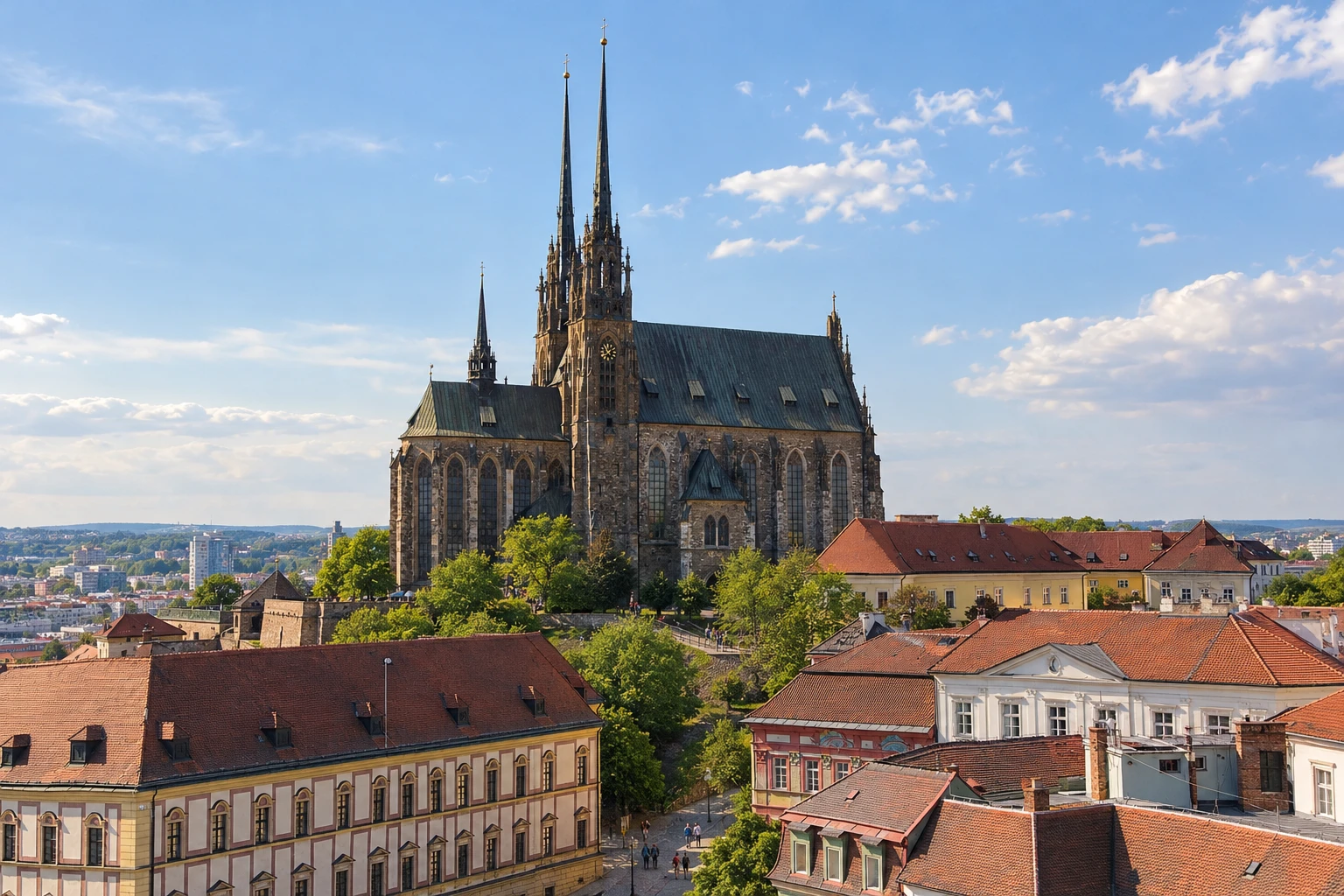
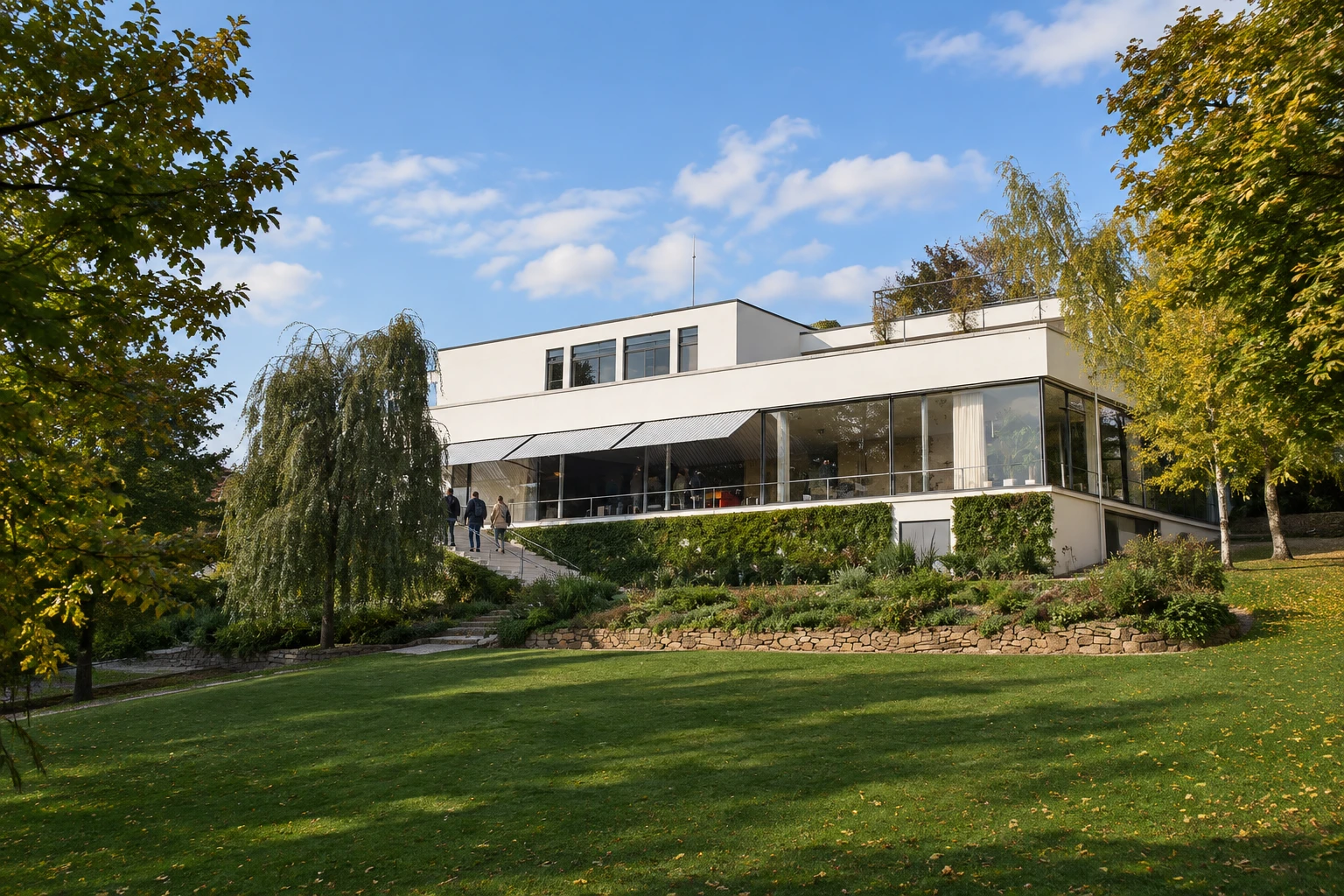
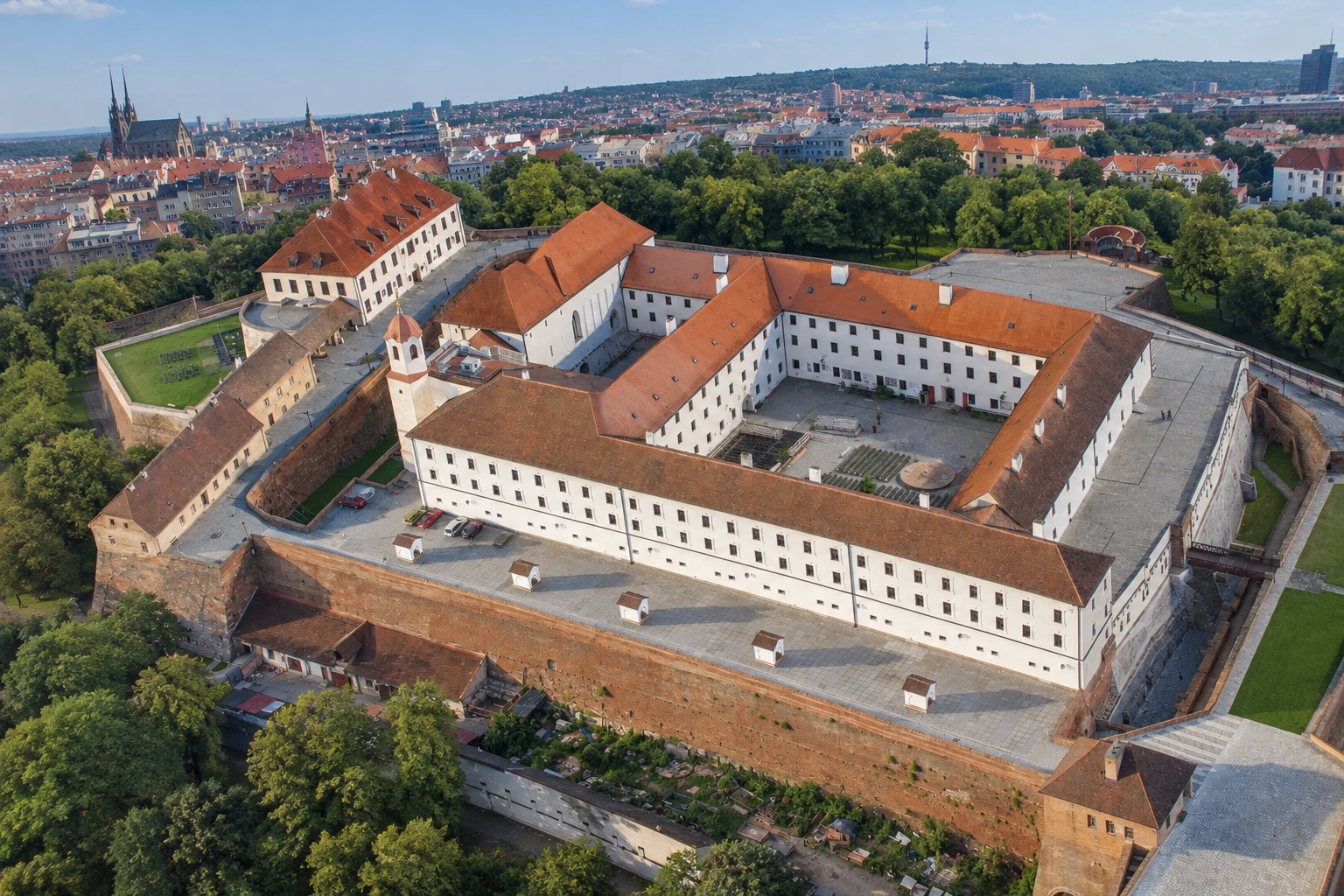
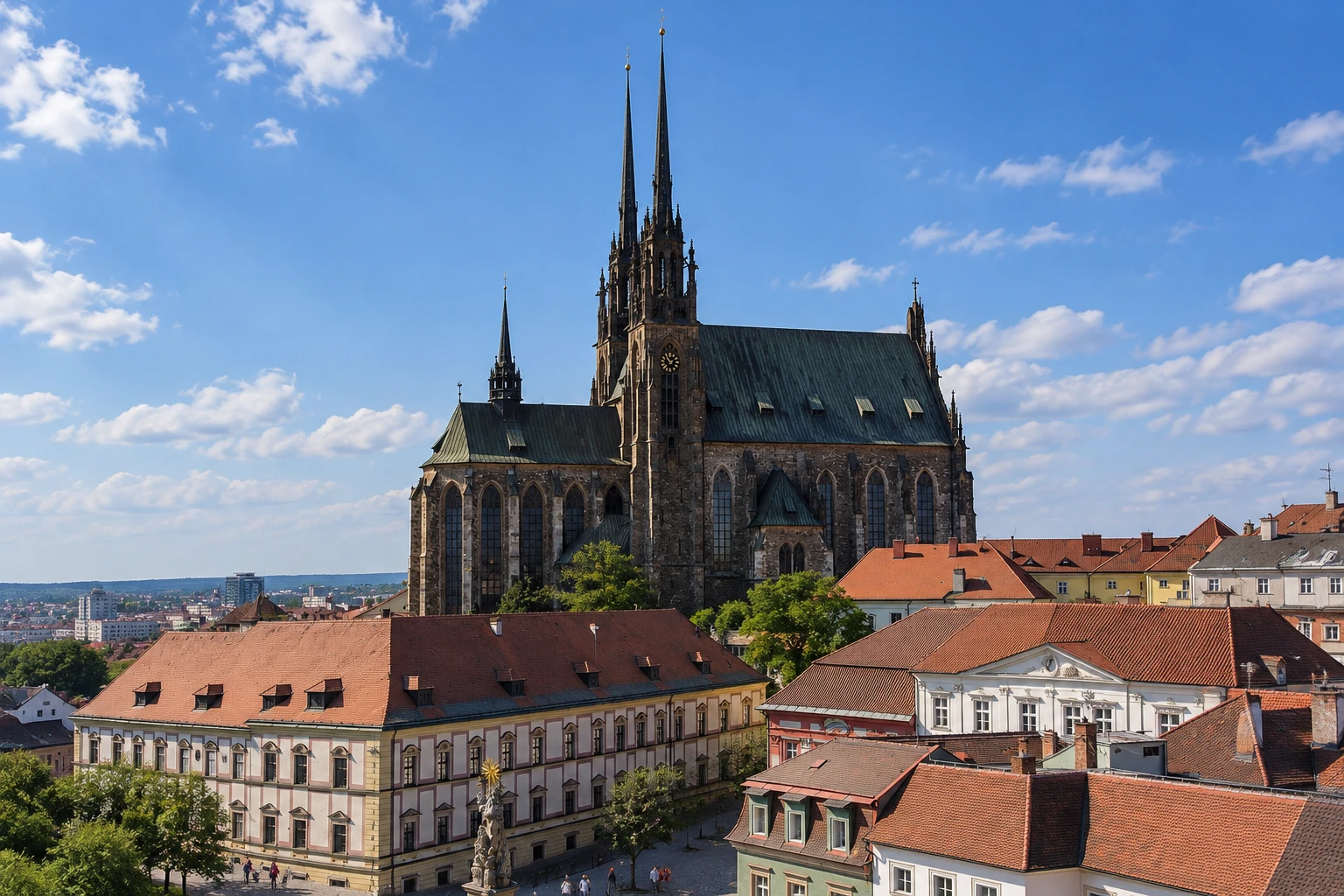
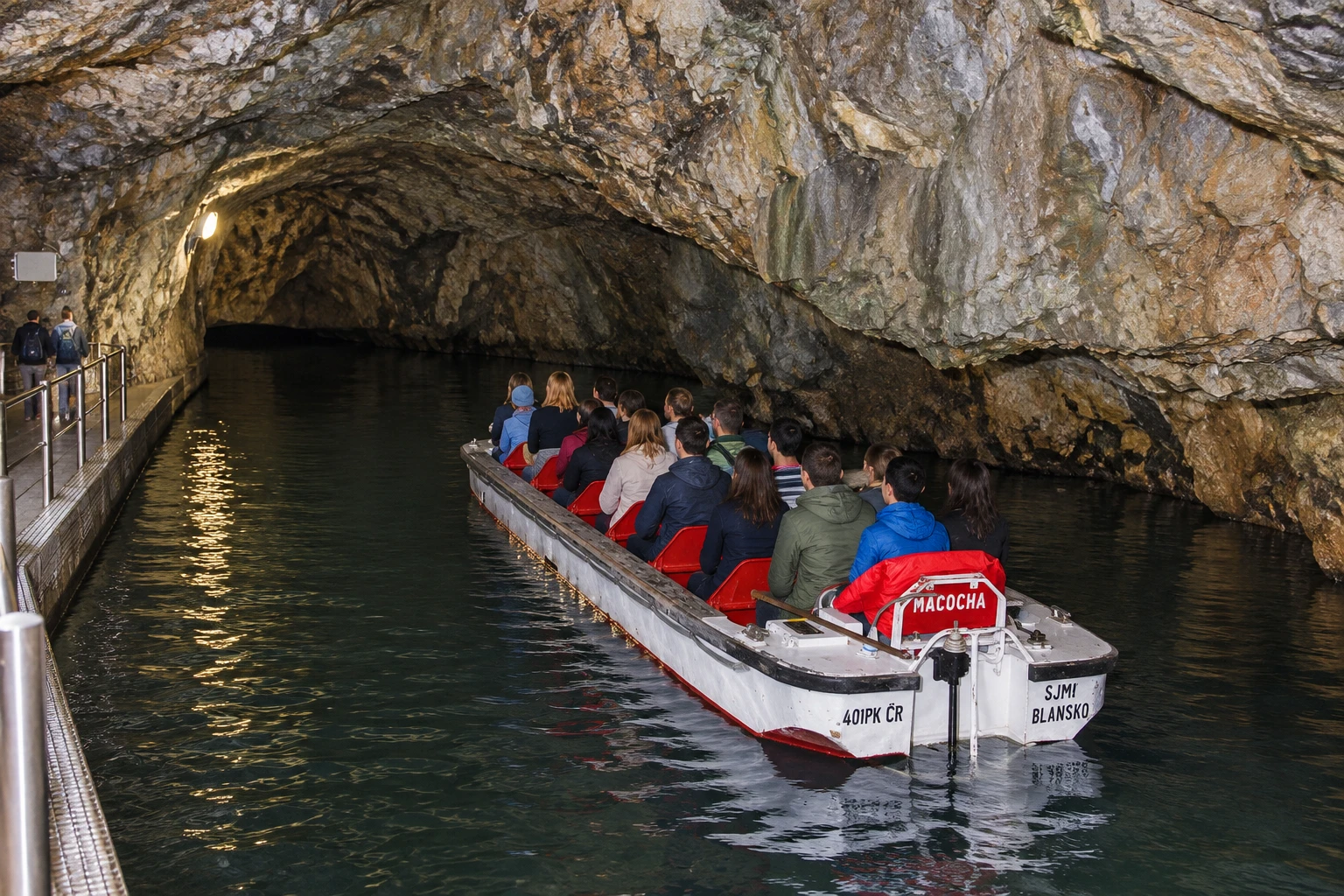
Illustrative images. The pictures in this guide are illustrations based on the real place, not photographs, and may differ from it.
The city
What to expect from Brno.
Brno combines Špilberk Castle, the Cathedral of St. Peter and St. Paul and the modern architecture of Villa Tugendhat. The hills help orient the central core. The Punkva caves, in the Moravian Karst, add a regional nature outing that requires planned entry and transport.
Villa Tugendhat sits on a residential slope of Brno. Designed by Ludwig Mies van der Rohe, the house is a landmark of modern architecture and part of the World Heritage. The relationship between interior spaces, glass and the garden explains the interest that goes beyond the discreet appearance seen from the street.
Špilberk occupies a hill close to Brno center, surrounded by park paths. The old castle brings together courtyards, museum spaces and references to its role as a fortress. The climb also helps to understand the position of the urban core around the elevation.
The Cathedral of St. Peter and St. Paul rises on the Petrov hill near the centre of Brno. Its pointed towers shape the city’s skyline. A visit makes it possible to relate the religious building to the surrounding streets and to the terraces that follow the upper part of the historic core.
The Punkva Caves are in the Moravian Karst north of Brno. The visit combines underground chambers with the Macocha abyss area and, depending on conditions, a boat section on the subterranean river. The outing requires arranging tickets and transport rather than being an improvised stop between towns.
Approximate distances. Check flights and bus, train or boat schedules before you travel.
Connections from Brazil usually require a stopover in another city. Confirm before booking. Brno hlavní nádraží receives domestic and international trains. The center is nearby; the local airport requires urban transport to the city.
How many days
Two urban days, plus a half-day or day for the caves to the north.
When to go
May, June and September usually favor Brno's center. July and August have long days but can bring heat and rain; December to February is winter, with cold and short daylight.
The seasons shown are the most usual ones; nature doesn't always follow the calendar.
Do you need a car?
Tram, bus and walking cover Brno. For Villa Tugendhat, check the connection to Černá Pole; for the caves, arrange the connection via Blansko.
Suggested itinerary
An order that works
Built with the places on this page. No rush: it's paced so you have time to see them.
One day in Brno
manhã
Petrov and the center
Climb up to the cathedral and then descend through the streets of the old core.
tarde
Špilberk
Walk through the park up to the castle and choose an interior route.
fim de tarde
Brno squares
Return to the center and observe the street layout between the squares.
noite
Base for the reserved day
Dine in the center and keep the following day aligned with the Villa Tugendhat or caves entrance.
Check before you go. Opening hours and days change, and places may close for renovations, holidays or events. This itinerary is a suggestion from Cidade Turismo, not a commitment: plan yours by checking directly with each place you intend to visit.
Before you go
Frequently asked questions
Does Brno have a walkable center?
Yes, but Petrov and Špilberk add hills. Urban transport helps for the more distant parts.
Where to fit Villa Tugendhat?
Use the reserved entry to set the day and avoid tying it to a short interval between trains.
Which base to use for the Punkva caves?
Brno allows departures via the Blansko area, adding regional transport and local access to the circuit.
How many days to stay in Brno without the rural trips?
Two days allow you to divide the hills, the center and a modern architecture visit.


 Brazil
 Antarctica
 Argentina
 Bolivia
 Chile
 Colombia
 Ecuador
 Falkland Islands (Malvinas)
 French Guiana
 Guyana
 Paraguay
 Peru
 Suriname
 Uruguay
 Venezuela
 Austria
 Belgium
 Croatia
 Denmark
 Finland
 France
 Germany
 Greece
 Hungary
 Iceland
 Ireland
 Italy
 Luxembourg
 Norway
 Poland
 Portugal
 Slovakia
 Slovenia
 Spain
 Sweden
 Switzerland
 the Netherlands
 the United Kingdom
 Turkey
 Bermuda
 Canada
 Greenland
 Mexico
 Saint Pierre and Miquelon
 the United States
 the Dominican Republic
 Japan
 Egypt
 South Africa
 Australia
 Fiji
 New Zealand
 Papua New Guinea