

 Brazil
 Antarctica
 Argentina
 Bolivia
 Chile
 Colombia
 Ecuador
 Falkland Islands (Malvinas)
 French Guiana
 Guyana
 Paraguay
 Peru
 Suriname
 Uruguay
 Venezuela
 Austria
 Belgium
 Croatia
 Denmark
 Finland
 France
 Germany
 Greece
 Hungary
 Iceland
 Ireland
 Italy
 Luxembourg
 Norway
 Poland
 Portugal
 Slovakia
 Slovenia
 Spain
 Sweden
 Switzerland
 the Czech Republic
 the Netherlands
 the United Kingdom
 Turkey
 Bermuda
 Canada
 Greenland
 Mexico
 Saint Pierre and Miquelon
 the Dominican Republic
 Japan
 Egypt
 South Africa
 Australia
 Fiji
 New Zealand
 Papua New Guinea
Museum · Chicago, the United States
Field Museum (Field Museum of Natural History)
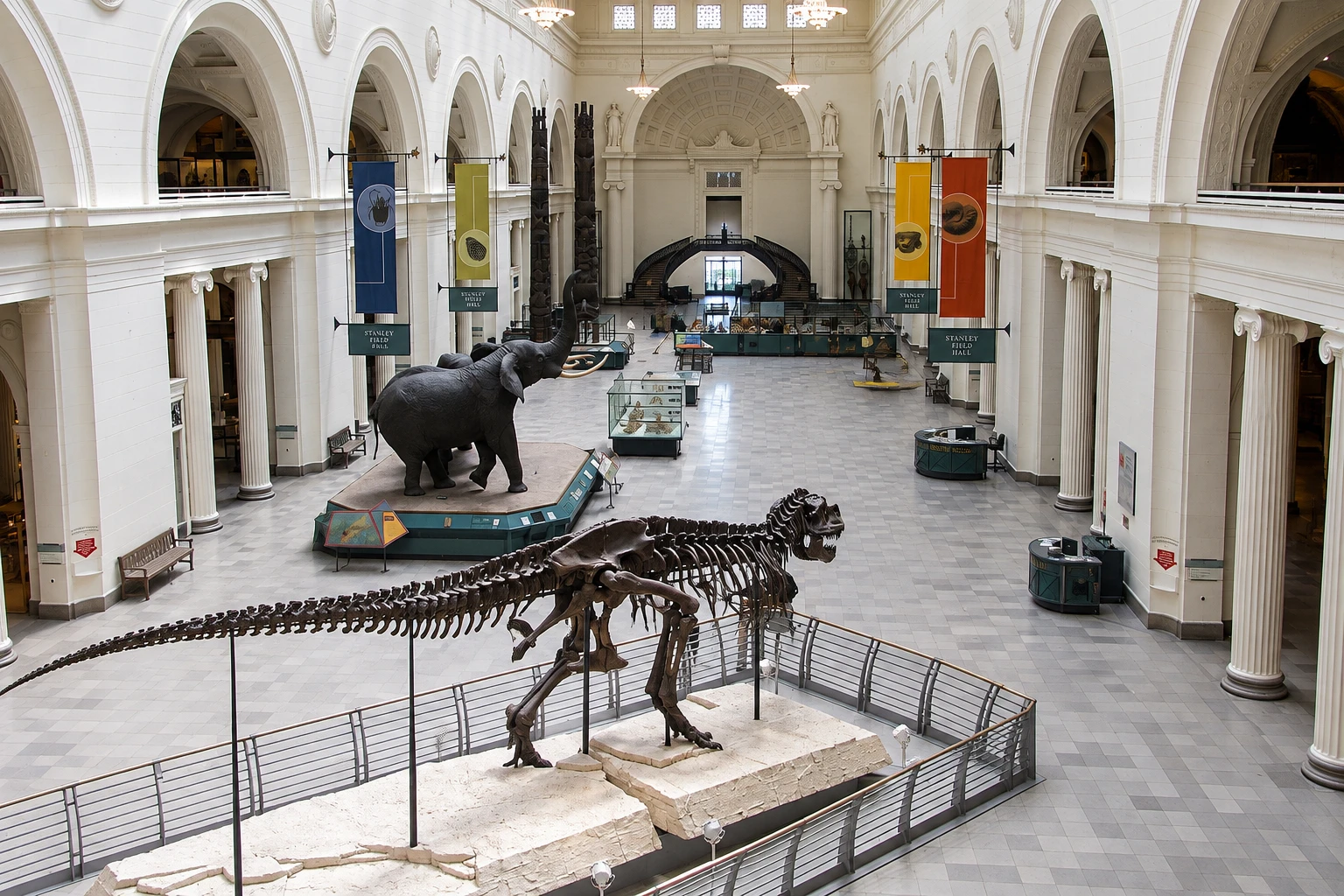
Natural history museum by the lake, with Sue, one of the most complete Tyrannosaurus skeletons ever found, and world cultures galleries.
Illustrative images. The pictures in this guide are illustrations based on the real place, not photographs, and may differ from it.

Discover
About Field Museum (Field Museum of Natural History)
The Field Museum is one of the largest natural history museums in the world, on the Museum Campus by Lake Michigan, housed in a white marble neoclassical building that opened in 1921.
The museum's star is Sue, one of the most complete and largest Tyrannosaurus skeletons ever found, displayed in its own gallery. In the great hall, a large titanosaur welcomes visitors. The collection also includes an exhibition on the evolution of life on Earth, a reconstructed Egyptian tomb with mummies, the Tsavo lions, gemstones, and galleries about the Indigenous peoples of the Americas and the Pacific.
The museum spans several floors; choose the galleries you want to see in advance to make the most of your visit.
Before you go
Practical information
Cidade Turismo reviews its information regularly, but something may have changed. Check with the place before planning your trip.
How much time to set aside
Three to four hours.
Best time
In the morning on weekdays; Saturdays, Sundays and school holidays draw the biggest crowds.
How to get there
By bus or on foot through the lakefront park, about 20 minutes from Millennium Park; the urban train stops at Roosevelt station.
Tip
Combine it with the Shedd Aquarium and the Adler Planetarium, on the same Museum Campus; city passes often include all three.
Official website
Your questions
Frequently asked questions about Field Museum (Field Museum of Natural History)
Where is the Tyrannosaurus Sue?
At the Field Museum in Chicago, in a dedicated gallery.
How long does a visit to the Field Museum take?
Three to four hours for the main galleries.
Is the Field Museum near the Shedd Aquarium?
Yes, both are on the Museum Campus, by the lake.