

 Brazil
 Argentina
 Bolivia
 Chile
Chile Colombia
 Ecuador
 Guyana
 French Guiana
 Falkland Islands (Malvinas)
 Paraguay
 Suriname
 Uruguay
 Venezuela
 Germany
 Belgium
 Spain
Spain France
 Greece
 the Netherlands
 Ireland
 Italy
Italy Luxembourg
 Portugal
 the United Kingdom
 Switzerland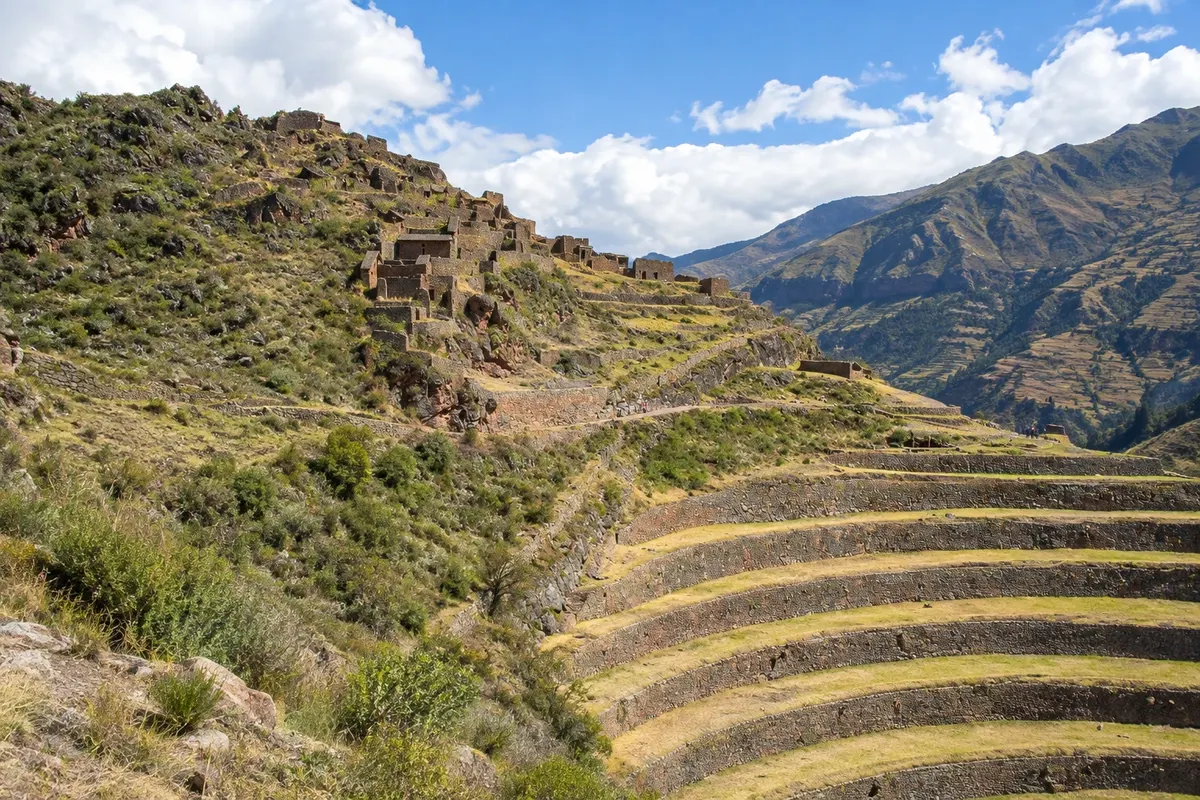
Archaeological site · Pisac, Cusco
Parque Arqueológico de Pisac
An Inca complex high on the mountain above the village, with curved terraces, the Intihuatana temple of fitted stone, residential neighborhoods and the largest known Inca cemetery, set in the cliffs.
Illustrative images. The pictures in this guide are illustrations based on the real place, not photographs, and may differ from it.

Discover
About Parque Arqueológico de Pisac
The Parque Arqueológico de Pisac occupies the ridge of a mountain above the village, between about 3,400 and 3,500 meters in altitude, with the Urubamba valley far below. Attributed to the rule of Pachacútec in the 15th century, the complex combined agricultural, religious, military and residential functions, and controlled access to the Valle Sagrado from Cusco.
The first thing that stands out are the agricultural terraces, which descend the mountain in curves following the terrain, and still show the irrigation channels. At the top is the Intihuatana sector, with the Temple of the Sun and stone constructions fitted as precisely as those at Qorikancha, around a carved rock that would have served as a sundial. Other sectors, such as Qantus Raqay and Pisaqa, contain houses, storage areas and walls.
On the slope of Tankanamarka, on the other side of the Kitamayo river valley, the cliffs are full of holes: they are Inca tombs, looted over the centuries, which formed the largest known Inca cemetery. They can be seen from afar, from the trail.
The visit is on foot, along dirt paths and stairways, with ups and downs. There are two entrances: the upper one, where vehicles arrive, and the lower one, in the village, from which you climb a long trail. The site is part of the Cusco tourist ticket. Bring water, a hat and sunscreen.
Before you go
Practical information
Cidade Turismo reviews its information regularly, but something may have changed. Check with the place before planning your trip.
How much time to set aside
About 2 to 3 hours, arriving via the upper entrance and walking down to the village.
Best time
Early in the morning, before the groups arriving from Cusco in late morning, or in the late afternoon. In the dry season, usually May to September, the trail is firm; from December to March it can be slippery. Confirm opening times before you go.
How to get there
The upper entrance is about 8 km from the village along the mountain road, a 20-minute taxi ride. The lower entrance is in the village, with a climb of about 1h30 on foot via stairways. One-day tours of the Valle Sagrado include transport to the upper entrance.
Tip
Take a taxi up to the upper entrance and walk down to the village, passing through all the sectors: the descent takes about 1h30 and finishes near the market.
Get your questions answered
Frequently asked questions about Parque Arqueológico de Pisac
What is the Intihuatana of Pisac?
It is the religious sector high on the site, with the Temple of the Sun and a carved rock thought to be a sundial, surrounded by fitted-stone constructions.
Is the Pisac trail difficult?
It has climbs, descents and stone stairways, above 3,400 meters. Entering by the upper entrance and descending to the village makes the effort easier.
What are the holes in the cliffs?
They are Inca tombs on the slope of Tankanamarka, which formed the largest known Inca cemetery. They were looted over the centuries and can be seen from the trail.