

 Brazil
 Argentina
 Bolivia
 Chile
Chile Colombia
 Ecuador
 Guyana
 French Guiana
 Falkland Islands (Malvinas)
 Paraguay
 Suriname
 Uruguay
 Venezuela
 Germany
 Belgium
 Spain
Spain France
 Greece
 the Netherlands
 Ireland
 Italy
Italy Luxembourg
 Portugal
 the United Kingdom
 Switzerland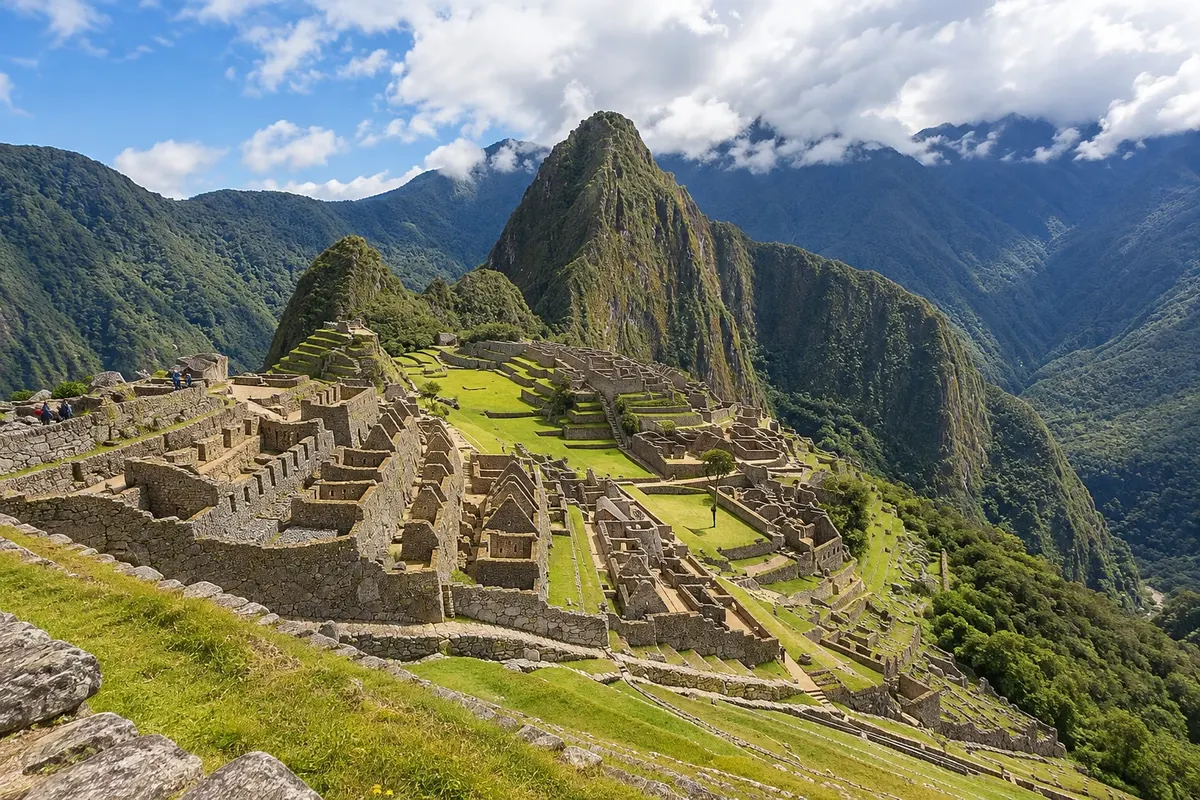
Archaeological site · Aguas Calientes, Cusco
Santuario Histórico de Machu Picchu
The 15th-century Inca citadel on a ridge between forested mountains, at about 2,430 m, with temples, plazas, terraces and stone houses. World Heritage since 1983; the ticket has a date, time and circuit.
Illustrative images. The pictures in this guide are illustrations based on the real place, not photographs, and may differ from it.

Discover
About Santuario Histórico de Machu Picchu
Machu Picchu sits on a ridge between the mountains Machu Picchu and Huayna Picchu, at about 2,430 meters altitude, with the Urubamba River making a curve hundreds of meters below. The citadel was built around the mid-15th century, during the rule of Pachacútec, as a residence and religious center. The Spaniards did not find it, and it became known worldwide after 1911 with the expedition of the American Hiram Bingham, guided by local residents.
The site is divided between the agricultural sector, with terraces descending the slope, and the urban sector, with more than 150 structures. Among them are the Temple of the Sun, with the curved wall over a rock, the Temple of the Three Windows, the Sacred Plaza, the Intihuatana, a carved rock at the highest point, and the Temple of the Condor. The houses, storehouses and fountains are linked by stairways and water channels that still work.
The ticket has a date, entry time and circuit, with a limited number of places, and the route is one-way, with defined paths that change what you see. The ascent to Huayna Picchu, the mountain of the classic photo, at about 2,700 meters, and to Montaña Machu Picchu, over 3,000 meters, requires a specific ticket with limited spots. Buy in advance and confirm the rules on the official channel.
The Historic Sanctuary of Machu Picchu, which includes the citadel and the surrounding forested mountains, has been a UNESCO World Heritage Site since 1983, for both culture and nature. There are llamas roaming the terraces, orchids and many bird species in the forest. The weather changes quickly: bring a rain jacket, sunscreen and insect repellent.
Before you go
Practical information
Cidade Turismo reviews its information regularly, but something may have changed. Check with the place before planning your trip.
How much time to set aside
About 2.5 to 3 hours on the circuit; with Huayna Picchu or Montaña Machu Picchu, 5 to 6 hours.
Best time
In the early morning hours, when the mist usually clears over the citadel, or late afternoon, with fewer people. In the dry season, typically May to September, there is more sun and more visitors. From December to March it usually rains and clouds cover the mountains part of the day.
How to get there
From Aguas Calientes, buses climb the switchback road in about 25 minutes, departing from the village's main street. On foot, the stair trail starts at Puente Ruinas and takes 1h30 to 2 hours to ascend. Via the Trilha Inca you arrive at the Porta do Sol at the top, with an authorized agency.
Tip
Hire a guide at the entrance or in advance to understand the sectors and respect the circuit route. Choose an early entry time and bring ID: the ticket is nominal. There are no restrooms inside the citadel, only at the entrance.
Official website
Get your questions answered
Frequently asked questions about Santuario Histórico de Machu Picchu
How to buy a Machu Picchu ticket?
Each ticket is valid for one day, one entry time and one circuit, and daily places are limited; from May to September they sell out earlier. Buy in advance and check the rules on the official channel.
What is needed to climb Huayna Picchu?
A specific ticket, with reduced slots per day and an assigned time. The climb is steep, with narrow stairways, and takes about 1 to 1.5 hours. Buy in advance.
Do I need a guide in Machu Picchu?
Visiting rules change and a guide may be required for some circuits. Check the official channel when buying your ticket. Even when not mandatory, a guide helps to understand the different sectors.
Who discovered Machu Picchu?
Local residents always knew the site. The citadel became known to the wider world after 1911, when the American Hiram Bingham arrived there guided by local farmers.
What to bring to Machu Picchu?
ID, rain poncho, sunscreen, insect repellent, hat and water. Large backpacks may be restricted: check the rules before you go.