

 Brazil
 Argentina
 Bolivia
 Chile
Chile Colombia
 Ecuador
 Guyana
 French Guiana
 Falkland Islands (Malvinas)
 Paraguay
 Peru
Peru Suriname
 Uruguay
 Venezuela
 Germany
 Belgium
 Spain
Spain France
 the Netherlands
 Ireland
 Italy
Italy Luxembourg
 Portugal
 the United Kingdom
 Switzerland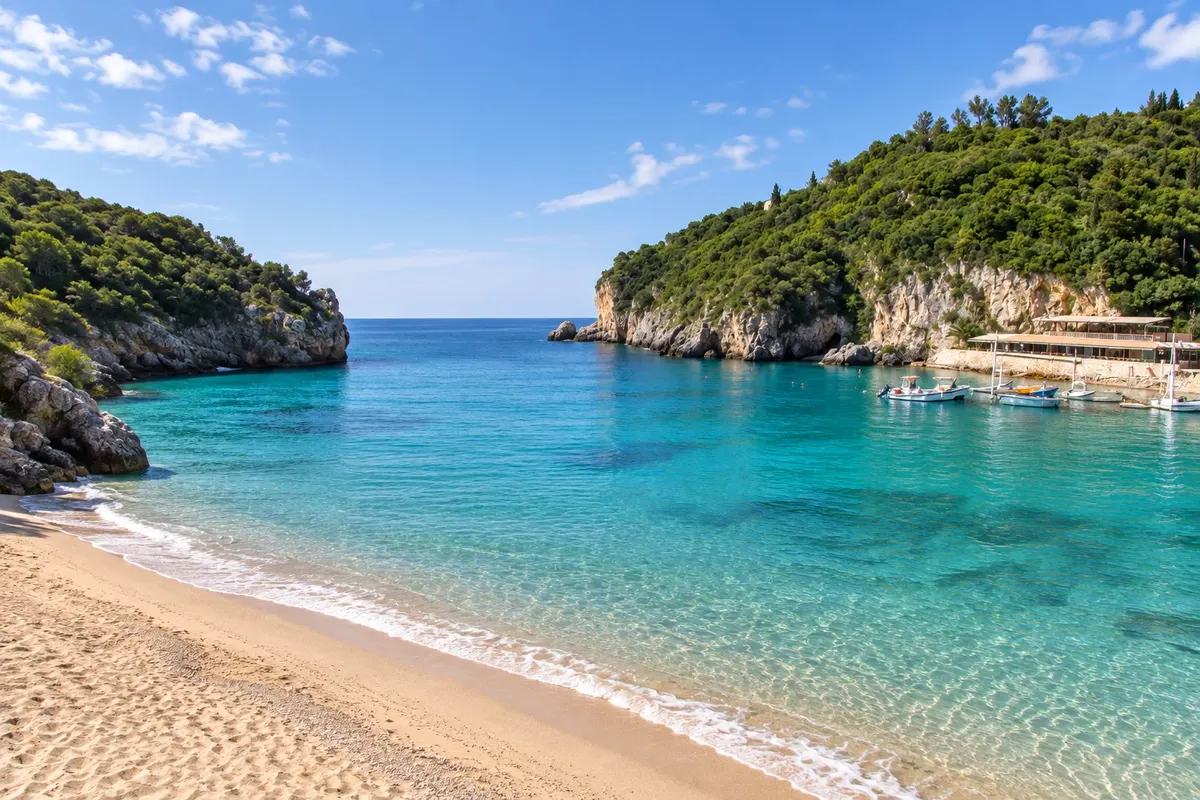
Monastery · Corfu, Ilhas Jônicas
Paleokastritsa e Mosteiro da Theotokos (Moni Theotokou Palaiokastritsas)
The Monastery of the Virgin atop the Paleokastritsa promontory, founded in 1225 and rebuilt in the 18th century, with a courtyard of bougainvillea, a small museum and views over the coves of the west coast.
Illustrative images. The pictures in this guide are illustrations based on the real place, not photographs, and may differ from it.

Discover
About Paleokastritsa e Mosteiro da Theotokos (Moni Theotokou Palaiokastritsas)
Paleokastritsa, 25 km from the city of Corfu, is the most photographed stretch of the west coast: six green-water coves between rocky promontories covered with cypresses and olive trees. At the top of the main promontory sits the monastery of the Virgin (Moni Theotokou), founded in 1225 and largely rebuilt in the 18th century, still inhabited by monks.
The courtyard is small, with whitewashed arches, bougainvillea and a well; the church has a gilded iconostasis and icons from the 17th and 18th centuries. A two-room museum houses Byzantine and post-Byzantine icons, liturgical books and, in one room, the skeleton of a whale found on the coast in the 19th century, which the monks have displayed ever since. From the terrace you can see the coves, the cliffs and, to the north, the rock of Angelokastro.
Local tradition links the bay to the Odyssey: it is said that Odysseus, shipwrecked, was found there by Nausicaa, daughter of the king of the Phaeacians. A rock in the sea is pointed out as the petrified ship.
In the bay, fishing boats run short trips to the sea caves and to beaches only reachable by water, and there are kayak and pedal boat rentals. The main beach, Agios Spyridon, has coarse sand and shingle, with tavernas around. The monastery usually opens from April to October, with a midday break; check before you go.
Before you go
Practical information
Cidade Turismo reviews its information regularly, but something may have changed. Check with the place before planning your trip.
How much time to set aside
30 minutes to 1 hour for the monastery; half a day or a full day if you include the beach and the boat to the caves.
Best time
Early in the morning, before the tour buses, for the monastery and photos. In the afternoon, the beach and the boat. The monastery usually opens from April to October, with a midday break; on August 15 (Feast of the Dormition) it fills with worshippers.
How to get there
25 km northwest of the city, about a 40-minute drive on a winding road. The green KTEL bus links the Corfu terminal to Paleokastritsa several times a day in season; the last stop is near the beach, and the monastery sits above, a 15-minute uphill walk.
Tip
Climb to the monastery early and leave the sea for later. Wear clothing that covers shoulders and knees; skirts and shawls are available to borrow at the entrance. The upper parking fills quickly. For the view over the bay from above, drive to the Bella Vista viewpoint in Lakones, 5 km away.
Get your questions answered
Frequently asked questions about Paleokastritsa e Mosteiro da Theotokos (Moni Theotokou Palaiokastritsas)
Can you go to Paleokastritsa without a car?
Yes. KTEL's green bus departs from Corfu terminal and reaches the beach in about 45 minutes, with several departures per day in season and fewer in winter. The monastery is a 15-minute uphill walk from the stop.
What's in the monastery museum?
Byzantine and post-Byzantine icons, books and liturgical objects, and the skeleton of a whale found on the coast in the 19th century.
Is the monastery open year-round?
It usually opens from April to October, with a break in the early afternoon. Outside the season and on worship days access may be restricted; check before you go.
What beaches are there in Paleokastritsa?
Six small coves with cold, clear water; the main one, Agios Spyridon, has coarse sand and tavernas. Some are reachable only by boat or kayak.