

 Brazil
 Argentina
 Bolivia
 Chile
Chile Colombia
 Ecuador
 Guyana
 French Guiana
 Falkland Islands (Malvinas)
 Paraguay
 Peru
Peru Suriname
 Uruguay
 Venezuela
 Germany
 Belgium
 Spain
Spain France
 the Netherlands
 Ireland
 Italy
Italy Luxembourg
 Portugal
 the United Kingdom
 Switzerland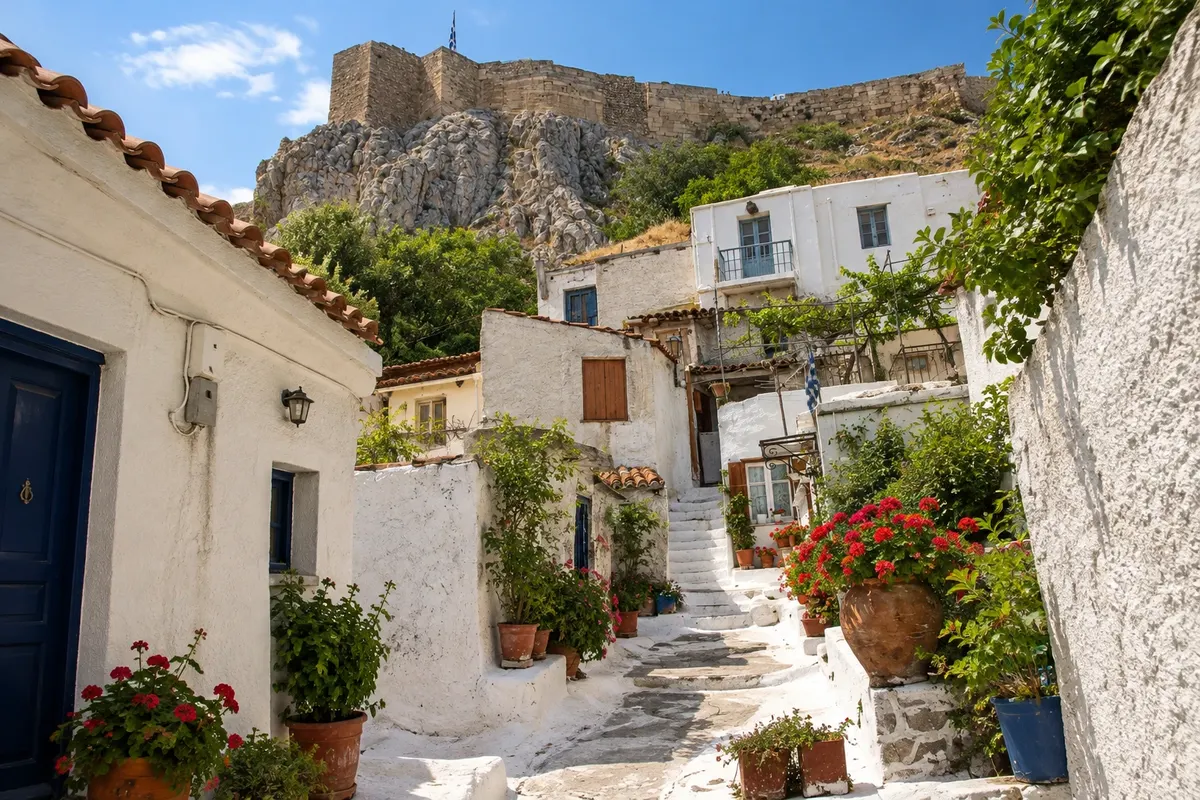
Neighborhood · Atenas, Ática
Plaka e Anafiotika
The old neighborhood on the slopes of the Acropolis, with pedestrian streets, neoclassical houses, small Byzantine churches and tavernas, and, at the top, Anafiotika—a cluster of white island-style houses clinging to the rock.
Illustrative images. The pictures in this guide are illustrations based on the real place, not photographs, and may differ from it.

Discover
About Plaka e Anafiotika
Plaka is the oldest continuously inhabited neighborhood of Athens, on the north and east slopes of the Acropolis, between the Akropoli, Syntagma and Monastiraki metro stations. Narrow pedestrian streets, 19th-century neoclassical houses with iron balconies, small Byzantine churches, souvenir shops and tavernas with tables in the street: it’s where almost every visitor walks, eats and gets lost. Adrianou and Kydathinaion streets are the main ones; the Mnisikleous staircase, covered in tables, is the most photographed. The neighborhood also houses the Museum of Greek Folk Art, the Museum of Musical Instruments, the Monument of Lisícrates (4th century BC), and the Metropolitan Cathedral on Mitropoleos Square, with the small Byzantine church of the Pequena Metrópole beside it.
At the top of Plaka, clinging to the rock of the Acropolis, is Anafiotika: a neighborhood of about 45 cubic, whitewashed houses with blue doors, bougainvillea and passageways barely wide enough for a person. It was built from the 1840s by workers from the island of Anafi, in the Cyclades, who came to work on the construction of King Otto’s palace and built the houses as they did on the island. Two small churches remain, Agios Georgios tou Vrachou and Agios Symeon. It’s a piece of island in the middle of the capital, with views over the rooftops and to Licabeto.
The streets are smooth stone and the climbs are steep. The houses in Anafiotika are inhabited: walk quietly and do not enter the courtyards.
Before you go
Practical information
Cidade Turismo reviews its information regularly, but something may have changed. Check with the place before planning your trip.
How much time to set aside
One to two hours to walk through Plaka and climb up to Anafiotika. The neighborhood is a place to return to at night for dinner.
Best time
Early morning, before the shops open, for an empty Anafiotika and the light on the white houses; or late afternoon, when the tavernas set the tables. In the hot months, Plaka’s streets stay lively late into the evening. On Sunday mornings there is mass in the small churches.
How to get there
Plaka is between Syntagma (lines 2 and 3), Monastiraki (1 and 3) and Akropoli (2) stations, all a 5-minute walk from the neighborhood. For Anafiotika, go up Stratonos Street or use the stairways that start from Prytaneiou Street, above the church of Agios Nikolaos Rangavas.
Tip
Ascend to Anafiotika via Stratonos Street and follow the narrow path that skirts the rock until you come out near the Ancient Agora, on the Monastiraki side: it’s the most beautiful route between the two neighborhoods. In Plaka, the tavernas on Filomousou Eterias Square and Kydathinaion Street are less pushy than those on Adrianou. Wear closed shoes: the pavement is worn marble.
Get your questions answered
Frequently asked questions about Plaka e Anafiotika
Why does Anafiotika look like a Greek island?
Because it was built by workers from the island of Anafi, in the Cyclades, who came to Athens in the 1840s to work on the construction of the royal palace and built the houses like on the island: cubic, white, with narrow passages.
Can you stay overnight in Plaka?
Yes, it's the neighborhood most sought for accommodation: everything is within walking distance and there are hotels of all sizes. Taverna activity continues late in the warm months; those seeking quiet choose a street away from Adrianou and Kydathinaion.
Is Plaka a neighborhood only for tourists?
The lower part, near Adrianou, is very touristy. The upper part, near Anafiotika, and the streets around the churches are residential and calmer. It's worth wandering aimlessly through the side streets.
What to see in Plaka besides strolling?
The Monument of Lisícrates, from the 4th century BC; the Catedral Metropolitana and the Pequena Metrópole, a 12th-century Byzantine little church; the Museu de Arte Popular Grega and the Museum of Musical Instruments; and the churches of Agios Nikolaos Rangavas and Agia Ekaterini, among the oldest in the city.