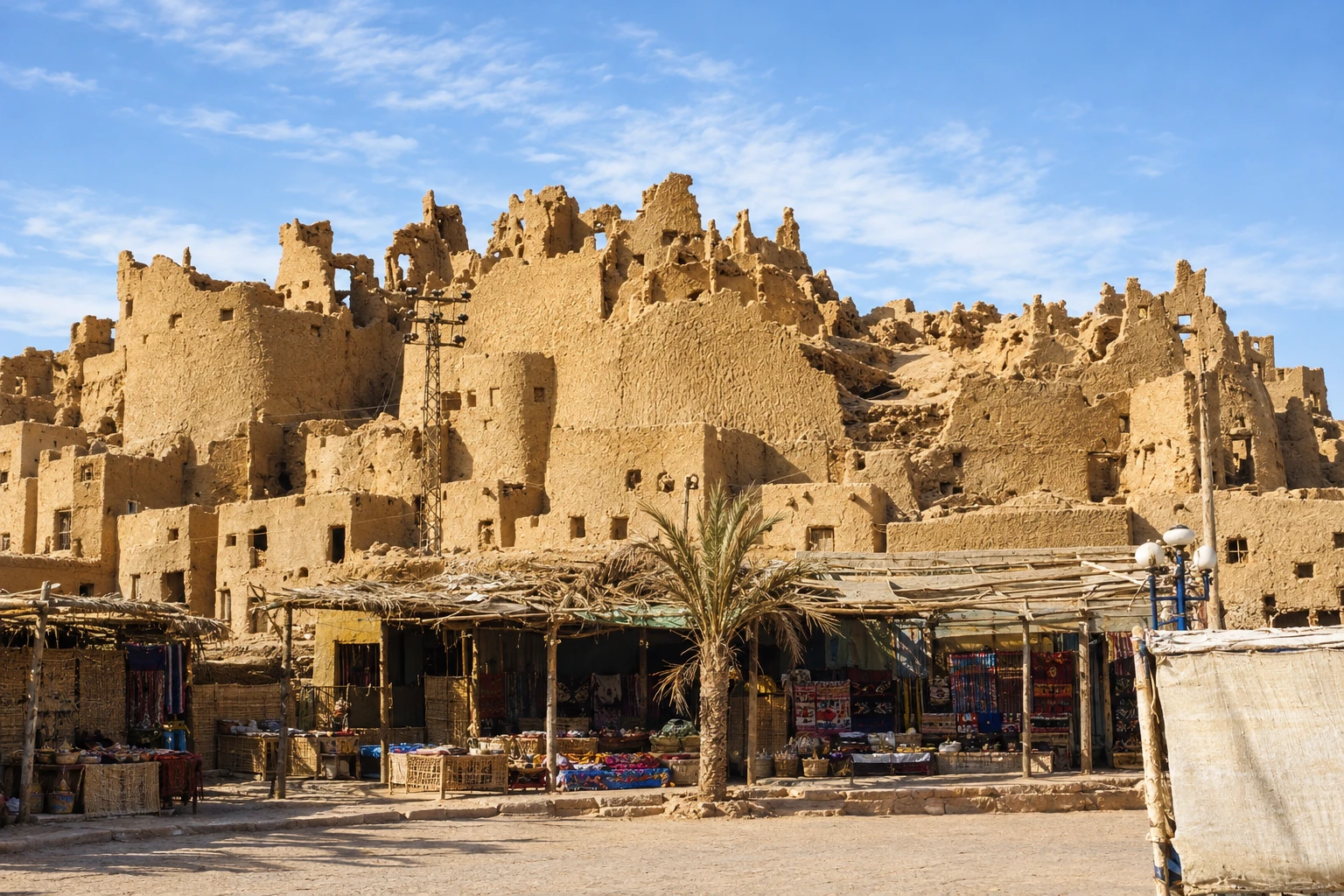
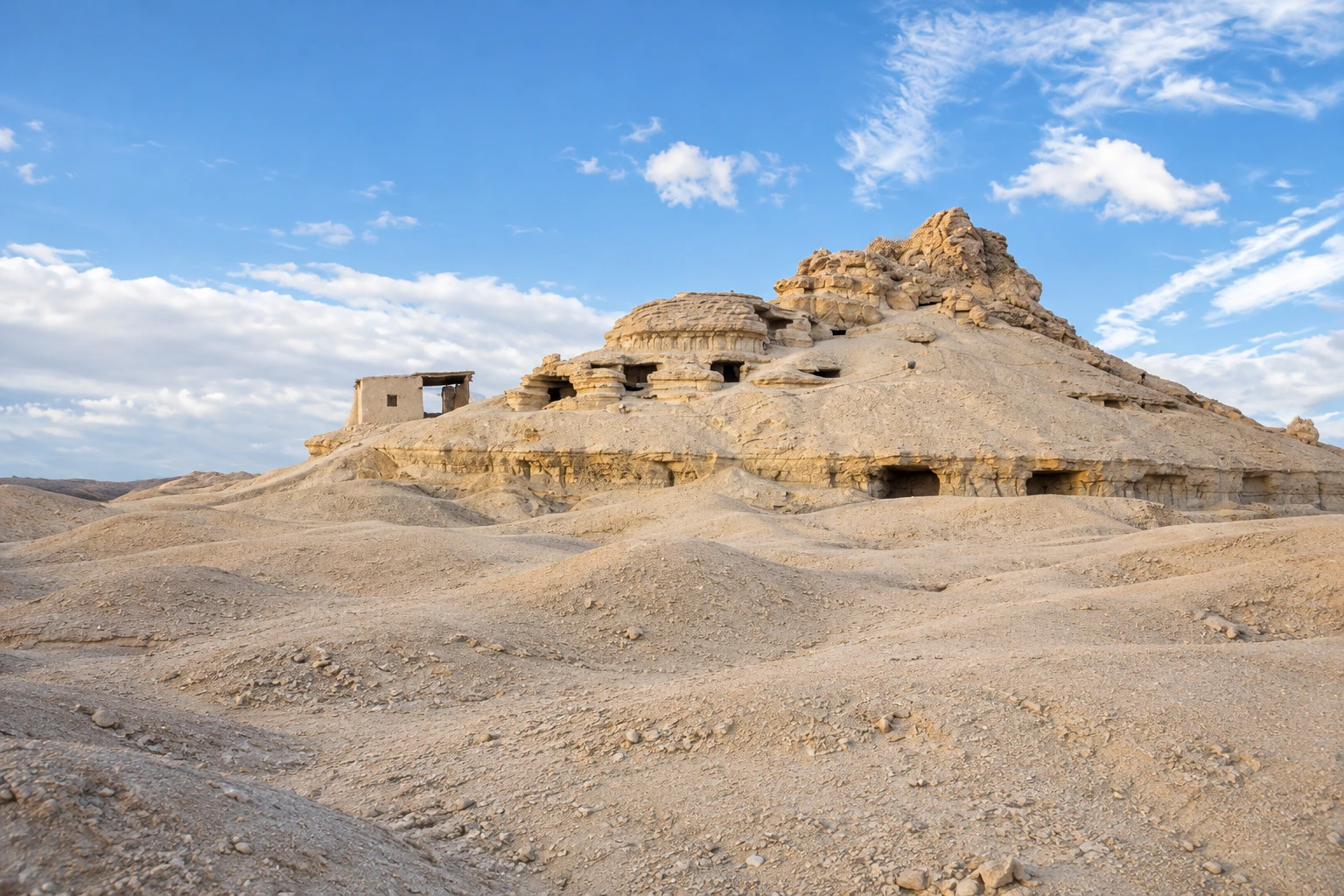
In the photo: Square and karshif buildings next to Shali, in Siwa.
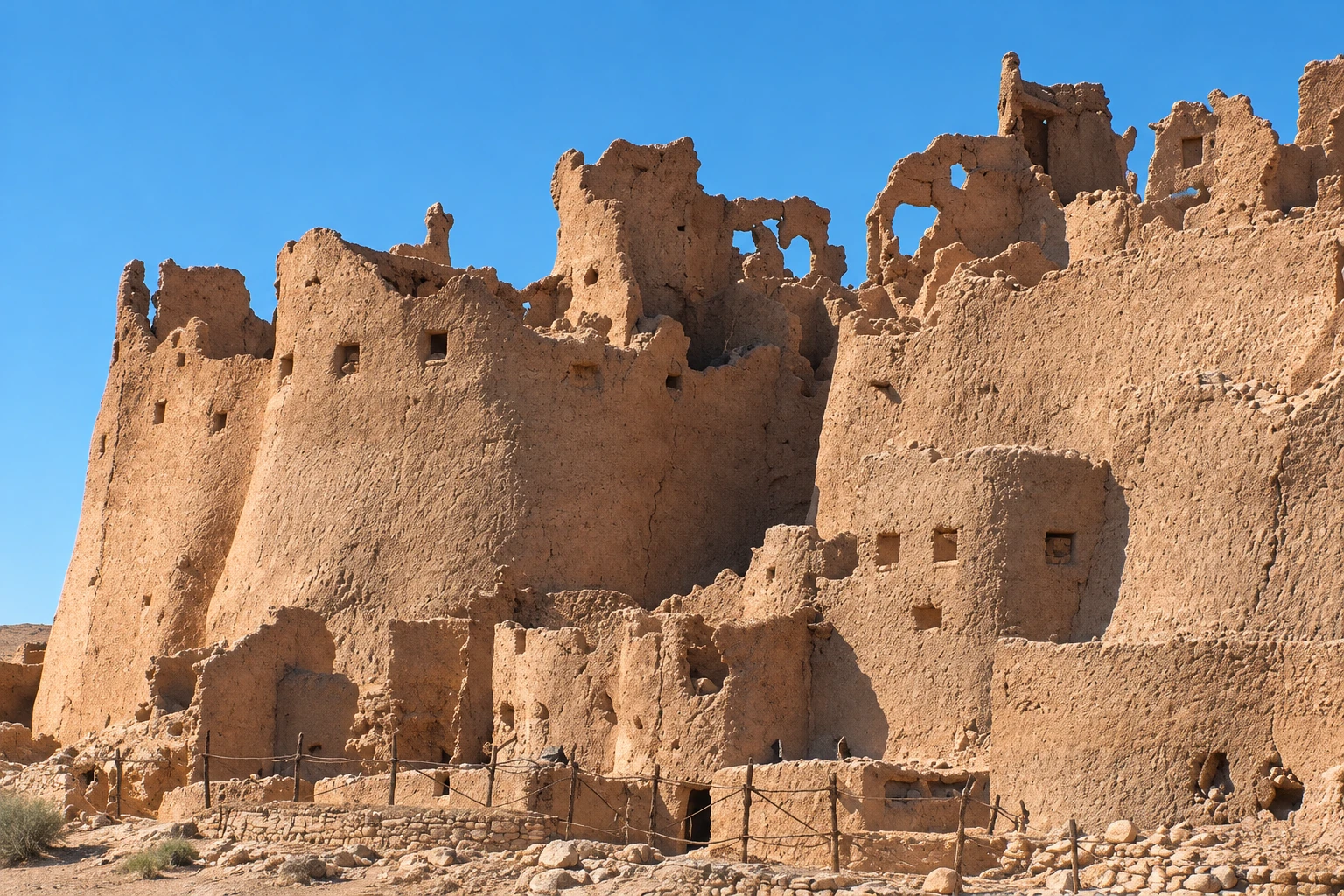
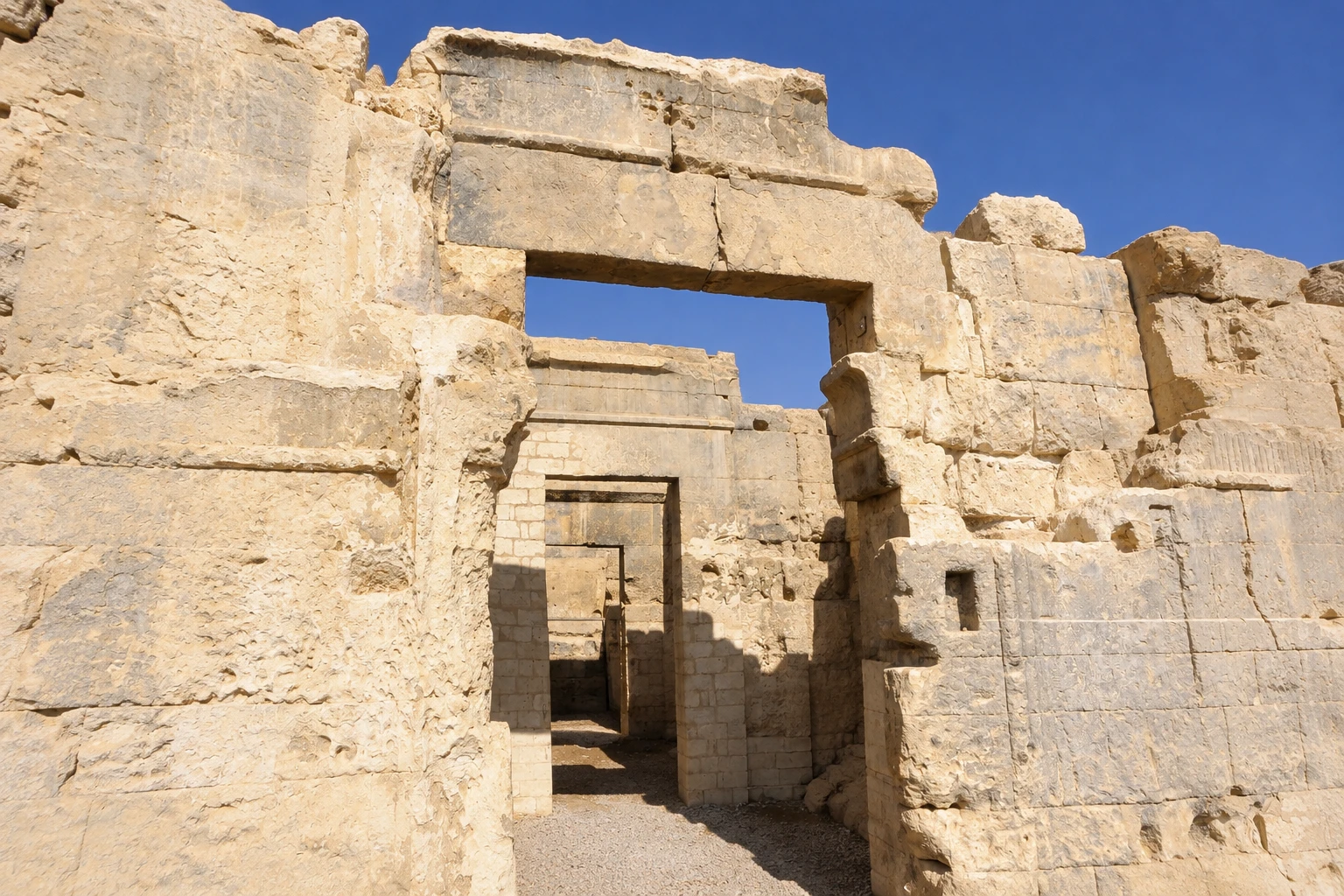
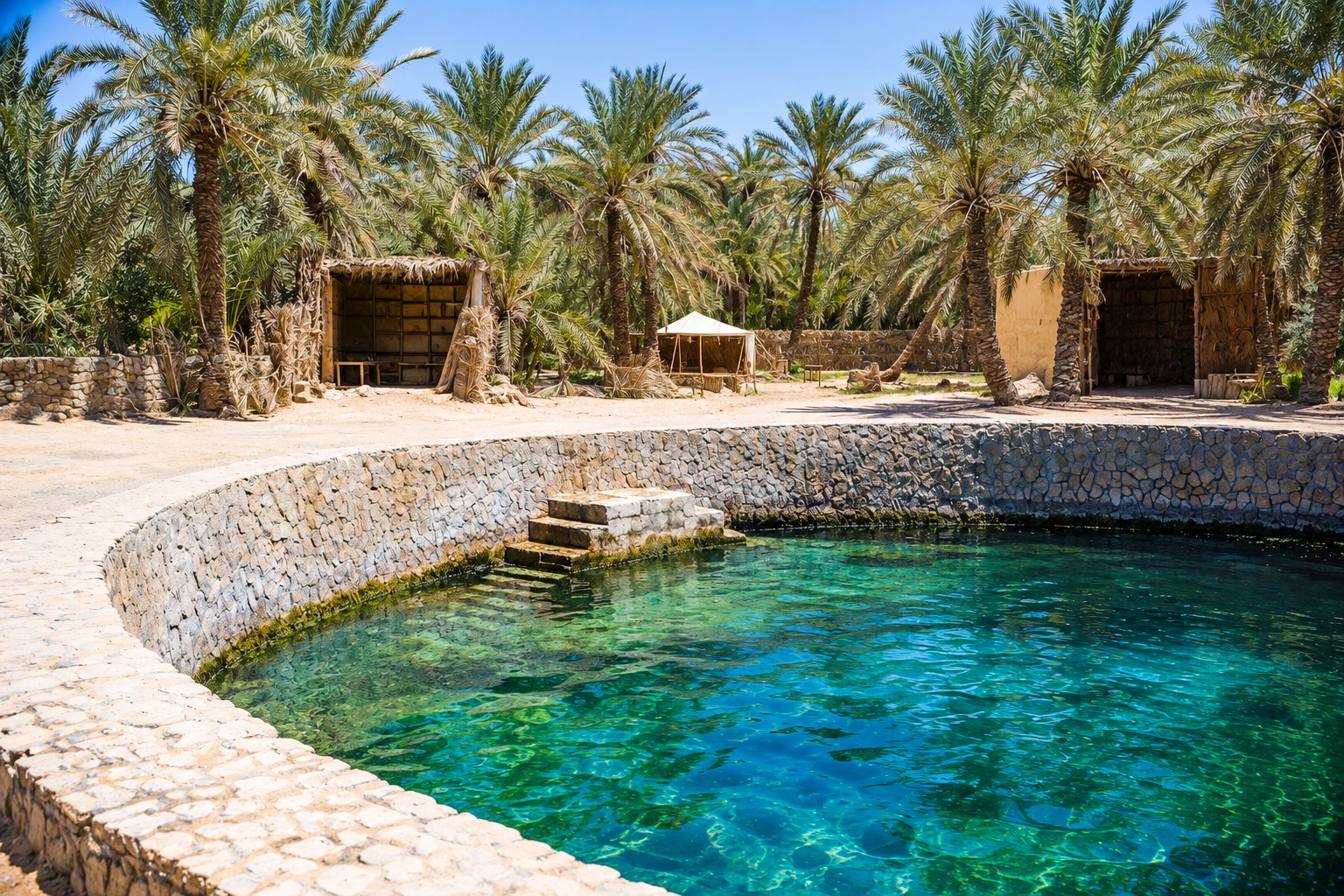
Illustrative images. The pictures in this guide are illustrations based on the real place, not photographs, and may differ from it.
The city
What to expect from Siwa.
Oasis town that grew around the ruins of Shali, with a market square, streets of mud-brick and karshif houses, and donkey-drawn carts. A few kilometers away are the ancient sites, springs and the oasis’s salt lakes.
Ruins of the ancient fortified town of Siwa, built of mud and salt over a rock outcrop in the center of the oasis, abandoned in the 20th century after heavy rains. From the top you can see the whole oasis.
Ruins of the Temple of the Oracle of Amun on Aghurmi hill, about 4 km from Siwa’s center, where Alexander the Great is said to have consulted the oracle in 331 BCE.
Hill north of Siwa with dozens of rock-cut tombs, some with Greco-Roman period paintings such as the tomb of Si-Amun. From the top you can see the town and the palm groves.
Marsa Matruh International Airport (MUH)Marsa Matruh · 305 km
Rodoviária de SiwaSiwa · 1 km
Approximate distances. Check flights and bus, train or boat schedules before you travel.
By road, Siwa is about 300 km from Marsa Matruh, with daily buses and cars with drivers. From Cairo there are overnight buses that pass through Alexandria and Marsa Matruh. The nearest airport with regular flights is Marsa Matruh (MUH).
How many days
Three to four days for the sites, the springs, the salt lakes and the sunset at Fatnas, at the oasis pace.
When to go
From October to April, with mild days; nights from December to February are cold. In summer the heat is very intense and the town becomes quieter.
The seasons shown are the most usual ones; nature doesn't always follow the calendar.
Do you need a car?
No. The town is explored on foot, and the nearby sites are reached by bicycle, donkey-cart, taxi or car with driver.
Suggested itinerary
An order that works
Built with the places on this page. No rush: it's paced so you have time to see them.
One day in Siwa
manhã
Shali and Gebel al-Mawta
Climb the Shali ruins early and continue to the painted tombs of Gebel al-Mawta.
tarde
Aghurmi and Fatnas
Visit the Oracle of Amun at Aghurmi, stop by Cleopatra’s Spring and finish with the sunset at Fatnas.
2 days in Siwa
Day 1
dia inteiro
Shali, Gebel al-Mawta and Aghurmi
Spend the day at the old town of Shali, the tombs of Gebel al-Mawta and the Oracle of Amun.
Day 2
dia inteiro
Springs and Fatnas
Spend the morning at Cleopatra’s Spring and the palm groves, and the afternoon on Fatnas island until sunset.
3 days in Siwa
Day 1
dia inteiro
Shali and Gebel al-Mawta
Start at Shali early in the morning and visit the tombs of Gebel al-Mawta.
Day 2
dia inteiro
Aghurmi and Cleopatra’s Spring
Cycle to Aghurmi and the Oracle of Amun, and bathe at Cleopatra’s Spring.
Day 3
dia inteiro
Palm groves and Fatnas
Walk through the palm groves and olive trees and finish the day at Fatnas, by the lakeshore.
Check before you go. Opening hours and days change, and places may close for renovations, holidays or events. This itinerary is a suggestion from Cidade Turismo, not a commitment: plan yours by checking directly with each place you intend to visit.
Before you go
Frequently asked questions
What to do in Siwa?
Climb the Shali ruins, visit the Oracle of Amun at Aghurmi, see the tombs of Gebel al-Mawta, bathe at Cleopatra’s Spring and watch the sunset on Fatnas island.
What language is spoken in Siwa?
Arabic and Siwi, a Berber-derived language spoken in the oasis.
How do you get around Siwa?
On foot in the center, and by bicycle, donkey-cart, taxi or car with driver to nearby sites.
What do you buy in Siwa?
Dates, olives and olive oil from the oasis, salt and Siwi embroidered handicrafts.


 Brazil
 Antarctica
 Argentina
 Bolivia
 Chile
 Colombia
 Ecuador
 Falkland Islands (Malvinas)
 French Guiana
 Guyana
 Paraguay
 Peru
 Suriname
 Uruguay
 Venezuela
 Austria
 Belgium
 Croatia
 Denmark
 Finland
 France
 Germany
 Greece
 Hungary
 Iceland
 Ireland
 Italy
 Luxembourg
 Norway
 Poland
 Portugal
 Slovakia
 Slovenia
 Spain
 Sweden
 Switzerland
 the Czech Republic
 the Netherlands
 the United Kingdom
 Turkey
 Bermuda
 Canada
 Greenland
 Mexico
 Saint Pierre and Miquelon
 the United States
 the Dominican Republic
 Japan
 South Africa
 Australia
 Fiji
 New Zealand
 Papua New Guinea