

 Brazil
 Antarctica
 Argentina
 Bolivia
 Chile
 Colombia
 Ecuador
 Falkland Islands (Malvinas)
 French Guiana
 Guyana
 Paraguay
 Peru
 Suriname
 Uruguay
 Venezuela
 Austria
 Belgium
 Croatia
 Denmark
 Finland
 France
 Germany
 Greece
 Hungary
 Iceland
 Ireland
 Italy
 Luxembourg
 Norway
 Poland
 Portugal
 Slovakia
 Slovenia
 Spain
 Sweden
 Switzerland
 the Czech Republic
 the Netherlands
 the United Kingdom
 Turkey
 Bermuda
 Canada
 Greenland
 Mexico
 Saint Pierre and Miquelon
 the United States
 the Dominican Republic
 Japan
 South Africa
 Australia
 Fiji
 New Zealand
 Papua New Guinea
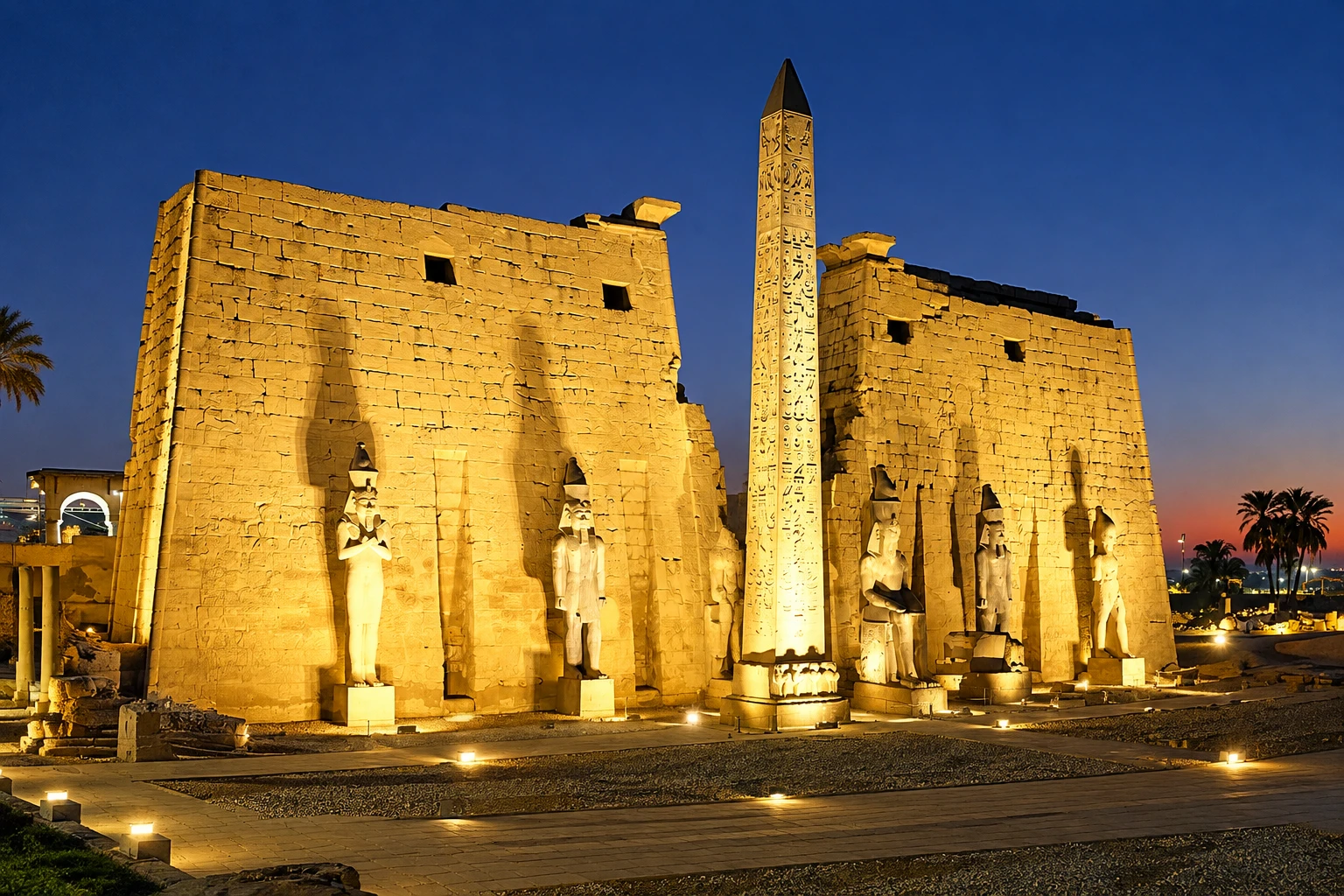
Temple · Luxor, Egypt
Luxor Temple
Temple in the city center dedicated to Amun, built by Amenhotep III and Ramesses II, with the obelisk at the entrance, colossal statues and courtyards illuminated at night.
Illustrative images. The pictures in this guide are illustrations based on the real place, not photographs, and may differ from it.

Discover
About Luxor Temple
The Luxor Temple stands in the city center on the Nile waterfront. It was built mainly by Amenhotep III and Ramesses II and was the setting for the Opet festival, when the statues of the gods were carried in procession from Karnak.
At the entrance, Ramesses II’s great pylon bears colossal statues of the pharaoh and a granite obelisk; its twin stands at Place de la Concorde in Paris. Inside are Ramesses II’s courtyard, Amenhotep III’s colonnade and, atop the ruins, the Abu el-Haggag mosque, still in use.
The temple is also visited at night when it is illuminated, and the Avenue of the Sphinxes begins in front of the pylon, heading toward Karnak.
Before you go
Practical information
Cidade Turismo reviews its information regularly, but something may have changed. Check with the place before planning your trip.
How much time to set aside
One to two hours.
Best time
Late afternoon and at dusk, when the temple is lit.
How to get there
On foot, in central Luxor, beside the Nile promenade.
Tip
Visit at sunset to see the temple in natural light and then illuminated.
Official website
Your questions
Frequently asked questions about Luxor Temple
Can you visit Luxor Temple at night?
Yes. The temple stays open into the evening and is illuminated: confirm the hours.
Where is the other obelisk from Luxor Temple?
In Place de la Concorde in Paris, since the nineteenth century.
What is inside Luxor Temple?
The pylon of Ramesses II, Ramesses II’s court, Amenhotep III’s colonnade and the mosque of Abu el‑Haggag.