Pašticada
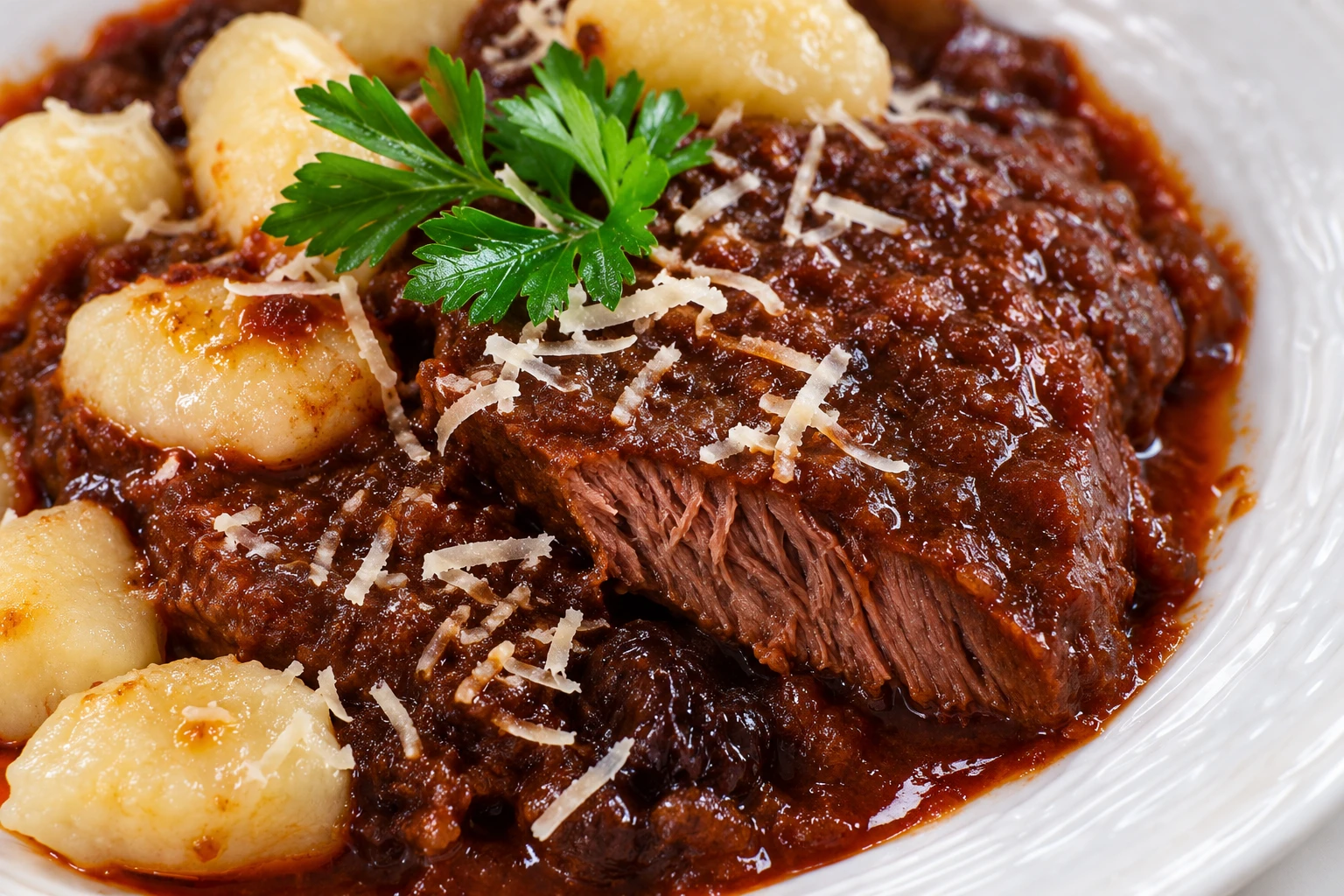
Beef larded with garlic, clove and bacon, marinated in wine and vinegar and cooked for hours in a dark sauce with dried plum and prošek. In Split, it’s served with gnocchi or pasta.
Antarctica
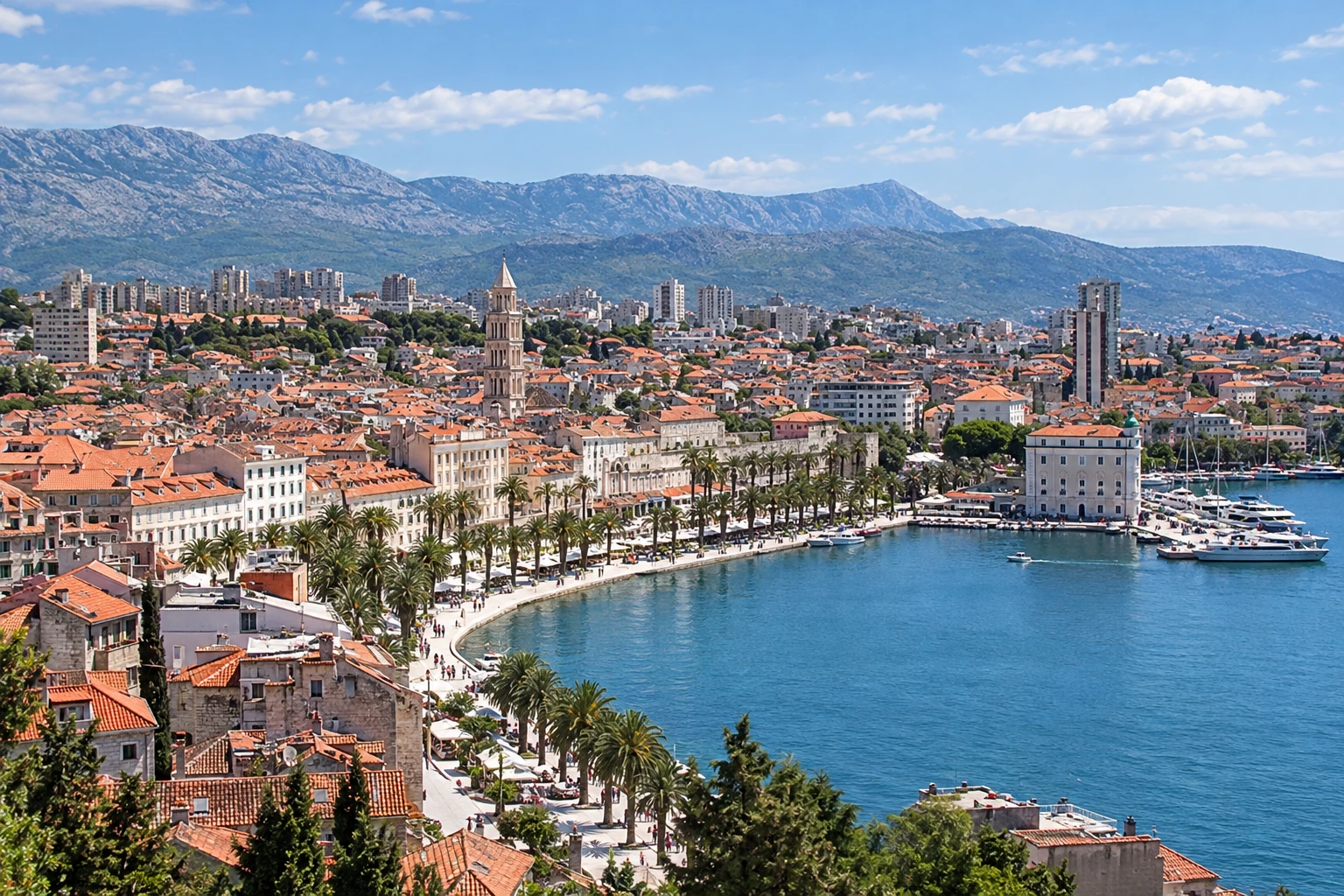
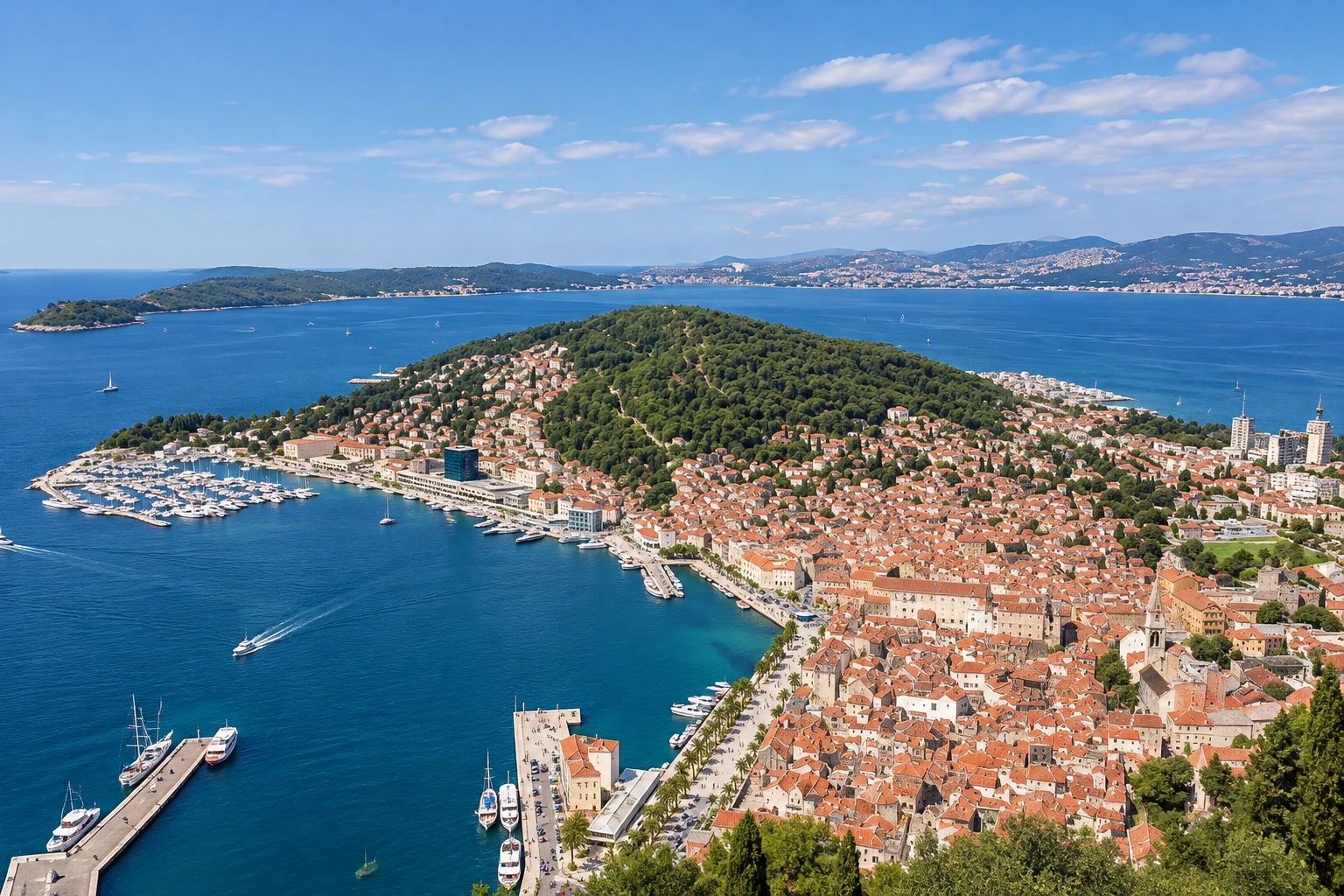
In the photo: Riva, Split
Illustrative images. The pictures in this guide are illustrations based on the real place, not photographs, and may differ from it.
The city
Split is organized around the Palace of Diocletian, a Roman core transformed into a neighborhood. The Cathedral of São Dômnio lies within that complex, while Marjan offers trails on a wooded peninsula. Nearby, Salona and Klis add archaeology and fortifications. The port connects the city to the islands of Dalmatia.
Split is Dalmatia’s largest city and Croatia’s second largest, with nearly 161,000 residents. It occupies a peninsula on the central Adriatic coast, with wooded Marjan hill at its western tip, the Mosor and Kozjak ranges behind it and the islands of Brač, Šolta, Hvar and Čiovo offshore. The seat of Split-Dalmatia County, it has one of the busiest passenger ports in the Mediterranean. Ferries and catamarans leave from here for the islands of central Dalmatia.
The city’s story begins with an emperor. Around AD 293, Diocletian commissioned a palace near the great Roman city of Salona for his final years and moved in in 305. In the seventh century, residents fleeing invasions of Salona took shelter inside the walls, turning the palace into a city. Split grew beyond it under Croatian kings, Venice, Napoleonic France and Austria, with each period leaving its mark. Diocletian’s Palace and the entire historic center have been on the UNESCO World Heritage List since 1979.
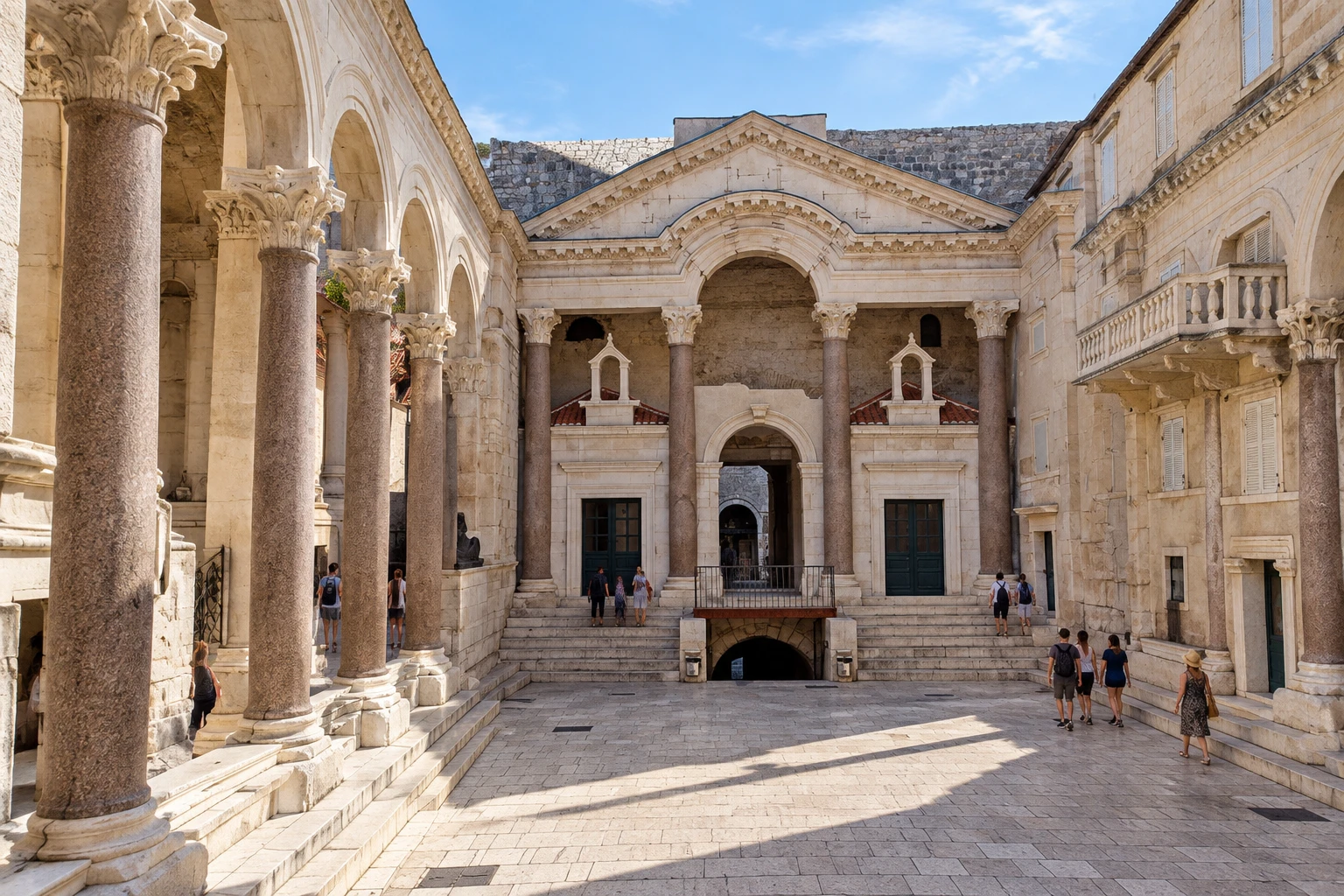
What sets Split apart is that people still live in its main monument. The palace is a rectangle of about 215 by 180 meters with a gate on each side. Inside, streets, houses, shops, cafés and churches lean against Roman walls. The Peristyle, the emperor’s ceremonial square, is now a meeting place. Diocletian’s mausoleum is the Cathedral of St. Domnius, and the substructures supporting the imperial apartments form a passage between the square and the sea. Outside are medieval squares, the fish market, the Pazar produce market and the Riva, a harbor promenade that residents treat as their living room.
Beyond the old center, the city has two sides. To the west, the fishing neighborhood of Veli Varoš climbs to Marjan forest park, with lookouts, medieval chapels, trails and pebble beaches. The gallery of sculptor Ivan Meštrović stands at the foot of the hill. East of the port, the city beaches begin at sandy Bačvice, where people play picigin in the shallows year-round. A few kilometers away are the ruins of Salona in Solin and Klis Fortress in the pass between the two mountain ranges.
The climate is Mediterranean. Summers are hot and dry, with average highs near 31°C in July and August and some days above 35°C. This is the season for beaches and festivals and the busiest period at the port. Spring and early fall, especially May, June, late September and October, are milder for walking. November and December are the wettest months. Winters are mild, with January averages near 8°C and occasional days of bura, the cold northerly wind.
You can explore the old center on foot in a day. With two or three days, add Marjan, museums, a beach and a trip to Salona and Klis. The port, bus station and railway station stand side by side a few minutes’ walk from the palace, making Split a convenient base for Trogir and the islands.
30 places to stay in Split.
30 places to eat in Split.
Hotéis e restaurantes da cidade no mapa.
Routes in Croatia
From Split to Dubrovnik by catamaran across the Adriatic, with stops in Milna, Hvar and Korčula.
Flavors of Croatia
Festivals and events
Dates change every year: check this year's date before you travel.
The local experience
The Dioklecijanova palača forms the old core of Split. The Roman palace was incorporated into the city: streets, passages and later-period buildings occupy the original structure. The visit takes place between public spaces and sections with separate entrances, rather than following a single circuit of rooms.
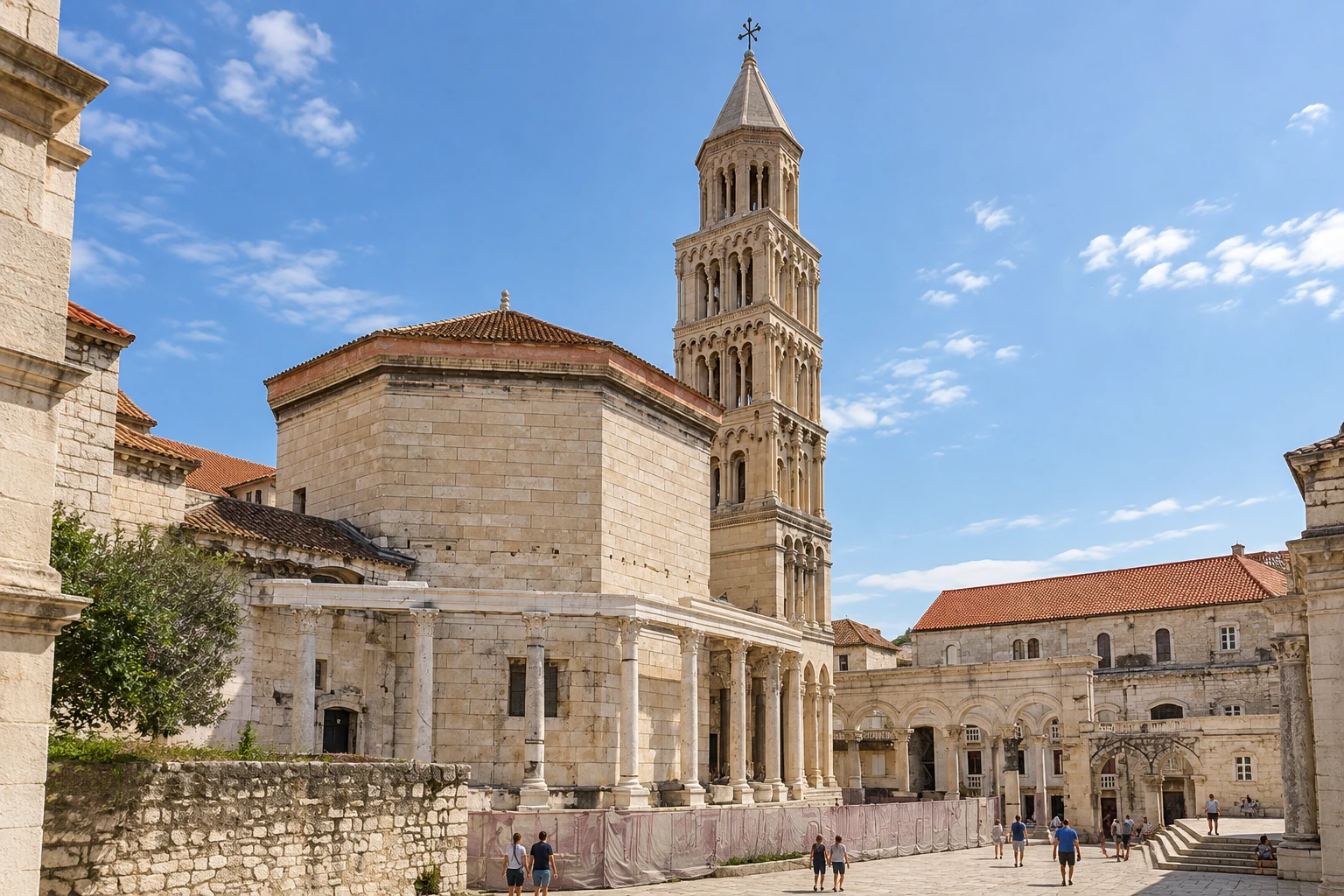
The Katedrala sv. Dujma occupies the former mausoleum of Diocletian, inside the palace of Split. The change of use preserved a Roman structure at the center of a religious complex. The cathedral can be perceived both by its ancient volume and by the elements added over time.
Park šuma Marjan occupies a wooded peninsula to the west of Split’s center. The tree-covered area contrasts with the dense streets of the palace and offers views of the city and sea from a different elevation. The outing can be a short climb to a viewpoint or a longer walk along the park’s trails.
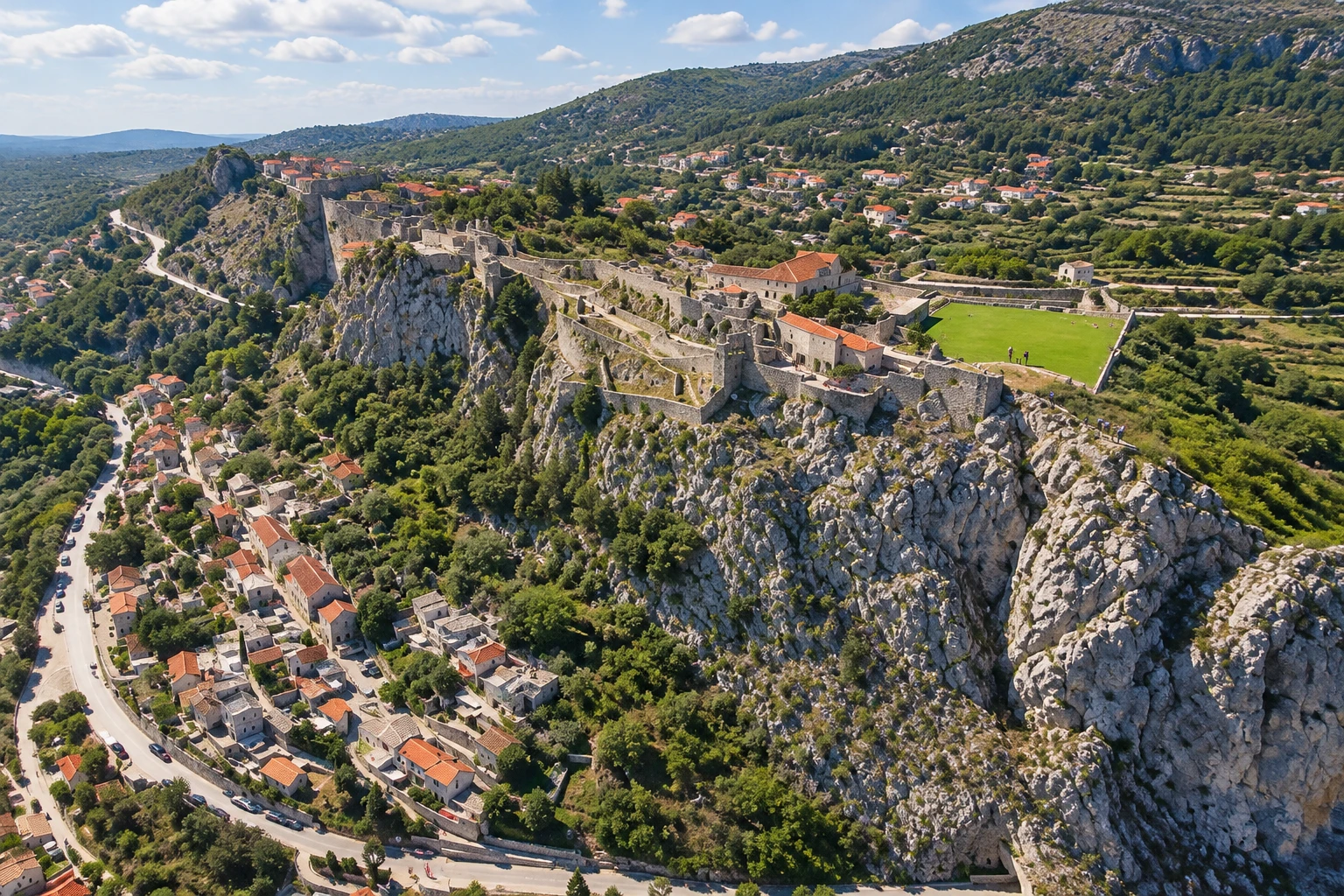
Tvrđava Klis follows a rocky ridge inland near Split. Its elongated form adapts to the terrain, with walls and enclosures laid out on different levels. The location helps to understand the link between inland routes and the plain that reaches the sea.
To choose before you go
Where each tour starts, how long it takes, how it is done, what is included and the price range.
Diocletian’s Palace (Dioklecijanova palača) is both one of the world’s best-preserved Roman monuments and a living neighborhood. Part luxury villa and part military camp, it forms a rectangle of about 215 by 180 meters, with corner towers and two main streets dividing it into four sections. The emperor occupied the southern half, the guards and services the northern half. Start on the Riva for a view of the south facade. Enter through the Bronze Gate, the most modest of the four, which once opened directly to the sea. It leads to the substructures. These rooms supported the imperial apartments above and mirror their layout, giving a sense of what the apartments looked like. The central hall, lined with souvenir stalls, connects the Riva and the Peristyle. Other rooms are open for visits and host exhibitions and fairs. The stairs emerge at the Peristyle, the palace’s central square enclosed by red granite columns. Here the emperor appeared before his subjects. An Egyptian sphinx around 3,500 years old watches over the square beside the cathedral. To the south lies the Vestibule, square outside and round inside, once the entrance to the residential quarters. A narrow alley leads to the Temple of Jupiter, converted into a baptistery. The street north from the Peristyle reaches the Golden Gate, the main entrance, where the road to Salona began. Outside stands Ivan Meštrović’s statue of Bishop Grgur Ninski. Tradition calls for touching his big toe and making a wish. The east–west street links the Silver Gate by the Pazar market to the Iron Gate, which opens onto Pjaca beneath an old 24-hour clock.
Stops: Bronze Gate, Palace cellars, Peristyle, Vestibule, Temple of Jupiter, Golden Gate, Statue of Gregory of Nin, Silver Gate, Iron Gate.
Includes: The streets, squares, and central hall of the palace cellars are free. The other cellar rooms, Temple of Jupiter, and cathedral sections have separate tickets. Check current prices for each.
Tip: Start early in summer. By midday the lanes are hot and crowded. Tourist information points on the Riva and in the Peristyle have city maps. Around noon in summer, the Peristyle usually hosts a reenactment of Diocletian's changing of the guard.
Best time: Year-round. May, June, September, and October offer lighter crowds and better walking temperatures.
Split Cathedral occupies the oldest building used by any cathedral in Europe, Emperor Diocletian’s mausoleum. In the seventh century the tomb of the persecutor of Christians became a church. Places of honor went to the relics of St. Domnius and St. Anastasius, martyrs executed in nearby Salona. St. Domnius, or Sveti Duje to locals, is the city’s patron saint. The mausoleum is octagonal on the outside, surrounded by a passage of 24 columns. The interior is circular, with alternating niches and two tiers of red granite columns. The frieze above them shows hunting scenes and two medallions traditionally identified as portraits of Diocletian and his wife, Prisca. Mosaics once covered the fan-patterned brick dome. The Middle Ages added the best-known features. Walnut doors carved by Andrija Buvina show scenes from the Gospels, from the Annunciation to the Resurrection, in fourteen panels on each side. Left of the entrance is the 13th-century hexagonal pulpit. The altar of St. Domnius has a Gothic canopy from 1427. St. Anastasius’s altar, made by Juraj Dalmatinac in 1448, has a relief of the Flagellation of Christ. Construction of the 57-meter bell tower began in the 13th century, and it was rebuilt around the turn of the 20th century. Climb the steps for views over the palace rooftops, harbor, Marjan and islands. A few steps away across the Peristyle, the former Temple of Jupiter has served as a baptistery since late antiquity. It holds a medieval font with a Croatian king on one panel, and Ivan Meštrović’s statue of St. John the Baptist. One of the granite sphinxes Diocletian brought from Egypt stands outside the entrance.
Stops: Cathedral of St. Domnius (Katedrala sv. Dujma), Bell tower, Cathedral treasury, Temple of Jupiter (baptistery).
Includes: The cathedral, bell tower, treasury, and baptistery charge admission, with tickets sold by section. Check current prices and visiting hours.
Tip: The cathedral is a place of worship. Dress appropriately and check visiting hours. The bell tower is reached entirely by stairs.
Best time: Year-round. May 7 is St. Domnius's Day, with a procession and festivities that draw crowds to the area.
Leave the palace through the Iron Gate to reach the Pjaca, officially Narodni trg, or People’s Square. First documented in the 13th century, it was the first area of Split settled outside the Roman walls and has been a center of city life for centuries. In the middle stands the old Gothic town hall, now an exhibition space. Around it are noble family palaces and a bookstore that has occupied the same spot since 1861. The square’s clock marks 24 hours instead of 12. Nearby is Voćni trg, or Fruit Square, named for the market where women from neighboring villages sold fruit. Its official name is Trg Braće Radić. From there, continue to the Peškarija fish market, in a Secession-style pavilion more than 120 years old. The stalls offer the Adriatic catch, from sardines and mackerel to sea bass and lobster. The market is on pedestrian Marmontova Street, named for Napoleon’s marshal who oversaw urban development in Dalmatian towns. At the end of Marmontova is Prokurative, or Republic Square. Three sides are lined with arcaded neo-Renaissance buildings reminiscent of St. Mark’s Square in Venice. The south side opens to the harbor. The square hosts concerts and festivals. Return to the palace and cross it along the main street to the Silver Gate. Just outside, beside the eastern wall and Church of St. Dominic, the Pazar is an open-air market selling fruit, vegetables and regional produce, and a focal point of city life.
Stops: Pjaca (Narodni trg), Voćni trg (Fruit Square), Peškarija fish market, Marmontova Street, Prokurative (Trg Republike), Pazar.
Includes: Self-guided walk. The squares and markets are free to explore.
Tip: Visit the markets early, when they're usually liveliest, and check which days they open.
Best time: Year-round.
The Riva is Split’s harbor promenade and its most important public space. It began taking its present form about two centuries ago under French rule and has been widened and remodeled several times. Its backdrop is the south facade of Diocletian’s Palace with the entrance to the substructures. Later buildings extend west, including the Church and Monastery of St. Francis. The pedestrian promenade is lined with cafés and hosts Carnival, the feast of St. Domnius, the Christmas market and celebrations of sporting victories. Continue west to Matejuška, for centuries the harbor for the small fishing boats of Veli Varoš. Dozens of boats are still moored here, nets hang out to dry and a monument to fishermen takes the shape of a large hook. It is also an informal evening meeting spot for the city’s young people. The waterfront continues along the West Coast, a 623-meter promenade paved with white Brač stone beside the yachts. Along the sea, bronze plaques set into the pavement commemorate Split’s Olympic medalists in chronological order. Look back for a view of the city. At the southwestern end of the port lies the Sustipan headland, named for a medieval monastery of St. Stephen. In the 19th century it became Split’s first cemetery. Today it is a pine-shaded park above the sea.
Stops: Riva, St. Francis Church and Monastery, Matejuška, West Coast waterfront (Zapadna obala), Sustipan Park.
Includes: Self-guided outing with free admission.
Tip: Come in late afternoon, when the whole town heads down to the Riva. On the waterfront, a model of the historic center and a reconstruction of the palace help you picture what you'll see inside.
Best time: Year-round. In December the Riva hosts the Christmas market.
Marjan is the pine-covered hill at the western tip of Split’s peninsula, about 3.5 kilometers long and 178 meters high at its summit. It is a forest park where locals walk, run, cycle and swim. They call it the holy hill for the little churches scattered among the trees. The climb begins a few minutes from the Riva through Veli Varoš, one of Split’s oldest outlying neighborhoods. Its steep streets and stone houses once housed fishermen and farmers. Steps lead to Prva vidilica, the first lookout, with views of the center’s rooftops, the harbor and the islands. The old Jewish cemetery is alongside it. About two hundred meters farther up the southeastern slope stands the Church of St. Nicholas, built in 1219 and dedicated to the patron saint of sailors. From here continue along the ridge or the southern promenade. At the Sedlo lookout tower, 148 meters above sea level, an elevator reaches the terrace overlooking Split and the surrounding area. The tower still serves as a fire lookout. Farther along the southern side are the Church of St. Jerome and, cut into the rock above it, cells occupied by hermits from the 15th century onward. The walk can end at the sea. Kašjuni, at the western tip of the hill, is a fine-pebble beach in a deep bay, with a café and changing cabins, popular with families. The park visitor center is on the waterfront at the foot of the steps. An audio guide with a map and 51 points of interest is also designed for blind visitors and those with low vision.
Stops: Veli Varoš, Prva vidilica (first lookout), Church of St. Nicholas, Sedlo observation tower, St. Jerome’s Church and the hermits’ cells, Kašjuni Beach.
Includes: The park and Sedlo tower are free. Check tower opening times. It closes at night and in bad weather.
Tip: Bring water. In summer go early or in late afternoon. An electric park bus leaves from the visitor center on certain days. Check whether it's running.
Best time: Spring and fall bring comfortable temperatures. In summer, combine the walk with a swim in the sea.
Ivan Meštrović is Croatia’s best-known sculptor. He created the statue of Grgur Ninski by the Golden Gate and the St. John the Baptist in the baptistery. In the early decades of the 20th century he bought land for a home in Meje, western Split, at the foot of Marjan’s southern slope. The villa, built during the 1930s, was designed for working, living and exhibiting. His family began using it in summer 1932 and last gathered here in 1941. In 1952 the sculptor donated four buildings and 132 works to the Croatian people. His Split house became the Meštrović Gallery, the city’s most visited. The collection spans his work through 1946 in marble, bronze, wood and plaster. The central ground-floor hall holds mainly marbles. The dining room retains the furnishings and atmosphere of the family home. The large east room focuses on religious sculpture, including wooden figures of Adam and Eve, and the Pietà has a dedicated space. Upstairs are works associated with Impressionism, Secession and Art Deco and pieces from the interwar period. The garden was planted with Mediterranean herbs according to the artist’s instructions. Nearby by the water is Kaštilac, also called Crikvine, a complex on a former 16th-century country estate restored by Meštrović. In the Chapel of Our Lady of Good Counsel he installed a series of wooden reliefs illustrating the life and Passion of Christ.
Stops: Meštrović Gallery (Galerija Meštrović), Kaštilac (Crikvine-Kaštilac).
Includes: The gallery and Kaštilac charge admission. Check current prices, opening days, and whether a single ticket covers both.
Tip: Pair the visit with a walk along the south side of Marjan or a stop at Kašjuni Beach.
Best time: Year-round. A good option on rainy days or during the hottest part of the day.

Split has beaches within the city. East of the port a waterfront walk links a string of coves, starting at Bačvice and continuing to Ovčice, Firule, Zenta, Trstenik, Žnjan and eventually Duilovo. Bačvice is the best known. A municipal beach since 1919, it is a few minutes’ walk from the port and downtown. Unusually for this coast, it has sand and shallow water. It is the birthplace of picigin, a volleyball-like game played in the shallows with a small ball, even in winter. People of all ages stroll the Bačvice promenade, which becomes one of the city’s nightlife hubs after dark. Firule, a little farther on, is also sheltered and fine-sanded, a traditional favorite for families with young children. Next door is the tennis center where several well-known Croatian players started out, including Goran Ivanišević. Trstenik, farther east, is pebbly, with a gentle entry into the sea. The next beach, Žnjan, lies between Trstenik and Duilovo. For pine trees and deeper water, head to the Marjan beaches on the other side of town. Fine-pebbled Kašjuni is the most popular.
Stops: Bačvice, Ovčice, Firule, Zenta, Trstenik, Žnjan.
Includes: The beaches are free. Loungers, umbrellas, and changing cabins cost extra where available.
Tip: Bačvice fills up on summer afternoons. For more room, follow the promenade to the next coves.
Best time: June to September for sea swimming. Picigin is played at Bačvice year-round.
Salona was the capital of the Roman province of Dalmatia and one of the great Adriatic cities, with around 60,000 inhabitants. Tradition holds that Diocletian was born here and chose the site for his palace to stay close to the city. The Golden Gate opened onto the Salona road. Destroyed during invasions in the seventh century, Salona was abandoned. Some inhabitants took refuge inside the palace, giving rise to Split. The ruins stand in the center of modern Solin beside the Jadro River, about 6 kilometers from Split, and form Croatia’s largest archaeological park. The walls, towers and gates, forum and temples, amphitheater and cemeteries of Christian martyrs such as Manastirine, Kapljuč and Marusinac convey the ancient city’s size. According to tradition, St. Domnius, bishop of Salona and later Split’s patron saint, was executed in the amphitheater. This is an outdoor visit over a large area. Be prepared to walk between sites within the archaeological park. Solin has other landmarks of Croatian history, including the Marian shrine founded by Queen Jelena more than a thousand years ago and the basilica ruins where King Zvonimir was crowned in 1076. Salona lies outside Split’s municipality but completes the story of the palace. A morning is enough, leaving time for Klis Fortress afterward.
Stops: Solin, Salona’s walls and gates, Forum, Amphitheater, Manastirine Necropolis.
Includes: The archaeological site charges admission. Transportation costs extra. Check current rates and opening times before you go.
Tip: Bring a hat, water and closed-toe shoes, and go early in summer. The city bus to Trogir leaves from the Sukoišanska Street terminal and passes through Solin. Check which stop is closest to the entrance.
Best time: Spring and fall. Summer gets very hot, so go early.
Klis Fortress stands on a rocky summit about 15 kilometers from Split, in the pass between the Mosor range to the east and Kozjak to the west. Control of the pass meant control of the route between the hinterland and the sea toward ancient Salona and Split. Illyrians, Croats, Venetians and Ottomans contested the site, which they regarded as the gateway to Dalmatia. In the ninth century the fortress became a seat of Croatian rulers. Later it held out against the Ottomans, its defense becoming a symbol of the Dalmatian struggle. The fortress you see today reflects centuries of reinforcement. Long and narrow, it follows the rocky ridge on several levels through a succession of walls, gates and enclosures. Walk uphill through the courtyards to the highest point. The view makes clear why the site was contested. Split, Kaštela Bay and the islands lie on one side, mountains and the road inland on the other. The fortress stood in for the city of Meereen in Game of Thrones. Klis is a separate municipality next to Split. City buses depart from the terminal on Sukoišanska Street. Since the fortress and the ruins of Salona are on the same side of Split, they combine well in a day by car or, after checking each leg’s timetable, by bus.
Stops: Klis, Klis Fortress (Tvrđava Klis).
Includes: The fortress charges admission, and transportation costs extra. Check current prices and opening periods.
Tip: The ground is uneven. Wear sturdy shoes and bring water and a hat.
Best time: Spring and fall. In summer, go early or in the late afternoon.
Day by day
Suggestions to plan the trip. Change the order of the days according to the weather and tour availability.
Start on the Riva at the model of the historic center and enter the palace through the Bronze Gate. Cross the substructures and climb to the Peristyle. Visit the Cathedral of St. Domnius and climb the bell tower if your legs allow, then see the Vestibule and Temple of Jupiter. Head north to the Golden Gate and the statue of Grgur Ninski. Follow the outside of the walls around to the Pazar, reenter through the Silver Gate and cross the palace along the main street to the Iron Gate and the Pjaca. Have lunch nearby. In the afternoon, explore Fruit Square, the fish market, Marmontova Street and Prokurative. Return to the waterfront via Matejuška. If time remains, climb the steps through Veli Varoš to Marjan’s first lookout for the view or walk to Bačvice beach. Finish with coffee on the Riva, as locals do. Save Salona, Klis and the museums for a longer stay.
Devote the morning to Diocletian’s Palace, including the substructures, Peristyle, cathedral and bell tower, Vestibule, Temple of Jupiter and the four gates. Go early, before the heat and tour groups. After lunch, explore outside the walls, taking in Pjaca, Fruit Square, the fish market, Marmontova and Prokurative. In late afternoon, walk the Riva to Matejuška and the West Coast with its Olympic medalists’ plaques. Continue to Sustipan park if you like.
Visit the Pazar in the morning, then climb Marjan through Veli Varoš to the first lookout and Church of St. Nicholas. For a longer walk, add the Sedlo tower and Church of St. Jerome. Descend on the southern side for the Meštrović Gallery and Kaštilac in Meje. Spend the afternoon by the sea. Choose nearby Kašjuni for pebbles and pines or sandy Bačvice beside the port to see picigin. On a rainy day, try a city museum such as the Archaeological Museum or the Ethnographic Museum beside the Vestibule.
Explore the palace in the morning, including the cathedral, bell tower and cellars. In the afternoon, visit the squares and markets outside the walls, Marmontova Street and Prokurative. Spend the late afternoon on the Riva and in Matejuška.
Climb Marjan through Veli Varoš and explore its lookouts and small churches. Visit the Meštrović Gallery and Kaštilac in Meje, then end the day at Kašjuni or Bačvice beach. On summer evenings, check the theater, opera and concert festival, which uses the Peristyle and other historic spaces as stages.
Set out early for the ruins of Salona in Solin, around 6 kilometers away, to see the walls, forum, amphitheater and Christian cemeteries. Split’s story begins here. Continue to Klis Fortress, about 15 kilometers from Split in the pass between Mosor and Kozjak. Climb to the top for views of the city and islands. By car the two visits fit comfortably into a day. By bus, check each route’s timetable at the Sukoišanska Street terminal. An alternative for day three is Trogir, a neighboring World Heritage town connected to Split by city bus, or an island trip. The ferry to Brač takes about 45 minutes.
Best time to go
The seasons shown are the most usual ones; nature doesn't always follow the calendar.
Winter · quiet town
Mild winter weather averages 8.2°C, with highs near 11°C, about 73 mm of rain over 10 days and 140 hours of sunshine. The cold northerly bura can make it feel colder. Visit the palace, cathedral and museums without lines. The Riva cafés fill on sunny mornings. Check winter boat times for the islands.
Winter · Carnival on the Riva when it falls in February
Temperatures average 8.7°C, with about 64 mm of rain over 9 days and 152 hours of sunshine. This is when winter makes itself felt most strongly. Visit museums and the Meštrović Gallery or take short walks on Marjan in settled weather. Carnival fills the Riva. Bring warm clothing and a raincoat.
Early spring
The average is 11.3 °C, with around 58 mm of rain over 10 days and 195 hours of sunshine. Life begins to move outdoors, with tables in the squares. Sunshine still alternates with showers. It’s comfortable to climb Marjan and visit Salona and Klis. The sea remains cold.
Spring · Easter when it falls in April
Temperatures average 14.9°C, with highs near 18°C, about 62 mm of rain over 10 days and 222 hours of sunshine. Spring suits all-day walks and outdoor sights nearby. Crowds grow around Easter. Some seasonal island services begin. Check schedules.
May 7: Feast of St. Domnius (Sudamja) · Spring
Temperatures average 19.7°C, with highs near 23°C, around 58 mm of rain over 9 days and 278 hours of sunshine. On May 7, Split celebrates St. Domnius, its patron, with a procession and events on the Riva. Long days, moderate heat and fewer visitors than in summer make this one of the most pleasant months. By late May, you can swim in the sea.
Early summer · Beach season
Temperatures average 24.2°C, with highs near 28°C, about 49 mm of rain over 8 days and 318 hours of sunshine. Summer and beach season begin. Check summer boat schedules to the islands. Visit the palace early and spend afternoons at Bačvice, Kašjuni or in Marjan’s shade. Reserve accommodations ahead.
Summer · summer festival in the Peristyle · Diocletian's changing of the guard · peak season
Temperatures average 26.8°C, with highs near 31°C, just 25 mm of rain over 5 days and 359 hours of sunshine. It is the driest and sunniest month. Some days exceed 35°C. Evenings bring theater, opera and concerts in historic settings. The city and port are busy. Buy boat tickets early and avoid midday at Salona and Klis.
Summer · festival nights · peak season
Temperatures average 26.8°C, with highs near 31°C, about 32 mm of rain over 5 days and 335 hours of sunshine. July’s heat and crowds continue, with cultural events at night. Beaches fill in the afternoon. The coves beyond Bačvice have more room. Reserve everything ahead.
Late summer · the sea is still warm enough for swimming
Temperatures average 21.7°C, with highs near 25°C, about 82 mm of rain over 8 days and 246 hours of sunshine. The heat eases and the season continues, especially late in the month when the sea is still warm enough for swimming. Showers return between spells of settled weather. It is a good month for combining the city, Marjan and the islands.
Fall
Temperatures average 17.4°C, with highs near 20°C, around 80 mm of rain over 9 days and 198 hours of sunshine. Mild fall weather brings fewer visitors to the palace and comfortable temperatures for Salona, Klis and Marjan’s trails. Seasonal island services gradually wind down, so confirm schedules.
Fall · Wettest month
The average is 13.1°C, with the year’s highest rainfall, around 120 mm over 12 days, and 129 hours of sunshine. It is a month for museums, the cathedral, the palace substructures and the Meštrović Gallery. The city stays lively with theater and concerts. Bring a raincoat and shoes with grip on wet stone.
Christmas market on the Riva
Temperatures average 9.4°C, with around 99 mm of rain over 12 days and 128 hours of sunshine. The Riva hosts a Christmas market with stalls and events throughout the holidays. Days are short, but sunny mornings still fill the cafés. The palace and cathedral are quiet for visits.
Plan the journey
Split Airport (SPU) stands in Kaštela about 24 kilometers from downtown on the road to Trogir. It is the country’s second-busiest airport by passenger numbers. Domestic routes and flights to several European cities operate year-round, with many more routes in summer.
An airport shuttle terminates at the main bus station beside the port, a few minutes’ walk from the palace. The Split–airport–Trogir city bus serves the suburban terminal on Sukoišanska Street. Taxis, prebooked transfers and car rentals are also available.
For an onward island trip, walk directly from the shuttle to the port next door. Check shuttle times and book boat tickets ahead in July and August.
Split’s main bus station is on the harbor waterfront beside the railway station and ferry quays, a few minutes’ walk from Diocletian’s Palace. It handles domestic and international services.
Buses connect Split with Croatia’s main cities. Šibenik is around 85 kilometers away and Zadar about 168. Other routes serve Zagreb and coastal cities, with more departures in season.
City and suburban buses leave from a different location, the Sukoišanska Street terminal. Routes to Trogir and the airport, Solin and Klis depart from there.
Buy tickets at the counter or online. Book ahead for summer weekends and confirm schedules before traveling.
Split is the terminus of the railway line from Zagreb. The station stands downtown beside the port and bus terminal. Long-distance trains connect the two cities. In summer, seasonal night trains also run, including services from other Central European countries.
A suburban line connects Split to Kaštela. For coastal cities, buses are usually more practical.
Check times and connections ahead, especially outside summer.
The A1 highway connects Zagreb with Split via Zadar and Šibenik. Along the coast, the Adriatic road links Split with Rijeka to the north and Dubrovnik to the south. Šibenik is about 85 kilometers away and Zadar about 168.
The old center, including the palace and squares, is pedestrian-only. Leave your car in a public garage or a lot around the center and continue on foot. In summer, accommodations with private parking save time.
A car is useful for nearby places such as Salona, Klis and Trogir. Only ferries take vehicles to the islands. Catamarans are passenger-only. In July and August allow plenty of time at the port to board with a car.
Split’s port, beside the center, is one of the Mediterranean’s busiest for passenger traffic. Ferries and catamarans serve the central Dalmatian islands of Brač, Šolta and Hvar and more distant islands including Vis, Korčula and Lastovo. There are also connections to Dubrovnik and Ancona in Italy, plus seasonal routes to other Italian ports.
As a guide, the ferry takes about 45 minutes to Brač and about an hour to Šolta. Hvar takes around two hours by ferry or one hour by catamaran.
Ferries carry vehicles and passengers. Catamarans carry passengers only, and some services are seasonal. Several companies use the port.
Buy summer tickets ahead, confirm your departure quay and arrive early. Cruise ships dock in the same port.
Explore central Split on foot. The palace, squares, Riva, port and the start of the Veli Varoš climb are a few minutes apart. Bačvice is also walkable.
City and suburban buses serve the rest of Split and the surrounding area in fare zones. Zone one covers Split, zone two includes Solin and Klis, and outer zones reach Kaštela and more distant places. Routes to surrounding towns leave from the Sukoišanska Street terminal. An app and interactive map show buses in real time.
Split has no trams. Rental bikes and cycle paths are useful for Marjan and the beach promenade. There are taxis, a circular sightseeing bus and water taxis in the port.
Your questions
Yes. The port has connections to different islands, but each route has its own destinations and operating seasons.
Three days allow you to see the palace, Marjan and part of the surroundings, not counting island days.
The streets of the core and the visitable sections have different access points; the cathedral requires its own planning.
Yes, by checking transport between the access points. Allow time for the archaeology and for the fortress, on uneven terrain.
Focus on the historic center. Enter Diocletian’s Palace from the Riva, walk through the cellars, visit the Peristyle, Cathedral of St. Domnius and Temple of Jupiter, and exit through the Golden Gate. Then walk through Pjaca, the fish market and Prokurative before returning along the waterfront. If you have time, climb to the first Marjan lookout or walk to Bačvice Beach.
You can walk through it for free. The palace is a city neighborhood with public streets and squares. The central hall of the cellars is a public passage between the Riva and the Peristyle. The other cellar rooms, the cathedral with its bell tower and treasury, and the Temple of Jupiter charge admission. Check current prices for each.
Yes. The bell tower of the Cathedral of St. Domnius is 57 meters tall. Stairs take you to the top for views over the palace rooftops, the port, Marjan Hill and the islands. The tower charges separate admission, and the entire climb is by stairs.
The airport is in Kaštela, about 24 km away. A shuttle bus links the terminal to the main bus station beside the port, a few minutes’ walk from the palace. The Split–airport–Trogir city bus serves the terminal on Sukoišanska Street. Taxis, prebooked transfers and rental cars are also available. Check schedules before traveling.
Yes, right in the city. Sandy Bačvice Beach has shallow water and is a short walk from the port. From there, a waterfront walk leads to Firule, Trstenik and Žnjan. On the other side of town, pebble beaches such as Kašjuni lie among pines at the foot of Marjan Hill. The swimming season runs from June through September.
It’s a game that originated on Split’s Bačvice Beach, a little like volleyball played in shallow water with a small ball. People play year-round, even in winter, in the shallow, sandy part of the beach.
From the west end of the Riva, walk up the steps through Veli Varoš. In a few minutes you’ll reach the first lookout over downtown and the port. Paths and stairs continue to St. Nicholas’ Church, the Sedlo observation tower, which has an elevator, and the south side of the hill. Roads, bike routes and city buses also reach parts of the park.
Trogir is the neighboring town west of Split, just beyond the airport. The Split–airport–Trogir city bus leaves from the Sukoišanska Street terminal. You can also drive or take a taxi. Trogir’s historic center, on an islet linked by bridges, is a UNESCO World Heritage Site.
City buses to both leave from the suburban terminal on Sukoišanska Street. The route to Trogir passes through Solin, home to the ruins of Salona, and another route climbs to Klis. Salona is about 6 km from Split and Klis about 15 km. Check schedules and the stop closest to each entrance before leaving.
As a guide, the ferry takes about 45 minutes to Brač and about an hour to Šolta. Hvar is about two hours by ferry or one hour by catamaran. Ferries carry cars, while catamarans carry passengers only. Schedules and frequency vary by season. Check ahead and book early in summer.
May, June, late September and October combine mild weather with lighter crowds and are the most comfortable times for the palace, Marjan, Salona and Klis. July and August are hot and dry, with average highs near 31 °C, busy beaches and evening festivals. November and December are the wettest months. Winter is mild and quiet.
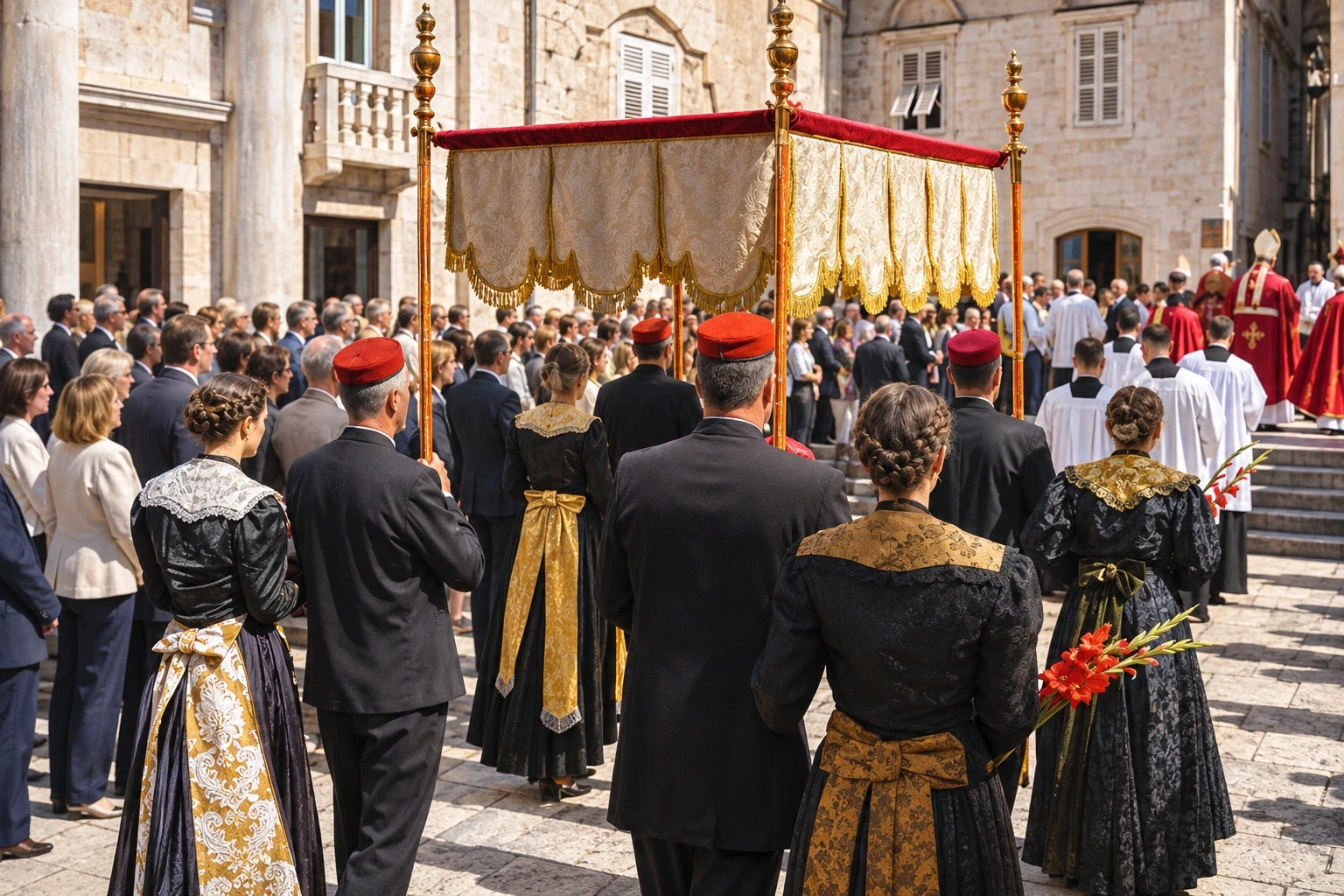
Called Sudamja, it celebrates the city’s patron saint on May 7. St. Domnius was bishop of nearby Salona. His relics are kept in the cathedral, originally Diocletian’s mausoleum. The celebrations include Mass, a procession and events on the Riva.
Yes. Several scenes were filmed in the cellars of Diocletian’s Palace. Nearby Klis Fortress stood in for the city of Meereen. Local agencies offer tours of the filming locations.
They’re side by side on the harbor waterfront, a few minutes’ walk from Diocletian’s Palace and the Riva. It’s easy to transfer between buses, trains and boats to the islands. City buses to surrounding places such as Trogir, Solin and Klis use a different terminal on Sukoišanska Street.
Yes, if you want a quieter city. Winter is mild, averaging around 8 °C in January, and you can explore the palace, cathedral and museums at leisure. In December, the Riva hosts a Christmas market. Expect more rain, especially in November and December, shorter days and different boat schedules to the islands.
Tradition says rubbing the statue’s big toe brings good luck and grants wishes. The statue of Bishop Gregory of Nin (Grgur Ninski), by sculptor Ivan Meštrović, stands just outside the Golden Gate of Diocletian’s Palace.