Hvar

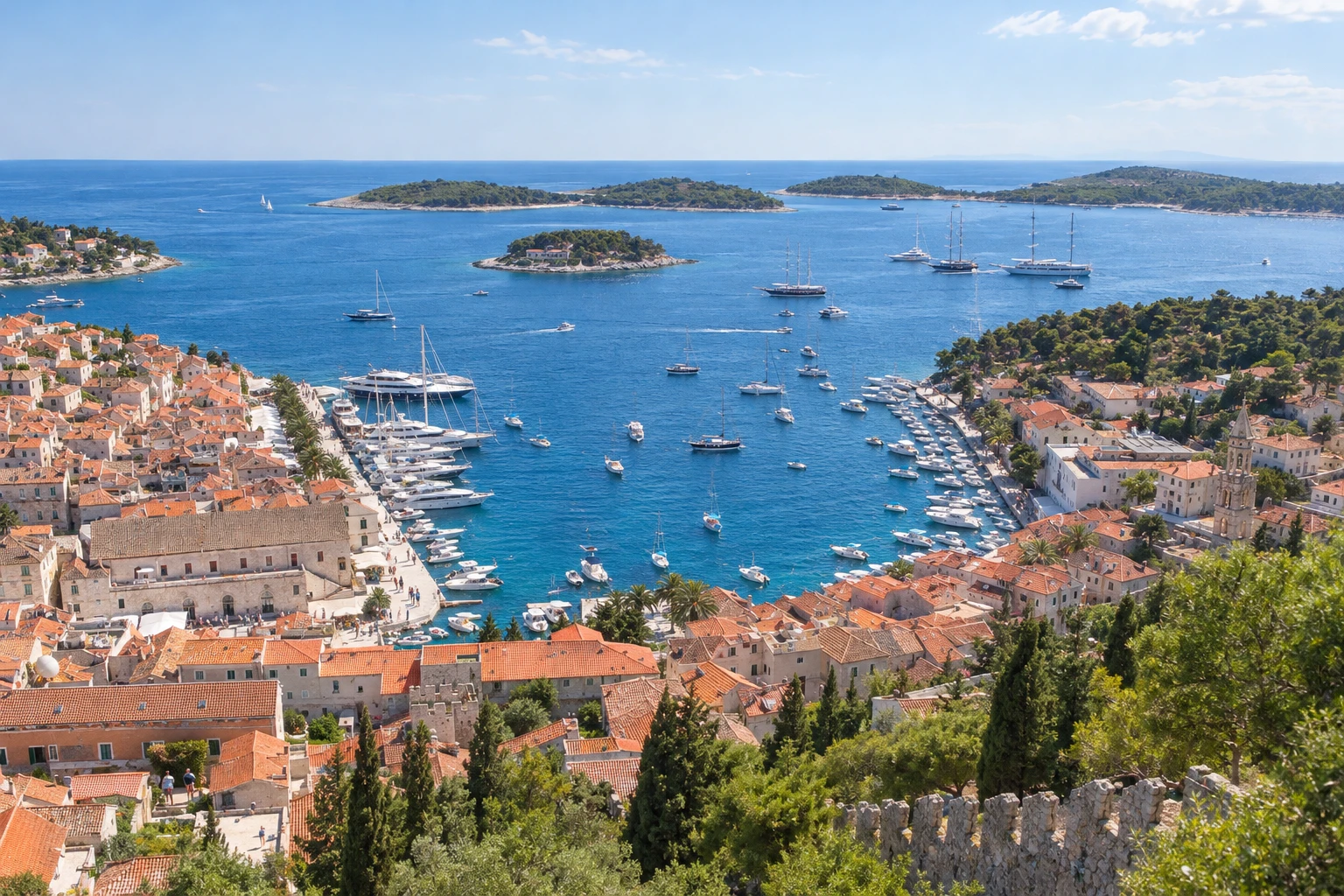
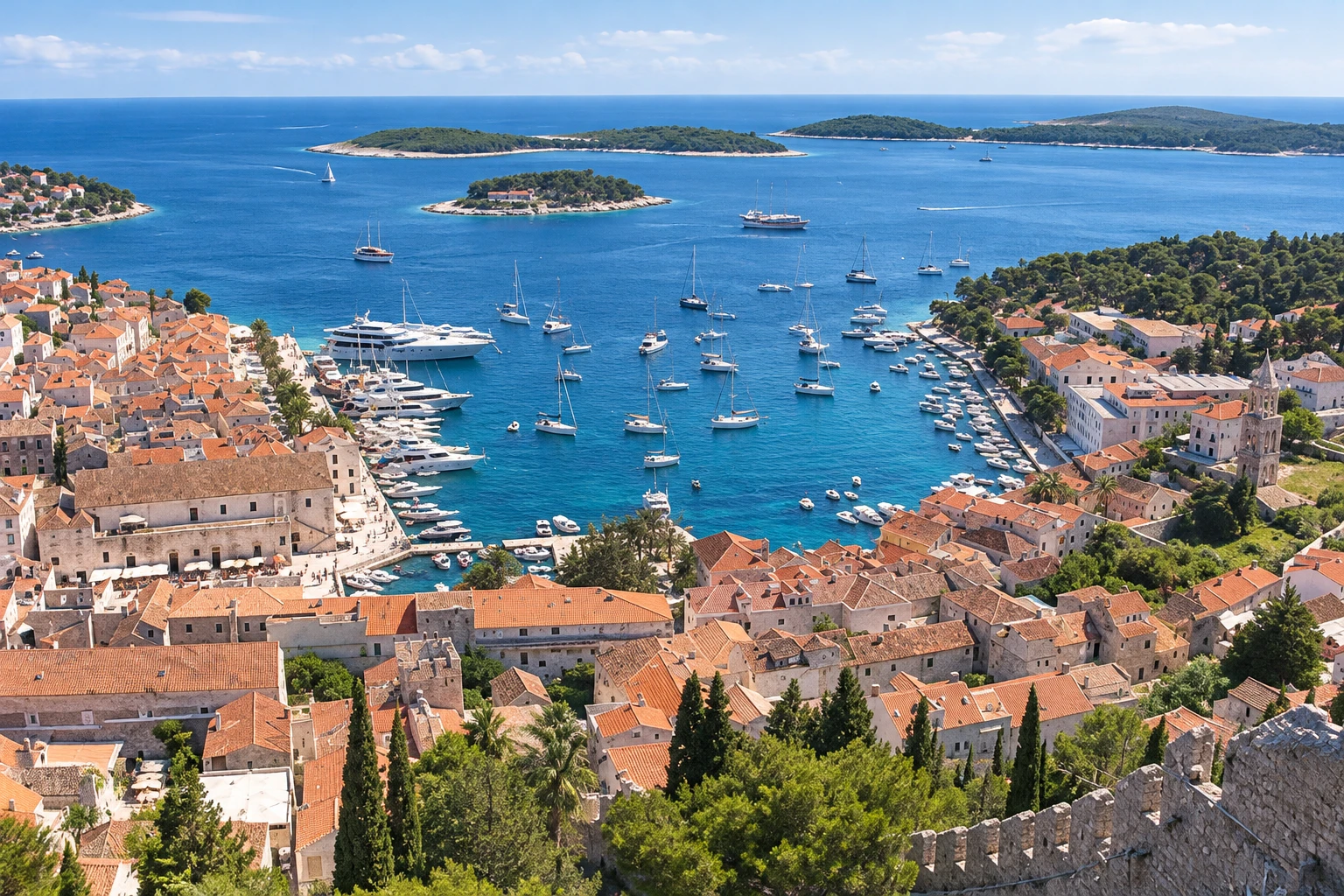
In the photo: Port of Hvar

Illustrative images. The pictures in this guide are illustrations based on the real place, not photographs, and may differ from it.

Get it on Google Play

The city

What to expect from Hvar.

Hvar is laid out around a sheltered port and a square that reaches the Cathedral of Sveti Stjepan. The Fortica occupies the hillside above the center. Offshore, the Pakleni islands offer boat trips with different stops. The town and the island share the same name, but they are not the same landing point.

Hvar Town sits at the western end of Hvar, Croatia's longest island, facing the small Pakleni archipelago. It's the island's capital and largest settlement, the port for catamarans from Split, and the departure point for water taxis to the islets offshore. Its architecture recalls centuries as a major Venetian port in the Adriatic: walls climbing the hillside, a fortress above, stone palaces, and a square opening onto the sea.

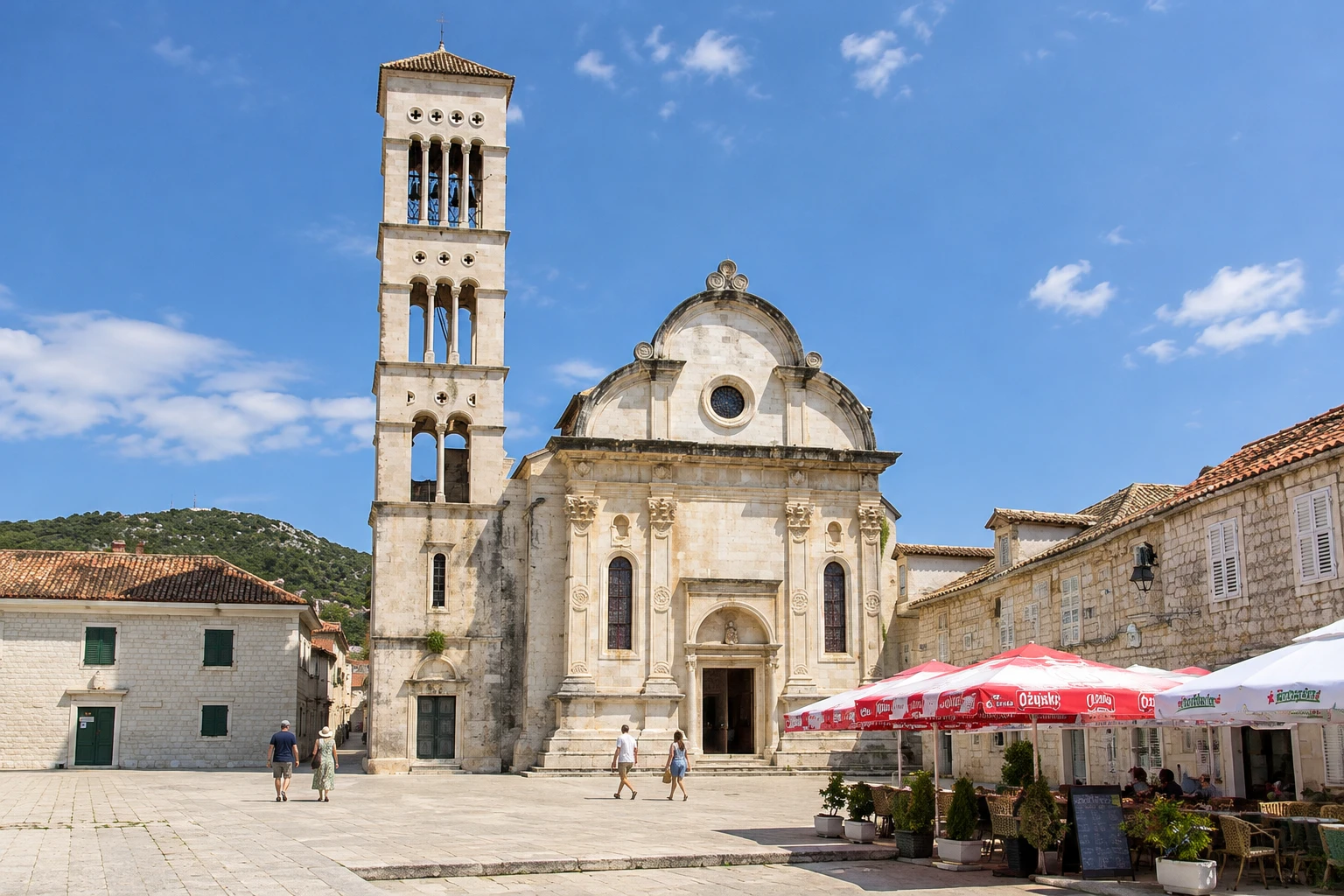
That square, Trg sv. Stjepana, known locally as the Pjaca, is the largest in Dalmatia. Today's paving covers a cove filled in over centuries. The communal well in the middle dates from 1529. At one end stands St. Stephen's Cathedral with its late Renaissance facade and bell tower. At the other is the quay. Beside the harbor, the Arsenal, once a galley shipyard, houses a public theater founded in 1612 on its upper floor. Nearby stand the Loža, the town loggia, and the clock tower.

North of the square, the stepped lanes of Groda lead up to Fortica, the 16th-century fortress overlooking the roofs, harbor, and Pakleni Islands. Along the way is the Benedictine convent, where the nuns make UNESCO-recognized agave lace. Burg lies south of the square. Follow the shore to the Franciscan monastery in Križa cove and nearby beaches including Pokonji dol.

Hvar is known for nightlife and yachts along the quay in high summer. Early in the morning and outside July and August, it moves at the pace of a small island town. The municipality also includes southern pebble coves such as Milna, Zaraće, and Dubovica, the stone lavender villages of Brusje, Velo Grablje, and Malo Grablje, and Sveta Nedjelja among steep hillside vineyards.

The island's climate explains its reputation. Hvar is Croatia's sunniest island, with more than 2,700 sunshine hours a year. June to September is hot and dry, with July and August averaging 25°C. The sea stays above 20°C for more than five months a year. May, June, and September combine sunshine, pleasant water, and lighter crowds. November to March brings more rain, averages around 10°C, and a quieter town. Some tourist services close, but catamarans from Split continue.

Explore the center on foot. Boats reach the islets and many coves. Two days cover town and the Pakleni Islands. With three or more, add the southern coves, inland villages, and neighboring Stari Grad, about 20 minutes away by road.

Share: WhatsApp

Where to stay

30 places to stay in Hvar.

Where to eat

30 places to eat in Hvar.

Mapa de Hvar

Hotéis e restaurantes da cidade no mapa.

Routes in Croatia

Hvar is part of the Dalmatian Islands from Split to Dubrovnik

From Split to Dubrovnik by catamaran across the Adriatic, with stops in Milna, Hvar and Korčula.

Explore the Dalmatian Islands from Split to Dubrovnik

Flavors of Croatia

To try Hvar

Discover other flavors of Croatia

Festivals and events

Festivals Hvar

Dates change every year: check this year's date before you travel.

Festival calendar in Croatia

The local experience

Things to do in Hvar

Hvar · Croatia · Fortress

Fortica Fortress

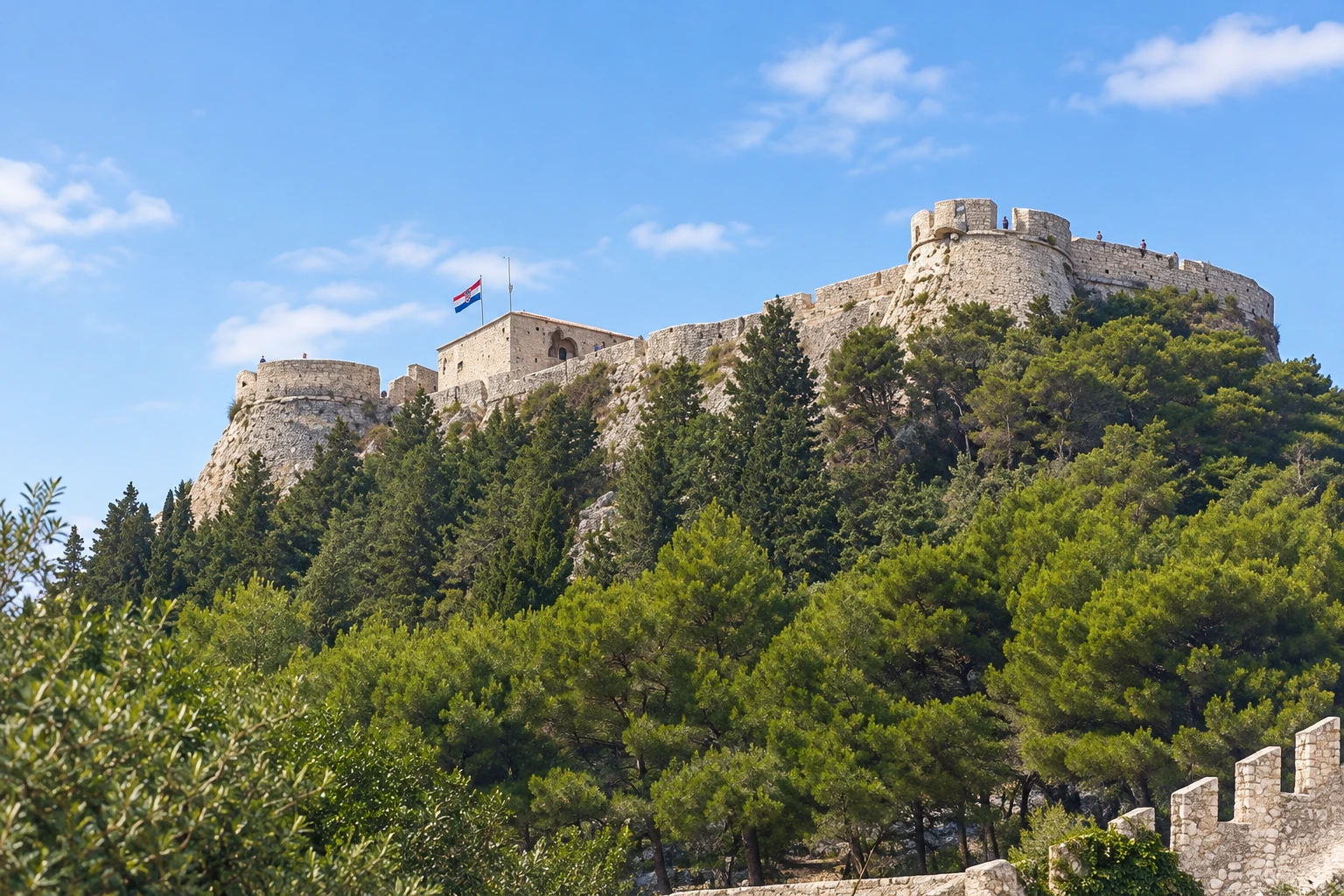
The Fortica occupies the hillside above the town of Hvar. The fortress follows the elevated position of the historic core and allows views over the port, the roofs and the Pakleni islands in the background. The visit combines the ascent from the town's streets with movement within the compound.

Explore Fortica Fortress

Hvar · Croatia · Cathedral

St. Stephen's Cathedral

Katedrala sv. Stjepana closes one end of Hvar's main square. The building and its bell tower form a landmark for those arriving at the port and walking through the center. The visit allows relating the religious space to the layout of the square and surrounding streets.

Explore St. Stephen's Cathedral

Hvar · Croatia · Archipelago

Pakleni Islands

The Pakleni otoci form a group of islands off Hvar. Coves, wooded stretches and rocky coasts make up a landscape experienced by boat and by stops at accessible areas. The archipelago is not connected to the town by bridge or land route.

Explore Pakleni Islands

To choose before you go

Tours in Hvar

Where each tour starts, how long it takes, how it is done, what is included and the price range.

Historic Hvar on foot: the Pjaca, the cathedral, the Loža, and the Arsenal

From Hvar harbor pier On foot About 2 hours Morning or late afternoon Easy

Start on the quay and enter the Pjaca, or Trg sv. Stjepana, Dalmatia's largest square. This was once a deep cove between two fortified settlements, Groda to the north and Burg to the south. Gradual infilling gave the square its present shape by the 15th century, with the cathedral to the east and the sea to the west. The central well dates from 1529. Paving was completed in 1780. St. Stephen's Cathedral, dedicated to Pope Stephen I, a martyr, was built between the 16th and 18th centuries on the site of a Benedictine convent. It has three aisles, a trefoil-shaped late Renaissance facade, and a bell tower finished in the mid-16th century. Venetian masters painted its altarpieces. Near the quay stands the Loža, the town loggia, first recorded in 1289 and rebuilt in the 15th and 16th centuries. Under Venetian rule it served as a public court. The clock tower, known as Leroj, stands beside it. The Arsenal by the quay served as the galley shipyard and storehouse. The present building dates from 1611. The following year saw the addition of the Fontik grain store and Belvedere terrace, the entrance to the theater founded in 1612 and often described as Europe's first public theater. The auditorium with its boxes dates from 1803. Finish with a walk among the stone houses and stairways of Groda behind the square.

Stops: Trg sv. Stjepana (Pjaca), St. Stephen's Cathedral, Loža and clock tower, Arsenal, Hvar Historic Theater.

Includes: The square and streets are free. The cathedral, theater, and Loža charge admission. A combined ticket covers several monuments. Check current prices.

Tip: The square is quieter in the early morning. Summer's midday sun reflects strongly off the pale stone. Go in the morning or late afternoon.

Best time: Year-round, with fewer visitors in May, June and September.

Climb to Fortica, the fortress above the town

From Trg sv. Stjepana (Pjaca) On foot About 1 hour 30 minutes Late afternoon Moderate, with stairs

Fortica crowns the hill north of the square. Defensive works began after 1278, when Hvar came under Venetian rule. The fortress and the walls running down the slope formed a single system. The present fortress dates from 1551. Twenty years later, residents sheltered here when an Ottoman fleet attacked and burned the town. In 1579 lightning struck the powder magazine, and the explosion damaged the fortress. Rebuilding in the early 17th century added Baroque bastions. The last barracks were built in 1775 and 1776. Climb from the Pjaca up the steps through Groda, then follow a hillside path. From the top you can see the roofs, harbor, and Pakleni Islands just offshore. Inside is a collection of amphorae and other objects recovered from the seabed. To avoid the climb, take a taxi or drive to near the entrance.

Stops: Fortica, Groda, Town walls.

Includes: Admission fee. Fortica is included in the combined ticket for the town's monuments. Check current prices and hours.

Tip: Bring water and wear sturdy shoes for the climb. Late afternoon light brings out the islets below.

Best time: Year-round. In summer, avoid midday.

The 1612 theater, agave lace, and the town museums

From The Arsenal, by the harbor On foot 2 to 3 hours Morning Easy

This indoor itinerary works well during the hottest hours or on a rainy day. Begin at the historic theater upstairs in the Arsenal. A Latin inscription above the door recalls 1612 as the second year of peace between the commune's rival groups. The auditorium's neo-Baroque appearance dates from the mid-19th century, and two historic painted stage sets survive, including an 1819 fresco. Continue uphill to the Benedictine convent, housed since 1664 in the family home of poet Hanibal Lucić. Since the 19th century the nuns have made lace here from threads drawn from agave leaves, a technique on UNESCO's intangible heritage list. Each piece is unique and may take months. The convent collection displays lace and works of art. On the square, the cathedral treasury occupies the bishop's palace and holds embroidered 15th-century vestments, precious metalwork, and icons from the island's churches. Outside the old walls, Hanibal Lucić's mid-16th-century summer residence has two buildings and a walled Renaissance garden. It houses the Hvar Heritage Museum. Downtown there's also a museum dedicated to Ivan Vučetić, an island native who pioneered fingerprint identification in criminal investigations.

Stops: Hvar Historic Theater, Benedictine convent, Cathedral treasury, Hanibal Lucić's summer residence, Ivan Vučetić Museum.

Includes: Each site charges admission or requests a donation. The theater is included in the combined monuments ticket. Check current prices.

Tip: Opening hours are short and seasonal. The convent closes at lunchtime and on Sundays. Some museums close on weekends. Check ahead.

Best time: Year-round. Some museums open on fewer days in winter.

Hvar's waterfront: from the Franciscan monastery to Pokonji dol Beach

From Hvar harbor pier On foot 2 to 3 hours, including a swim Morning or afternoon Easy

Follow the seafront promenade from the harbor to the Franciscan monastery on Križa cove. Its Gothic church of Gospa od Milosti was built in the 15th century. Above the main portal is a Virgin and Child by Niccolò di Giovanni Fiorentino. Inside are 16th-century altars and the grave of poet Hanibal Lucić. The refectory holds Matteo Ponzoni's Last Supper, the island's best-known historical painting. A centuries-old cypress grows in the garden. Continue along the waterfront to Pokonji dol, the town's largest beach, a stretch of pebbles 1.5 km from downtown. There are restaurants and rentals for loungers, kayaks, and pedal boats. Seven panels mark a geological trail between Pokonji dol and Punta Kovač on the other side of the harbor. The most unusual is at Punta Kovač, explaining a rare rock formed 66 million years ago that geologists associate with a tsunami triggered by an asteroid impact. In the opposite direction, the promenade leads to more pebble beaches near the hotels.

Stops: Franciscan monastery, Church of Gospa od Milosti, Pokonji dol, Punta Kovač.

Includes: Public beaches are free. Loungers and equipment cost extra. The monastery museum charges admission when open.

Tip: The Franciscan monastery museum doesn't always open to visitors. Check before planning a visit and bring water shoes.

Best time: May to October, or June to September for swimming.

Water taxi to the Pakleni Islands: Jerolim, Marinkovac, and Palmižana

From Hvar harbor pier Water taxi Half a day or a full day Morning and afternoon Easy

The Pakleni Islands form a line of 21 islands, islets, and reefs across the horizon off Hvar Town. Protected for its distinctive landscape, the area has seagrass meadows, caves, and sandy seabeds. There is no bridge or road. In season, water taxis leave Hvar's quay daily, each for a particular cove. Jerolim is a small islet with two pebble beaches and two places serving food and drinks. On Marinkovac, Stipanska has bars and a rocky coast. On the other side, restaurants line Ždrilca cove, and a path leads to Mlini Beach, with clear water surrounded by greenery. Palmižana is the best-known stop. The boat drops you at the marina cove, and a short walk leads to Vinogradišće Bay, with restaurants and a partly pebbly, partly sandy beach popular with families. A 3.5 km trail from Palmižana leads to Vlaka village and another pebble beach. Choose one or two stops per day. Agree on your return time when you disembark and note both the boat's name and the cove.

Stops: Pakleni Islands, Jerolim, Marinkovac, Stipanska, Ždrilca, Mlini, Palmižana, Vinogradišće, Vlaka.

Includes: Pay the boat operator separately for the crossing. Check current fares. Loungers and meals cost extra.

Tip: Bring water, a hat, and water shoes. Outside summer there are few boats and some island restaurants close.

Best time: June to September, when water taxis run daily. In May and October, service depends on the weather.

South coast coves: Mekićevica, Milna, Zaraće, and Dubovica

From Hvar Town Car, bus, boat or on foot Half a day or a full day Morning and afternoon Easy

East of town, the municipality's southern coast is a series of pebble coves set among pines, vineyards, and rocky slopes. Mekićevica, 2.5 km away, has two pebble beaches and a white rocky headland. Reach it along the coast on foot or by boat. Milna, 4 km away, is one of Hvar's oldest seaside resorts, with two family-friendly pebble beaches, waterfront restaurants, and a 17th-century nobleman's house. Nearby are the wooded coves of Malo and Veliko Borče. Boats run from Hvar harbor in season, and you can also drive, take a bus, or follow walking trails. Farther along, Zaraće has a broad pebble beach below the small abandoned village of the same name, perched on a rock. Dubovica, 8 km from town, has one of the island's most popular beaches, a wide stretch of pebbles with a restaurant. Arrive by road or boat. Also about 8 km from town are the Crvene stijene, or Red Rocks, vertical layers of reddish limestone rising from the sea like organ pipes.

Stops: Mekićevica, Milna, Borče, Zaraće, Dubovica.

Includes: The beaches are free. Transportation, parking, and loungers cost extra.

Tip: Arrive early in July and August, when the best-known coves fill up. Bring water and shoes for pebble beaches.

Best time: June to September.

See 2 more tours

Lavender villages: Brusje, Velo Grablje, and Malo Grablje

From Hvar Town Car, bike or on foot Half a day Morning Easy by car, moderate on foot

Three stone villages reveal an inland side of the island quite different from Hvar's quayside. Brusje lies on the old road to Stari Grad, a few kilometers from Hvar, overlooking the mainland and sea. Originally a shepherds' village, its history is intertwined with wine, olive oil, rosemary oil, lavender, and honey. A small family museum displays old objects from the area. The village celebrates its patron saint, St. George, on April 23. Velo Grablje was once the center of lavender production in Dalmatia. Emigration and a fire that destroyed many fields almost emptied the village. A group of young residents revived its traditions and started the Lavender Festival, opening the harvest and oil distillation to visitors. Today the village has a restaurant and is a starting point for walks. Down the hillside is Malo Grablje, abandoned decades ago when its inhabitants moved to Milna on the coast. The empty houses still stand, and a restaurant opens in summer. From here you can descend to Milna. A marked cycling route loops from Hvar through Milna, Velo Grablje, and Brusje and back to Hvar.

Stops: Brusje, Velo Grablje, Malo Grablje, Milna.

Includes: The villages are free to visit. Meals and local products cost extra.

Tip: Lavender usually blooms in early summer. Dates for the Velo Grablje festival change each year, so check ahead. Bring water. The trails have little shade.

Best time: April to June and September to October. In high summer, go very early.

Sveta Nedjelja: steep vineyards, a cave, and the open sea

From Hvar Town Car Full day Morning and afternoon Moderate

Sveta Nedjelja is a settlement about 12 km east of Hvar Town on the south coast below the island's highest ridge. This is the heart of Hvar's wine region. Steep south-facing slopes give the Plavac Mali grape the conditions it needs, and vines cover the hillsides. Above the village is a large, easily reached cave used as a shelter and place of worship since ancient times. Remains of a small 16th-century religious retreat survive inside. The cliffs make Sveta Nedjelja the island's main rock climbing destination, with a via ferrata. Below are pebble beaches and restaurants. Hikers descending Hvar's highest peak stop at Lučišće cove beneath the cliffs. A little farther on, Jagodna and Bojanić bad, about 13 km from town, combine pebble beaches with sloping vineyards. The village is easiest to reach by car. Wine is part of local life, so save tastings for another time if you're driving.

Stops: Sveta Nedjelja, Sveta Nedjelja Cave, Lučišće, Jagodna.

Includes: Winery tastings, meals, and climbing equipment cost extra and require advance reservations.

Tip: Check the access route before leaving. Wear hiking shoes for the cave.

Best time: May to October. Spring and fall are more comfortable for climbing.

Day by day

1, 2 and 3-day itinerary in Hvar

Suggestions to plan the trip. Change the order of the days according to the weather and tour availability.

1 day · 1 day in Hvar Town: the square, the fortress, and a cove

For Visitors coming for the day by catamaran from Split or stopping between islands · Based in Hvar Town
  1. Day 1 · From the Pjaca to Fortica, with a swim in the sea

    After disembarking, start at the Pjaca. See St. Stephen's Cathedral, the 1529 well, the Loža with its clock tower, and the Arsenal. Go upstairs to the historic theater, then on to the Benedictine convent for its agave lace. Before the midday heat, climb the Groda steps to Fortica for views over town and the Pakleni Islands. Have lunch downtown. Spend the afternoon by the sea. In summer take a water taxi to Jerolim or Palmižana and return at day's end. Out of season, walk along the waterfront to the Franciscan monastery and Pokonji dol Beach. Stroll along the quay before the last catamaran and check the return sailing well ahead.

2 days · 2 days in Hvar: the town and the Pakleni Islands
For Overnight visitors dividing their time between historic sights and the sea · Based in Hvar Town
  1. Day 1 · The historic center, museums, and Fortica

    In the morning explore the Pjaca, cathedral, Loža, and Arsenal, and visit the theater founded in 1612. Continue to the Benedictine convent and cathedral treasury or the summer residence of Hanibal Lucić. After lunch, rest during the hottest hours or follow the waterfront to the Franciscan monastery and Pokonji dol for a swim. Climb to Fortica in late afternoon. For the evening, check the June–September summer festival program for events at the theater, monastery, and other historic venues.

  2. Day 2 · A day on the islets

    Take a water taxi from the quay in the morning. Spend the morning on Marinkovac between Ždrilca and Mlini Beach and the afternoon at Palmižana, crossing on foot to Vinogradišće Bay. If you'd prefer to stay in one place, choose Jerolim. Arrange your return with the boat operator and bring water and water shoes. Outside summer, when boats run less often, substitute Mekićevica and Milna, reached on foot, by bus, or by car.

3 days · 3 days in Hvar: the town, islets, and island interior
For Visitors who want time to explore the city and its rural outskirts · Based in Hvar Town
  1. Day 1 · The city

    Start the morning at the Pjaca, St. Stephen's Cathedral, the Loža, Arsenal, and historic theater, then visit the Benedictine convent and museums. In the afternoon follow the waterfront to the Franciscan monastery and Pokonji dol. Climb to Fortica at day's end.

  2. Day 2 · Pakleni Islands

    Spend the day island-hopping by water taxi: Marinkovac for Ždrilca and Mlini, and Palmižana for Vinogradišće Bay. For a walk, follow the trail from Palmižana to the village of Vlaka. Return in late afternoon and stroll along the quay.

  3. Day 3 · Lavender villages and the south coast

    In the morning drive or cycle up the old road to Brusje and continue to Velo Grablje and Malo Grablje. Descend to Milna for lunch facing the sea. Spend the afternoon there or at Dubovica Beach. Another option is Sveta Nedjelja, with its cave, vineyards, and pebble beaches. Without a car, take a scheduled bus from Hvar to neighboring Stari Grad to visit the old town and UNESCO-listed agricultural plain. Check return times.

Best time to go

When to go: Hvar month by month

The seasons shown are the most usual ones; nature doesn't always follow the calendar.

January Some rain

The coldest month averages around 9°C, with about 10 rainy days interspersed with sunshine. The town is quiet and many tourist services close. Catamarans from Split continue on a reduced schedule. It's a good time for walks and exploring the town without crowds.

February Some rain

Temperatures average around 9°C and days are slightly longer. Low season continues with reduced services. Rough seas can delay or cancel boats. Trails to Milna and the inland villages are rewarding on clear days. Bring warm clothing and rain gear.

March Some rain

Temperatures rise to an average of about 11°C, and the island starts preparing for the season. Rain still falls on about 10 days. The green interior makes this a good time for cycling and walking. Check which museums and restaurants have reopened.

April Some rain

Dry Stone Days in Velo Grablje · Feast of St. George in Brusje (April 23)

Spring averages around 14°C, with more hours of sunshine. Some services reopen and boat connections start increasing. The sea is still cold for swimming. This is a good month for inland villages, Fortica, and coastal trails.

May Low rain

Tour de Hvar trail race (mid-May)

Temperatures average about 18–19°C, with little rain and long days. Weather permitting, water taxis to the Pakleni Islands resume, and crowds are still moderate. By late in the month you can try a first swim in the cool sea. This is one of the most pleasant months for walking and cycling.

June Low rain

Hvar Summer Festival opens at month's end

Early summer brings averages of 22–23°C, about 6 days of rain, and more than ten hours of sunshine a day. The sea is comfortable for swimming, water taxis run daily, and the town gradually fills. Lavender usually blooms around this time. Book accommodation and catamarans ahead.

July Low rain

Hvar Summer Festival · Lavender Festival in Velo Grablje (date to be confirmed) · Summer Jazz in Milna (late in the month)

The driest and sunniest month averages 25°C, with afternoons above 30°C on more than a third of days. It's peak season, with a busy quay, lively nightlife, and crowded beaches. Go to the coves early and explore the historic center in the morning or late afternoon. Festival concerts and plays fill historic venues.

August Low rain

Hvar Summer Festival · Summer Jazz in Milna (early in the month)

The heat matches July, averaging 25°C, and rain is rare. This is the busiest month. Buy catamaran tickets ahead and arrive early for water taxis. Southern coves and more distant islets usually offer more space than beaches beside town.

September Some rain

Hvar Summer Festival through early September

Temperatures average around 22°C, the sea remains warm, and crowds thin from midmonth. Rain gradually returns, falling on about 6 days. Water taxis and catamarans still run frequently.

October High rain

Mild fall weather averages 18°C, with rain on about 9 days. Swimming is still possible on sunny days. Crowds thin, water taxis become less frequent, and some island restaurants close. A good time for villages and walks.

November High rain

Theater Night, with events at the historic theater

The wettest month of the year brings about 11 rainy days and an average near 14°C. Low season begins, with shorter monument hours and fewer boats. The historic theater hosts concerts and performances.

December High rain

Hvar Christmas market · Feast of Sv. Špirijun in Sveta Nedjelja (December 14) · New Year's Regatta at month's end

Temperatures average around 10°C, with rain on about 12 days. The holiday program includes a Christmas market, and the New Year's Regatta brings sailors to the harbor. Few hotels and restaurants stay open. Reserve ahead and check catamaran times.

Plan the journey

How to get there: Hvar

By catamaran: directly from Split to Hvar Town harbor

The simplest way to arrive is the passenger catamaran from Split to Hvar Town's central harbor, about an hour away. Several operators serve the route year-round, with few sailings in winter and many in summer.

The catamarans do not carry cars. Seats sell out in July and August, so buy ahead online or at the Split harbor ticket counters. Make sure your ticket says Hvar Town rather than Stari Grad or Jelsa.

Catamarans also leave Hvar Town for Korčula and, on some days, Vis. In season, coastal routes connect Hvar with Brač, Korčula, Mljet, and Dubrovnik. Rough seas can delay or cancel sailings, especially in fall and winter.

By car ferry: Split–Stari Grad and Drvenik–Sućuraj

Hvar Island has four ports with scheduled services. Only two take cars. The main ferry terminal near Stari Grad has year-round sailings from Split, with a crossing time of about two hours. From the terminal, Hvar Town is about a 20-minute drive. Scheduled buses meet the ferries and continue to town. Buy tickets on board.

At the island's eastern tip, the Drvenik–Sućuraj ferry takes about 30 minutes, a convenient crossing from Dubrovnik and the south. From Sućuraj the drive runs the length of the island to Hvar Town and takes about 1½ hours.

Split ferries fill up in summer. Reserve a space for your car and arrive early for boarding. In peak season there is also a ferry from Italy to Stari Grad.

By air: Split Airport and the boat crossing

Hvar has no scheduled flights. Only a small airfield for light aircraft operates on the Stari Grad Plain. The main airport for the island is Split (SPU) on the mainland.

Take a bus, taxi, or transfer from the airport to Split harbor, about 25 km away. Continue by catamaran to Hvar Town or by ferry to Stari Grad. Allow plenty of time between landing and sailing, especially outside summer, when daily departures are limited. A late afternoon flight may mean spending the night in Split.

From Dubrovnik Airport you can continue by catamaran in season or travel by road to Drvenik for the Sućuraj ferry.

By bus and car around the island

Scheduled buses link Hvar Town with Stari Grad, the ferry terminal, Jelsa, and Vrboska. Several daily departures are timed to meet ferries from Split. Buy your ticket from the driver.

Two roads lead to Stari Grad. The newer, faster road passes near Milna, while the slower, scenic old road goes via Brusje. A car is handy for the southern coves and Sveta Nedjelja.

Taxis and car, scooter, and bike rentals are available in town.

Getting around town on foot and by water taxi

Walk around the compact historic center. From the Pjaca it's only a few minutes to the Franciscan monastery or the start of the Fortica climb. The lanes of Groda rise in steps, so pack light if you're staying there.

In season, water taxis leave from the quay for the Pakleni Islands and some coves. Walk along the waterfront to Pokonji dol or, if you have more time, to Mekićevica and Milna.

If you're arriving by car, arrange parking with your accommodation before traveling.

Your questions

Frequently asked questions about Hvar

Is Hvar the port for car ferries?

Ferries from Split carrying vehicles arrive at Stari Grad, and the continuation to Hvar is by road.

How many days to stay in the town of Hvar?

Three nights allow splitting time between the center, the Fortica and a sea outing.

Can the Pakleni be visited on foot from Hvar?

No. They are islands and require a crossing, with defined landing and return points.

Does Hvar's fortress require a climb?

Access on foot involves elevation change and stairs; consider road transport to the nearby area if you want to reduce the walk.

When is the best time to visit Hvar Town?

June to September brings beach weather, daily water taxis, the summer festival, and hot, dry days. July and August are the busiest months, with the liveliest nightlife. May, June, and September combine sunshine, pleasant seas, and fewer crowds. November to March is wetter, averaging around 10°C. Some hotels, restaurants, and museums close, but catamarans still connect the town with Split.

How do I get to Hvar Town from Split?

Passenger catamarans sail directly from Split harbor to Hvar Town in about an hour. They run year-round, with more departures in summer. With a car, take the roughly two-hour ferry to Stari Grad and drive another 20 minutes. Buy ahead in July and August and check the destination port on your ticket.

Does Hvar Island have an airport?

There are no scheduled flights. The island has only a small airfield for light aircraft on the Stari Grad Plain. The usual airport is Split on the mainland. Continue about 25 km to Split harbor, then take a catamaran or ferry. In season you can also arrive by catamaran from Dubrovnik.

How do I get from Stari Grad ferry terminal to Hvar Town?

Take a scheduled bus, taxi, or car. Buses meet ferries from Split and continue to Hvar Town. Buy tickets on board. By car it's about 20 minutes on the newer road. Outside summer there are only a few buses each day, so check the timetable before boarding in Split.

Which beaches are near central Hvar?

The beaches are pebbly or rocky. The town's largest, Pokonji dol, is 1.5 km from the center along the waterfront. Other pebble beaches lie beside the hotels across the harbor. East along the coast you'll find Mekićevica, 2.5 km away, and Milna, 4 km away. For patches of sand, take a water taxi to Palmižana in the Pakleni Islands.

Which Pakleni island should I choose for the day?

Jerolim is a small islet with two pebble beaches. Marinkovac has bars and a rocky shore at Stipanska, and the quieter Ždrilca cove, with a path to Mlini Beach. Palmižana has sandy stretches and restaurants at Vinogradišće Bay, popular with families. Water taxis leave from Hvar's quay. Agree on your return time when you get off.

What is Hvar agave lace and where can I see it?

It's lace made with threads drawn from agave leaves. Only the nuns of Hvar Town's Benedictine convent have practiced the technique since the 19th century. UNESCO recognizes it as intangible heritage. Each piece is made without a pattern, and larger works take five to six months. Visit the collection at the convent in Groda. It has short opening hours and closes on certain days, so check ahead.

When can I see lavender in Hvar?

Lavender usually blooms in early summer, with the harvest following shortly afterward. Velo Grablje, in Hvar municipality, is the village most closely associated with lavender. Its festival features harvesting and oil distillation. Dates vary each year, so check before traveling. Brusje, on the old road to Stari Grad, also has a tradition of growing lavender.

Is Hvar worth visiting in winter?

Yes, if you like quiet streets and walking. Temperatures rarely drop below 10°C, and there are plenty of sunny days between showers. Few hotels and restaurants stay open, water taxis to the Pakleni Islands virtually stop, monuments keep shorter hours, and catamarans run infrequently. Book accommodation and check the boats ahead of time.

What does Hvar's combined monuments ticket include?

It covers Fortica, the historic theater, the Arsenal, the Loža, the clock tower, and the church of Sv. Ivan. The cathedral, Benedictine convent, and museums charge separately. The ticket is worthwhile if you plan to climb to the fortress and visit the theater. Check current prices and seasonal opening hours.

Traveler, share your experiences through photos Up to 5 photos of each place you visited.
See the destination Hvar Find another city