Šibenik

Šibenik-Knin Capital

Šibenik

In the destination Šibenik.

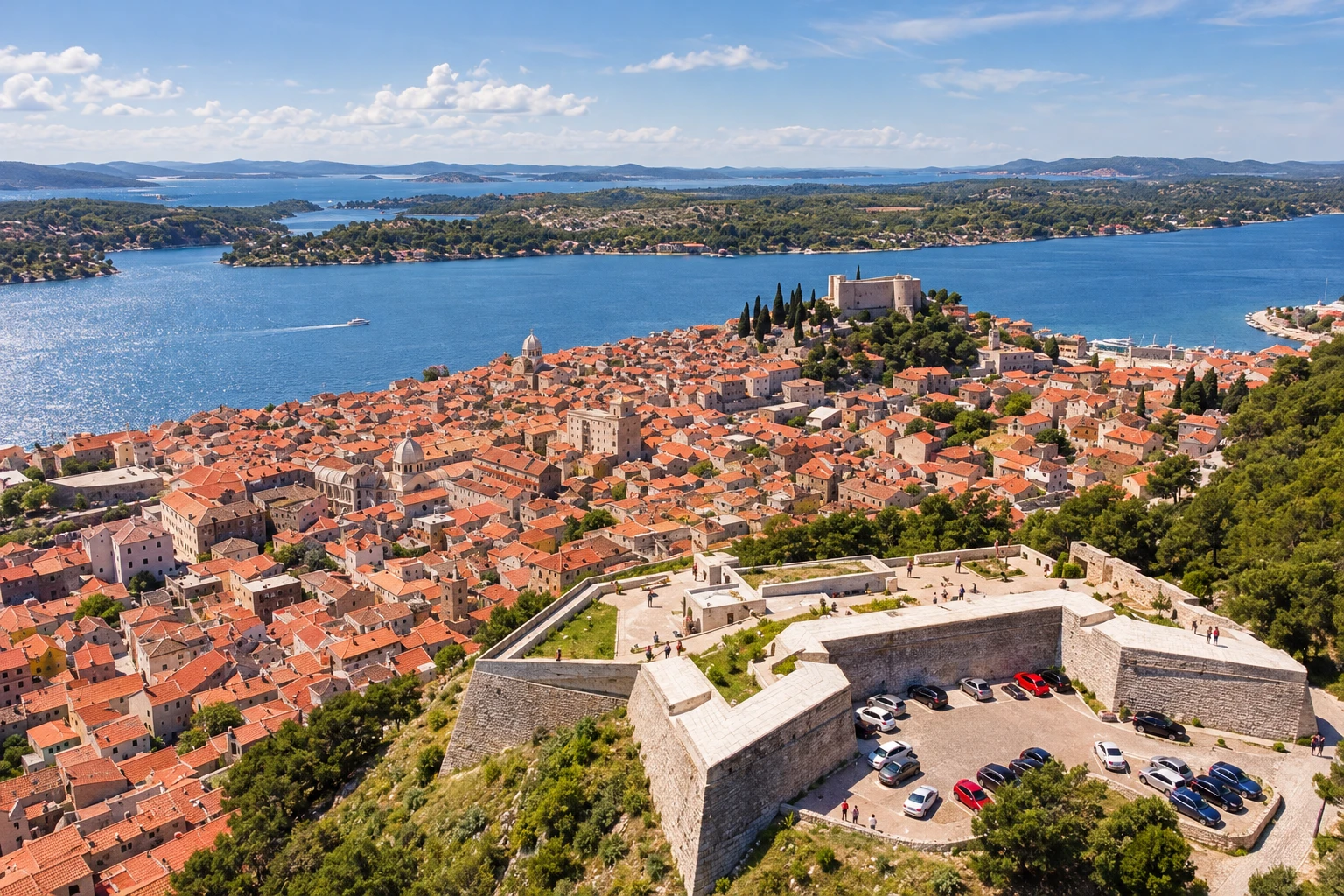
In the photo: Šibenik historic center

Illustrative images. The pictures in this guide are illustrations based on the real place, not photographs, and may differ from it.

Get it on Google Play

The city

What to expect from Šibenik.

Šibenik pairs the Cathedral of St. James with fortresses in different positions: St. Michael and Barone occupy hills, while St. Nicholas guards the channel entrance. The town is also a base for Skradinski buk in the Krka. The center has stairways and sloping streets, so the itinerary alternates the waterfront and the climbs.

Šibenik lies midway along the Dalmatian coast in a deep, sheltered bay where the Krka River meets the Adriatic. The seat of Šibenik-Knin County, it has about 40,000 residents and lies halfway between Zadar and Split, about an hour's drive from either. The open sea comes into view only beyond St. Anthony's Channel (Kanal sv. Ante), a narrow passage about 2.5 km long linking the bay to the archipelago.

Unlike most towns on the Croatian coast, Šibenik has neither Greek nor Roman origins. Croats founded it in the Middle Ages, and the first written mention appears in a document issued by King Petar Krešimir IV at Christmas in 1066. Its streets follow no regular grid. The old town climbs the hillside in lanes and stairways beneath St. Michael's Fortress, resembling a stone amphitheater from the sea. Locals divide it into Gorica, the upper town, Dolac, the lower waterfront area, and Grad, the flatter section with the cathedral and squares.

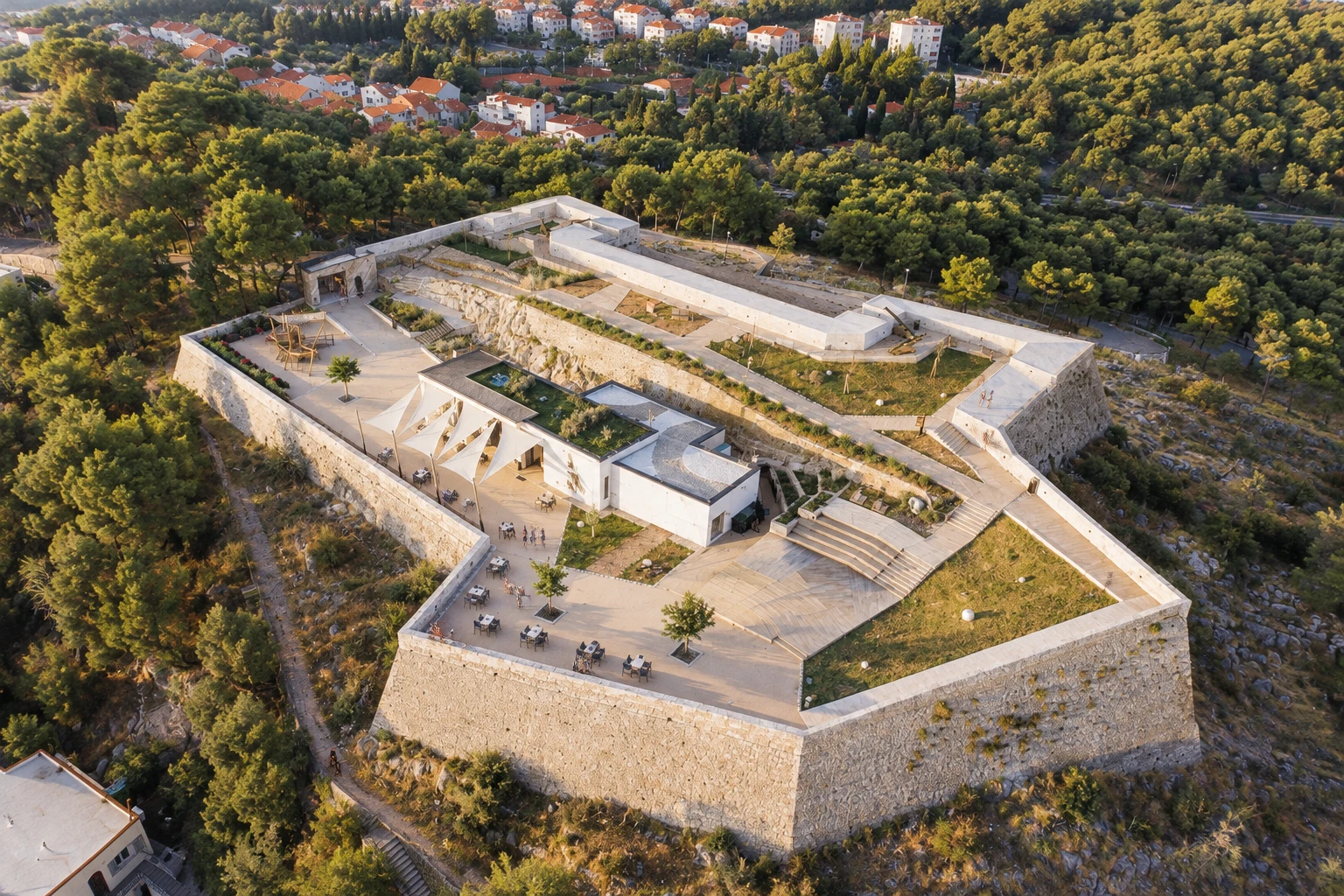
Šibenik has two UNESCO World Heritage sites. The Cathedral of St. James (Katedrala sv. Jakova), built over 105 years beginning in 1431, is entirely stone, from walls to dome. The 16th-century St. Nicholas' Fortress (Tvrđava sv. Nikole) occupies an islet at the channel entrance and is accessible by boat. Three more fortresses rise on hills above the center: St. Michael's, the oldest, now a summer concert venue, and St. John's and Barone, built by the townspeople in 1646 under threat from the Ottomans.

Šibenik is also a base for trips on the water. Scheduled boats leave the waterfront for Zlarin, Prvić, Kaprije, and Žirje, and in summer for the beaches of Jadrija and Martinska. Banj Beach is a few minutes' walk from the center with views of the old town. The Lozovac entrance to Krka National Park, which gives access to the Skradinski buk waterfalls, is about 15 km away within the municipality. In 1895 the falls powered street lighting in Šibenik through one of the world's first alternating-current systems.

The climate is Mediterranean. July and August are hot and dry, averaging close to 25°C with plenty of sunshine. This is the busiest season for beaches and concerts in the fortresses. May, June, and September are milder and easier for uphill walks. Rain increases from October to December. Winter is cool, with averages of 7°C to 8°C in January and February and occasional bura, a cold wind from inland.

With limited time, the essentials fit into a day: the cathedral, the old town streets, and the climb to St. Michael's. With two or three days, add the other fortresses, the boat trip to St. Nicholas', an island, and the Krka waterfalls. Bring sturdy shoes. Almost all of the old town is explored on foot over smooth stone and steps.

Share: WhatsApp

Where to stay

32 places to stay in Šibenik.

Where to eat

25 places to eat in Šibenik.

Map of Šibenik

The city's hotels and restaurants on the map.

The local experience

Things to do in Šibenik

Šibenik · Croatia · Cathedral

Cathedral of St. James

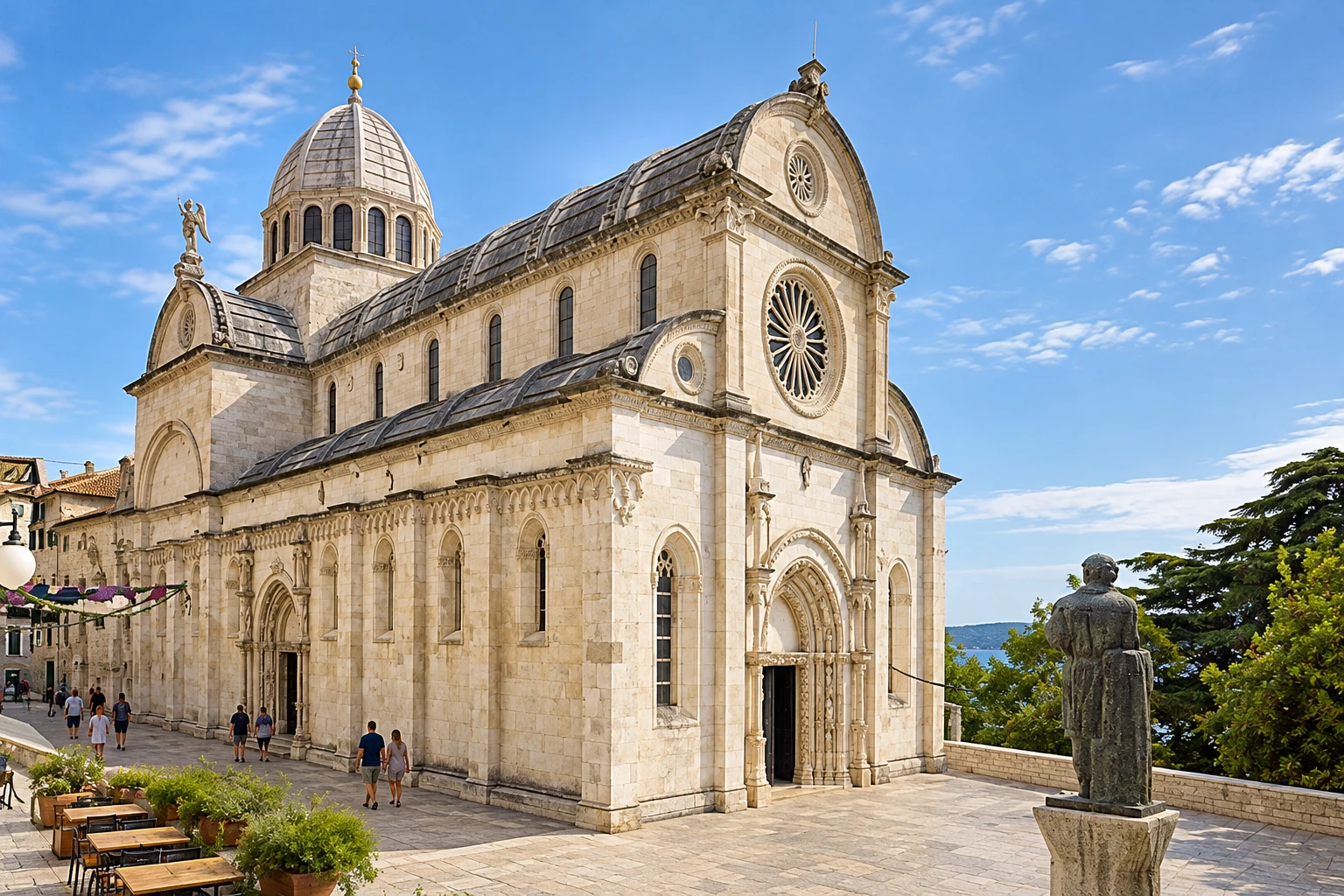
The Katedrala sv. Jakova rises beside the square and the waterfront of Šibenik's historic center. The cathedral combines Gothic and Renaissance solutions in a stone construction. Its mass and dome appear from various points in the town, but the visit also calls for observing the facades up close.

Explore Cathedral of St. James

Šibenik · Croatia · Fortress

St. Michael's Fortress

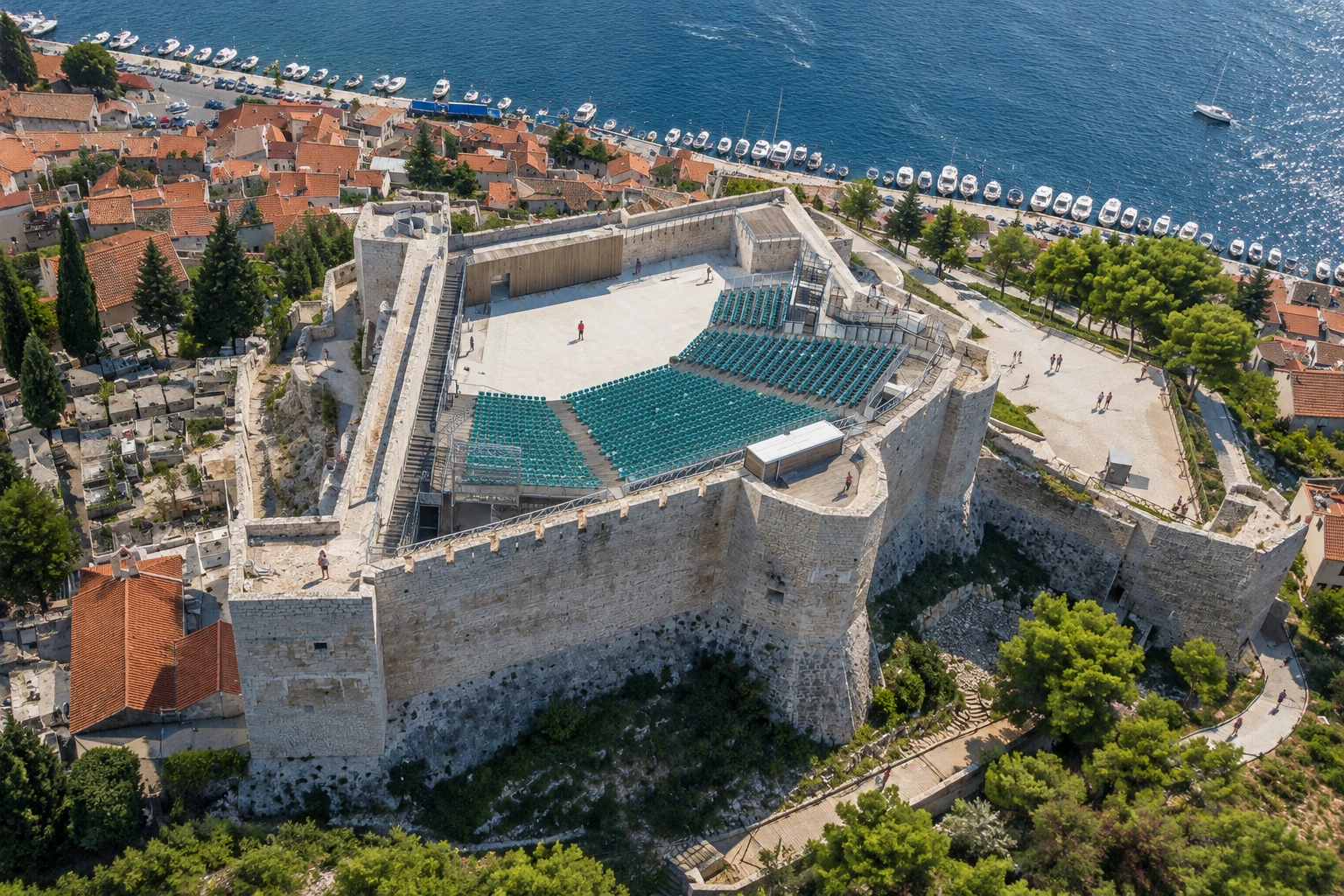
The Tvrđava sv. Mihovila sits on a rise above Šibenik's center. The fortress is linked to the formation of the urban core and offers a reading of the town from above. The contrast between the walls, roofs and the channel explains part of the visit's interest.

Explore St. Michael's Fortress

Šibenik · Croatia · Fortress

St. Nicholas Fortress

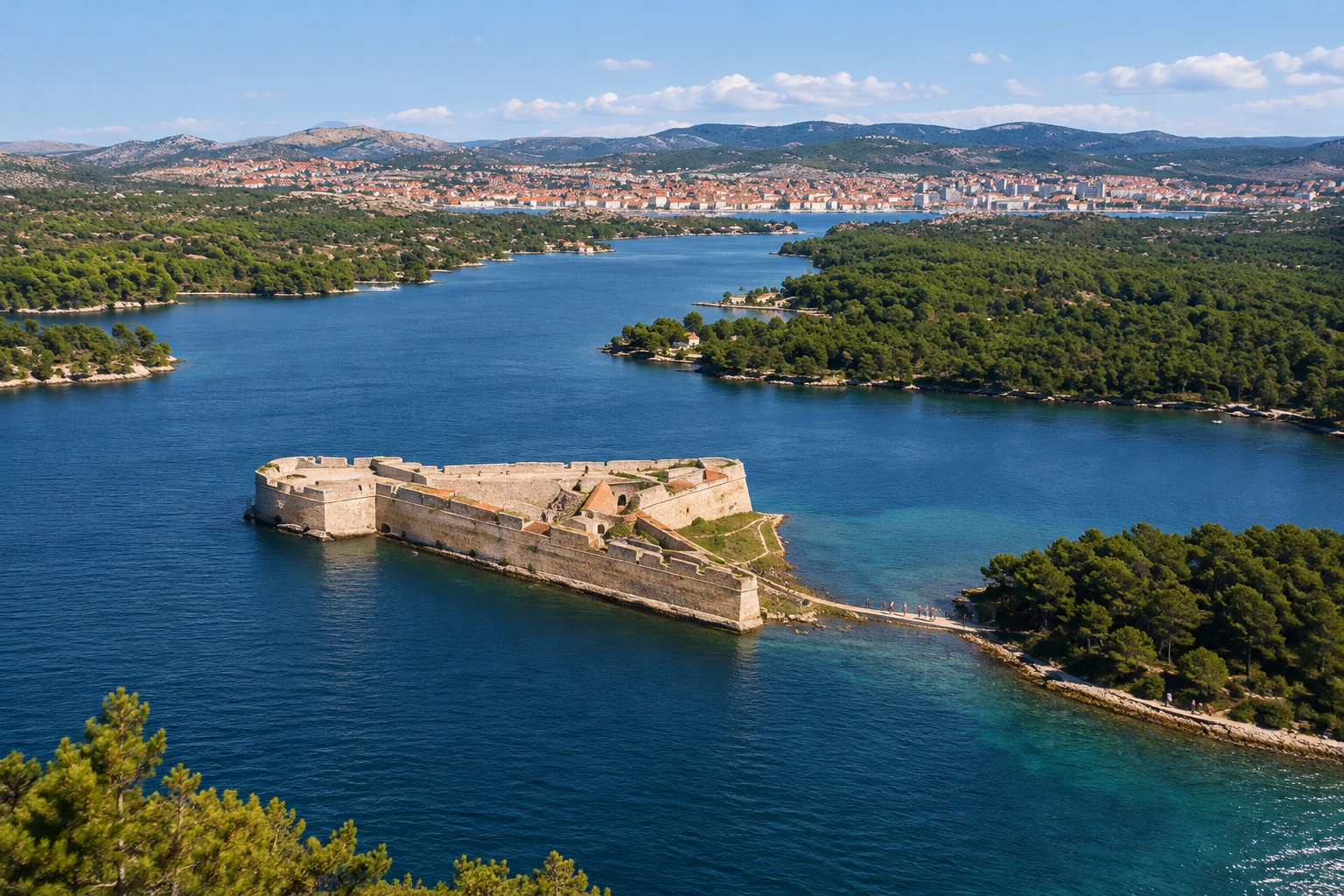
The Tvrđava sv. Nikole sits by the entrance to the Sveti Ante (Santo António) channel, at Šibenik's maritime approach. Its position on the water and the design of the fortification set this complex apart from the hilltop fortresses of the city. It is a visit that requires its own logistics.

Explore St. Nicholas Fortress

Šibenik · Croatia · Fortress

Barone Fortress

The Tvrđava Barone sits on a hill in Šibenik and offers a different reading of the city's fortification system. The site faces the landward relief and the position of the urban core by the channel. The visit complements the São Miguel fortress without repeating the same siting.

Explore Barone Fortress

See 1 more place in Šibenik

To choose before you go

Tours in Šibenik

Where each tour starts, how long it takes, how it is done, what is included and the price range.

Walking the old town via the cathedral square, Four Wells, Kalelarga and Masna

From Poljana, the square at the entrance to the old town Self-guided walk 2 to 3 hours Morning or late afternoon Easy to moderate, with steps

Šibenik's car-free old town is best explored on foot. Enter from Poljana, the square that once stood against the city walls, and you'll reach a small open space where the way forks into two very different streets. To the left is Kralja Tomislava, known locally as Kalelarga, the wide street. Long the street of traders, craftspeople, and evening strolls, it still has shops selling local crafts and souvenirs. Follow the stone paving to the end for the Cathedral of St. James. The cathedral stands on the Square of the Republic of Croatia, the heart of town life since the Middle Ages. Around it are the loggia, the Bishop's Palace adjoining the church, and the Prince's Palace, the former seat of Venetian authority and now the City Museum. West of the cathedral is the Square of the Four Wells. What looks like a brick terrace with four stone wellheads is the roof of a large public cistern commissioned in 1446, which supplied water until the 19th century. The wellheads bear carvings of the lion of St. Mark and of St. Michael, Šibenik's patron saint. Back at the fork, the other street, Zagrebačka, takes you into Masna, or “greasy street.” The nickname comes from taverns that served workers and passersby their midmorning meal. It's lively year-round, with cafés and places serving daily specials in the side lanes. At the end of Masna, the way climbs into Gorica, the steepest part of the center, leading up to St. Michael's Fortress. Look for small churches along the way. There are more than twenty in the old town, and stairways are everywhere: the city counts about 2,800 steps.

Stops: Poljana, Kalelarga (Kralja Tomislava Street), Republic of Croatia Square, Cathedral of St. James, Square of the Four Wells, Masna ulica (Zagrebačka Street), Gorica.

Includes: Self-guided outing. The streets and squares are free. The cathedral, City Museum, and interior of the Four Wells cistern have their own admission charges and visiting periods. Check each before going.

Tip: The smooth stone streets become slippery when wet. Wear shoes with good grip. In summer, go early or after the midday heat, when the town starts filling up again.

Best time: Year-round. During June's International Children's Festival, the streets are decorated and filled with workshops and performances.

St. James’s Cathedral, Civitas Sacra and the City Museum

From Republic of Croatia Square On foot 2 to 3 hours Morning or afternoon Easy

The Cathedral of St. James joined the UNESCO World Heritage List in 2000. Construction began in 1431 and lasted 105 years, long enough for its early Gothic style to blend with the Renaissance style of the later work. The distinguishing feature is its material: the whole cathedral is stone, without mortar, timber beams, or roof tiles. Large stone slabs were carved to fit together. Look up inside and you'll see the same shapes visible on the exterior facade, roof, and dome. The master who changed the design was Juraj Dalmatinac, whose signature appears on the apses. He carved the frieze around the back of the church with 71 human heads and 3 lions' heads. The human faces portray his contemporaries, mostly men but also women and children, almost at eye level as you walk past. He also designed the baptistery on the lowest level, a small space where Gothic stone lacework meets Renaissance sculpture. After his death, Nikola Firentinac completed the vaults and dome. A three-minute walk away on Kalelarga, Galbiani Palace houses Civitas Sacra, the cathedral interpretation center. Interactive exhibits on three floors explain how the church was built and display sacred art from the cathedral and parishes throughout the diocese. Beside the cathedral in the Prince's Palace, the City Museum tells the story of Šibenik and its region from prehistoric times to the end of the 18th century. Begin in the atrium with the archaeological collection, including ritual vessels of the Danilo culture. A section on the cathedral displays original pieces of its dome.

Stops: Cathedral of St. James (Katedrala sv. Jakova), Cathedral baptistery, Civitas Sacra in Galbiani Palace, Šibenik City Museum in the Rector’s Palace.

Includes: The cathedral, Civitas Sacra, and the museum each charge admission. Check current prices and opening periods before visiting.

Tip: The cathedral hosts Mass, weddings, and baptisms. Dress appropriately and keep quiet. Walk around the outside first to see the frieze of heads and the dome from different angles.

Best time: Year-round. A good option on rainy days or during the hottest summer hours.

St. Michael’s Fortress and St. Lawrence’s Garden

From Old Town, via the uphill route through Gorica On foot 2 to 3 hours Morning or late afternoon Moderate, with an uphill flight of steps

St. Michael's is the oldest of Šibenik's four fortresses and the place where the city began, with the settlement growing beneath it. It stands on a rocky outcrop about 70 meters above the old town and takes its name from the Archangel Michael, Šibenik's patron saint, whose image appears on buildings throughout the city. For centuries the fortress and the walls extending from it toward land and sea protected the town. After taking control, the Venetians added a double wall forming a retreat corridor to ships in the harbor. Long a military zone closed to residents, it's now the city's main summer stage, with a 1,077-seat amphitheater facing the bay. From above you can see the old town roofs, the cathedral dome, St. Anthony's Channel, and the islands. Projections illuminate two 15th-century cisterns inside, and an audio guide is available. The fortress has two entrances. The southern one serves walkers climbing from the old town through Gorica's lanes and steps. The northern entrance near the fire station has road access and is the entry point for visitors with reduced mobility. From the plateau an elevator serves the other levels. On the way up or down, stop at the Mediterranean garden of St. Lawrence's Monastery, beside the church bell tower at the top of one of Gorica's steepest streets. The medieval-style layout has paths forming a cross, a small central fountain, and four box-edged beds of aromatic and medicinal herbs. Capers grow in cracks in the walls. There's a café and restaurant.

Stops: Gorica, Mediterranean Garden of St. Lawrence’s Monastery, St. Michael’s Fortress (Tvrđava sv. Mihovila).

Includes: The fortress charges admission, with a combined ticket for all three land fortresses. St. Lawrence's garden charges a small fee if you don't order at the café. Check current prices.

Tip: Hours change seasonally, and sightseeing may end earlier on concert days. Check before going up. Last entry is usually half an hour before closing.

Best time: Year-round. Summer brings evening concerts. Visit in the morning or late afternoon when it's cooler.

St. John's and Barone fortresses via the streets of Varoš

From Downtown Šibenik via the Varoš neighborhood On foot or by taxi to near the entrances 3 to 4 hours Morning or afternoon Moderate, with an uphill stretch

These two fortresses on hills above the center were both built in 1646. With the arrival of firearms, the medieval walls were no longer enough, and the Ottoman frontier was only a few kilometers away. Šibenik's residents paid for and built both fortresses themselves in 58 days. The following year the defenses withstood a monthlong Ottoman siege, and the city never became part of the Ottoman Empire. Barone stands on a hill about 90 meters high. It takes its name from Baron Christoph Martin von Degenfeld, a German in Venetian service who initiated its construction. It's the easiest to visit: almost every level is accessible to people with reduced mobility. There's a playground, a shop, and a year-round café overlooking the town and channel. Summer brings a jazz festival and outdoor movies. St. John's is the highest, standing on a hill about 120 meters high and covering nearly 19,000 square meters. It has two parts. The Star to the south preserves the pointed outline of the 17th-century fortress, and the northern outer defenses, the Pincers, house an educational campus. Enter the Star on the south side and follow the path to the Pincers. A café at the top opens in summer. A scene from the fifth season of Game of Thrones was filmed here. Reach both on foot through Varoš, the former farming neighborhood below the forts that has produced several well-known Croatian musicians. Follow the signs and keep heading uphill.

Stops: Varoš, Barone Fortress (Tvrđava Barone), St. John’s Fortress (Tvrđava sv. Ivana).

Includes: Barone tickets cover St. John's, and St. John's tickets cover Barone. A combined ticket covers all three land fortresses, including St. Michael's. Check current prices.

Tip: Start at St. John's in the morning for a cooler climb and finish at Barone, which has shade and a café. Hours change seasonally. Last entry is usually half an hour before closing.

Best time: Spring and fall for comfortable temperatures. In summer, avoid midday.

By boat to St. Nicholas Fortress

From Šibenik waterfront, beside the fortress information center Sightseeing boat departing from and returning to the waterfront Just over 2 hours Morning or afternoon Easy to moderate

St. Nicholas' Fortress stands at the entrance to St. Anthony's Channel, surrounded by the sea on the islet of Ljuljevac. It's Šibenik's second World Heritage site, listed in 2017 as part of the Venetian defensive works of the 16th and 17th centuries. Before the fortress, the islet housed a Benedictine monastery dedicated to St. Nicholas, and two towers at the channel mouth defended the town. After the Ottomans took nearby Skradin in the 16th century, Venice commissioned architect Gian Girolamo Sanmicheli to build a fortress here to withstand artillery. The stone base blends into the rock, and the walls are brick, which better absorbed the impact of cannonballs. The plan is triangular, with a round bastion facing the channel. Its presence alone proved sufficient: there were no naval battles off Šibenik. Visit by boat from the city waterfront near the fortress information center. Boats return to the same spot, and the trip takes just over two hours. The crossing is part of the experience, following the roughly 2.5 km channel between pine-covered slopes and showing the city as sailors once saw it. Ashore, walk through the interior rooms and climb to the upper platform. Each opening in the parapets where cannons once stood frames a different view of the channel, the city in the distance, or the islands. By land you can only reach the islet of Školjić opposite the fortress at the end of the St. Anthony's Channel promenade. There is no entrance from there.

Stops: Šibenik waterfront, St. Anthony’s Channel (Kanal sv. Ante), St. Nicholas’ Fortress (Tvrđava sv. Nikole).

Includes: The ticket includes the round-trip boat ride. Departures have set times and limited capacity. Check current prices and the seasonal calendar.

Tip: Buy your ticket in advance in summer and arrive early at the boarding point. Bring water, a hat, and sturdy shoes. The plateau is open and unshaded.

Best time: Visits usually run from May to mid-October, with more departures each day in July and August. The boat doesn't operate outside the season.

Walk along St. Anthony’s Channel to Školjić Islet

From Paninkovac Bay or Škar Bay in Zablaće On foot or by bike, with a car or taxi to the starting point 2 to 4 hours round trip Morning or late afternoon Moderate

For decades the eastern side of St. Anthony's Channel was a military zone closed to residents. Today a 4.4 km coastal path crosses a protected landscape of Aleppo pines and holm oaks from Paninkovac Bay to the islet of Školjić opposite St. Nicholas' Fortress. Walking the full route one way takes about two hours. The marked path follows the terrain, leading over high cliffs and down to small bays where you can swim. At the highest point is a lookout, with a rest area just below overlooking Šibenik, its fortresses, and its bridge. Other sections offer views of the archipelago and the fortress at the channel mouth. About halfway along is a small jetty. From here you can reach two unusual sights: a natural cave containing the little Church of St. Anthony the Hermit and tunnels cut into the waterfront rock during World War II. At Minerska Bay the St. Anthony's Channel Visitor Center occupies former barracks. Interactive exhibits explore the seabed and local nature. Outside are a café, playground, small amphitheater, and rest areas. A section of the trail starting at Škar Bay has been adapted for blind and low-vision visitors, with descriptions in Braille. The route ends at the wooden footbridge to Školjić. The fortress stands just beyond, but entry is only by boat from the city waterfront.

Stops: Paninkovac Bay, Channel overlook, Cave church of St. Anthony the Hermit, Sea tunnels, St. Anthony’s Channel Visitor Center on Minerska Bay, Školjić Islet.

Includes: The path is free to walk. The Visitor Center has its own admission fee and opening times. Check current rates.

Tip: To avoid walking the 4.4 km in both directions, start at Škar Bay on the Zablaće side, closer to the visitor center and fortress. Bring water and a swimsuit in summer. Lights mark the path at night.

Best time: Year-round. In summer, go early or in the late afternoon. Spring and fall are the most comfortable seasons for walking.

See 4 more tours

Šibenik waterfront, Dolac and Banj Beach

From Robert Visiani Park beside the Krka quay On foot 1 to 2 hours, plus time at the beach Late afternoon Easy

The waterfront, known to locals as the Riva, follows the southwestern edge of the old town from Robert Visiani Park and the Krka quay to Dolac. This level walk beside the bay lets you see the town from below after looking down on it from the fortresses. Robert Visiani Park follows the remains of the walls, linking Poljana square with the sea. At its lower end, facing the water, is the monument to King Petar Krešimir IV, whose document of 1066 contains the first mention of Šibenik. Above the quay stand the church and monastery of St. Francis. Continue along the waterfront below the Prince's Palace, home of the City Museum. Austrian naval cannons in front of an old city gate make a popular photo stop. Rebuilt in the mid-20th century after World War II bombing, the central stretch mixes modern architecture with older stone buildings. Across the bay you can see the Martinska peninsula and the entrance to St. Anthony's Channel. Dolac was once an outlying neighborhood of fishers and laborers. The waterfront continues past café terraces and a little harbor for local boats to Banj Beach. This public fine-pebble beach in the Crnica neighborhood is about a ten-minute walk from the old town. Its distinguishing feature is the view of the old town, cathedral dome, and fortresses from the shore. There's a seafront promenade, showers, a playground, exercise equipment, and bars.

Stops: Robert Visiani Park, Monument to King Petar Krešimir IV, Krka quay, Waterfront (Riva), Dolac, Banj Beach.

Includes: Self-guided outing. The waterfront and Banj Beach are free to visit.

Tip: Late-afternoon light catches the stone of the old town, and the waterfront fills with people. For a swim at the pebble beach, rubber sandals help.

Best time: Walk year-round. For swimming in the sea, visit June through September.

By boat to the beaches of Jadrija and Martinska

From Šibenik waterfront Scheduled boat in summer, with road access to Jadrija as well Half a day or a full day Morning and afternoon Easy

Jadrija and Martinska are traditional swimming spots for Šibenik residents, with scheduled boats from the city waterfront during summer. Martinska is on the peninsula across the bay from the old town. Named after the 15th-century Church of St. Martin, it's a protected wooded area facing the historic center. Jadrija is Šibenik's oldest bathing resort, opened on August 6, 1922, as the town's first registered public beach. It stands at the mouth of St. Anthony's Channel on St. Andrew's islet, which was linked to the mainland by a causeway that same year, directly opposite St. Nicholas' Fortress. Its 1871 lighthouse still operates. Jadrija is best known for its diving board and row of bathing cabins with doors painted in every color. Both beach and lighthouse are on Croatia's register of cultural heritage. Exposure to the wind makes it popular with windsurfers even outside summer. Šibenik Bridge gave Jadrija a road link, 14 km from the old town. The favorite way to arrive is still by sea. The boat crosses the bay and follows the whole channel, with views of the town and pine-covered slopes along the way.

Stops: Martinska, St. Anthony’s Channel, Jadrija, St. Andrew’s Lighthouse.

Includes: The boat fare is charged separately. The beaches are free to enter. Check the service calendar and current fares before setting out.

Tip: Confirm your return trip when boarding. The routes run only in summer and have few daily departures. Jadrija has bars and places to eat. Bring water for Martinska.

Best time: June through September, when scheduled boats run.

By scheduled boat to Zlarin Island, with an option to visit Prvić

From Šibenik quay, next to the bus station Scheduled passenger boat Half a day or a full day Morning and afternoon Easy

The islands of the Šibenik archipelago are small, green, and almost traffic-free. Only the most distant, Žirje, has cars. Zlarin is the closest to town, about twenty minutes by boat, and is part of the municipality. The journey is a sight in itself. From the dock beside the bus station, the boat gives you a view of the town's amphitheater shape, its three land fortresses, and its cathedral. It crosses St. Anthony's Channel and passes St. Nicholas' Fortress before reaching open water. Zlarin is known for red coral, harvested and worked by islanders since the 15th century. At the head of the bay among stone houses stands the Croatian Coral Center. Its exhibition occupies four floors of a former coral-processing house. Start with the tools of early coral fishers, including a large cross with a stone weight and nets, then explore jewelry and island stories. Finish with coral as a living animal, the ecosystem it depends on, and the shift from harvesting to conservation. The same line continues to neighboring Prvić, just over half an hour from Šibenik, stopping at Prvić Luka and Šepurine. In Prvić Luka, the Faust Vrančić Memorial Center honors the Šibenik-born inventor who spent his childhood on the island and is buried in the church next door. Models of his inventions include the Flying Man, considered the first functional parachute. With planning you can visit both islands in a day. Kaprije and Žirje, farther out, are on a different route and need a full day.

Stops: Šibenik quay, St. Anthony’s Channel, Zlarin, Croatian Coral Center, Prvić (Prvić Luka and Šepurine).

Includes: The boat fare and admission to each of the two centers are charged separately. Check the boat schedule and current prices before setting off.

Tip: Plan your day around boat times, especially outside summer. Buy tickets at the company office on the waterfront or online.

Best time: May through September for settled weather and time by the sea. Outside summer, check the service schedule.

Skradinski buk waterfalls in Krka National Park via the Lozovac entrance

From Šibenik Car, taxi or regional bus to the Lozovac entrance Half a day, or a full day with the park’s boat trips Morning Easy to moderate

Krka National Park protects the river that flows into Šibenik Bay. Its defining feature is travertine, a rock formed by calcium carbonate deposited by the water. Over centuries these deposits have built barriers and waterfalls. Of the Krka's seven waterfalls, the last, Skradinski buk, is the most visited and closest to town. The park has four entrances. The land entrance at Lozovac is within the municipality of Šibenik, about 15 km or twenty minutes' drive from the center, and has free visitor parking. Another route to Skradinski buk is via neighboring Skradin on the river. A park boat from there to the falls is included in admission. A day ticket allows one visit to each site on the same day. If you enter at Lozovac, you can't return by the Skradin boat, and vice versa. At Skradinski buk, paths and boardwalks lead among the river channels, islets, and lookouts. Along the way, old watermills display traditional crafts and items from the ethnographic collection. You'll also see remains of the hydroelectric plant that supplied power to light Šibenik in 1895. For a full day, take a park excursion boat upriver from Skradinski buk toward the little island of Visovac, with its Franciscan monastery, and the Roški slap waterfall. These excursions cost extra and can be booked only on site. The park is open year-round, with seasonal hours.

Stops: Lozovac entrance, Skradinski buk, Watermills, Remains of the 1895 hydroelectric plant.

Includes: National park admission varies by season. It covers same-day land sites and, if entering at Skradin, the boat to Skradinski buk. Boats to Visovac and Roški slap cost extra. Check current prices.

Tip: Arrive early in summer, when visitor numbers peak. Confirm how to get between the Lozovac entrance and the falls in your season. Without a car, also check regional bus schedules.

Best time: Spring and fall for milder weather and smaller crowds. The river usually carries more water in winter. In summer, vegetation is at its lushest and the park fills up.

Day by day

1, 2 and 3-day itinerary in Šibenik

Suggestions to plan the trip. Change the order of the days according to the weather and tour availability.

1 day · One day in Šibenik: the cathedral, old town and St. Michael’s Fortress

For Travelers visiting for the day from Split, Zadar or a cruise ship · Based in Šibenik
  1. Day 1 · The highlights on foot

    Start early on Poljana and enter the old town along Kalelarga to the Square of the Republic of Croatia. Walk around the Cathedral of St. James to see the frieze of heads, then go inside for the nave and baptistery. Stop at the Square of the Four Wells next door. While it's still morning, climb through Gorica's lanes to St. Michael's Fortress. The view lays out the city below: rooftops, bay, St. Anthony's Channel, and islands. Stop at the garden of St. Lawrence's Monastery on the way down. Have lunch downtown. Masna and its side streets have plenty of places serving local food. In the afternoon choose Civitas Sacra and the City Museum for the history of the cathedral and town, or head to Barone Fortress for its café and view. Finish along the waterfront from Robert Visiani Park to Dolac and, in summer, at Banj Beach, a ten-minute walk away. Allow extra days for the other fortresses, the boat to St. Nicholas', and the Krka waterfalls.

2 days · Two days in Šibenik: the stone city and its fortresses
For Travelers staying one or two nights who want to see all four fortresses · Based in Šibenik
  1. Day 1 · The cathedral, old town and St. Michael’s

    Spend the morning in the center: Kalelarga, the Cathedral of St. James inside and out, the Square of the Four Wells, and Civitas Sacra, a three-minute walk away. If you have time before lunch, visit the City Museum in the Prince's Palace. Have lunch on or around Masna, then climb through Gorica to St. Michael's Fortress. Buy the combined ticket for the three land fortresses here if you plan to visit them all. Descend via St. Lawrence's garden. Late in the afternoon, walk along the waterfront to Dolac. In summer, check the concert program at St. Michael's.

  2. Day 2 · St. Nicholas’ Fortress by boat, then St. John’s and Barone

    During the visiting season, from May to mid-October, set aside the morning for St. Nicholas' Fortress. The boat leaves the waterfront, travels through St. Anthony's Channel, and returns to the same spot in just over two hours. Buy your ticket ahead. In the afternoon, climb the streets of Varoš to St. John's, the highest fortress, then continue to Barone for a café and some shade. Stay for the late light over the town and channel. Outside the boat season, spend the morning walking the St. Anthony's Channel promenade from Škar Bay. You can reach Školjić islet facing the fortress, though there's no entrance from that side.

3 days · Three days in Šibenik: the city, fortresses and Krka waterfalls
For Travelers based in the city who want to visit the national park or an island · Based in Šibenik
  1. Day 1 · The cathedral, old town and St. Michael’s

    Spend the morning walking the old town from Poljana and Kalelarga to the Cathedral of St. James, the Square of the Four Wells, and Masna. Visit Civitas Sacra or the City Museum before lunch. In the afternoon, climb through Gorica to St. Michael's Fortress and come down via St. Lawrence's garden. End the day on the waterfront and in Dolac.

  2. Day 2 · The fortresses and the channel

    In the morning, take the seasonal boat tour of St. Nicholas' Fortress or follow the St. Anthony's Channel promenade to the lookout and visitor center. After lunch, climb through Varoš to St. John's and Barone. In summer, if you'd prefer the sea to an uphill walk, spend the afternoon at Banj Beach or take a scheduled boat to Jadrija and save the fortresses for early the next morning.

  3. Day 3 · Skradinski buk or an island

    Set off early for Krka National Park via the Lozovac entrance, about 15 km from town. Walk the paths at Skradinski buk to its mills and lookouts. For a longer day, buy a separate ticket in the park for an excursion boat to Visovac and Roški slap. Half a day is enough for the falls, leaving time to enjoy the city waterfront in the late afternoon. For a day at sea instead, take the scheduled boat to Zlarin and visit the Croatian Coral Center. Continue to Prvić if time allows. Plan around the boat schedules and confirm the return before boarding.

Best time to go

When to go: Šibenik month by month

The seasons shown are the most usual ones; nature doesn't always follow the calendar.

January Some rain

Winter · quiet town

Winter temperatures average 6.8°C, with about 74 mm of rain over ten days and 129 hours of sunshine during the month. Days are short and the bura, a cold wind from inland, can blow. The city is quiet, and you can visit the cathedral, museums, and old town without waiting in line. The St. Nicholas' Fortress boat and beach routes are out of service. Check the fortresses' shorter seasonal hours.

February Some rain

Winter

Temperatures average 7.4°C, with about 60 mm of rain over nine days and 151 hours of sunshine. It's still winter, with cold mornings and some mild, sunny afternoons. This is a good month for museums, the cathedral, and short waterfront walks. At Krka National Park the river usually runs high and crowds are light. Bring a warm layer and a raincoat.

March Some rain

Early spring

Temperatures average 10°C, with about 62 mm of rain over nine days and 196 hours of sunshine. The days lengthen, making climbs to the fortresses more comfortable. The weather can still change quickly from sunshine to showers. The St. Anthony's Channel walk makes a good outing on settled days. The sea is still cold for swimming.

April Some rain

Spring · Easter when it falls in April

Temperatures average 13.6°C, with about 63 mm of rain over ten days and 222 hours of sunshine. Spring brings green landscapes and comfortable temperatures for walking all day. Crowds grow at Easter. This is a good time to visit Krka National Park before summer heat and crowds arrive. Check whether seasonal boat routes have started running.

May Low rain

Spring · Visiting season begins at St. Nicholas’ Fortress

Temperatures average 18.4°C, with about 49 mm of rain over nine days and 286 hours of sunshine. It's one of the best months for the fortresses and islands, with long days, moderate warmth, and fewer visitors than in summer. Boats to St. Nicholas' Fortress usually resume service. The sea is still cool, but beach days begin toward the end of the month.

June Low rain

International Children’s Festival · Mussel and Debit wine festival · Early summer

Temperatures average 22.2°C, with about 53 mm of rain over eight days and 312 hours of sunshine. Summer begins. From the middle of the month, the old town hosts the International Children's Festival, held since 1958, with morning workshops and evening street performances and outdoor films. June also brings a festival pairing mussels from the bay with white Debit wine. Scheduled boats to Jadrija and Martinska usually start running.

July Low rain

Summer · Concerts at St. Michael’s Fortress · Jazz and movies at Barone

Temperatures average 25°C, with about 30 mm of rain over five days and 358 hours of sunshine, making this the driest and sunniest month. It's peak season, with busy beaches and concerts in the fortresses. Do your climbing early or in the late afternoon and spend midday by the sea. Buy St. Nicholas' boat tickets in advance, get to Krka early, and book accommodations ahead.

August Low rain

Summer · Light is Life festival on August 28 · High season

Temperatures average 24.6°C, with about 45 mm of rain over five days and 326 hours of sunshine. July's heat and crowds continue. On August 28, light installations commemorate the day in 1895 when Krka's hydroelectric plant first lit the streets. Traffic on the A1 highway can slow down on weekends.

September Some rain

Late summer

Temperatures average 20.6°C, with about 76 mm of rain over seven days and 254 hours of sunshine. The heat eases, beach days continue, and crowds gradually thin. It's a good month to combine fortresses, islands, and Krka. Showers return on some days. Boats to St. Nicholas' Fortress still run with fewer departures. Check the beach boat schedules.

October High rain

Fall · End of the boat season for St. Nicholas’ Fortress

Temperatures average 16.3°C, with about 83 mm of rain over nine days and 200 hours of sunshine. Fall is mild, with settled days alternating with rainy fronts. Boat trips to St. Nicholas' Fortress usually end in the middle of the month. It's still comfortable to walk the channel path and climb to the fortresses. Pick a museum for wet days.

November High rain

Fall · Wettest month

Temperatures average 11.7°C, with the year's heaviest rainfall, about 112 mm over 12 days, and 131 hours of sunshine. Days shorten and some seasonal services have closed. The cathedral, Civitas Sacra, and the City Museum are quiet. Bring a raincoat and shoes that grip wet stone.

December High rain

Advent in Robert Visiani Park · Ice rink on Poljana · New Year’s Eve outside the cathedral

Temperatures average 8.2°C, with about 95 mm of rain over 12 days and 114 hours of sunshine, the least of any month. Advent fills Robert Visiani Park for much of the month with food stalls, stages, and children's events. A skating rink goes up on Poljana, and the city celebrates New Year's Eve outside the Cathedral of St. James. A half marathon usually runs through town early in the month.

Plan the journey

How to get there: Šibenik

By air via Split and Zadar airports

Šibenik has no airport. It lies between two international airports, each less than an hour away by car on the A1 highway.

Split Airport (SPU) in Kaštela, about 60 km away, is the busier of the two and the usual choice for Šibenik. Several European capitals have flights during the year, and the number of routes increases substantially in summer. Zadar Airport (ZAD) is a similar distance away and specializes in low-cost routes, particularly in season.

Continue from either airport by prebooked transfer, rental car, or bus with a change. There is no direct bus from Split Airport to Šibenik. Change in Trogir or in Split itself. From Zadar Airport, take a bus to Zadar bus station and continue by intercity bus.

Most international routes operate from spring to fall. In July and August book transfers ahead, and confirm flights and connections before purchasing.

By bus: the bus station beside downtown

The bus is the most practical way to reach Šibenik by public transportation. The waterfront bus station is about a ten-minute walk from the Cathedral of St. James, and many places to stay downtown are within walking distance. The station has a waiting room, luggage storage, a café, and a taxi stand outside.

Split and Zadar, the nearest major cities, have frequent daily buses. Allow about 1½ hours from Split and 1 hour and 15 minutes to 1½ hours from Zadar. Zagreb has daily year-round service taking 4 to 5 hours, depending on the route and stops. From Rijeka on the northern Adriatic, allow about 5 hours.

Seasonal international services, direct or with a connection, arrive from cities including Ljubljana, Vienna, Munich, and Zurich, as well as from Bosnia and Herzegovina.

There are more departures in summer than in winter. Buy tickets ahead online or at the ticket counter for July and August weekends, and confirm times before traveling.

By train with a change in Perković

Šibenik has a train station a few minutes' walk from the center, though there are no direct connections from major cities. The line joins the Croatian interior at Perković junction, where you change to a local train into town.

From Zagreb, the trip including the change takes 6 to 7½ hours depending on the connection, considerably longer than the bus. It's an option if you prefer rail and want an unhurried look at the Dalmatian interior.

Check schedules ahead, particularly outside summer, when connections are infrequent and subject to change.

By car: the A1 highway and where to park

The A1 highway runs beside Šibenik. Its dedicated city exit joins the D533, which reaches the center in minutes. Follow the A1 south from Zagreb or Zadar, or north from Split. Split and Zadar are each about an hour away. Pay highway tolls in cash or by card.

In July and August, especially on Fridays and Saturdays, the A1 can be slow, particularly between Karlovac and Zadar.

Parking is available beside the pedestrian-only old town. Poljana underground garage is the closest and opens around the clock. There are street spaces on the waterfront and in Dolac, with other parking zones a short walk away. A large seasonal lot about ten minutes' walk away suits longer stays. In summer, accommodations with a reserved space save time.

A car is handy outside town. The Lozovac entrance to Krka National Park is about 15 km away, and neighboring Skradin stands on the river. Plitvice is about 2½ hours by road.

By boat from the waterfront to the islands and beaches

Boats from Šibenik serve islands and beaches within its own archipelago.

Scheduled passenger boats leave the quay beside the bus station. One line calls at Zlarin, about twenty minutes away, and Prvić, just over half an hour away, then continues to Vodice. Another serves the more distant islands of Kaprije and Žirje. Buy tickets at the company's waterfront office or online.

In summer, scheduled boats link the city waterfront with Jadrija and Martinska beaches. For Krapanj island, board at Brodarica, a settlement a few kilometers south within the municipality. A boat leaves hourly and the crossing takes 3 to 5 minutes.

Tours of St. Nicholas' Fortress use a dedicated boat from the waterfront, included in admission. Cruise ships dock at the port beyond the bus station.

Schedules and frequency vary by season. Check before leaving and confirm your return trip.

Getting around on foot and by bus, bike or taxi

Explore the pedestrian-only old town on foot through its narrow streets and stairways. The waterfront is flat, while Gorica and the fortresses involve climbs. The center is within walking distance of both the bus and train stations.

City buses serve neighborhoods and settlements across the municipality. They leave from the bus station, which also serves regional routes to towns throughout the county. Map apps show city bus routes.

Public rental bikes are available at stations on the waterfront and in other neighborhoods, and shops rent mountain bikes and e-bikes. They're handy for Šubićevac Forest Park, the St. Anthony's Channel promenade, and the settlements of Brodarica and Zablaće.

Taxis run day and night and are the quickest way to reach the higher fortresses and outlying beaches. The main stands are beside the bus station, on the waterfront near the Krka quay, and by Poljana square.


Your questions

Frequently asked questions about Šibenik

How many days to dedicate to Šibenik?

Three days allow separating the historic core, the fortresses and the Krka waterfalls.

Are Šibenik's fortresses together?

No. St. Michael and Barone are on hills; St. Nicholas is located in the channel and has its own access program.

Can I swim at Skradinski buk?

No. The visit is along the park's paths and viewpoints.

Is Šibenik flat for walking?

The waterfront is a lower reference, but the old town and the fortresses involve stairways and climbs.

What can I do in Šibenik in one day?

See St. James's Cathedral inside and out, walk along Kalelarga, through Four Wells Square and the Masna area, then climb to St. Michael's Fortress for views of the town, channel, and islands. In the afternoon choose the City Museum, Civitas Sacra, or Barone Fortress and finish on the waterfront. The other fortresses, the boat to St. Nicholas, and Krka need more time.

Why is St. James's Cathedral a World Heritage Site?

It was built entirely of stone, without mortar, wooden beams, or roof tiles. Precisely cut slabs fit together so the exterior reflects the interior, from the facade to the dome. Construction began in 1431 and lasted 105 years, bridging the Gothic and Renaissance periods. Juraj Dalmatinac created the exterior frieze of 71 human heads and 3 lions' heads, as well as the baptistery. UNESCO listed the cathedral in 2000.

Can I walk to St. Nicholas Fortress?

You can walk as far as the viewpoint opposite it. The 4.4 km St. Anthony's Channel promenade ends on the islet of Školjić, facing the fortress, but there's no entrance from there. Visits are by boat from the Šibenik waterfront and take just over two hours round trip. Boats usually run from May to mid-October. Check the calendar before going.

Is there a combined ticket for Šibenik's fortresses?

Yes. The Barone Fortress ticket covers St. John's Fortress and vice versa. You can also buy a ticket for all three land fortresses, including St. Michael's, at the first one you visit. St. Nicholas Fortress requires a separate ticket that includes the boat. The city also has a visitor card with admissions and discounts. Check current prices.

Does Šibenik have a beach?

Yes. Banj is a pebble beach about ten minutes' walk from the Old Town, with views of the cathedral and fortresses. In summer, scheduled boats from the waterfront serve Jadrija Beach at the mouth of St. Anthony's Channel and Martinska Beach on the peninsula opposite town. There are also swimming spots along the channel promenade, in Brodarica and Zablaće, and on the islands.

How do I get from Split Airport to Šibenik?

Split Airport is about 60 km away, less than an hour on the A1 highway. Options include a prebooked transfer, rental car, or bus. There is no direct airport bus. Change in Trogir or at Split bus station, where buses to Šibenik take about 1½ hours. Shared transfers also run according to bookings. Reserve ahead in July and August.

How do I get from Šibenik to Krka National Park?

The Lozovac entrance for the Skradinski buk waterfalls is about 15 km from downtown, roughly twenty minutes by car, and has visitor parking. Another option is to go to Skradin and take the park boat to the falls, included with admission. Excursion boats also leave from Šibenik's waterfront. If you're traveling without a car, check regional bus times at the bus station.

Where can I park in Šibenik?

The Old Town is pedestrianized. The underground Poljana garage is closest to the historic center and opens around the clock. There is street parking on the waterfront, in Dolac, and in other zones a short walk away. A large seasonal lot about ten minutes away on foot is useful for longer stays. Check current rates for each zone.

Which islands can I visit from Šibenik?

Zlarin, about twenty minutes away by ferry, is known for its red coral tradition and the Croatian Coral Center. Prvić, on the same line, has a center devoted to inventor Faust Vrančić. Kaprije and Žirje are farther out and need a full day. Krapanj, the sponge divers' island, is a few minutes by boat from Brodarica. For the Kornati Islands, tours leave from Murter, about 35 km away.

When is the best time to visit Šibenik?

May, June, and September combine long days, moderate heat, and smaller crowds. They're the most comfortable months for climbing to the fortresses. July and August are the hottest and driest, with beach weather, concerts, and a full town. Rain increases from October to December, peaking in November. The boat to St. Nicholas Fortress usually runs from May to mid-October.

Does Šibenik appear in Game of Thrones?

Yes. Šibenik stood in for Braavos in episodes of the fifth season. St. James's Cathedral and the Old Town skyline appear in those scenes. St. John's Fortress was used for the fighting arena in Meereen.

What is Šibenik's International Children's Festival?

Held since 1958, the festival celebrates art made for and by children. It runs for about two weeks in June after school lets out. Locals call it the fifth season. Flags featuring children's self-portraits decorate the Old Town. In the morning there are workshops on the squares, and in the evening there are theater performances, street artists, and outdoor films on the Gorica steps.

Can I get to Šibenik by train?

Yes, with a transfer. The station is a few minutes' walk from downtown, and the line connects with the rest of the country at Perković junction. From Zagreb, allow 6 to 7½ hours by train, compared with 4 to 5 hours by bus. Connections are scarce outside summer, so check times ahead.

What should I try in Šibenik?

Look for pidoće, mussels raised in the brackish water where the Krka River meets the sea. They're plumpest from June to October and are often served with Debit, a white wine made from an old local grape variety. A June festival celebrates both. Simple restaurants on the streets around Masna serve daily Dalmatian specials.

Is Šibenik worth visiting in winter?

Yes, if you enjoy a quiet town. The cathedral, museums, and land fortresses welcome visitors year-round, with seasonal hours. Krka National Park also opens year-round, and Robert Visiani Park hosts Advent festivities in December. Sea excursions pause for winter, including the St. Nicholas boat and beach routes. Expect cool days, rain, and occasional strong winds.

Is Šibenik a good base for visiting Zadar and Split?

It's an option if you're driving. Each city is about an hour away on the A1 highway, in opposite directions, and frequent buses serve both. Šibenik's center is only a few minutes from the highway exit. Plitvice is about 2½ hours away by road and works as a day trip if you start early.

Traveler, share your experiences through photos Up to 5 photos of each place you visited.
See the destination Šibenik Find another city