Korčula

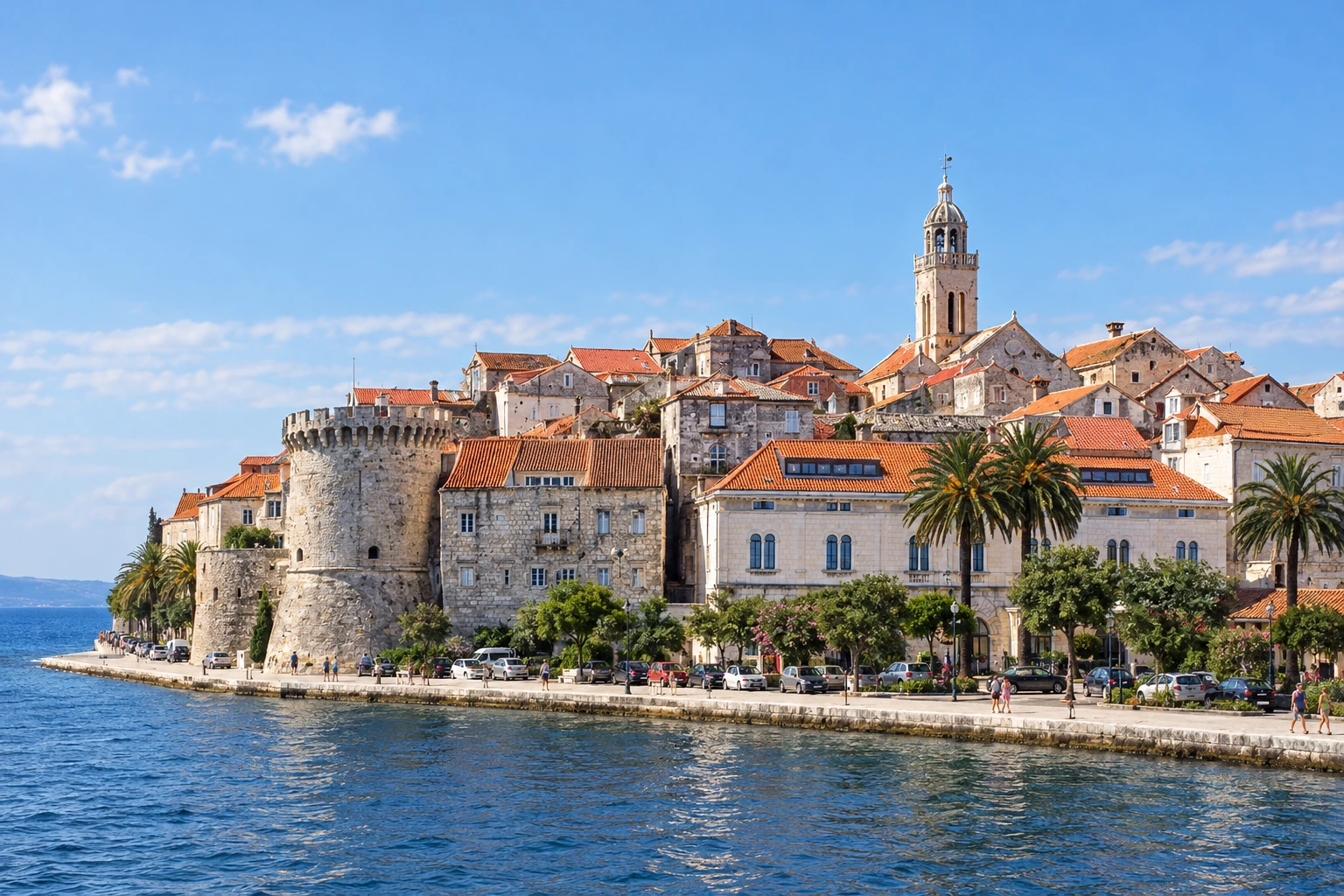
In the photo: Old town Korčula

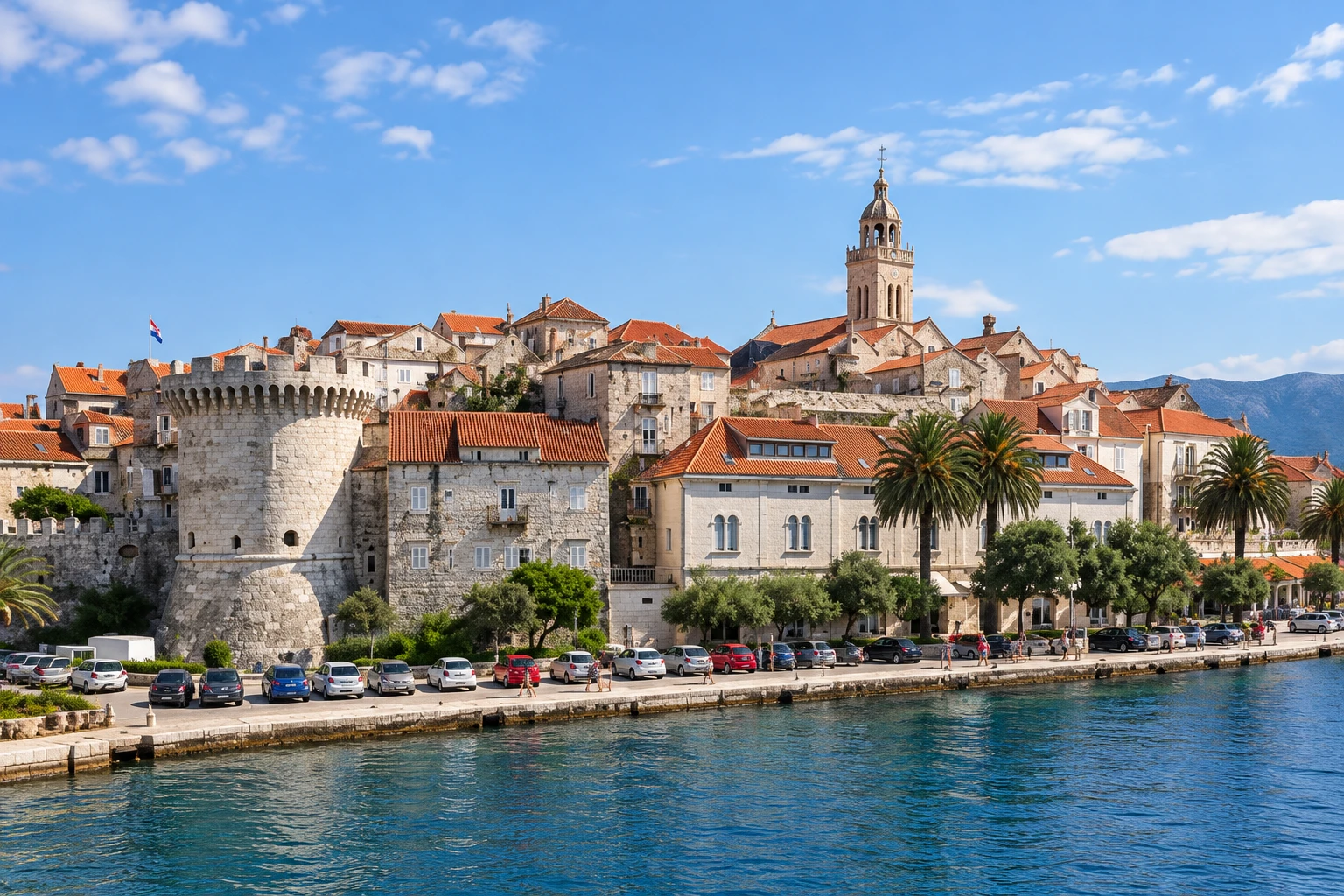
Illustrative images. The pictures in this guide are illustrations based on the real place, not photographs, and may differ from it.

Get it on Google Play

The city

What to expect from Korčula.

Korčula has a fortified core on a peninsula of the island of the same name. The Cathedral of St. Mark and the City Museum help explain the stonework, navigation and urban life. The streets and the outer waterfront are explored on foot; you must check the arrival port to distinguish the town from other island localities.

Korčula is a walled town on a small peninsula on the east coast of the island of the same name in southern Dalmatia. Here the channel between the island and the Pelješac peninsula narrows to around 1,270 meters, a position that explains the walls, towers and centuries of Venetian rule. The old town is on UNESCO’s Tentative List.

Its layout is distinctive. One main street runs the length of the peninsula and side streets descend toward the sea at an angle, like a fish skeleton. The design lets air circulate while shielding houses from the strongest winds. The walls were built and reinforced from the 13th century onward. Some walls and towers came down in the 1870s, but the Kopnena vrata or Land Gate, the Veliki Revelin tower of 1485 and several seaside towers still stand.

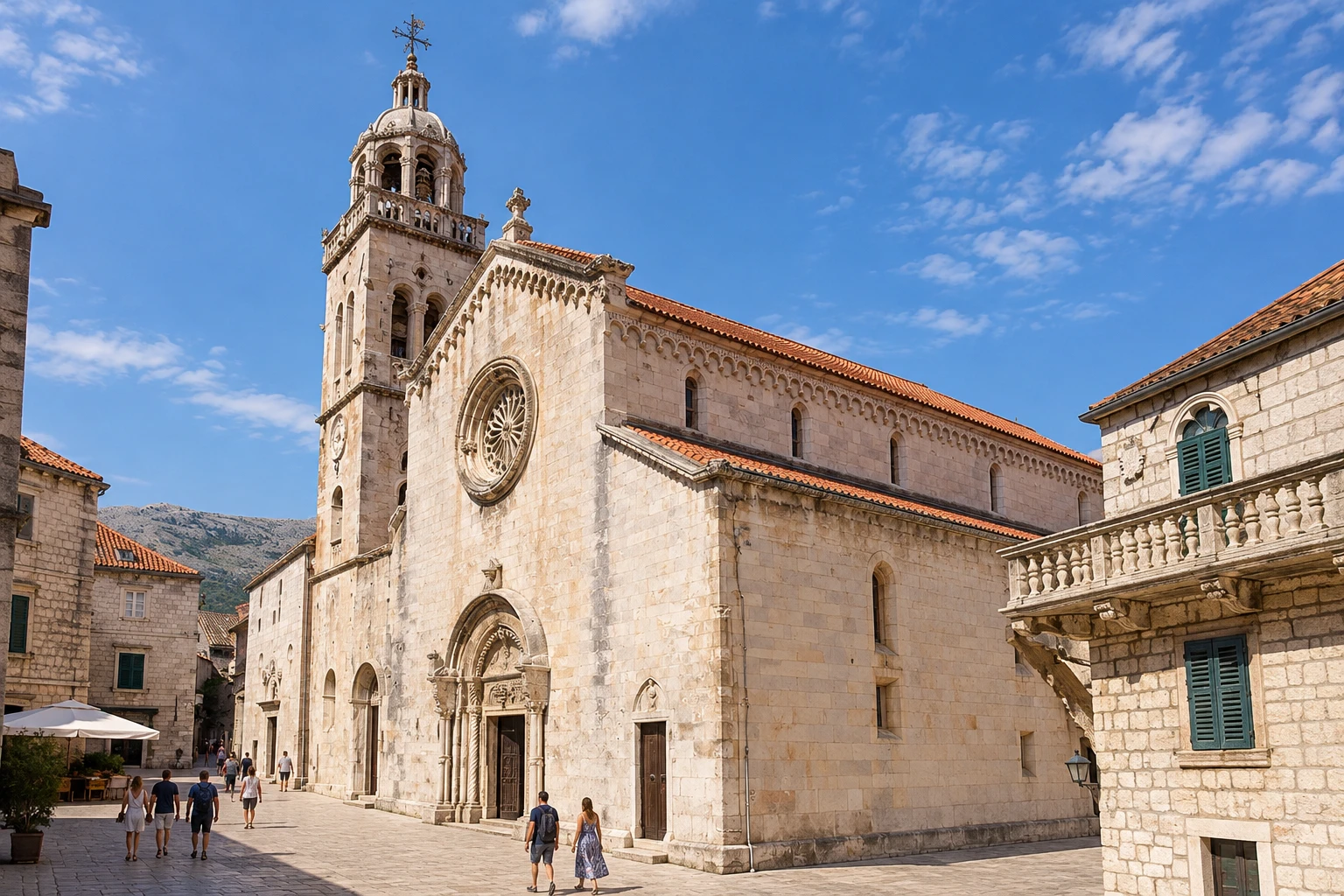
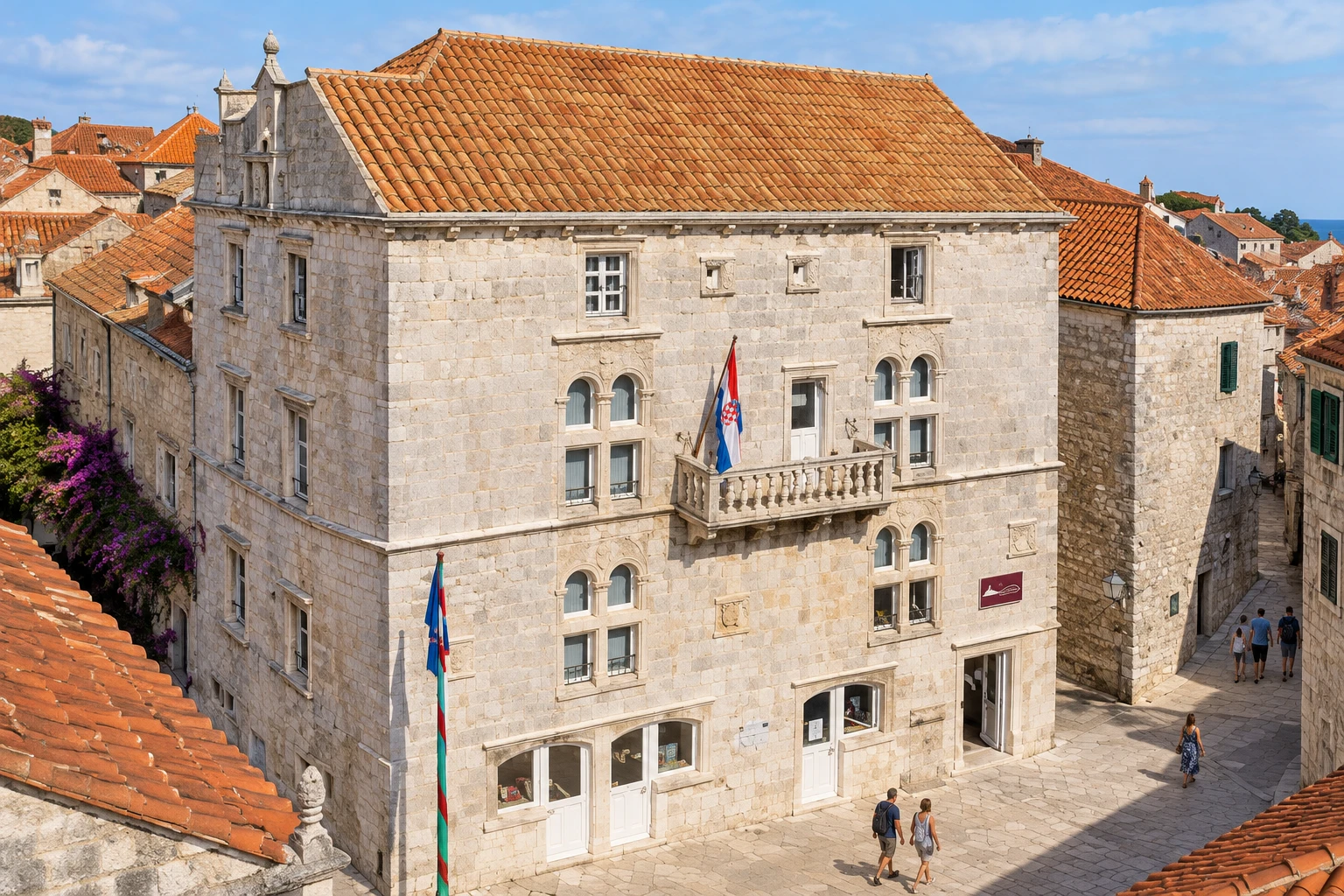
At the center is the square of the Katedrala sv. Marka, built between the 14th and 16th centuries by local stonemasons and Italian masters. Around it are the Opatska riznica, a sacred art museum in the former bishop’s palace, and the Gradski muzej Korčula in the Gabrielis Palace. A few steps away are the icon collection of the All Saints Brotherhood and the center dedicated to Marco Polo. Local tradition says the traveler was born here, though historians still debate his birthplace. You can explore everything on foot in a few hours.

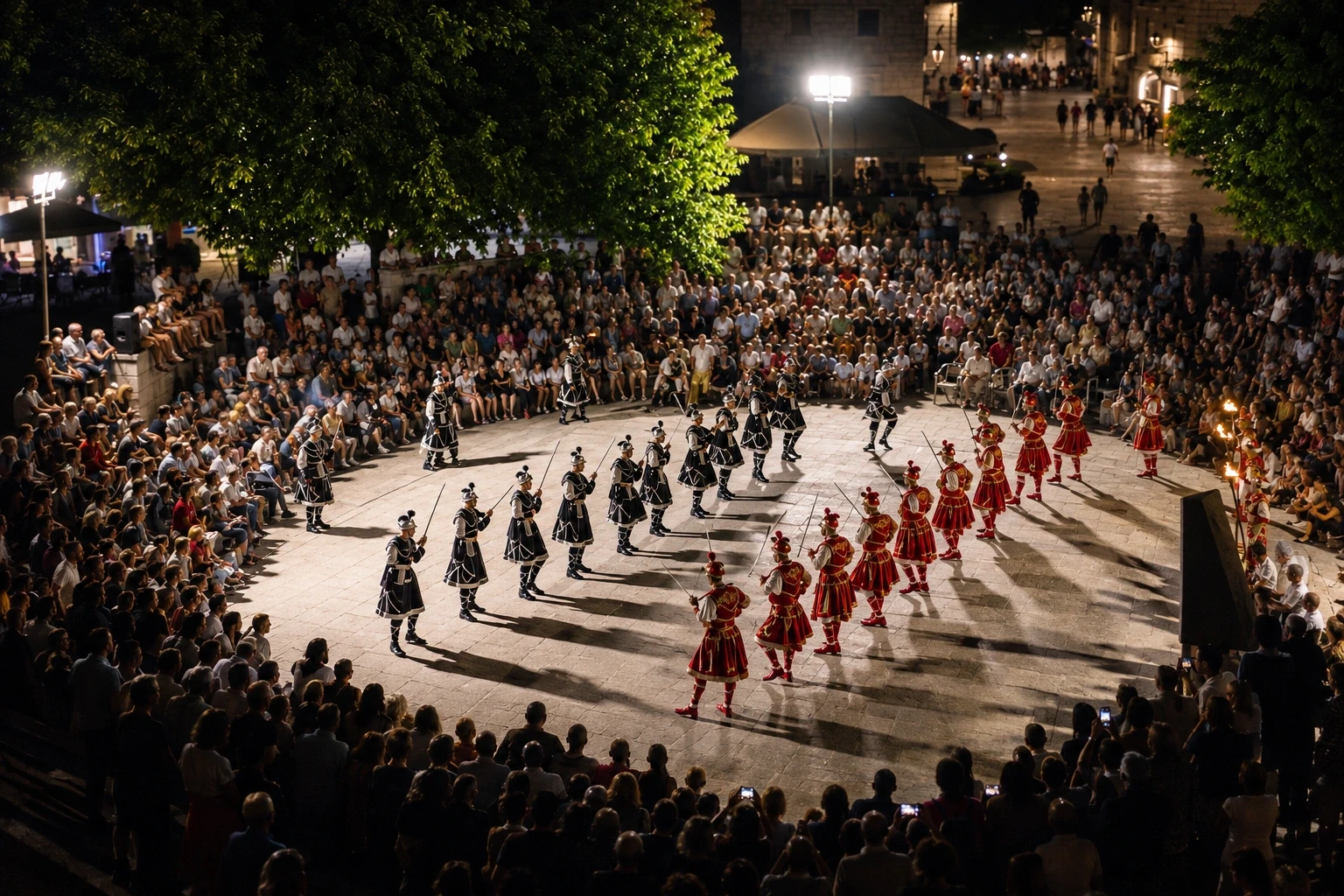
The town has its own Moreška, a sword dance performed for over 400 years, in which two kings and their armies fight over a young woman. Regular performances run from June to mid-October. The most solemn takes place on July 29, the feast of St. Theodore (Sv. Todor), when the town also holds a procession. During Holy Week, the three brotherhoods walk the streets in robes carrying large candles.

Beyond the walls the town continues along the waterfront. A walk of about half an hour brings you to Sv. Antun hill, with 101 steps between cypresses planted in 1708 and views over the archipelago. Opposite the harbor lie the islets of pine-covered Badija, home to a Franciscan monastery, and Vrnik, whose quarries supplied the pale stone of many Dalmatian towns. In summer water taxis cross from town.

The municipality extends beyond the peninsula. Žrnovo, 4 kilometers away, preserves the tradition of handmade makaruni pasta. Pupnat, 11 kilometers away and at 360 meters the island’s highest settlement, is a starting point for the descent to the south coast coves. Račišće, 12 kilometers away, is a north coast fishing village. Čara, around 25 kilometers away, is the home of pošip white wine.

The climate is Mediterranean. June through September brings hot, dry days, average highs near 28°C in July and August and sea temperatures around 24°C. Beaches, frequent boats and crowded streets mark the season. April, May and October are mild and quieter for walking and cycling. From November to March it rains more, highs range from around 10°C to 15°C, boats are less frequent and some tourist services usually close.

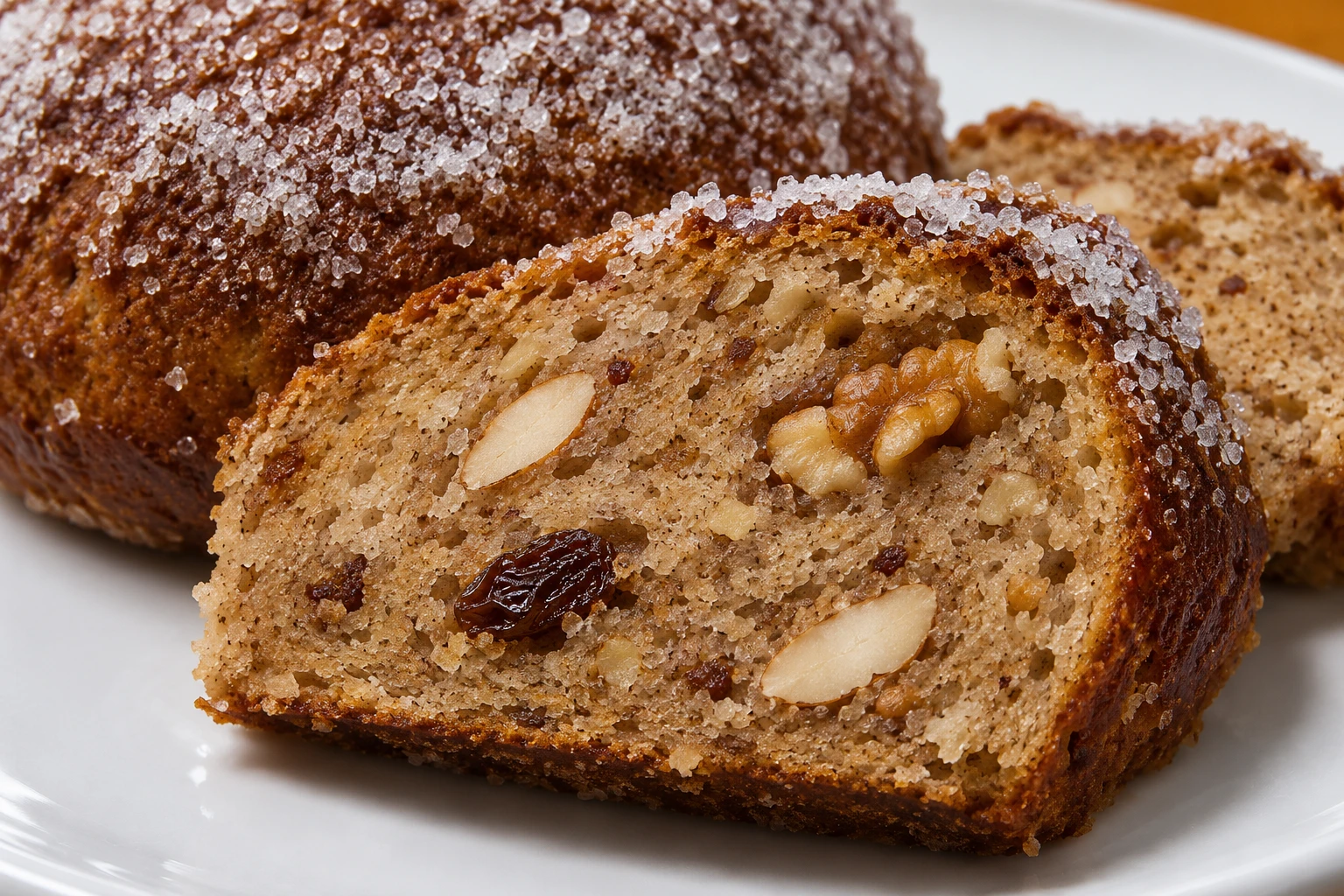
Local menus feature fish, octopus, oysters, pašticada (slow-cooked marinated meat) and sweets such as cukarini and klašuni. Island wines include pošip, grk grown in neighboring Lumbarda, and the red plavac mali.

Lumbarda on the island’s eastern tip, Orebić across the channel and Vela Luka at the western tip are separate municipalities accessible by road or boat from Korčula.

Share: WhatsApp

Where to stay

30 places to stay in Korčula.

Where to eat

18 places to eat in Korčula.

Map of Korčula

The city's hotels and restaurants on the map.

Flavors of Croatia

To try Korčula

Discover other flavors of Croatia

Festivals and events

Festivals Korčula

Dates change every year: check this year's date before you travel.

Festival calendar in Croatia

The local experience

Things to do in Korčula

Korčula · Croatia · Historic center

Korčula Old Town

Korčula's Stari grad occupies a small peninsula on the island's east coast. The core is enclosed by fortification elements and organized by streets that open out from a central axis. The layout of the passageways helps reveal the relationship between the topography, circulation, and the sea.

Explore Korčula Old Town

Korčula · Croatia · Cathedral

St. Mark's Cathedral

The Katedrala sv. Marka stands at the central point of Korčula's old core. The building combines Gothic and Renaissance elements crafted by local masters and others from around the Adriatic. Its location on the square lets you study the façade before entering the religious space.

Explore St. Mark's Cathedral

Korčula · Croatia · Museum

Korčula Town Museum

The Gradski muzej Korčula occupies the Gabrielis Palace in the old town core. The visit brings together the island’s history and the activities that have shaped urban life. The building itself helps to understand the layout of a historic residence alongside the central square.

Explore Korčula Town Museum

To choose before you go

Tours in Korčula

Where each tour starts, how long it takes, how it is done, what is included and the price range.

Walk through the Old Town: Kopnena vrata, the cathedral, museums, and towers

From Kopnena vrata, the Old Town's Land Gate On foot 3 to 4 hours, including visits inside Morning Easy

Korčula’s old town fits on a peninsula you can cross on foot in a few minutes, but give it a full morning to explore at leisure. Enter through the Kopnena vrata, the Land Gate. Above it are two emblems of local history, the winged lion of St. Mark representing Venice and a 1925 plaque commemorating a thousand years since King Tomislav’s coronation. Beside it stands the Veliki Revelin tower, built in 1485 as part of the defenses and usually open to visitors from June through October. The Arsenal of 1572 is nearby. The main street climbs to the square of the Katedrala sv. Marka. Bonino da Milano designed the portal. The upper bell tower and the ciborium over the high altar were made by local master stonemason Marko Andrijić. Inside are paintings by Jacopo Tintoretto and sculptures by Croatian artists including Ivan Meštrović. Beside the cathedral, the former bishop’s palace houses the Opatska riznica, with religious art by Venetian and Croatian masters. The best-known work is the 1431 polyptych by Blaž Jurjev Trogiranin. Opposite is the Gradski muzej Korčula in Gabrielis Palace, a 15th- and 16th-century residence. The collection spans prehistory through the trades that shaped the town, stonemasonry and shipbuilding. An old kitchen has been recreated in the attic. Descend the side streets to the Church of All Saints, belonging to the town’s oldest brotherhood, founded in 1301. It holds icons brought from Crete in the 17th century. Nearby is the center dedicated to Marco Polo. On the western waterfront stands the Loža of 1548, the former customs house. Complete the circuit along the shore beneath the towers.

Stops: Kopnena vrata, Veliki Revelin, Katedrala sv. Marka, Opatska riznica, Korčula Town Museum (Gabrielis Palace), Icon Collection of the Brotherhood of All Saints, Marco Polo Center, Loža.

Includes: Self-guided outing. The cathedral, museums, and tower charge separate admission. Check current prices.

Tip: Start early in summer, before the crowds arrive. Museum and tower visiting days and hours vary seasonally. Check ahead. Wear sturdy shoes for the smooth stone streets and steps.

Best time: Year-round. More sites open from May to October. Veliki Revelin tower usually opens from June to October.

Sv. Antun Hill: 101 steps and views over the archipelago

From Korčula Old Town On foot About 2 hours round trip Morning or late afternoon Moderate

Sv. Antun hill lies about half an hour’s walk from the center toward Lumbarda, in a protected landscape. A stone stairway of 101 steps begins in the Sveti Antun neighborhood, lined by cypresses planted in 1708. On top stands a small 14th-century church originally dedicated to St. Anthony the Hermit and, after a late 17th-century remodeling, to St. Anthony of Padua. Reliefs depicting the saint appear on the wall of a neighboring house. From the top you can see the town, the Pelješac Channel and the islets of the Korčula archipelago. Local celebrations mark the saint’s feast on June 13.

Stops: Sveti Antun neighborhood, Cypress avenue, Church of St. Anthony.

Includes: Self-guided outing.

Tip: Bring water and avoid midday in summer. The climb is tiring in the heat. The church isn't always open, but the walk and view are worth the trip.

Best time: Year-round on dry days. From June to August, go early in the morning or in the late afternoon.

Water taxi to Badija Island: a Franciscan monastery, a walking trail, and a swim in the sea

From Korčula Town harbor Water taxi Half a day Morning or afternoon Easy

Badija is a pine-covered islet with Mediterranean vegetation, about 1 square kilometer in area, in the eastern Pelješac Channel directly offshore from Korčula. In summer water taxis make regular crossings from town. Visible from afar are the Franciscan monastery and church, built in the late Gothic style after 1420 and enlarged in 1909. The complex has returned to the Franciscans and serves as a house of retreat and prayer. There are no daily visits. Guided tours must be requested from the monastery in advance. On the hill above is the little church of Sv. Katarina, dating to the 15th and 16th centuries. An easy dirt path circles the entire island through pines and past pebble coves where you can swim. Fallow deer roam freely. In early August, Korčula residents make the pilgrimage of Gospa od Anđela, known as Perdun, with a procession to the monastery church.

Stops: Badija, Badija Franciscan Monastery, Church of St. Catherine.

Includes: Pay the boat operator separately for the crossing. Check current fares.

Tip: Agree on a return time with the boat operator before going ashore. Bring water, a snack, and water shoes for the pebble beaches. Don't feed the animals.

Best time: June to September, when water taxis run regularly and the sea is warmer.

Vrnik Island: the quarries that supplied Korčula stone

From Korčula Town harbor Water taxi About 3 hours Morning or afternoon Easy

Vrnik is an islet east of town, only 50 meters high, with a tiny settlement home to a few families. It is the site of Korčula’s oldest and best-known quarry. The island has 29 quarries, many still clearly visible. From antiquity to the mid-20th century the island supplied pale limestone used in buildings across Dalmatia, from Hvar to Dubrovnik, and beyond. Working the stone shaped generations of masons and sculptors, including Frano Kršinić, a prominent figure in 20th-century Croatian sculpture. The walk is short. By the sea stands the newer church of Gospa od Pohođenja, built in 1856. Farther on, beside the old quarries, is the earlier church of the same name dating to 1674. The old school becomes a summer gallery with exhibitions by Croatian artists. The island also has a beach. In summer, water taxis from Korčula town serve Vrnik.

Stops: Vrnik, Old quarries, Church of Our Lady of the Visitation, Gallery in the former school.

Includes: Pay the boat operator separately for the crossing. Check current fares.

Tip: The island has few services. Bring water and arrange the return trip with your boat operator. The quarry ground is uneven. Stay on the paths.

Best time: June to September, when water taxis operate and the gallery is usually open.

An evening of Moreška: Korčula's sword dance

From Korčula Old Town On foot Part of the evening Evening Easy

The Moreška is Korčula town’s sword dance. Documents confirm performances in the 17th century, and it is thought to be older, with roots in fencing practice. The story follows two kings fighting over a young woman. The Black King, Moro, holds Bula captive. The White King, Osman, arrives with his army to free her. Seven battles follow, the two groups crossing swords in increasingly fast choreography to music by Krsto Odak. The White King wins in the end. Dancing the Moreška is an honor among the town’s men. Roles pass from father to son and require long training. Regular evening performances take place several times a week from June through September, then less frequently until mid-October. The most solemn follows the procession on July 29, the feast of the town’s patron St. Theodore. In September, a festival in Korčula and other local communities brings together the island’s sword dances, the Moreška, Kumpanjija and Moštra.

Stops: Korčula Old Town.

Includes: Admission fee, with reduced prices for children. Check current prices. Buy tickets at the entrance, at agencies in town, or online.

Tip: Check the year's schedule before traveling. Performance days vary by month. Arrive early to choose a seat.

Best time: June to September, with several performances a week and some dates in the first half of October. July 29 is the traditional date.

Žrnovo and Kočje: stone villages, makaruni pasta, and rock formations in the woods

From Korčula Town Car, taxi, or bike Half a day Morning or afternoon Easy to moderate

Žrnovo is 4 kilometers from town and among the island’s oldest settlements. Its four hamlets, Brdo, Prvo Selo, Kampuš and Postrana, lie among dry-stone walls and holm oak woods. Old routes through the village now serve walkers and cyclists, including the Roman Road and Marmont’s Road. Each hamlet has stone houses, small churches and patron saint festivities. Postrana keeps the Moštra sword dance alive with an August 16 performance on St. Roch’s Day. The writer Petar Šegedin was born here. From Brdo, the highest hamlet, an easy walk leads to Kočje, a protected landscape of vegetation-covered dolomite rocks in the woods. Žrnovo is also home to žrnovski makaruni, hand-rolled pasta served with meat sauce. In August the Makarunada brings residents and visitors together for a pasta-making workshop and tasting. On the northern coast, 3 kilometers from central Korčula, Žrnovska Banja cove has seaside houses and family taverns and makes a swimming stop on the return.

Stops: Žrnovo, Brdo, Prvo Selo, Kampuš, Postrana, Kočje.

Includes: Self-guided outing. Transportation and meals cost extra.

Tip: The settlements are spaced apart and uphill, so expect climbs when cycling. At Kočje, wear closed-toe shoes. The rocks get slippery after rain.

Best time: April to October. August brings Makarunada and the feast of St. Roch in Postrana.

See 4 more tours

The north coast to Račišće: the coves of Žrnovska Banja, Kneže, Vaja, and Samograd

From Korčula Town Car, motorcycle or bike Half a day to a full day Full day Easy

The road west from Korčula follows the island’s north coast facing the Pelješac peninsula and passes a succession of coves. The first is sheltered Žrnovska Banja, 3 kilometers from the center and popular with boaters. Next is Kneže, a small settlement beside a pebble cove among olive and pine trees. Račišće, 12 kilometers from town, is a fishing village founded in the late 17th century by families from the Makarska coast and Herzegovina. From the late 19th to the mid-20th century residents owned the island’s largest fleet of small sailing vessels, and many still work at sea. Two churches mark the village, the older Gospa pomoćnica kršćana and the parish church of St. Nicholas, patron saint of sailors. Waterfront taverns serve Dalmatian cooking. From Račišće a path leads to the clear-water coves of Vaja and Samograd, popular with nature lovers.

Stops: Žrnovska Banja, Kneže, Račišće, Vaja Cove, Samograd Cove.

Includes: Self-guided outing. Transportation and meals cost extra.

Tip: The road is narrow and winding. If cycling, go early. For Vaja and Samograd, bring water, a hat, and water shoes.

Best time: June to September for swimming. May and October bring milder weather for cycling and walking.

Pupnat and the south coast: the island's highest village and Pupnatska Luka cove

From Korčula Town Car or motorcycle Half a day to a full day Full day Easy to moderate

Pupnat, 11 kilometers from town, is the island’s highest settlement at 360 meters and one of its oldest. Surrounded by olive groves, vineyards and woods, it retains single-story stone-roofed houses. To the southeast, a group of old stables is a rare example of rural architecture. In the center stands the parish church of Gospa od Sniga (Our Lady of the Snows), first mentioned in 1393 and enlarged between 1600 and 1620. Next door the brotherhood house preserves objects belonging to the local fraternity and Pupnat’s Kumpanjija, one of the island’s oldest sword dance associations. Its dance is performed on August 5, the patron saint’s feast. Trails and narrow roads descend from Pupnat to the south coast coves facing Lastovo and Mljet. They include Pupnatska Luka, the best known, and Bačva. In the past, village women carried firewood to Korčula on mules, and residents produced lime and charcoal. Today it is a quiet stop between town and the open sea to the south.

Stops: Pupnat, Church of Our Lady of the Snows, Pupnatska Luka, Bačva.

Includes: Self-guided outing. Transportation and meals cost extra.

Tip: Narrow roads lead to the coves. Drive slowly, and in summer go early. Bring water and water shoes.

Best time: June to September for the beach. The feast of Gospa od Sniga falls on August 5.

Čara and Pošip wine: vineyards, a countryside church, and Zavalatica cove

From Korčula Town By car or on a tour with a local operator About 5 hours Afternoon Easy

Čara stands around 25 kilometers from town on a rise above the broad fertile field of Čarsko polje. It is one of the island’s best-known wine villages. The pošip grape, native to Korčula, was identified here and produced one of the first Croatian wines with legally protected origin. It is a full-bodied, golden white wine. The cooperative winery stands at the edge of the field, and several family cellars offer tastings, often with olive oil and other homemade products. In the center, a centuries-old cypress beside the parish church of St. Peter is protected as a natural monument. On the road to the sea among the vineyards, the 14th-century church of Gospa od Čarskog polja is an island Marian shrine, with a Baroque marble altar and English alabaster reliefs. Pilgrimages take place on July 25, the feast of Čara’s patron St. James, when the Kumpanjija is also danced, and on September 8. The road ends on the south coast at the coves of Žitna and Zavalatica. Čara’s wine once shipped from Zavalatica, now a place for summer homes and swimming.

Stops: Čara, St. Peter’s Church, Čarsko polje, Church of Our Lady of Čarsko Polje, Zavalatica.

Includes: Go independently or with a tour company. Tastings and meals cost extra. Check current prices.

Tip: Contact the cellar ahead to confirm it welcomes visitors that day. Arrange a designated driver or join a tour if you plan to drink.

Best time: May to October. A pilgrimage and Kumpanjija sword dance take place on July 25.

Cycle the Eno Gastro route: Korčula, Žrnovo, and Lumbarda

From Central Korčula Town By bike About 2 hours 30 minutes of cycling Morning Moderate

Of the island’s marked cycling routes, number 2, called Eno gastro, begins and ends in central Korčula town. The 22.4-kilometer loop includes 17.4 kilometers of pavement, 5 kilometers of packed dirt and 350 meters of elevation change. The town tourist office estimates 2½ hours of cycling and rates the difficulty 2 out of 5. The route climbs from town to the settlements of Žrnovo through Prvo Selo, Kampuš and Postrana, passing olive groves, dry-stone walls and vines. It descends to Lumbarda, a separate municipality on the eastern tip of the island where growers cultivate the grk grape on sandy soil. From Lumbarda the circuit returns to Korčula. The name refers to possible stops for food and wine, from village taverns in Žrnovo serving handmade makaruni to Lumbarda wineries. For a greater challenge, route 1 on the same network loops around the island for 131 kilometers.

Stops: Korčula, Prvo Selo, Žrnovo, Kampuš, Postrana, Lumbarda.

Includes: Self-guided outing. Bike rental, if needed, costs extra.

Tip: Download the GPX track from the routes page on the town's tourism website. The climb to Žrnovo comes near the start. Set off early in summer and bring water.

Best time: April to June and September to October for mild weather. In high summer, go only in the early morning.

Day by day

1, 2 and 3-day itinerary in Korčula

Suggestions to plan the trip. Change the order of the days according to the weather and tour availability.

1 day · 1 day in Korčula: the walled town and Sv. Antun Hill

For Visitors arriving by boat from Split, Hvar, Dubrovnik, or Orebić who have just one day · Based in Korčula Old Town
  1. Day 1 · From the Land Gate to sunset on the waterfront

    Enter through the Kopnena vrata and climb the Veliki Revelin tower if open. Follow the main street to the square of the Katedrala sv. Marka. See the portal, interior and neighboring Opatska riznica. Cross the square to the Gradski muzej Korčula in Gabrielis Palace. Descend the side streets, noticing the fishbone layout. Stop at the Church of All Saints for the icon collection and at the center dedicated to Marco Polo. Have lunch in the old town and try fish, octopus or pašticada with a glass of pošip or grk. In the afternoon, follow the waterfront to Sveti Antun and climb the 101 steps between the cypresses. From the top you can see the town, channel and islets. Return late in the afternoon and walk around the outside of the peninsula beside the sea beneath its towers. On a Moreška evening, finish with the sword dance. Before setting out, confirm your return boat and departure quay.

2 days · 2 days in Korčula: the town and the islets of Badija and Vrnik
For Overnight visitors looking to combine historic sights with time by the sea · Based in Korčula Town
  1. Day 1 · The Old Town and Sv. Antun

    Devote the morning to the old town, including Kopnena vrata, Veliki Revelin, Katedrala sv. Marka, Opatska riznica and the Gradski muzej Korčula. After lunch see the icon collection and Marco Polo center, then rest during the hottest hours. Late in the afternoon, walk to Sv. Antun hill and climb the cypress-lined staircase to see the archipelago from above. In the evening, stroll along the western waterfront by the Loža and, in season, watch the Moreška.

  2. Day 2 · Water taxi to Badija and Vrnik

    In the morning, take a water taxi from the harbor to Badija. Circle the island on the dirt path, see the Franciscan monastery from outside, climb to the church of Sv. Katarina and choose a cove for a swim. In the afternoon, if a boat is available, continue to Vrnik. Walk among the old quarries and visit the two churches of Gospa od Pohođenja and the gallery in the former school. Always arrange the return with the boat operator. Outside summer, when water taxis are scarce, substitute Žrnovo and Kočje or the cycling route to Lumbarda.

3 days · 3 days in Korčula: the town, islets, and island interior
For Visitors with a car, motorcycle, or the energy to cycle who want to explore the local villages · Based in Korčula Town
  1. Day 1 · The walled town

    Take a leisurely walk through the old town, visiting the Land Gate, tower, cathedral, Opatska riznica, town museum, icon collection and Marco Polo center. Have lunch inside the walls. In the afternoon, walk to Sv. Antun hill. In the evening, see the Moreška if there is a performance, or dine on the waterfront.

  2. Day 2 · Badija, Vrnik and the beach

    Spend the day by the sea. Take a morning water taxi to Badija, walk around the island and swim in a pebble cove. In the afternoon, continue to Vrnik and its quarries or stay on the town beaches, such as Banje. Save the end of the day for an unhurried walk through the old town’s side streets as the crowds thin.

  3. Day 3 · Žrnovo, Pupnat and Čara

    Set out early for Žrnovo, 4 kilometers away. Explore a hamlet and walk from Brdo to the Kočje rocks. Continue to Pupnat, the island’s highest settlement, and see the church of Gospa od Sniga. From Pupnat, descend to Pupnatska Luka for a swim or continue to Čara, around 25 kilometers from town, for the pošip vineyards and the church of Gospa od Čarskog polja. If you are driving, leave the tasting to someone else in your group. On the way back, stop in Žrnovo for a dinner of handmade makaruni. For the north coast instead, spend the day on the road through Žrnovska Banja, Kneže and Račišće.

Best time to go

When to go: Korčula month by month

The seasons shown are the most usual ones; nature doesn't always follow the calendar.

January High rain

Final days of Advent u Korčuli, through January 6

Cold and damp by coastal standards, with average highs around 10°C, chilly nights and roughly 110 mm of rain. The sea is around 14°C. Boats are infrequent and many tourist services close, leaving the old town empty to explore. Confirm museum openings and boat and bus times.

February Some rain

Winter continues, with average highs near 11°C and just under 100 mm of rain. Wind can disrupt crossings. The quiet town suits visitors interested in architecture without crowds. Plan around limited beach opportunities and water taxi service to the islets.

March Some rain

Vela setemana (Holy Week) when it falls this month · Slow Food Korčula Festival · Camino Korčula Weekend

Highs rise to around 13 °C, but several days bring rain, totaling about 90 mm. The year’s events get underway with the local food festival, the Camino Korčula walk and, when Easter falls in March, the brotherhoods’ Holy Week processions.

April Some rain

Vela setemana (Holy Week) when it falls this month · Start of seasonal catamaran services

Spring brings average highs around 17°C and about 80 mm of rain. Seasonal catamarans resume and the town gradually reopens. It is a good month to walk to Sv. Antun, cycle and visit Žrnovo and Pupnat. The sea is still cold at around 15°C.

May Low rain

Mild days, with average highs near 22 °C and less rain (about 65 mm). Crowds are still moderate, and almost everything is open. The sea is around 18 °C, too cold for many swimmers. It’s a good time for bike routes and inland villages.

June Low rain

Regular Moreška evenings begin · Feast of St. Anthony (June 13) · Midyear masquerade (June 30)

Summer begins with average highs near 26°C, little rain and sea temperatures around 22°C. Water taxis serve Badija and Vrnik, Veliki Revelin tower usually opens and the Moreška performance season begins. On the 30th a masked parade celebrates the halfway point of the year.

July Low rain

Feast of St. Theodore and City Day (July 29), with a procession and Moreška · Kumpanjija in Čara (July 25)

The driest month brings average highs near 28°C and a sea temperature around 24°C. High season means frequent boats, busy streets and strong demand for accommodations. Book ahead and visit the old town early or late in the afternoon. On the 29th, the patron saint’s feast includes Mass, a procession and the ceremonial Moreška.

August Low rain

Perdun on Badija (early August) · Kumpanjija in Pupnat (August 5) · Makarunada in Žrnovo · Moštra in Postrana (August 16) · Feast of St. Bartholomew (August 24)

Summer heat brings average highs near 28°C and the year’s warmest sea at around 25°C. This is the busiest month, with the most celebrations in the municipality’s villages. Buy boat tickets ahead and reach south coast coves early. Showers are rare.

September Some rain

Korkyra Baroque Festival · Island sword dance festival · Restaurant week and Slow Food Korčula fair

Average highs drop to around 25°C, the sea stays near 23°C and crowds thin. Rain gradually returns, about 75 mm. Baroque music fills churches and squares, and the month features sword dances and local food. It is a good time to combine beaches and sightseeing.

October High rain

Final Moreška performances in the first half of the month · Seasonal catamaran services end

Fall brings average highs near 20°C, with the sea still around 21°C early in the month. Rain increases to about 105 mm. Seasonal boat services end during the month and water taxis become less frequent, so check schedules. It is a good time for walks and wine villages.

November High rain

St. Martin’s Day (November 11), with lojenica, the town’s sweet bread · Advent u Korčuli begins late in the month

One of the rainiest months, with about 135 mm of rain and average highs near 15 °C. The town returns to its local rhythm, and some businesses catering to visitors close. Lojenica is baked for St. Martin’s Day. Advent events begin late in the month.

December High rain

Advent u Korčuli, late November through January 6

A rainy month, with about 135 mm and average highs near 11°C. Advent brings concerts, workshops and Christmas sweets to town and the surrounding villages. Boats are infrequent. Plan your arrival via the Orebić ferry or by bus and confirm times.

Plan the journey

How to get there: Korčula

By air via Dubrovnik or Split

The international airports of Dubrovnik and Split serve Korčula. Zagreb is an option if you are combining the island with the capital.

From Dubrovnik, travel by road along the Pelješac peninsula to Orebić and cross by ferry, or take a seasonal catamaran from the city port. From Split, the most direct route is a catamaran from the city port to Korčula via Hvar.

The airports are outside the city centers and ports. Allow transfer time to the quay and leave a margin between flight and boat, especially outside summer when departures are fewer. Check seasonal origins and routes with the airlines.

By catamaran from Split, Hvar and Dubrovnik

Passenger catamarans are the most common way to reach Korčula town. They carry no cars and dock in the port beside the old town.

Services connect Split and Dubrovnik, stopping at islands including Brač, Hvar, Korčula and Mljet depending on the route and operator. Most operate April through October, with more departures from June through September. Outside the season a few connections to Split remain, generally via Hvar.

Several companies run these routes and each sells its own tickets online or at port counters. Summer sailings fill up, so buy ahead. Check your arrival port carefully. Some services call at Vela Luka at the other end of the island rather than Korčula town.

Rough seas can delay or cancel departures, particularly in fall and winter.

By car: Orebić–Dominče or Split–Vela Luka ferry

Two ferries bring cars to the island.

The shorter crossing leaves Orebić on the Pelješac peninsula for Dominče, the ferry quay a few kilometers from Korčula’s old town. It takes about 20 minutes and operates year-round with departures throughout the day. Dubrovnik to Orebić is just over 100 kilometers by road along the peninsula.

The other ferry leaves Split for Vela Luka at the island’s western tip, around 50 kilometers by road from Korčula town. The crossing is much longer but saves travelers from the north a detour along the coast.

Boarding lines form in summer, so arrive early. Walk around the old town. Park outside the walls and arrange parking with your accommodations.

By bus from Dubrovnik, Split and Zagreb

Regular buses connect Dubrovnik, Split and Zagreb with Korčula. The bus travels along the Pelješac peninsula, boards the ferry at Orebić and terminates in town.

From Dubrovnik the trip takes about three and a half hours, with few daily departures. The journey from Zagreb or Split is long. Many travelers take a bus or train to Split and continue by catamaran. Split has the nearest railway station to the island.

Outside summer, when catamarans are less frequent, the bus and Orebić ferry provide the most regular mainland connection. Check operating days and times before traveling.

Traveling on foot from Orebić and getting around the town and island

From Orebić without a car, take a passenger boat across the channel to Korčula town if it is running that season. Alternatively, take the car ferry to Dominče and a bus or taxi downtown.

In town you can walk everywhere on the small old peninsula. In summer water taxis leave the harbor for the islets of Badija and Vrnik.

For the municipality’s villages and the rest of the island, buses run along the main road between Korčula and Vela Luka. Check schedules, which are reduced outside the season. A car, motorcycle or bicycle gives you more flexibility for the coves on the southern and northern coasts.

Your questions

Frequently asked questions about Korčula

Is Korčula a town or an island?

The name is used for both. When you buy transport, check the exact port on the ticket.

Is Dominče inside the old town?

No. It is a ferry access point with a land connection onward to Korčula's urban area.

Was Marco Polo born in Korčula?

The association is part of local tradition, but the birthplace is disputed and should not be treated as established.

How many nights to stay in Korčula?

Two or three nights allow time for the monuments and the streets without relying on a quick boat-to-boat visit.

Where and when can I see Moreška in Korčula?

In Korčula Town in the evening. Regular performances take place several times a week from June through September, with fewer dates through mid-October. The most traditional performance is on July 29, the feast of St. Theodore, the town’s patron saint. Buy tickets at the entrance, through local agencies or online. Check the year’s calendar before traveling.

When is the best time to visit Korčula?

June through September offers beaches, frequent boats, Moreška performances and hot, dry days. July and August are busiest. May, early June, September and early October bring mild weather and fewer visitors. November through March sees more rain, fewer boats and some tourist services close for the season.

Are there beaches near Korčula’s old town?

Small pebble beaches and swimming spots such as Banje line the town waterfront. For larger coves, take a water taxi to Badija or travel by road to Žrnovska Banja, Kneže and Račišće on the north coast, or Pupnatska Luka on the south coast. Bring water shoes, as sandy spots are rare.

Can I visit the monastery on Badija?

You can explore the island freely. In summer water taxis run from Korčula harbor, and a path circles Badija. The Franciscan monastery has no daily visiting hours. Contact the monastery ahead of time to request a guided visit. The church welcomes worshippers at Mass and during the pilgrimage in early August.

Does the catamaran arrive near Korčula’s old town?

Yes. Passenger catamarans serving Korčula Town dock beside the old town. The car ferry from Orebić arrives at Dominče, a few kilometers away, and some services from Split stop at Vela Luka on the opposite end of the island. Check the port on your ticket.

How do I get from Dubrovnik to Korčula?

In season, from April through October, passenger catamarans run from Dubrovnik harbor to Korčula Town. A year-round option is to drive or take a bus along the Pelješac peninsula to Orebić, then cross the channel by ferry in about 20 minutes. The bus journey takes around three and a half hours. Check operating days and times before traveling.

What should I eat and drink in Korčula?

Try fish, octopus and oysters, or pašticada, slow-cooked marinated meat served with gnocchi. Žrnovski makaruni are hand-rolled pasta from Žrnovo, served with meat sauce. Local sweets include cukarini and klašuni, with lojenica baked for St. Martin’s Day in November. Island wines include white pošip from Čara and Smokvica, white grk from Lumbarda and red plavac mali.

Can I visit Korčula on a day trip?

You can see the old town in half a day, including the Land Gate, cathedral, museums and waterfront walk. The easiest day trip is from Orebić across the channel. From Hvar, Split or Dubrovnik, it depends on seasonal catamaran schedules. A day trip leaves out the offshore islets, the evening Moreška and the villages around town.

Is it worth renting a car or motorcycle in Korčula?

The old town peninsula is easy to explore on foot. For Žrnovo, Pupnat, Račišće, Čara and the south coast coves, a vehicle or bike gives you flexibility, as local buses run infrequently. The side roads are narrow and winding.

Traveler, share your experiences through photos Up to 5 photos of each place you visited.

Routes in Croatia

Korčula is part of the Dalmatian Islands from Split to Dubrovnik

From Split to Dubrovnik by catamaran across the Adriatic, with stops in Milna, Hvar and Korčula.

Explore the Dalmatian Islands from Split to Dubrovnik
See the destination Korčula Find another city