

 Brazil
 Antarctica
 Argentina
 Bolivia
 Chile
 Ecuador
 Falkland Islands (Malvinas)
 French Guiana
 Guyana
 Paraguay
 Peru
 Suriname
 Uruguay
 Venezuela
 Albania
 Austria
 Belgium
 Croatia
 Denmark
 Finland
 France
 Germany
 Greece
 Hungary
 Iceland
 Ireland
 Italy
 Luxembourg
 Norway
 Poland
 Portugal
 Slovakia
 Slovenia
 Spain
 Sweden
 Switzerland
 the Czech Republic
 the Netherlands
 the United Kingdom
 Turkey
 Bermuda
 Canada
 Greenland
 Mexico
 Saint Pierre and Miquelon
 the United States
 the Dominican Republic
 Japan
 Egypt
 South Africa
 Australia
 Fiji
 New Zealand
 Papua New Guinea
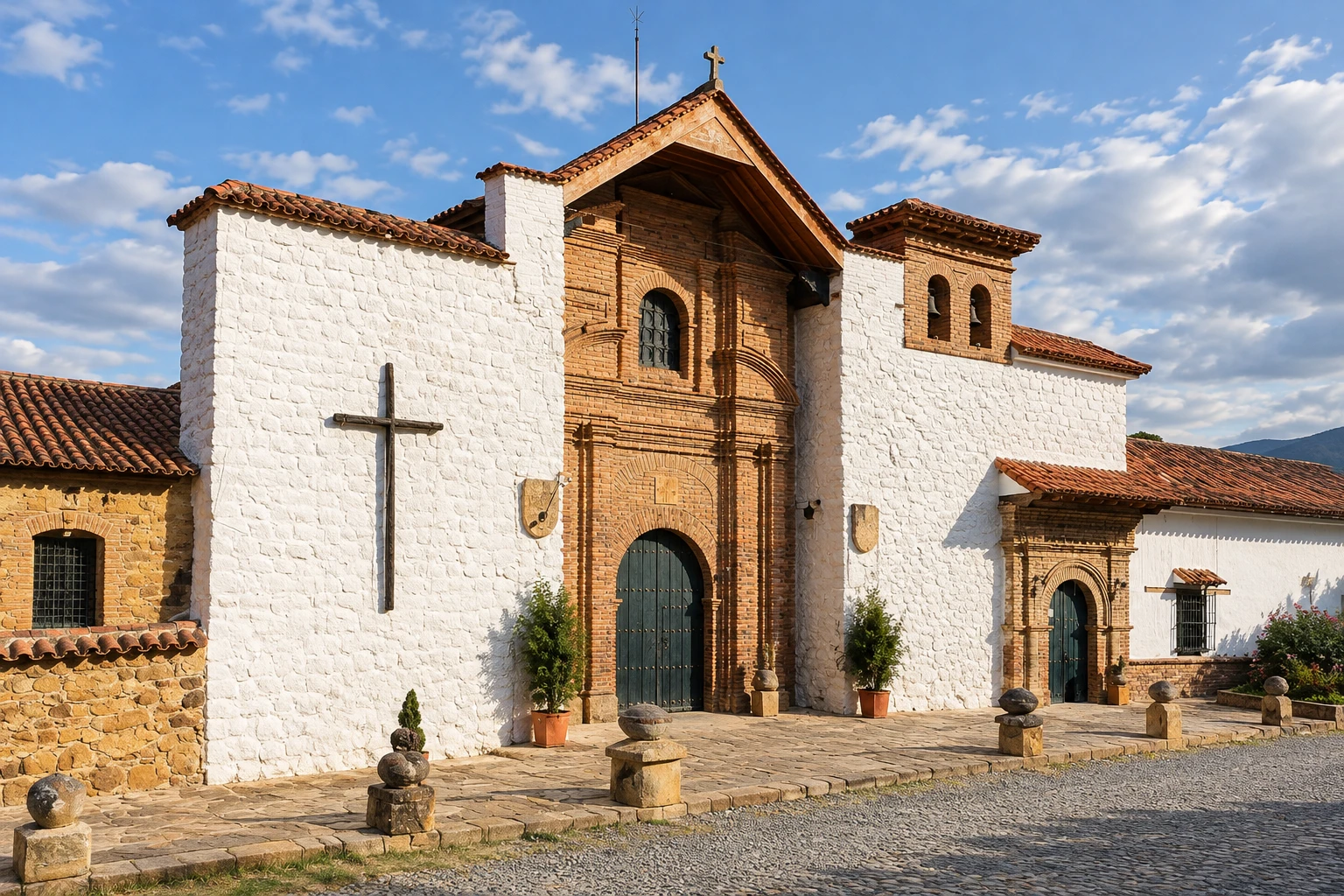
Convent · Villa de Leyva, Colombia
Convent of Santo Ecce Homo
Dominican convent founded in 1620, in a valley about 8 km from Villa de Leyva, with a stone cloister, colonial church and marine fossils visible in the floor slabs.
Illustrative images. The pictures in this guide are illustrations based on the real place, not photographs, and may differ from it.

Discover
About Convent of Santo Ecce Homo
The convent of Santo Ecce Homo is in an isolated valley in the municipality of Sutamarchán, about 8 km from Villa de Leyva. It was founded by Dominican friars in 1620, on lands donated by Juan de Mayorga, and was named after a painting of the Ecce Homo, the image of Christ crowned with thorns, brought from Europe. It is a national monument of Colombia.
The complex includes a colonial church and a cloister around a courtyard garden. The thick walls, stone corridors and the friars' cells show how a convent functioned in the interior of the Novo Reino de Granada.
Because the region was once seabed, several floor slabs cut from local stone preserve marine fossils, such as ammonites, which visitors look for while walking the corridors. The surrounding landscape, a dry valley with hills, is part of the visit.
Before you go
Practical information
Cidade Turismo reviews its information regularly, but something may have changed. Check with the place before planning your trip.
How much time to set aside
About an hour.
Best time
In the morning or mid-afternoon. Visiting days and hours are limited; check before you go. Weekends usually have more visitors.
How to get there
It's about 8 km from Villa de Leyva, along the road that passes through the Ecce Homo valley, in the municipality of Sutamarchán. Go by car, taxi or on a tour that combines the convent with El Fósil and El Infiernito.
Tip
Notice the fossils in the floor slabs along the cloister corridors. Dress discreetly: it is a religious site. Combine it with Ráquira if you are travelling by car.
Your questions
Frequently asked questions about Convent of Santo Ecce Homo
When was the convent of Santo Ecce Homo founded?
In 1620, by the Dominican friars. The convent is a national monument of Colombia.
Are there fossils in the convent of Ecce Homo?
Yes. Several floor slabs, cut from the local stone, show marine fossils such as ammonites.
Is the convent of Ecce Homo far from Villa de Leyva?
It's about 8 km away, in the municipality of Sutamarchán. You need to go by car, taxi, or on a tour.