

 Brazil
 Antarctica
 Argentina
 Bolivia
 Chile
 Colombia
 Ecuador
 Falkland Islands (Malvinas)
 French Guiana
 Guyana
 Paraguay
 Peru
 Suriname
 Uruguay
 Venezuela
 Austria
 Belgium
 Croatia
 Denmark
 Finland
 France
 Germany
 Greece
 Hungary
 Iceland
 Ireland
 Italy
 Luxembourg
 Norway
 Poland
 Portugal
 Slovakia
 Slovenia
 Spain
 Sweden
 Switzerland
 the Czech Republic
 the Netherlands
 the United Kingdom
 Turkey
 Bermuda
 Greenland
 Mexico
 Saint Pierre and Miquelon
 the United States
 the Dominican Republic
 Japan
 Egypt
 South Africa
 Australia
 Fiji
 New Zealand
 Papua New Guinea
Historic site · Churchill, Canada
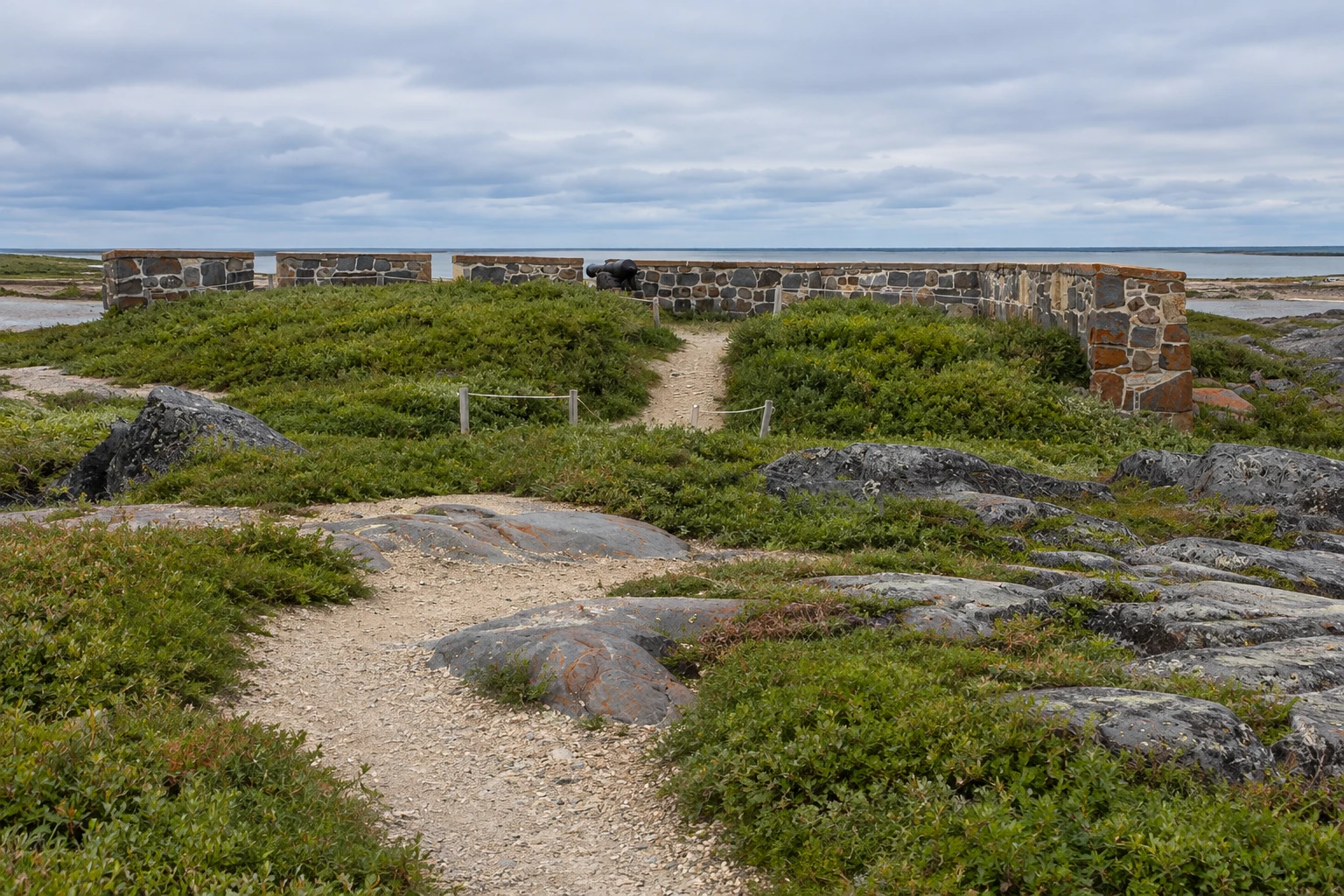
Cape Merry National Historic Site
Rocky promontory at the mouth of the Churchill River with an 18th-century cannon battery and views of the beluga estuary and the Prince of Wales fort.
Illustrative images. The pictures in this guide are illustrations based on the real place, not photographs, and may differ from it.

Discover
About Cape Merry National Historic Site
Cape Merry is the rocky point on the town’s shoreline where the Churchill River meets Hudson Bay. In 1746 the Hudson’s Bay Company installed a battery of cannons there to protect the river mouth, supporting the fort on the opposite bank. Low stone walls and a few cannons remain.
The site is a natural viewpoint: from it you can see the estuary, the Prince of Wales Fort on the far shore and, in summer, the belugas that come and go with the tide. The smooth, glacier-scarred rocks have colorful lichens and tundra flowers.
Cape Merry is part of the Prince of Wales Fort National Historic Site, managed by Parks Canada. Because of polar bears, interpreters accompany visits in the summer season; outside that season, go only with a guide or with local guidance.
Before you go
Practical information
Cidade Turismo reviews its information regularly, but something may have changed. Check with the place before planning your trip.
How much time to set aside
One hour.
Best time
July to August, with interpreters and belugas in the estuary.
How to get there
About 3 km from downtown Churchill, at the end of the road that passes the port, by car or with an operator.
Tip
Bring binoculars to see the belugas in the estuary and the details of the fort on the opposite bank.
Official website
Your questions
Frequently asked questions about Cape Merry National Historic Site
What can you see from Cape Merry?
The Churchill River estuary, Prince of Wales Fort and, in summer, belugas.
Can you go to Cape Merry alone?
In the summer season Parks Canada interpreters are present; because of polar bears, always follow local guidance.
When was the Cape Merry battery installed?
In 1746 by the Hudson’s Bay Company.