Cidade Alta de Santa Cruz Cabrália
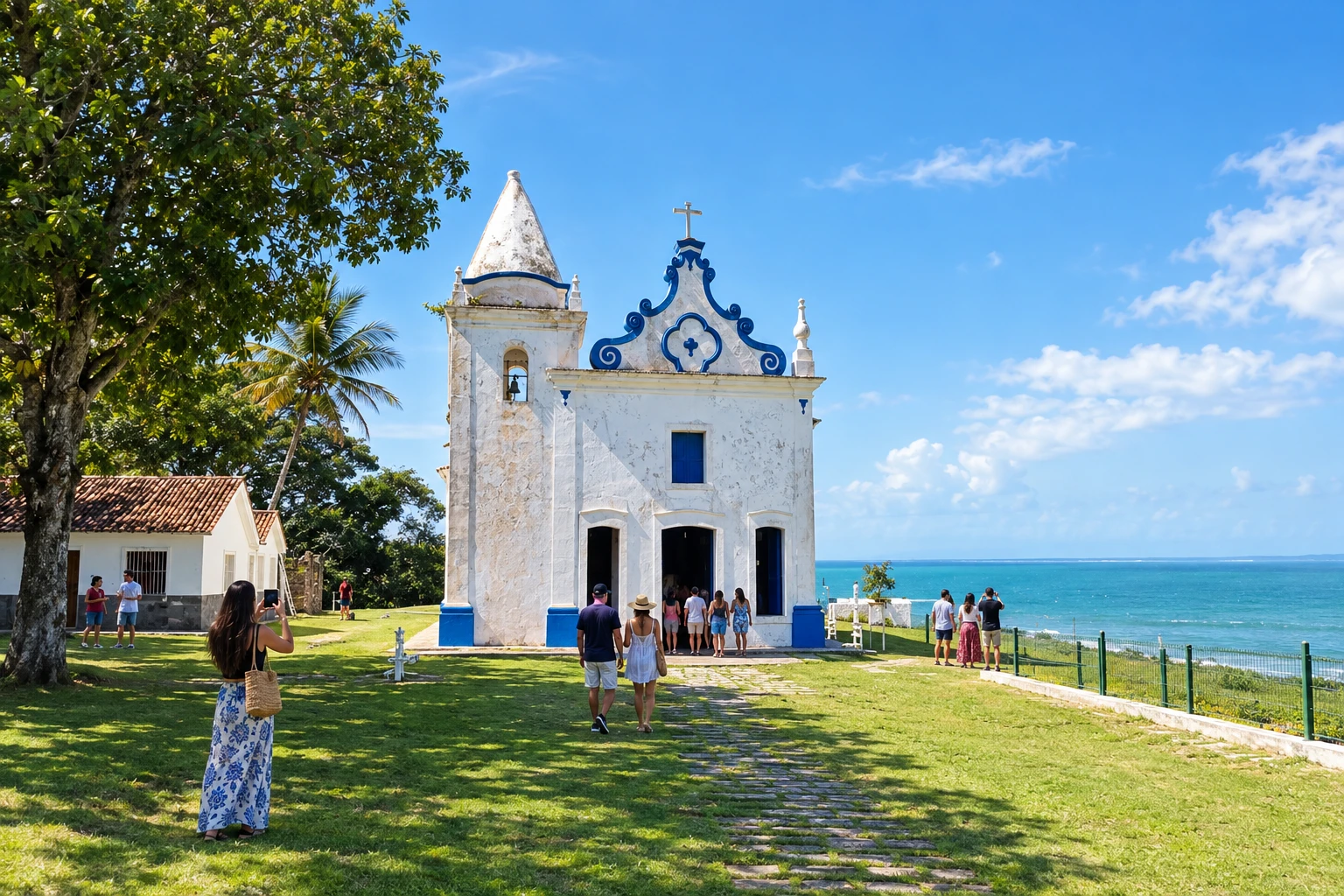
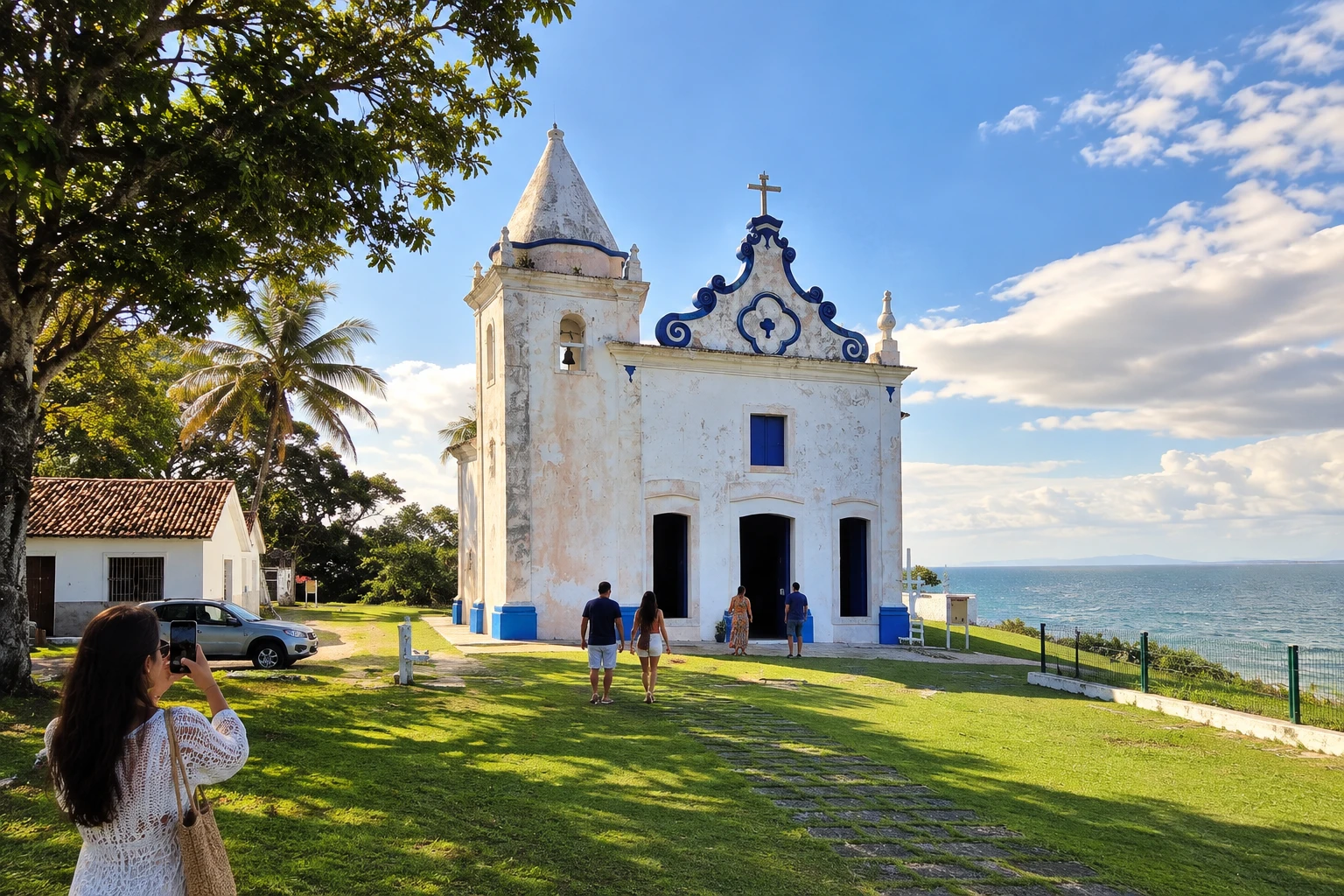
The historic core brings together the Igreja de Nossa Senhora da Conceição, the old Casa de Câmara e Cadeia and the coastal view. The visit focuses on public and exterior spaces.
Antarctica
In the photo: The historic core brings together the Igreja de Nossa Senhora da Conceição, the old Casa de Câmara e Cadeia and the coastal view. The visit focuses on public and exterior spaces.
Illustrative images. The pictures in this guide are illustrations based on the real place, not photographs, and may differ from it.
The city
Santa Cruz Cabrália brings together Cidade Alta, with the Igreja de Nossa Senhora da Conceição and the old Casa de Câmara e Cadeia, and Coroa Vermelha, linked to the memory of the first mass and the Pataxó presence. The Rio João de Tiba separates the town center from the beaches of Santo André. The heritage and the waterfront require their own travel within the municipality.
Santa Cruz Cabrália is the first municipality north of Porto Seguro, at the southern tip of Bahia. The seat is about 23 km from Porto Seguro center via BR-367, which follows the coast, and the airport serving the city is Porto Seguro’s. It was a village tied to Porto Seguro until 1938, when it became independent. It is quieter than its neighbor and has about 35 km of coastline, much of it almost deserted.
The municipality has three very different areas, and you should choose your base with that in mind. The first, for those coming from Porto Seguro, is Coroa Vermelha, a district about 8 km from the seat. It is a cove of calm sea, protected by reefs, where low tide forms natural pools and uncovers a sand point that juts into the sea. There, according to tradition, Frei Henrique de Coimbra celebrated the first mass on Brazilian soil on April 26, 1500, four days after Cabral’s fleet arrived; a large cross marks the spot. Coroa Vermelha is also Pataxó indigenous land, and the path to the beach passes through craft shops run by village families.
The second area is the seat. The town was built on two levels. Below, at the João de Tiba River, are the quay, from which schooners depart to the Coroa Alta reef, Praça Pedro Álvares Cabral and the ferry embarkation. On a small hilltop is Cidade Alta, listed as national heritage, with the Mother Church of Our Lady of Conception, the old Town Hall and Jail, ruins and old houses, and views of the river, town and sea. Between Coroa Vermelha and the seat stretches Praia de Mutari, about 4 km long; near the town is Arakakaí beach.
The third area begins on the other side of the João de Tiba. The ferry takes less than 15 minutes to Santo André, a small beach village with a calm cove and long stretches of undeveloped beach. To the north are Santo Antônio and Guaiú beaches, even emptier, and the road continues to Belmonte, the next town, which has its own page.
The climate is the same as along this coast: hot year-round and rain distributed in showers over the twelve months. From December to March highs range from 27 °C to 29 °C. From June to September, about 24 °C to 26 °C, with cooler nights and less rain; August and September tend to be the driest months. March, April and November are among the rainiest. The sea receives water from several rivers and can become turbid after rain while remaining calm. The lowest tides, near full and new moons, reveal the natural pools of Coroa Vermelha and Coroa Alta.
In April, Coroa Vermelha usually hosts the Pataxó Indigenous Games, bringing together villages from southern and far-southern Bahia, and commemorates the date of the first mass. January, July and long holidays are the busiest periods, concentrated in Coroa Vermelha; Santo André remains quiet even in high season.
One day is enough to see Coroa Vermelha and Cidade Alta from Porto Seguro. To stay, choose between Coroa Vermelha, with more structure and closer to the airport, and Santo André, for relaxation. Two or three days let you combine the history, a boat trip and the northern beaches.
81 places to stay in Santa Cruz Cabrália.
10 places to eat in Santa Cruz Cabrália.
13 lugares no mapa: onde ficar e onde comer, por bairro.
The local experience
The historic core brings together the Igreja de Nossa Senhora da Conceição, the old Casa de Câmara e Cadeia and the coastal view. The visit focuses on public and exterior spaces.
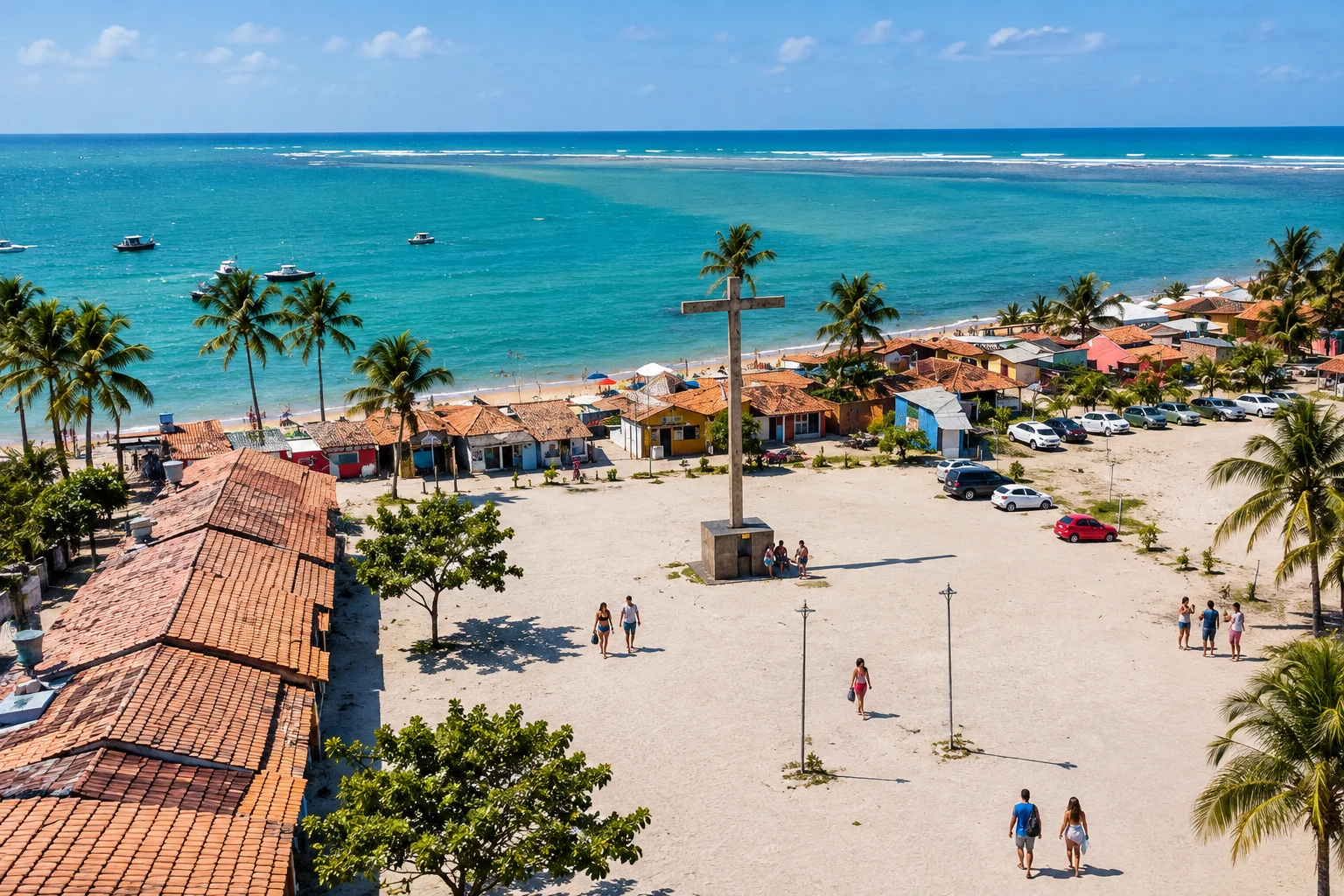
The coastal strip of Coroa Vermelha brings together the beach, the cross linked to the memory of the first mass, and the Pataxó cultural presence. The walk includes the shore and its public surroundings.
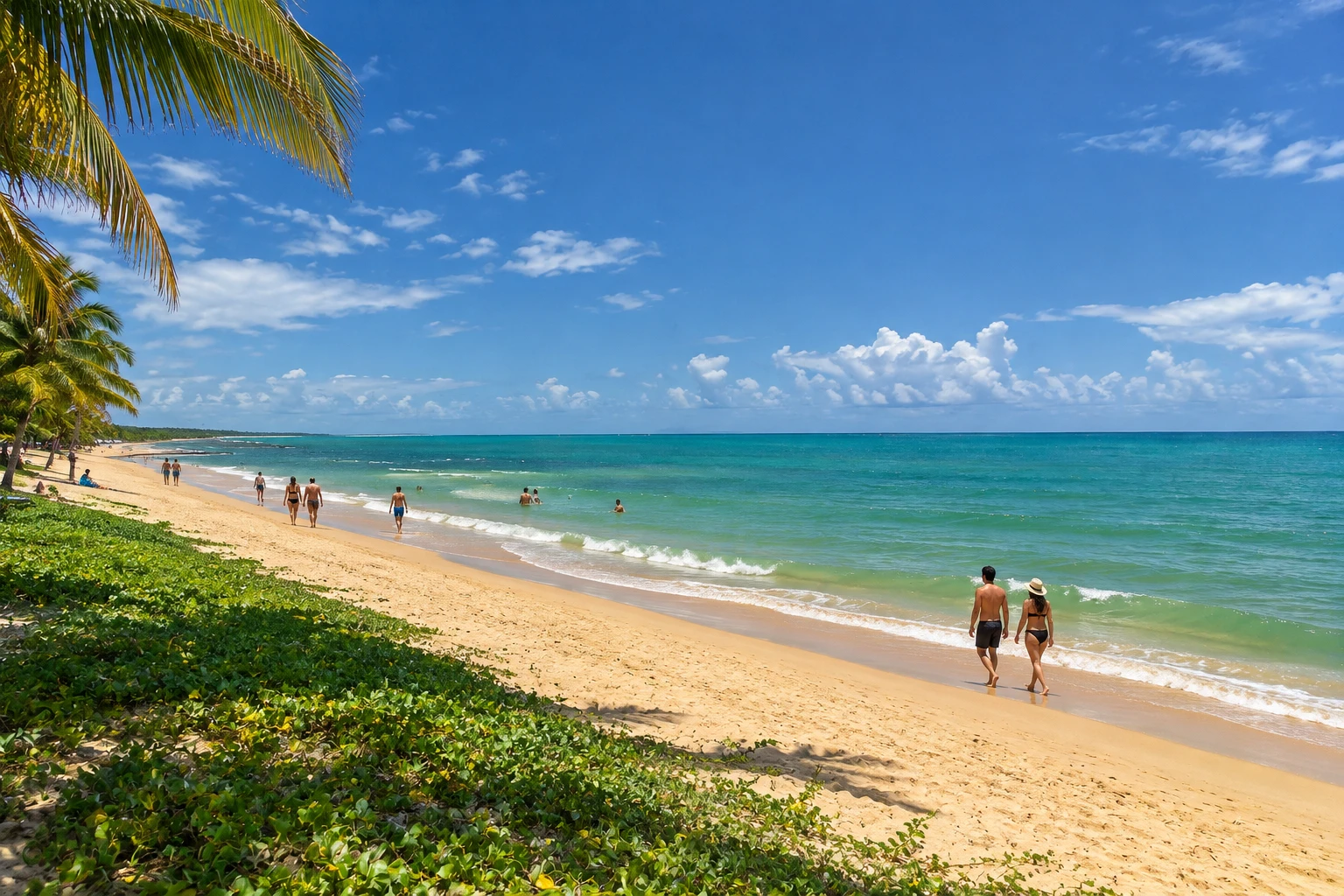
Arakakaí follows the urban area of Santa Cruz Cabrália. The beach lets you visit the seafront near the municipal seat without crossing the João de Tiba.
Santo André combines a settlement and a beach north of João de Tiba, in Santa Cruz Cabrália. Approaching from the center may include a ferry crossing, followed by local access.
To choose before you go
Where each tour starts, how long it takes, how it is done, what is included and the price range.
Coroa Vermelha is the part of Santa Cruz Cabrália closest to Porto Seguro: it is about 8 km from the municipal seat and about 16 km from the center of the neighboring city. The beach is nearly 2 km long and continues uninterrupted into Mutá Beach; the monument to the discoverers at the town entrance is a useful landmark for where it begins. From the road to the sand you walk along a boardwalk of stalls and small shops. Many sell Pataxó crafts: wooden bowls and mortars, headdresses and seed jewelry, and straw items. At the end of the path, in an open square by the sea, stands the large cross that marks the site where, according to tradition, the first mass in Brazil was held on April 26, 1500. The beach has two sides. The left corner, where the cross and the sand spit are located, has simple restaurants with a fisher-hut feel. The right side, adjacent to Mutá, hosts the larger beach stalls. The sea is calm, protected by reefs. At low tide natural pools form and the sand spit appears, allowing you to walk out into the sea; the effect is stronger on full and new moon days, when the tide recedes more. Coroa Vermelha is Pataxó indigenous land. Buy crafts directly from the makers, ask permission before photographing people, and if you want to visit a village, look for those that welcome visitors with accompaniment by residents.
Stops: Cross of the First Mass, Pataxó craft trade, Coroa Vermelha Beach, Coroa Vermelha sand spit.
Includes: Access to the cross square, the boardwalk, and the beach is free. Parking, purchases at the stalls, and other spending are paid separately.
Tip: Check the tide table and arrive about an hour before low tide. On good tide days the beach fills; if you prefer quiet, walk toward the Mutari Beach side, in the direction of the town center.
Best time: All year round, on low tides at full and new moons. In April there are the Pataxó Indigenous Games.
Almost everyone who goes to Santo André passes through Cabrália’s main town, and few stop. The center is small and can be seen quickly, in two sections. Start below, at Praça Pedro Álvares Cabral, in front of the pier. This is the best-preserved part of the center, on the banks of the Rio João de Tiba. The schooners for trips to Coroa Alta depart from here in the morning. Then go up to the Upper Town, on top of a small hill. The site is listed as national heritage and includes the Igreja Matriz de Nossa Senhora da Conceição, the former Town Hall and Jail, some ruins and old houses. From the courtyard beside the church there is a view over the historic center, the Rio João de Tiba and the sea. The visit is mainly exterior. The church and the old Town Hall are not always open, and the walk is worth it for the square, the facades and the viewpoint. On the way down there are restaurants around the pier square. If you are staying in Santo André you can leave the car on the other side, cross the ferry on foot and continue to the right until you reach the square.
Stops: Santa Cruz Cabrália Pier, Praça Pedro Álvares Cabral, Igreja Matriz de Nossa Senhora da Conceição, Casa de Câmara e Cadeia, Rio João de Tiba.
Includes: There is no charge to walk along the pier, the square and the church plaza.
Tip: Parking in the center is difficult: come by bus from Porto Seguro or on foot via the ferry if you’re in Santo André. Late afternoon, with the sun lower, is the most pleasant time to walk up.
Best time: All year.
This is the municipality's boat tour, and boarding is at the town’s own pier: schooners and flat-bottom boats depart in the morning from the pier on the banks of the João de Tiba River. Most passengers arrive from Porto Seguro in agency vans; those staying in Cabrália or Santo André only need to get to the pier. The boat goes down the river through mangroves to the mouth and then out to Coroa Alta, a marine park off the coast near Santo André. There is a sandbank that remains exposed even at high tide and, around it, reefs where the low tide forms natural pools. The stop is for swimming and snorkeling with a mask. Coroa Alta receives fewer boats than Recife de Fora, near Porto Seguro. On the return, itineraries usually stop at Santo André beach for lunch and at Ilha do Sol in the river, known for its mangrove mud bath and for selling sweets and handicrafts. The order of stops can change day to day because the boat must be at the reef at low tide. In rough seas, the tour may stay only on the river. Those staying in Santo André have another option: charter a smaller boat, alone or shared with other guests, to go to the reefs at low tide or to cruise the João de Tiba at sunset.
Stops: João de Tiba River, Coroa Alta, Santo André, Ilha do Sol.
Includes: Usually includes the boat and the guide and, on agency departures, transport from Porto Seguro hotels. Lunch, drinks and mask rental are paid separately. Check the current rates.
Tip: Ask when booking about the stopover time at Coroa Alta and whether there is an alternative in case of rough sea. Bring sunscreen, a towel and footwear that can get wet.
Best time: Days of calm sea and low tide, year-round.
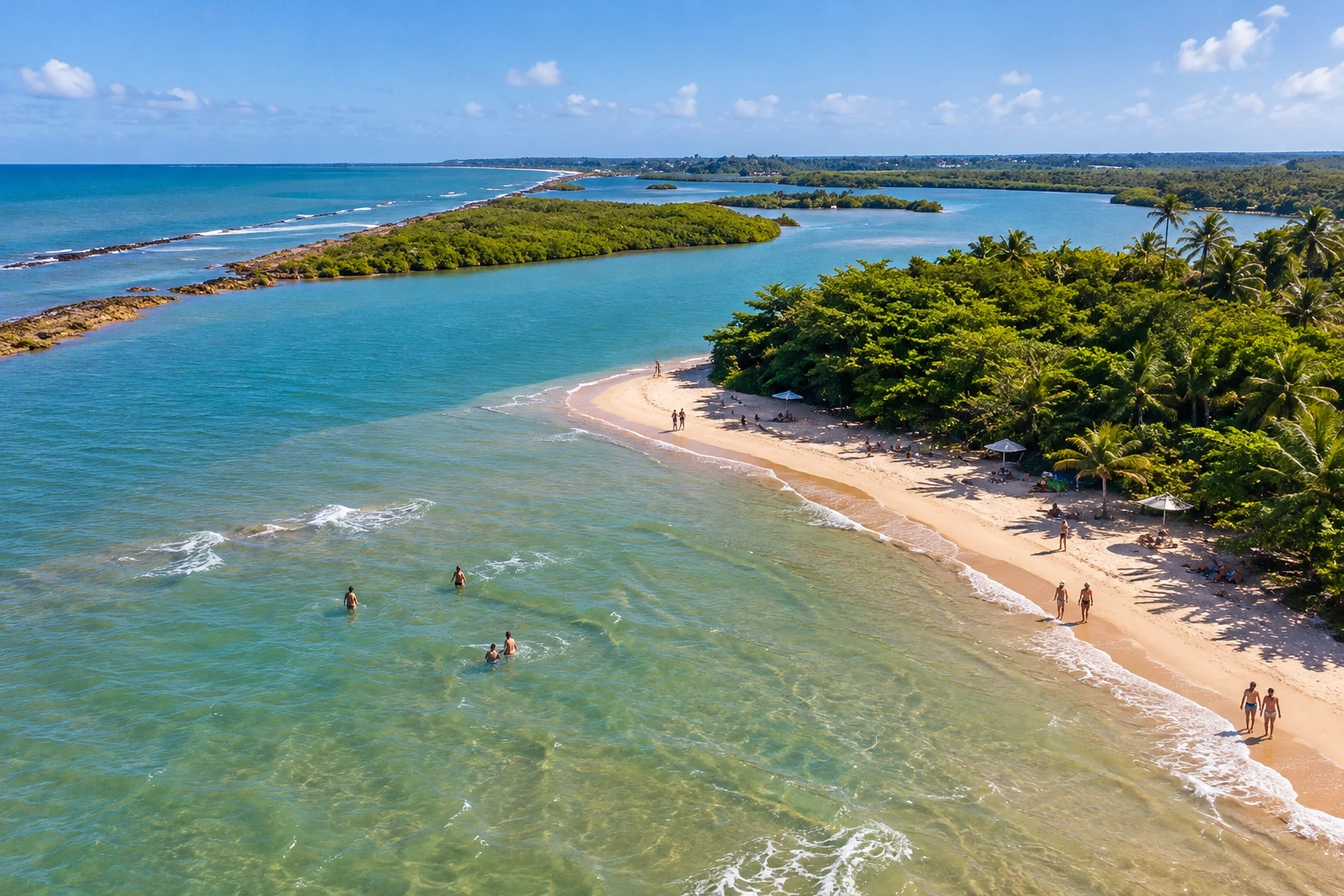
R$120 to R$150 · per person, adult, shared tourSanto André is a district of Santa Cruz Cabrália and lies on the other side of the Rio João de Tiba. The only way to get there is by the ferry that leaves from the town: the crossing itself takes less than 15 minutes and, with boarding and disembarkation, about 30. During the day there are departures every half hour from both banks. The landing is far from the village, so it’s convenient to cross by car or arrange a taxi in advance on the other side. The village is small, with guesthouses, a few restaurants and little commerce. The beach starts at Ponta de Santo André, where the river’s arm meets the sea and the sand widens; it’s a good stretch for entering the water and has no beach stands. Going left you reach the cove of Praia de Santo André, with a small cluster of stands on the southern corner and then long empty stretches. The northern corner, closed by a mangrove, is Praia das Tartarugas, which at low tide becomes a shallow pool. The sea is calm, even when there is some swell. Don’t expect blue water every day: the region’s rivers can cloud the sea, especially after rain. What the place offers is space and silence, even in summer. The village became known outside Brazil in 2014, when the German national football team stayed here during the World Cup.
Stops: Rio João de Tiba, Village of Santo André, Ponta de Santo André Beach, Santo André Beach, Praia das Tartarugas.
Includes: You pay for the ferry and, if applicable, parking and consumption. Pedestrians pay the crossing only from Cabrália to Santo André; vehicles pay both ways. Check the current fare table.
Tip: The village doesn’t have everything on hand: bring cash and leave with the car fueled. On the day you leave, allow plenty of time to cross, especially if you have a flight from Porto Seguro.
Best time: All year. The sea tends to be clearer after several days without rain.
After Santo André the road continues north toward Belmonte and passes two beaches that are worth the detour if you’re already on that side of the ferry. Santo Antônio Beach is about 8 km from the village. The sand is firmer and darker than at Santo André, and the tide varies more: at low tide during the full and new moons the sea recedes and the beach becomes very shallow. Guaiú Beach is about 13 km from the village and still feels wild. the Guaiú River flows into the sea there, and bathing in the freshwater at the river mouth complements the sea bath. At both beaches the facilities are limited to a few beach restaurants, and it’s advisable to reserve. You go by car or arrange a round trip with a taxi driver from the village. The same road leads to Belmonte, about 50 km from Santo André, a cocoa-era town on the Jequitinhonha River, which has its own page.
Stops: Santo Antônio Beach, Guaiú Beach, Guaiú River.
Includes: Access to the beaches is free. Food and drink at restaurants and transport are paid by each visitor.
Tip: Book lunch before you leave. Bring water, insect repellent and cash.
Best time: All year; at low tides during full and new moons Santo Antônio Beach becomes shallower.
Prices are estimates, checked in November 2026 with local operators, and may change with the season and the type of tour. Confirm with the operator before booking.
Day by day
Suggestions to plan the trip. Change the order of the days according to the weather and tour availability.
Plan the day around the tide. If low tide is in the morning, start at Coroa Vermelha: walk along the Pataxó craft promenade, see the cross that marks the first Mass and stroll along the sandy point while the sea is out. Stay for a swim in the tidal pools and have lunch at one of the beach stalls. In the afternoon, follow BR-367 to the town center, about 8 km away, by bus or car. Pass by Praça Pedro Álvares Cabral and the pier and climb to the Upper Town to see the Mother Church of Our Lady of the Conception, the old Town Hall and Jailhouse and the view of the river and sea. If low tide is in the afternoon, reverse the order: Upper Town early, beach later. If you have a car and energy you can take the ferry at the end of the day just to visit the Ponta de Santo André, but the round trip takes more than an hour; with only one day, it’s better to leave Santo André for another visit.
Use the first day for the south side of the river. Go to Coroa Vermelha at low tide to see the cross, the sand spit and the tidal pools, and set aside time for Pataxó handicrafts on the way to the beach. In the other part of the day, visit the town center: the pier, Praça Pedro Álvares Cabral and Cidade Alta, with the main church and the lookout over the João de Tiba River. Take advantage of your stop at the pier to book the boat trip for the next day and confirm the departure time. Those staying in Santo André take the ferry at the end of the afternoon.
There are two ways to use the second day. The first is the schooner tour that leaves the pier in the morning: descent of the João de Tiba River, a stop for a swim at Coroa Alta at low tide, lunch in Santo André and a stop at Ilha do Sol. It takes about 6 hours. The second is a beach day on the other side of the ferry. Start at Ponta de Santo André, walk along the cove to Praia das Tartarugas and, if you have a car, in the afternoon continue to Santo Antônio, about 8 km from the village, or to Guaiú, about 13 km away, where the river meets the sea. With a third day, do both, or continue along the road to Belmonte, about 50 km from Santo André.
Best time to go
The seasons shown are the most usual ones; nature doesn't always follow the calendar.
High season · Heat and showers
Hot, with highs of 27 °C to 29 °C and lows around 23 °C, and showers. This is the busiest month in Coroa Vermelha, where the stalls fill up and BR-367 traffic slows. Santo André remains quiet; book accommodation in advance.
Hottest month · Carnival
Highs around 29 °C, warm sea, and showery rain. At Carnival, when it falls in February, activity increases in Coroa Vermelha. If you want quiet, stay by Santo André or on the northern beaches.
More rainy days · Less busy
Highs near 28 °C and more rainy days. After Carnival, the beaches empty. Rivers bring more water to the sea, which can become turbid in Santo André and Guaiú. Schedule the Coroa Alta trip at the start of your stay so you can reschedule if necessary.
Pataxó Indigenous Games, in Coroa Vermelha · Date of first Mass, 26th
Frequent rain and highs of 27 °C to 28 °C. This month is most connected to the place’s history: Coroa Vermelha usually hosts the Pataxó Indigenous Games, with traditional competitions and performances by nearby villages, and the 26th commemorates the first Mass. Confirm dates for each year before planning.
Low season · Cooler days
Highs drop to about 26 °C and rain decreases compared with April. Activity is low across the municipality, and the beaches of Santo André and the northern coast are almost empty. Bring a light raincoat and check the forecast before boat trips.
Cooler days · Moderate rain
Highs of 25 °C to 26 °C, lows near 22 °C, and moderate rain. Evenings call for a light sweater. Visitor numbers remain low until the end of the month, when holidays begin. Good time for Cidade Alta and for walking along the beaches.
School holidays · Less rain
Highs around 24 °C to 25 °C and lows of 21 °C to 22 °C, with less rain. Holidays bring activity back to Coroa Vermelha. The humpback whale season along the coast runs from July to October; whale-watching boats depart from Porto Seguro.
Dry month · Wind
One of the driest months, with highs of 24 °C to 25 °C and cool nights. The constant wind can stir the sea on some days. With no holidays or school breaks, it’s a quiet month, good for Santo André and the northern beaches.
Driest month · Large tidal variation
It’s one of the driest months, with highs of 25 °C to 26 °C. Wind and large tidal variation are common: at full and new moons, the sandspit at Coroa Vermelha and the pools at Coroa Alta become more extensive.
Heat returns · October 12 holiday
Rain increases again and highs rise to 26 °C–27 °C. The October 12 holiday brings activity to Coroa Vermelha for a few days; for the rest of the month the pace is calm. Bring a light rain jacket and confirm boat departures the day before.
Wettest month · Holidays
This is usually the rainiest month, with many days of showers and highs of 26 °C–28 °C. The sea near river mouths becomes turbid more often. Keep Historic Town and the crafts of Coroa Vermelha as activities for rain breaks.
Start of high season · Year-end peak
Showery rain and highs of 27 °C–28 °C. Activity grows during the month and reaches its peak in the final week. Book accommodation and tours in advance and allow extra time for the Santo André ferry on the busiest days.
Plan the journey
Santa Cruz Cabrália has no airport: use Porto Seguro’s, about 24 km from Cabrália’s town seat and about 30 km from the village of Santo André, including the ferry crossing.
The airport receives direct flights from several Brazilian state capitals and, on some days, from interior cities; from other origins there are connections. Check the current network.
From arrivals you continue by taxi, transfer, rental car or bus. The route is straightforward: go down to the Porto Seguro shoreline and take the BR-367 north, always along the sea. Allow 45 minutes to 1 hour to reach the ferry boarding in Cabrália’s town seat, because traffic usually slows around Taperapuã in Porto Seguro and on the urban stretch of Coroa Vermelha.
Long-distance buses arrive at Porto Seguro bus station. From there a local line continues to Cabrália.
The line between Porto Seguro and Santa Cruz Cabrália runs along the BR-367, passing the beaches of Orla Norte, Mutá and Coroa Vermelha, and operates from early morning until night, with frequent departures. The whole trip takes just over 1 hour. There is a stop near Porto Seguro airport.
It’s the simplest way to visit Coroa Vermelha and the town center without a car. For Santo André, the bus drops you at the town center; you walk across the ferry on foot and, on the other side, you need to have arranged a taxi or the pousada’s transport, because the drop-off is far from the village.
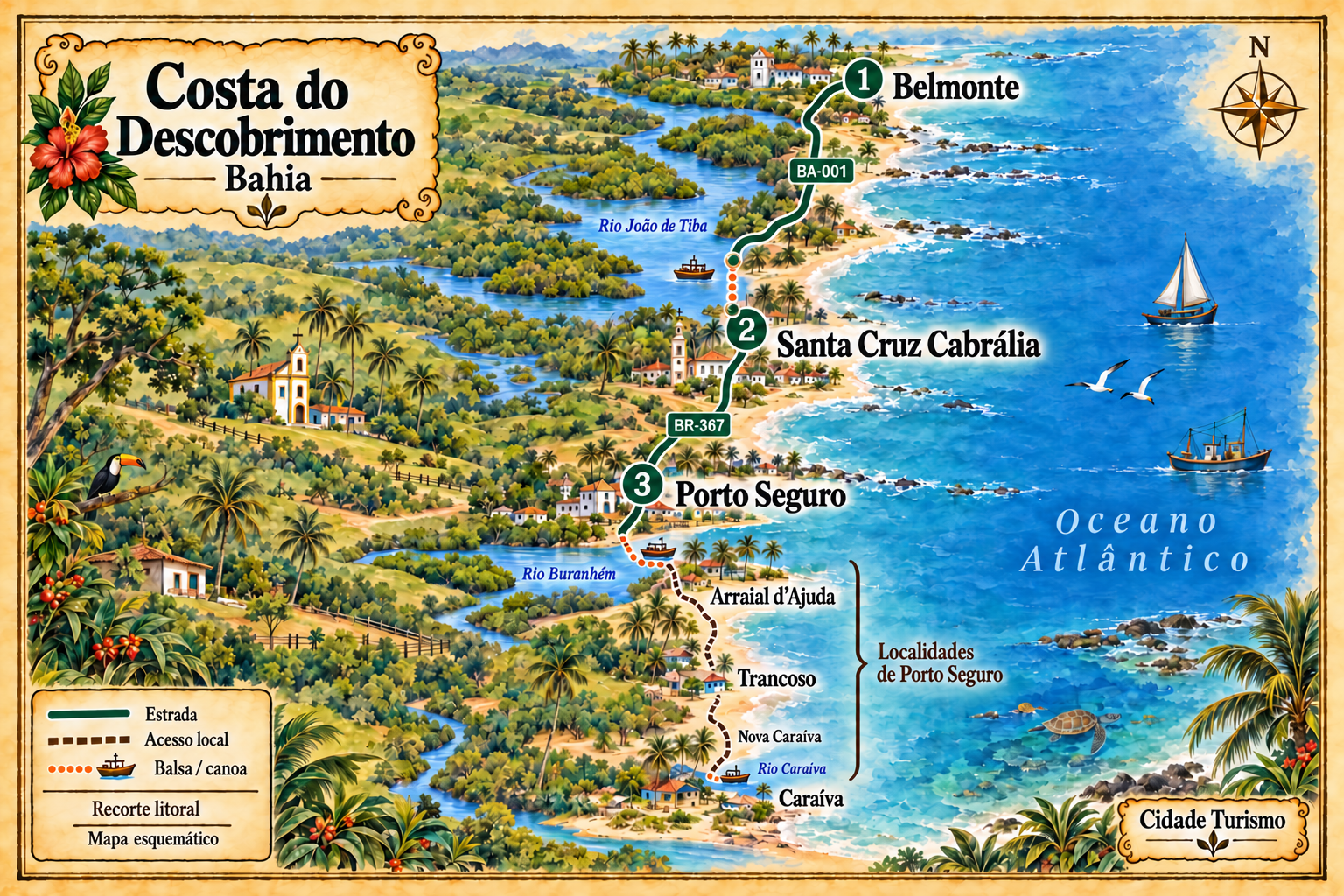
The usual route is via Porto Seguro: BR-101 to Eunápolis, BR-367 to Porto Seguro and from there the same BR-367 north along the shore to Coroa Vermelha and Cabrália’s town seat, about 23 km from downtown Porto Seguro.
Those heading straight to Santo André from BR-101 have an alternative that avoids Porto Seguro and the ferry: a road that leaves BR-101 about 30 km north of Eunápolis, passes the village of Barrolândia and reaches the coastal highway between Belmonte and Santo André. From Eunápolis it’s about 140 km, roughly 50 km more than via Porto Seguro. The entrance is poorly signposted, and the first 500 meters are unpaved.
In Cabrália’s town seat, parking downtown is difficult.
The ferry links the town seat of Santa Cruz Cabrália to Santo André and is the route to the whole northern part of the municipality. It runs every day, day and night, on a fixed schedule: during the day it departs every half hour from both banks at the same time; at night, hourly; in the early morning, with longer intervals.
The crossing takes less than 15 minutes; adding boarding and disembarking, about 30 minutes. Pedestrians pay only in the Cabrália-to-Santo André direction, and vehicles pay both ways. Small children and older adults are exempt, according to the rule in force. Check the current rates and accepted payment methods.
The landing in Santo André is distant from the village: those who cross on foot need transport on the other side. On the return, on a flight day, allow plenty of time, because missing one ferry means waiting for the next.
From Porto Seguro Airport, taxis make the trip to Coroa Vermelha, Cabrália’s town seat and Santo André by fixed rates; for Santo André, ask if the ferry is included. Village guesthouses usually recommend local taxi drivers who pick up at the airport by appointment. Ride-hailing cars accept the ride, but for Santo André drivers often ask an extra amount because of the ferry and the return without a passenger.
Within the municipality, Coroa Vermelha and the town seat are handled on foot and with the BR-367 bus. In Santo André, the village and the beach are explored on foot or by bicycle; to get to Santo Antônio, Guaiú and Belmonte you need a car or a prearranged taxi.
Renting a car pays off if you want to visit the northern beaches or will continue along other points of the coast. If you stay only in Coroa Vermelha or only in Santo André, it isn’t necessary.

Your questions
The locality and its beach are in Santa Cruz Cabrália, on the coastal stretch connected to BR-367.
Plan the João de Tiba ferry crossing or the approach via BA-001 to the north and confirm local access.
The square and the exteriors already make up the ensemble; entry into the buildings depends on staff availability.
The beach is next to the municipal seat and does not require the João de Tiba crossing used for Santo André.
According to tradition, on Coroa Vermelha Beach, in Santa Cruz Cabrália, on April 26, 1500, four days after Pedro Álvares Cabral’s fleet arrived. The service was led by Friar Henrique de Coimbra. A large cross in an open square by the sea marks the spot, and access is free.
Coroa Vermelha has more hotels, beach bars and shops, calmer sea conditions, and is closer to the airport and tours from Porto Seguro. Between Coroa Vermelha and the town center, along Mutari Beach, lodging is quieter. Santo André, on the other side of the ferry, is for those seeking rest: an empty beach, a small village and pousadas, with fewer services. The coast north of Santo André has few options.
You can go year‑round: it’s warm in every month and rain falls in showers. August and September are usually the driest months, with less movement. From December to March the sea is warmer and Coroa Vermelha busier. March, April and November are among the rainiest months. To see the natural pools, the tide matters more than the month: prefer days near full moon and new moon.
By bus. The line between Porto Seguro and Santa Cruz Cabrália follows BR-367 along the beaches, passes Coroa Vermelha and ends at the town center, with frequent departures during the day. The whole trip takes a little over 1 hour. Taxis and ride‑hail cars also do the route, and agencies in Porto Seguro sell tours to Coroa Vermelha and Coroa Alta with transport from hotels.
It departs from Cabrália’s town center and crosses the João de Tiba River in under 15 minutes; with boarding and disembarking, allow about 30 minutes. It operates every day, day and night: every half hour during the day, hourly at night and with longer intervals at dawn. It carries cars and pedestrians. Pedestrians pay only on the outbound trip from Cabrália to Santo André; vehicles pay in both directions. Check the current timetable.
To stay in the village and on the beach, no: everything is done on foot or by bicycle. A car becomes useful to reach Santo Antônio and Guaiú beaches, Belmonte or other coastal points, and for arrival, because the ferry disembarkation is far from the village. Without a car, arrange transport with your pousada or a local taxi driver.
At low tide. The sand spit and the pools only appear when the sea recedes, and the effect is strongest on days of full moon and new moon, when tidal variation is greater. Check the day’s tide table and arrive about an hour before the lowest point. With high tide the beach is still good for swimming, but without the pools.
In both municipalities. The Coroa Vermelha Indigenous Land, of the Pataxó people, was homologated in 1998 in two parcels. The strip along the sea, where the beach, the cross and the craft commerce are, is in Santa Cruz Cabrália, from the mouth of the Mutari River to the border with Porto Seguro. The larger parcel is inland, a few kilometers from the coast. When visiting, buy handicrafts directly from the families and ask permission before photographing people.
From the dock at the Santa Cruz Cabrália headquarters, on the banks of the João de Tiba River, in the morning. The boat goes down the river, stops at Coroa Alta for swimming at low tide, and usually includes stops at Santo André and Ilha do Sol, totaling about 6 hours. Agencies in Porto Seguro sell the tour with transport to the dock; those staying in Cabrália can board directly.
One day is enough to see Coroa Vermelha and the Cidade Alta from Porto Seguro. With two days you can add the boat trip to Coroa Alta or a beach day in Santo André. People who choose Santo André to relax usually stay three days or more and use one of them for the northern beaches or for Belmonte.
Yes. Belmonte is about 50 km north of Santo André, along the coastal road that passes the beaches of Santo Antônio and Guaiú. It’s an old town from the cacao era, on the banks of the Jequitinhonha River, and has its own page. Travel by car or arranged taxi; check road conditions and return transport beforehand.
It’s calm: even when there is some swell, strong undertows are uncommon. The color varies. The area receives water from several rivers, which can cloud the sea, especially after rain, so don’t expect blue water every day. The stretch at Ponta de Santo André, where the river meets the sea, and Praia das Tartarugas at low tide are among the most popular spots for entering the water.
Brazilian routes
Between Belmonte, Santa Cruz Cabrália and Porto Seguro, the coastline brings together estuaries, historical heritage and communities linked to Pataxó culture.