Região das Missões

RS

Região das Missões

Ruínas jesuítico-guarani, museus e caminhos rurais no noroeste do Rio Grande do Sul.

Sul

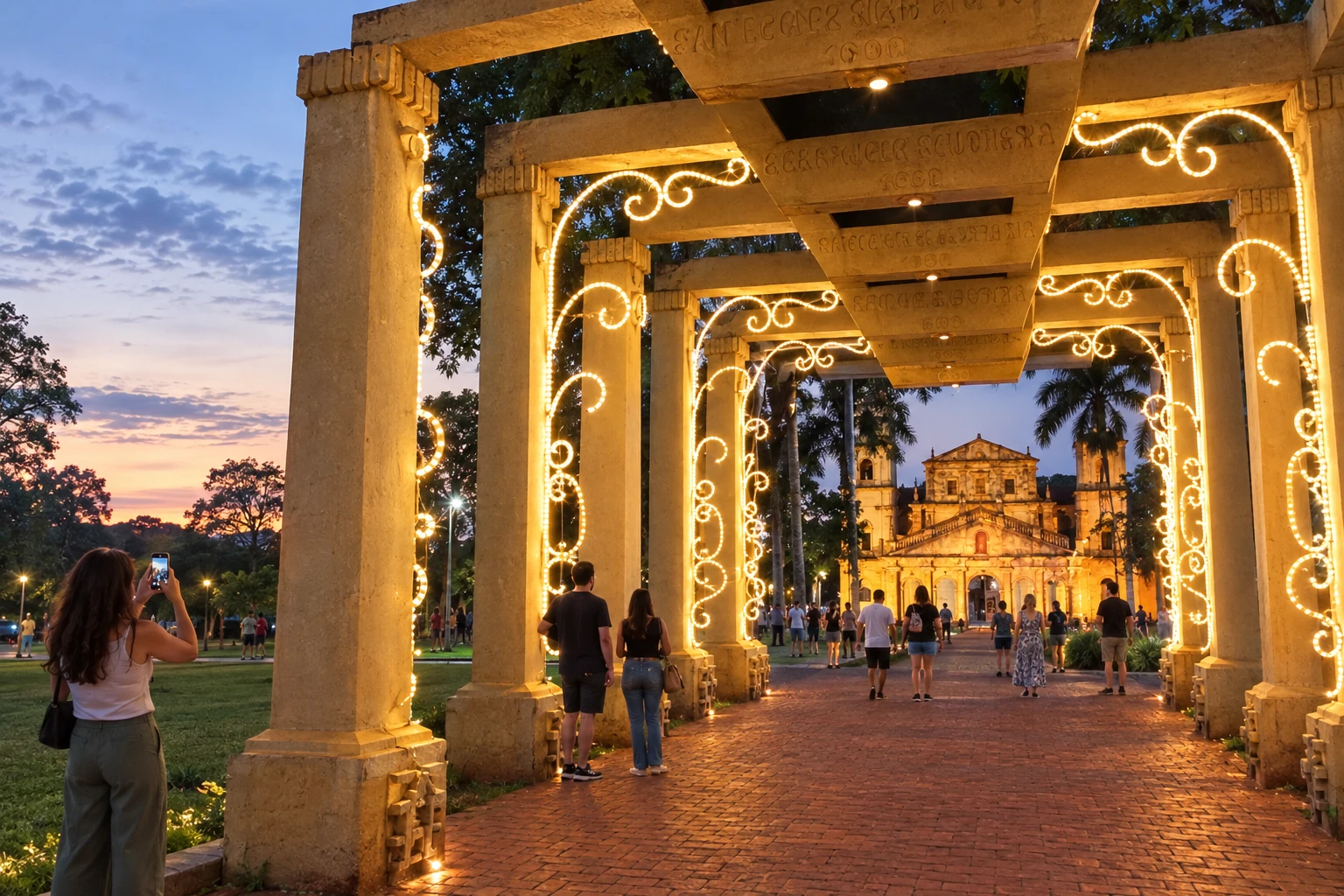
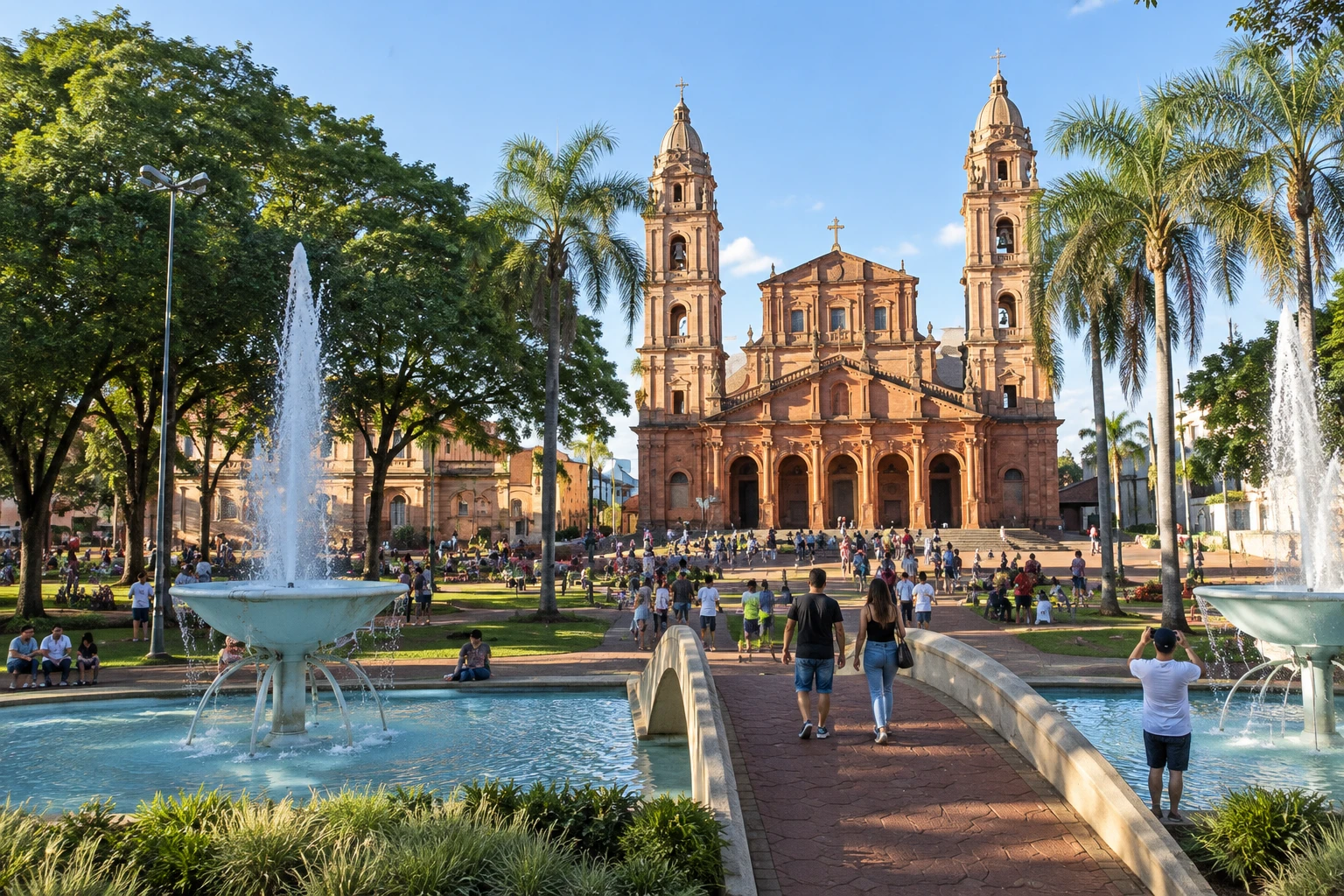
In the photo: Portal dos 30 Povos, no centro histórico de Santo Ângelo, Região das Missões.

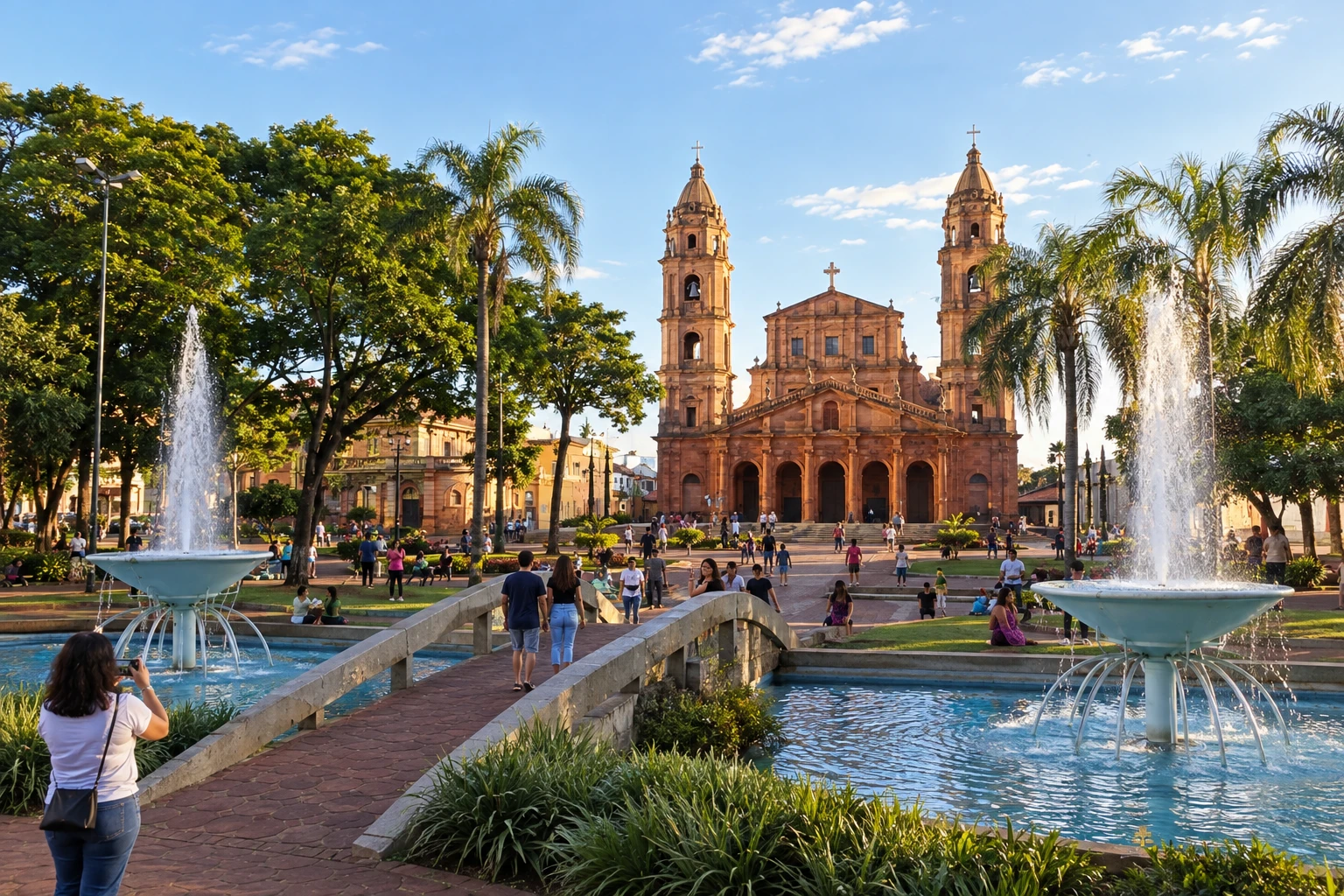
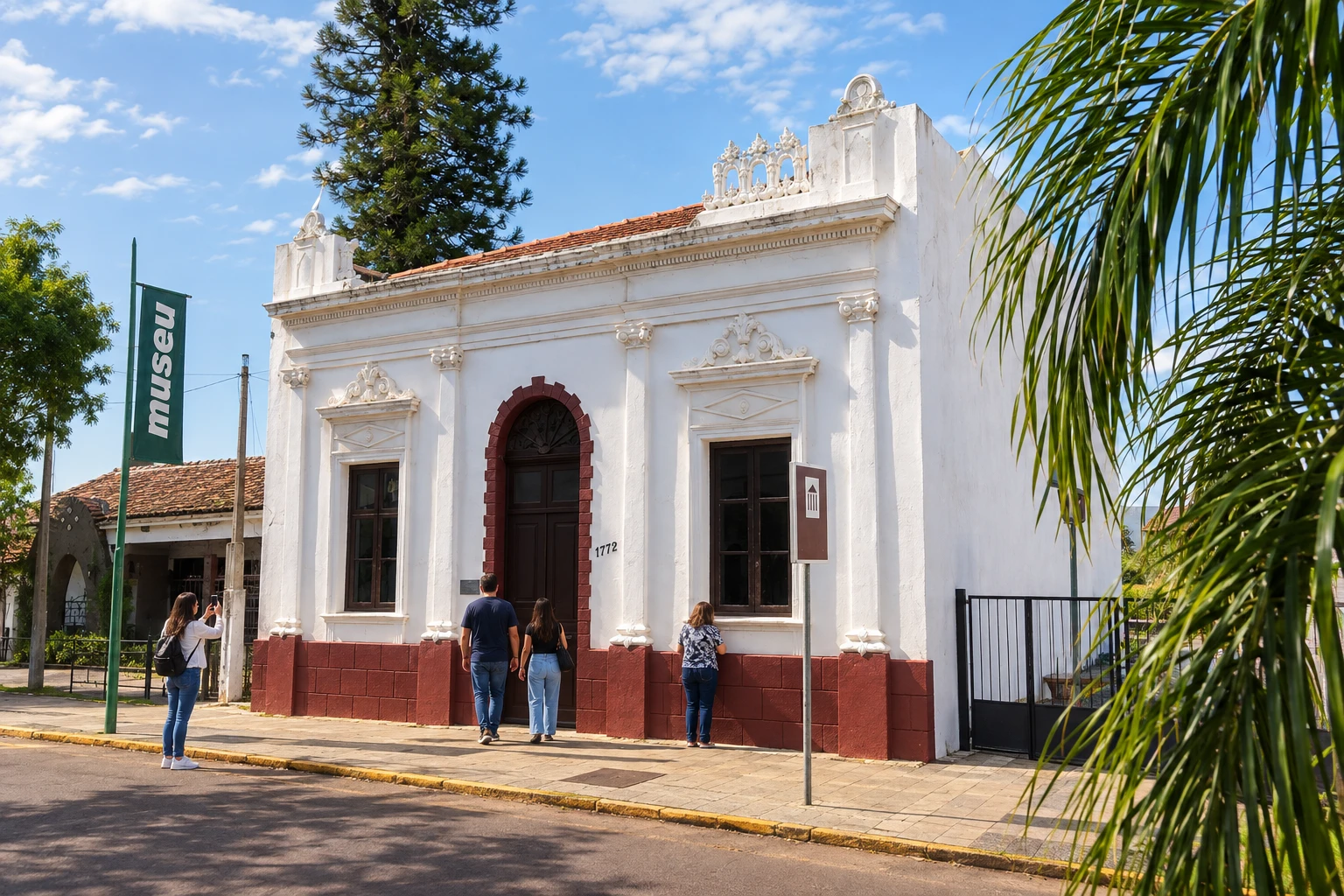
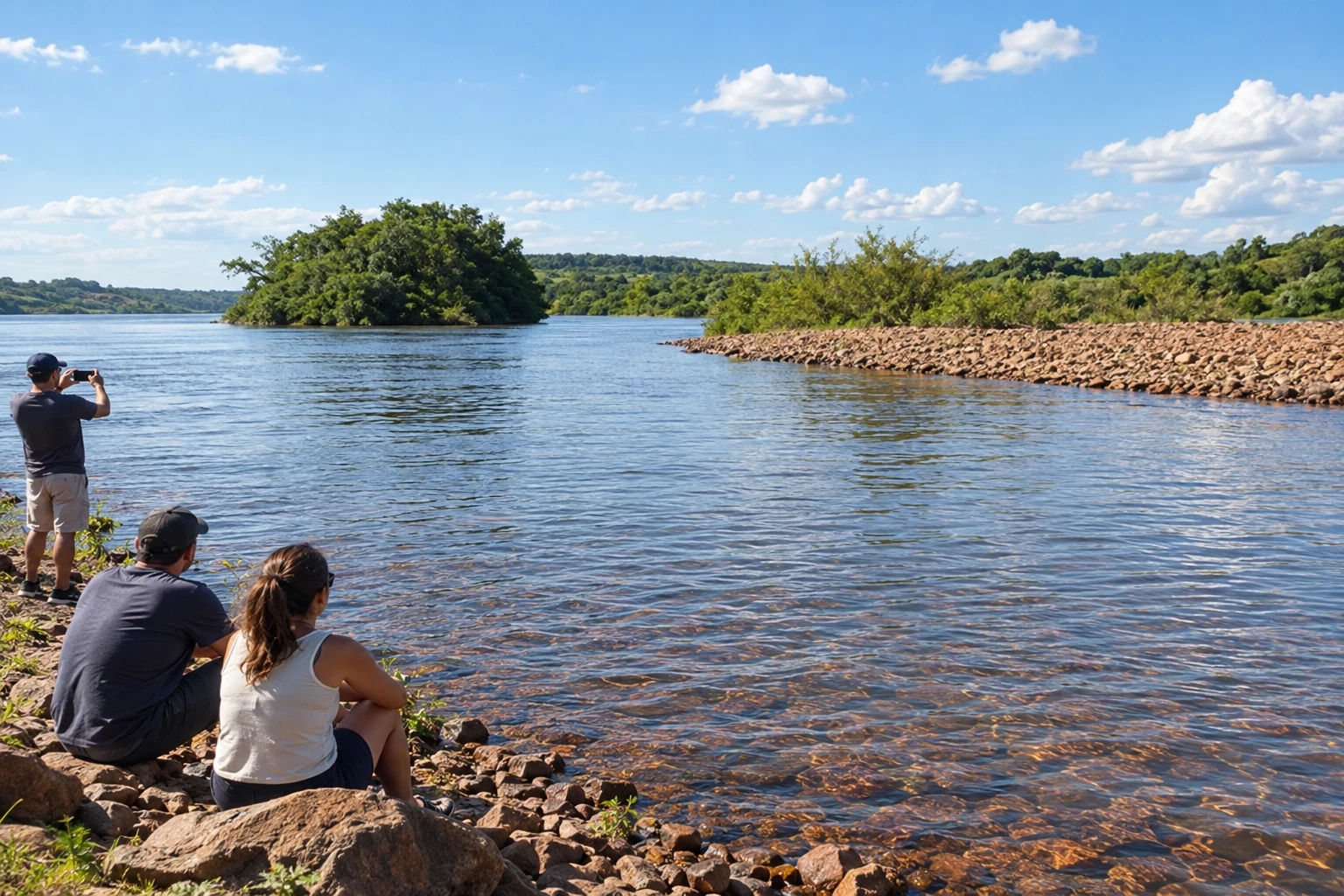
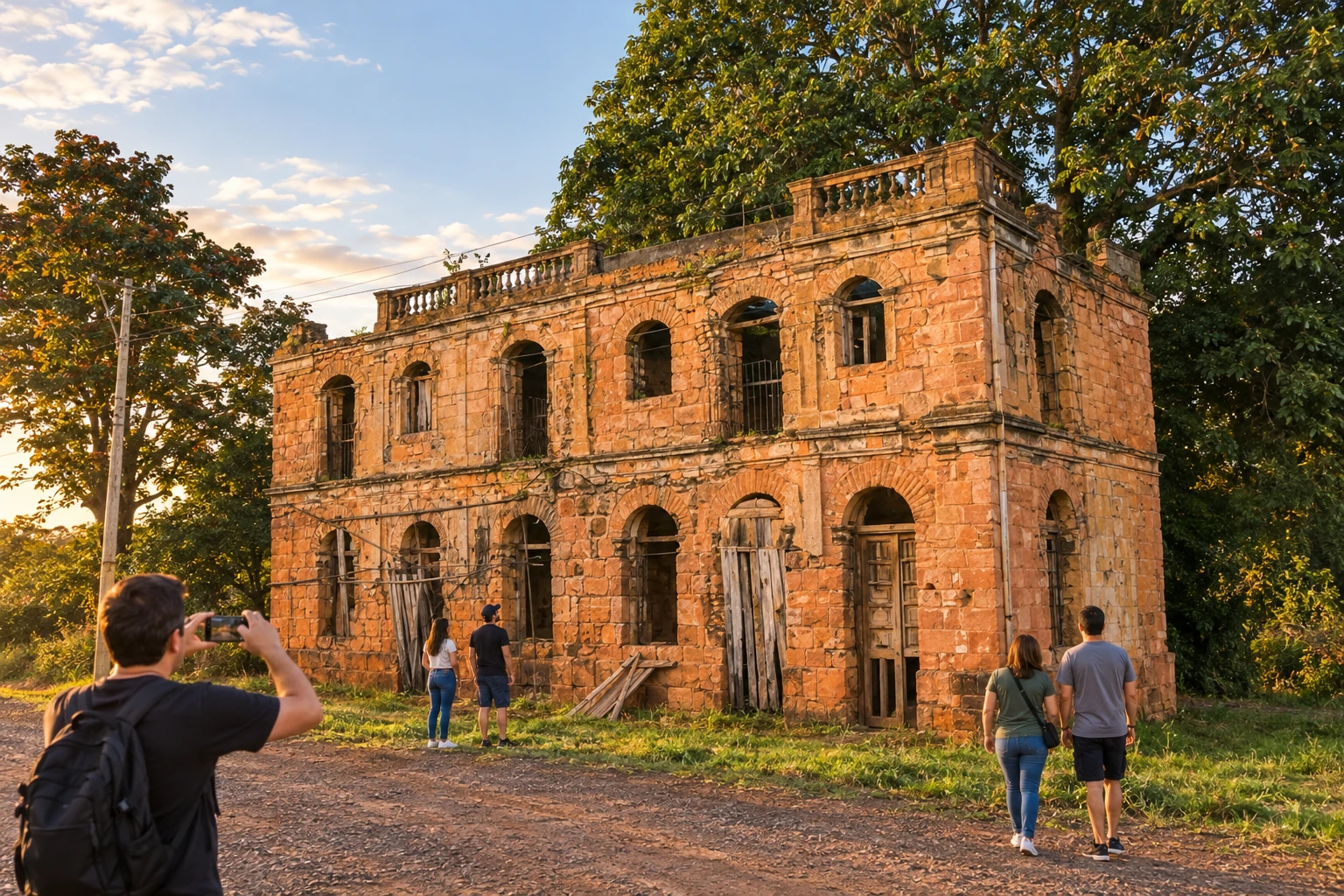
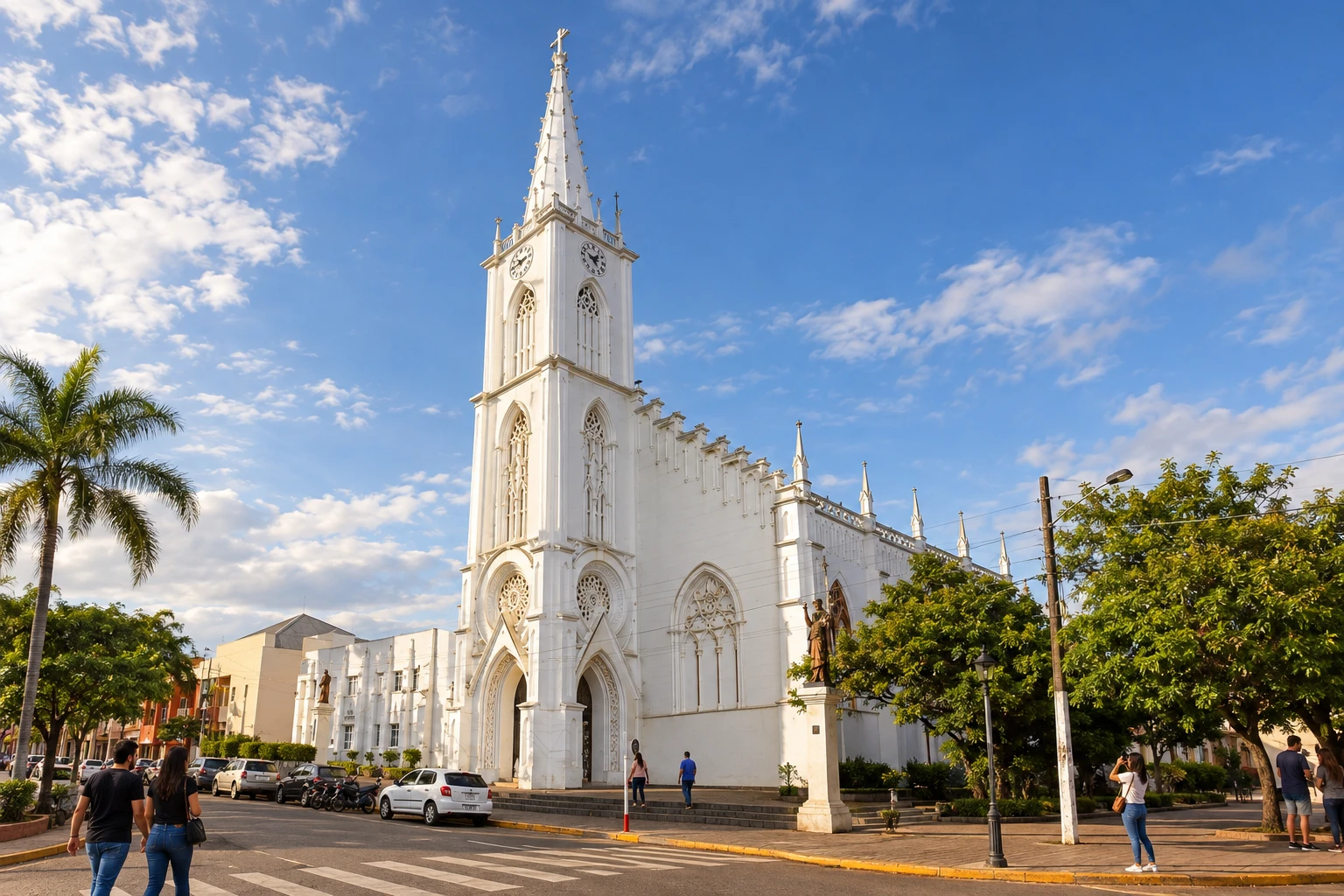
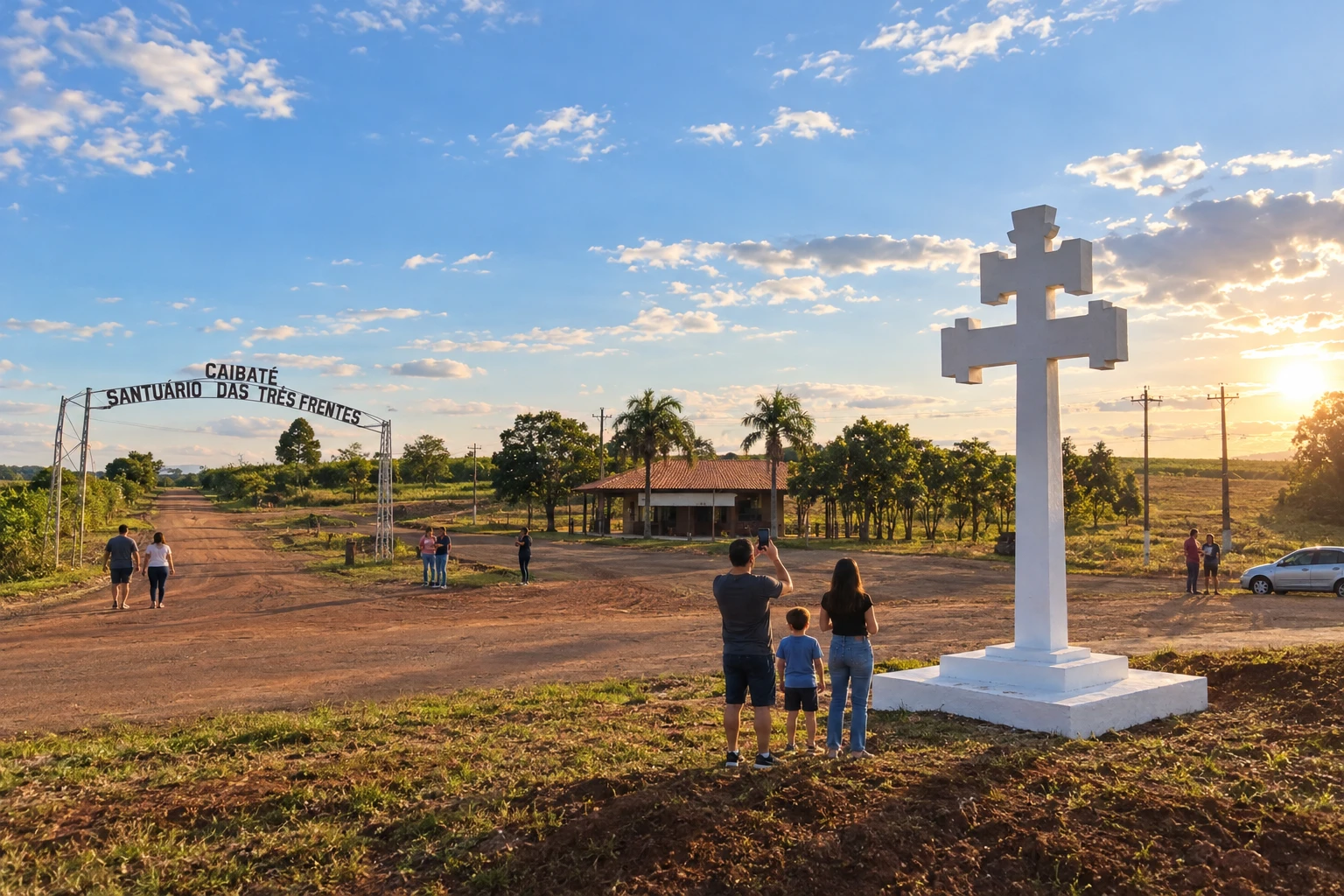
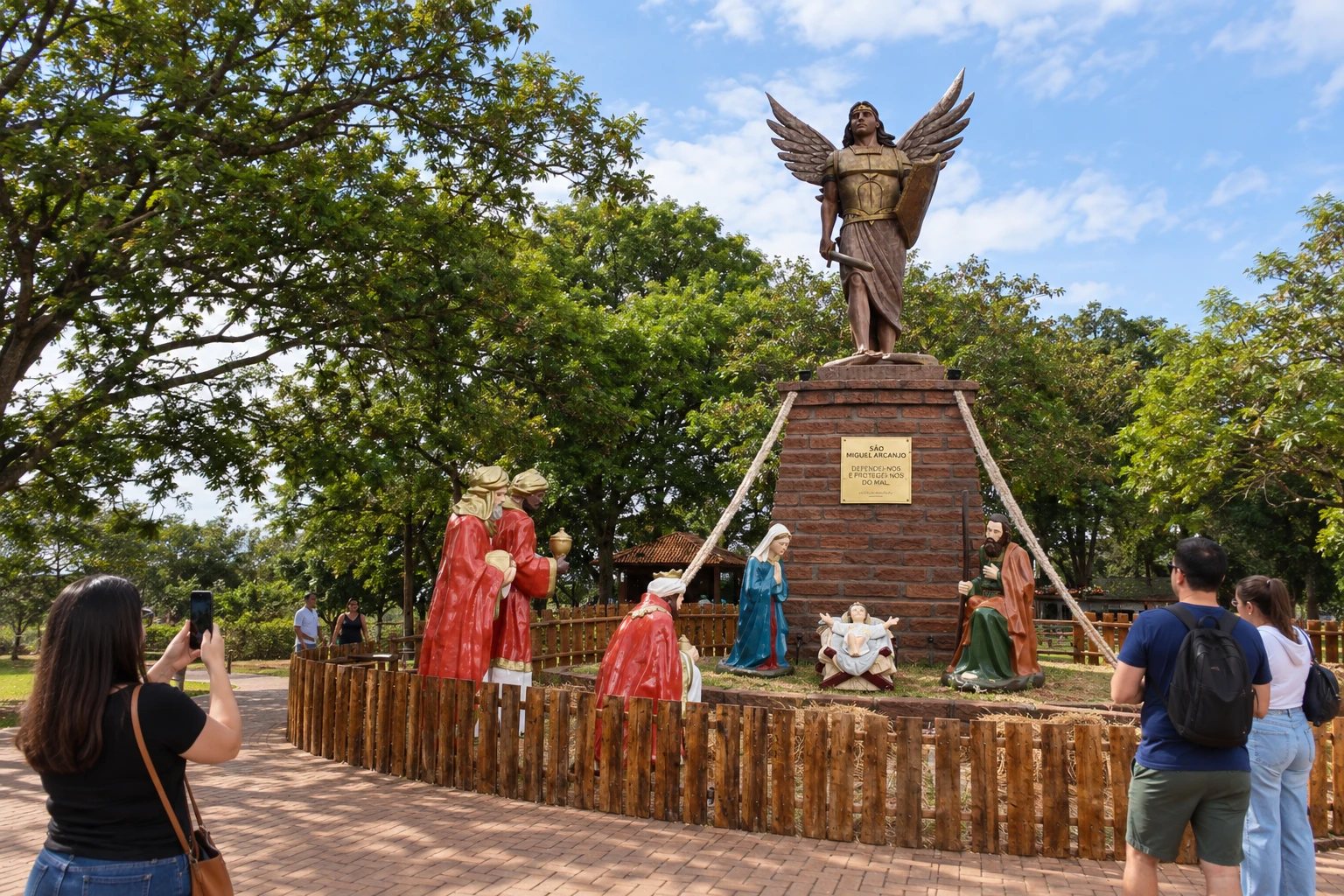
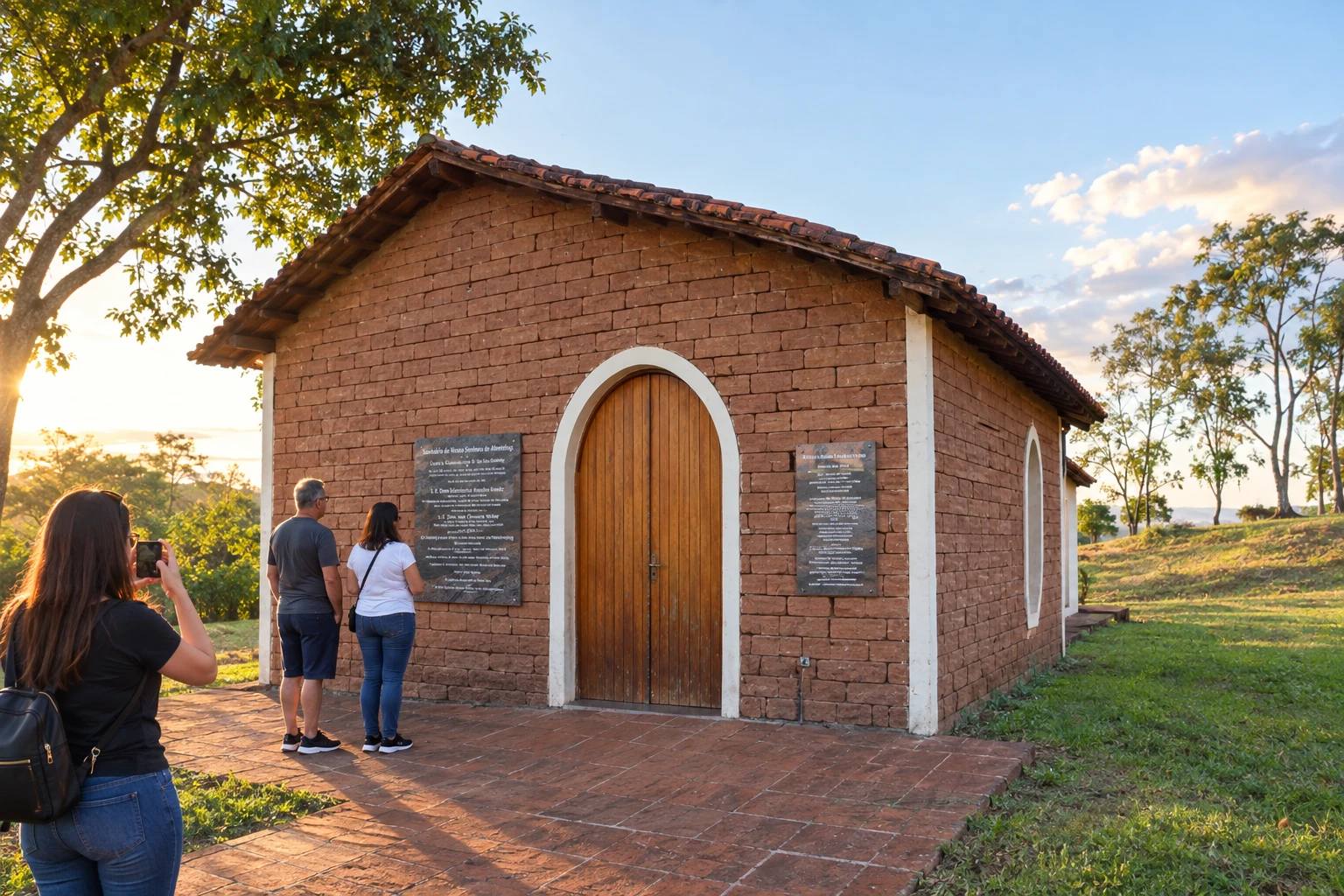
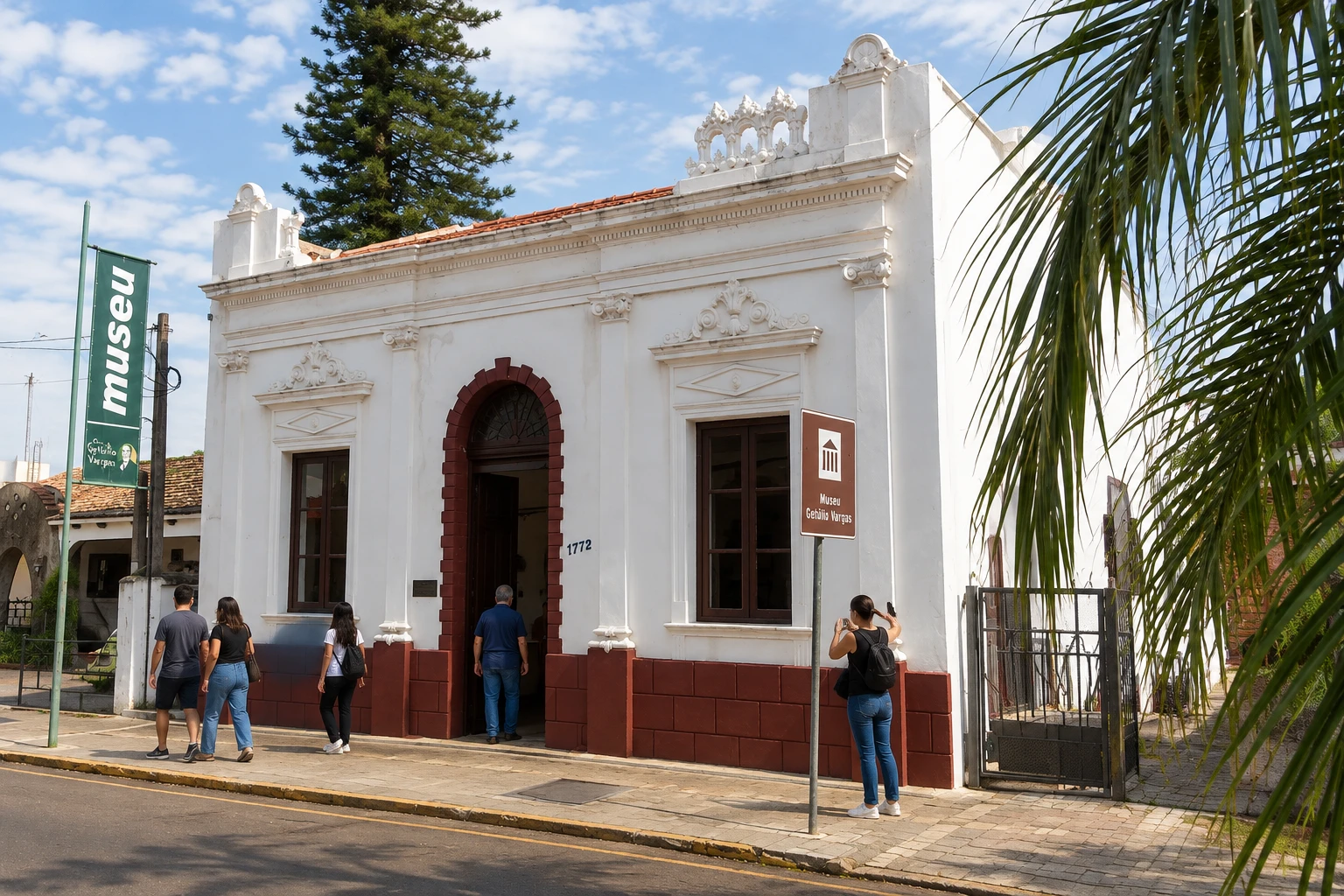
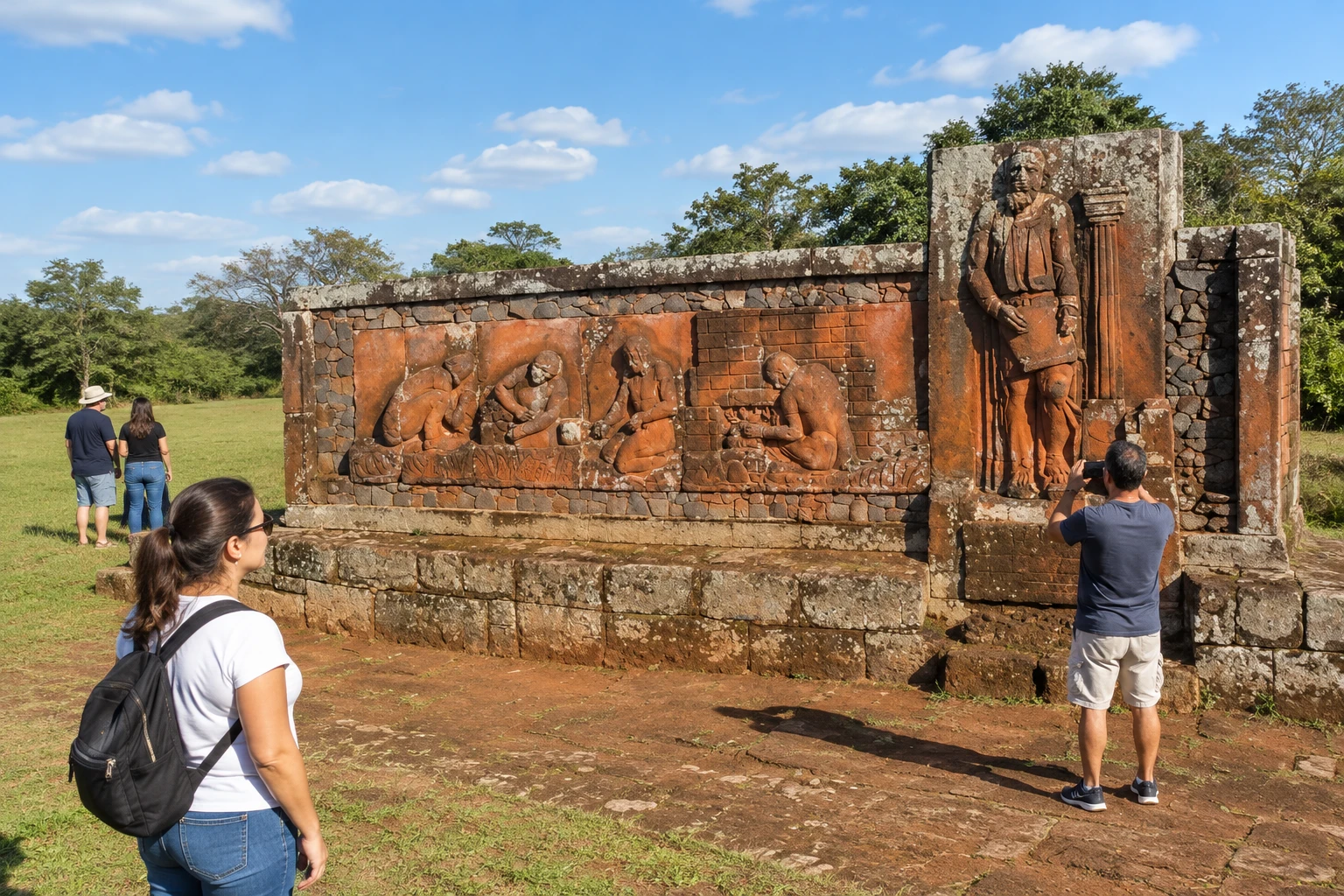
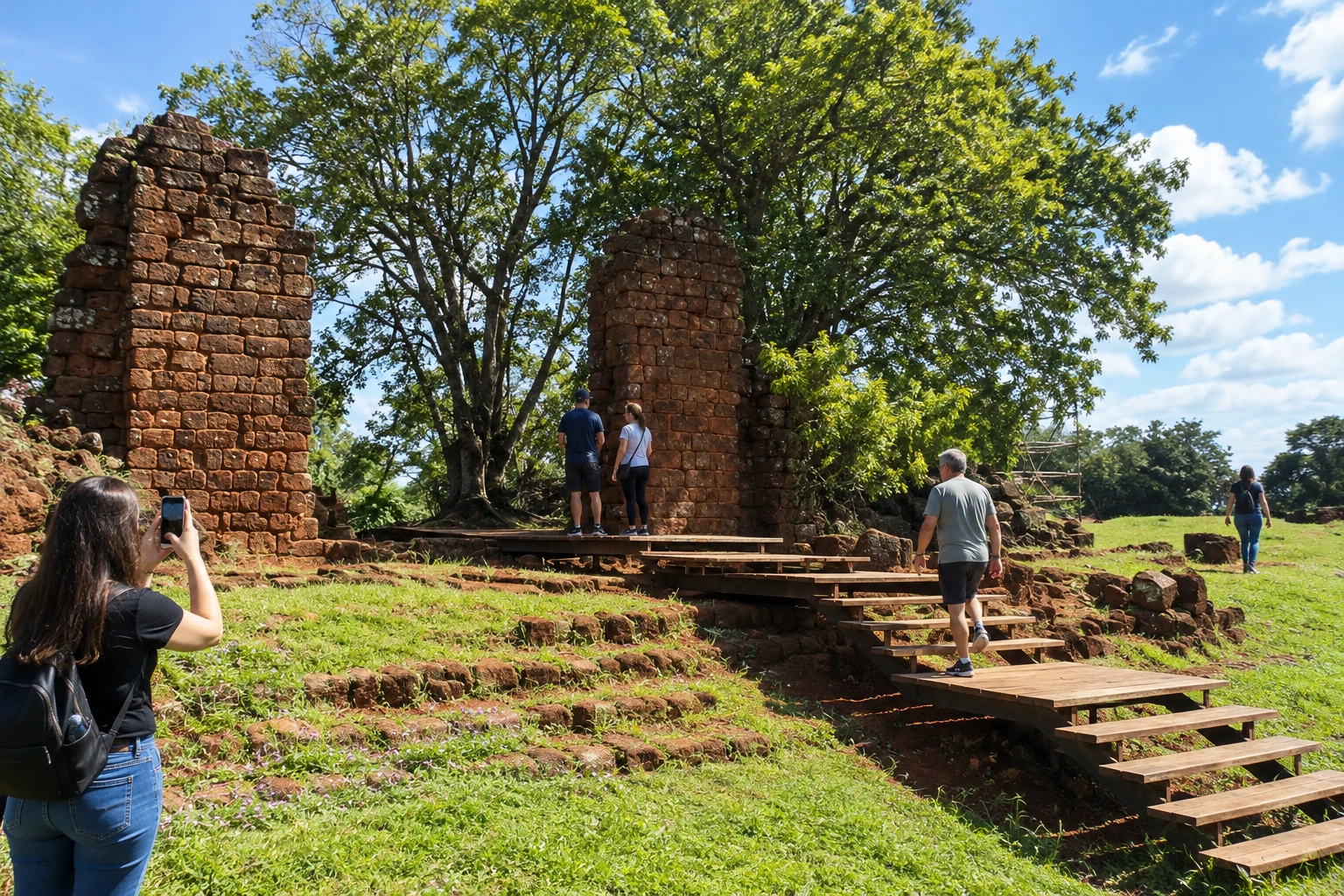
Illustrative images. The pictures in this guide are illustrations based on the real place, not photographs, and may differ from it.

Get to know the place

A region to enjoy
at your own pace.

A Região das Missões reúne o patrimônio dos antigos povoados jesuítico-guarani e a vida atual de municípios do noroeste gaúcho. Ruínas em arenito, esculturas sacras, museus e festas religiosas ajudam a conhecer essa história por diferentes perspectivas. Campos, comunidades rurais e o Rio Uruguai também fazem parte da paisagem.

A viagem pode combinar passeios locais com uma peregrinação organizada, mas são experiências com acessos e preparação próprios. Os sítios arqueológicos preservam vestígios de construções e exigem respeito às áreas de visitação. A caminhada pelas antigas ligações missioneiras atravessa estradas de terra e inclui apoios que precisam ser combinados antes da partida.

This destination brings together 8 cities: Santo Ângelo, São Borja, Garruchos, São Nicolau, São Luiz Gonzaga, Caibaté, São Miguel das Missões, Entre-Ijuís.

Share: WhatsApp
Traveler, share your experiences through photos Up to 5 photos of each place you visited.

One destination, many paths

The cities on this trip

Start with one city or combine several in your itinerary.

Where Região das Missões is The star marks the nearest capital, Porto Alegre.
Porto AlegreSanto ÂngeloSão BorjaGarruchosSão NicolauSão Luiz GonzagaSão Miguel das Missões

Mapa: @svg-maps/brazil, CC BY 4.0

How to get there: Região das Missões

O acesso terrestre depende da cidade escolhida como base no noroeste do Rio Grande do Sul. Para chegar de avião, consulte as ligações disponíveis para Santo Ângelo e organize o transporte até sua primeira parada.

Suggested arrival point: Santo Ângelo

The local experience

Things to do in Região das Missões

See 21 more places in Região das Missões

To choose before you go

Tours in Região das Missões

Where each tour starts, how long it takes, how it is done, what is included and the price range.

Sítio Arqueológico São Miguel Arcanjo and Museu das Missões

From Centro de São Miguel das Missões visit on foot, with a guide or audio guide mid-morning or mid-afternoon morning or afternoon easy

The site is in the centre of São Miguel das Missões and preserves the remains of the former Jesuit‑Guarani reduction of São Miguel Arcanjo, a UNESCO World Heritage Site since 1983. The visit is on foot, across lawns and paths among the ruins. The highlight is the church façade, in sandstone, designed by the Italian priest João Batista Primoli and built between 1735 and 1745. The second tower, which would have been the astronomical observatory, was not completed. Around it are remains of the college, the priests' house and the cemetery. Inside the park is the Museu das Missões, with sacred sculptures from the Sete Povos, mostly polychromed wood. It can be visited with a tour guide or with an audio guide, when available. The site is managed by Iphan and the entrance fee is collected at the gate.

Stops: Sítio Arqueológico São Miguel Arcanjo, Igreja de São Miguel Arcanjo, Museu das Missões.

Includes: Site entrance paid separately, with reduced (half‑price) fare for students and seniors. Access to the museum, located inside the park, is usually included. Guide and audio guide are separate services. Check Iphan's current rates.

Tip: Confirm days and opening hours: Mondays often have restricted operation. There has previously been a restriction on Pix at the entrance, so bring cash. Wear closed shoes and carry water. Combine the visit with the Som e Luz show, which takes place at the same site at dusk.

Best time: All year. On rainy days the lawn is wet; in summer, bring sun protection.

Agencies that run it: Trip Tri Destinos, Destino Tri Viagens.

Sound and Light show at the Ruins of São Miguel

From Archaeological Site, São Miguel das Missões outdoor show, seated 48 minutes night easy

Since 1978, the church ruins have been lit at dusk while a narration tells the birth, development and end of the Jesuit-Guaraní experience. The story is told by two characters, the church and the land, in 48 minutes that cover daily life, politics, art, war and faith in the reductions. The original audio features voices of well-known actors such as Fernanda Montenegro and Lima Duarte. The Portuguese session takes place daily. The Spanish and English versions are presented on alternating days of the week. The start time varies with the season. Tickets are sold starting one hour before the session.

Stops: Sítio Arqueológico São Miguel Arcanjo.

Includes: Show ticket, paid separately from the site's admission. Reduced fares are available for students and people over 60, and the Spanish and English sessions have their own prices. Check the municipality's current rate table.

Tip: Arrive early to choose your seat. The show is outdoors: bring warm clothing in autumn and winter and insect repellent in summer. Check the day for the language you want and the start time for the month before you go. As it ends at night, arrange your return to your base before the session.

Best time: Year-round. Confirm the start time for the season when you travel.

Agencies that run it: Trip Tri Destinos, Destino Tri Viagens.

Historic center of Santo Ângelo

From Praça Pinheiro Machado, Santo Ângelo on foot mid-morning or mid-afternoon morning or afternoon easy

The tour is on foot, around Praça Pinheiro Machado, which occupies the site of the former square of the reduction of Santo Ângelo Custódio. In the square, a 30-arch portal displays the name of each of the mission peoples, in the order of their founding dates. At the back stands the Catedral Angelopolitana, begun in 1929 on the site of the old Jesuit church. The façade has stone sculptures of the patron saints of the Sete Povos. The cathedral is open daily in morning and afternoon periods. Nearby, the Museu Municipal Dr. José Olavo Machado occupies a 19th-century manor house and houses pieces of local history and the missionary period. The museum is open Tuesday through Sunday. Local agencies also include the Janelas Arqueológicas and the Memorial Coluna Prestes on the route.

Stops: Praça Pinheiro Machado, Arcos dos 30 Povos, Catedral Angelopolitana, Museu Municipal Dr. José Olavo Machado, Memorial Coluna Prestes.

Includes: The cathedral and the municipal museum have free admission, according to consulted sources. A tour guide, if desired, is hired separately. Food and transportation between sites are the traveler's responsibility.

Tip: Confirm the museum's opening days and hours before going. The cathedral is an active church: respect times of worship. The city is a starting point for São Miguel das Missões and São João Batista; it's worth combining this visit with the route.

Best time: All year. Prefer the cooler hours in summer.

Agencies that run it: Trip Tri Destinos, Destino Tri Viagens.

Sítio Histórico de São Nicolau and Café de Cambona

From Praça Padre Roque Gonzáles de Santa Cruz, São Nicolau on foot, with local guide (book in advance) around mid‑afternoon afternoon easy

São Nicolau was the first reduction in the current territory of Rio Grande do Sul. The archaeological site is in the central square, has free access and, according to consulted sources, is always open to visitors. The guided tour goes through the adega jesuítica, the museum Fragmentos de uma Civilização, which tells the history of the reduction, and the Sobrado da Família Silva. The main church is also part of the route. At the end, agencies and the community offer the café de cambona, a tropeiros' drink made with coffee and embers, served with bolinho frito and other accompaniments. Tasting requires prior reservation.

Stops: Sítio Arqueológico de São Nicolau, Adega Jesuítica, Museu Fragmentos de uma Civilização, Sobrado da Família Silva, Igreja Matriz de São Nicolau.

Includes: The visit to the site has no entrance fee. Local guide and café de cambona are paid separately when hired directly or through an agency; transportation to the town is not included in one‑day packages. Check current prices with the organizer.

Tip: Book the guide and the café de cambona in advance. The town is about 56 km from São Miguel das Missões, according to a local agency's itinerary; arrange transportation beforehand.

Best time: All year. The town holds a café de cambona festival, with its own program.

São Lourenço Mártir Archaeological Site

From São Luiz Gonzaga (center), via BR-285 by car or tour, visit on foot about 1 hour at the site morning or afternoon easy

The site is located in the district of São Lourenço das Missões, about 30 km from the seat of São Luiz Gonzaga, with access via BR-285. The reduction was founded in 1690. The visit is on foot, in an open area where you can see remains of the church, the cemetery, the school and the estate, partially covered by vegetation. Trees grow among the old stone walls. Sheep of the raça crioula lanada breed, introduced by the Jesuits to the region, live on the site. At the entrance there is an exhibition about the archaeological research carried out there. The site is listed and managed by Iphan, and admission is free, but there is a fixed visiting schedule.

Stops: São Lourenço Mártir Archaeological Site, Visitor Support Center.

Includes: Free admission, according to consulted sources. Transport, guide and meals are the traveler's responsibility.

Tip: Check the visiting hours before you go. Paved road reaches close to the ruins and the remainder is a dirt road; bring water and sunscreen, as there is little shade outside the tree cover. Pairs well with a visit to São Miguel das Missões on the same day.

Best time: All year round. Avoid heavy-rain days because of the dirt section.

São João Batista Archaeological Site (Entre-Ijuís)

From Entre-Ijuís (center), via BR-285 by car or tour, trail on foot about 1 to 2 hours morning or afternoon easy

The site is located in the locality of São João Velho, about 19 km from the center of Entre-Ijuís: part of the route is along BR-285 and the remainder on a rural dirt road. The reduction, founded in 1697, became known for the first ironworks in southern South America. The visit is on foot, in an open-air area with trees. An interpretive trail passes by remains of the square, the church, the cemetery, the school and the priests' house. There is an exhibition of archaeological finds and a stone monument to Father Antônio Sepp, who founded the reduction. The Santuário Nossa Senhora de Altoetting is next door. The site is part of the Parque Histórico Nacional das Missões, administered by Iphan, and does not charge admission.

Stops: São João Batista Archaeological Site, Monument to Father Antônio Sepp, Sanctuary Nossa Senhora de Altoetting.

Includes: Admission is free, according to consulted sources. Guide, transportation and meals are the traveler's responsibility.

Tip: Confirm opening days: sources differ, and Mondays are usually for maintenance. There is little support infrastructure at the site; bring water. It's an easy stop between Santo Ângelo and São Miguel das Missões.

Best time: All year round. After rain, the dirt road can become difficult.

See 10 more tours

Santuário do Caaró (Caibaté)

From Caibaté or São Miguel das Missões car or excursion, visit on foot about 1 to 2 hours morning or afternoon easy

The sanctuary is located in Caibaté, about 2 km from the access junction on BR-285, at the site of the former reduction of Caaró. It commemorates the missionary martyr saints Roque González, Afonso Rodrigues and João de Castilhos, from 1628. The visit is on foot. The Capela dos Santos Mártires houses images of the saints and a representation of Father Roque González's heart. There is also a monument, the Stations of the Cross and a spring of water sought by pilgrims. Mass is held on Sunday mornings. The major annual pilgrimage takes place on the third Sunday of November. Agencies from São Miguel das Missões include the sanctuary on guided itineraries.

Stops: Santuário do Caaró, Capela dos Santos Mártires, Fonte do Caaró, Monumento ao Coração do Padre Roque González.

Includes: Visit to the sanctuary without an admission fee, according to consulted sources. Guide, when hired through an agency, and transport are paid separately.

Tip: It is a place of prayer: wear discreet clothing and speak quietly. Confirm opening hours or schedule the visit. In November the pilgrimage changes activity in the region; book transport in advance. The Trilha dos Santos Mártires, a 170 km horseback route, ends at the sanctuary.

Best time: All year round. In November there is the pilgrimage, with high attendance.

Walking itinerary Terra dos Presidentes, in São Borja

From Centro de São Borja on foot through the center about 3 to 4 hours morning or afternoon easy

São Borja was the first of the reductions of the Sete Povos and is the birthplace of Getúlio Vargas and João Goulart. The official walking route through the center begins at the Igreja Matriz São Francisco de Borja and at Praça XV de Novembro, where the Mausoléu de Getúlio Vargas is located. It continues to the Memorial Casa João Goulart, the family's house, with documents, photos and furniture. The Museu Getúlio Vargas, on Avenida Presidente Vargas, occupies an early 19th-century house and displays a library, uniforms and personal items. In front of the two museums there are statues of the former presidents. The Museu Municipal Apparício Silva Rillo, the Missioneiro, covers the period of the reductions. The route ends at Praça da Lagoa.

Stops: Igreja Matriz São Francisco de Borja, Praça XV de Novembro, Memorial Casa João Goulart, Museu Getúlio Vargas, Museu Municipal Apparício Silva Rillo, Praça da Lagoa.

Includes: The municipal museums and the Museu Getúlio Vargas usually have free admission, but check. Guide and transport are extra. The Tourism Department organizes guided visits.

Tip: Museum hours change; confirm days and times before going and avoid Monday. The sites are close to each other, near Avenida Presidente Vargas. It is the starting point of the Caminho das Missões.

Best time: All year. April and May have more school visits to the Vargas museums.

Rural tour at Borraio Minhas Origens (Museu do Colono)

From São Miguel das Missões (about 10 km from the site) car or transfer; trail and horseback riding on site about 2 hours morning or afternoon easy

Borraio Minhas Origens is located in the district of Mato Grande, inland from São Miguel das Missões, about 10 km from the archaeological site. The museum brings together everyday items from the colonization period, between 1950 and 1960, from the Guasso family, of Italian origin. There is an adobe shed and the borraio, the fogo de chão that gives the place its name and remains lit every day. The property has sheep, goats and horses. The local agency Missões Turismo offers the rural tour with a trail in the woods, horseback riding, contact with the animals, a visit to the museum and a café campeiro. Visits can be made any day, and groups need to schedule.

Stops: Borraio Minhas Origens, Museu do Colono, Mato Grande.

Includes: Museum admission is paid separately and is also sold via digital platforms. When booked through an agency, the trail walk, horseback ride, visit and country-style coffee are usually included. Transport and other meals are the traveler's responsibility. Check the current table of who charges.

Tip: Present photo ID at the entrance. Groups must book in advance. Bring closed shoes and lightweight clothes for the countryside; the road to the site is rural, so confirm the route before you go.

Best time: All year round, preferably on dry days.

City tour on the Dindinho Missioneiro

From São Miguel das Missões recreational trailer with guide check with the Tourism Office check with the Tourism Office easy

The Dindinho Missioneiro is a cultural ride in a recreational trailer hitched to a pickup truck, with capacity for 20 passengers. It travels the main streets of São Miguel das Missões and the town's attractions, accompanied by a tour guide. Costumed characters enliven the route and tell part of the local history. The ride is recommended for families and groups who want an overview before visiting the site. Operation depends on scheduling with the municipal Tourism Office.

Stops: Center of São Miguel das Missões, Tourist attractions of the municipality.

Includes: Tour guide and city route. Attraction tickets are usually not included. Check with the Tourism Office for conditions and the current rate table.

Tip: Confirm availability, departure point and schedule before travel, especially outside holidays and vacation periods. Prefer to book in advance for groups.

Best time: Year-round; confirm operation with the Tourism Office.

Historic center of São Luiz Gonzaga: Igreja Matriz, museums and grotto

From Center of São Luiz Gonzaga on foot and by car between the sites about half a morning morning easy

São Luiz Gonzaga was one of the reductions of the Sete Povos. In the Igreja Matriz there are mission-era Baroque statues, part of the reduction's heritage, which guided tours usually include. The Museu Arqueológico gathers ceramic fragments made by the Guarani. The Gruta Nossa Senhora de Lourdes and the Museu Municipal Senador Pinheiro Machado complete the circuit, as does Praça Jayme Caetano Braun. The sites are close to each other. The Sítio Arqueológico São Lourenço Mártir is the farthest point and functions as a separate excursion.

Stops: Igreja Matriz de São Luiz Gonzaga, Museu Arqueológico, Gruta Nossa Senhora de Lourdes, Museu Municipal Senador Pinheiro Machado, Praça Jayme Caetano Braun.

Includes: Visits are generally free, but confirm at each site. A tour guide, when arranged through an agency, and transportation are charged separately.

Tip: Confirm opening days and times of churches and museums before going. Combine with the Sítio São Lourenço Mártir, about 30 km away, on the same day.

Best time: All year.

2-day guided itinerary through Santo Ângelo, São Miguel and São João Batista

From Santo Ângelo (operator's reception, including at the airport) van or car with a tour guide 2 days all day easy

It is a local-agency itinerary that concentrates the region's main sites into two days, with a tour guide specialized in the history of the Missões. The first day starts in Santo Ângelo and continues to São Miguel das Missões, where the group attends the Som e Luz, a 48-minute sound-and-light show at dusk. On the second day there is a guided visit to the Sítio Arqueológico São Miguel Arcanjo and the Museu das Missões, with a collection of sacred art from the missionary Baroque. There is a stop at the local handicraft market and a visit to a Guarani village. Afterwards the group goes to a rural property with the Museu do Colono for lunch, and to the Sítio São João Batista.

Stops: Santo Ângelo, Sítio Arqueológico São Miguel Arcanjo, Museu das Missões, Som e Luz show, Museu do Colono, Sítio Arqueológico São João Batista.

Includes: According to the operator: transport with pick-up, guide, tickets for the site and the show, ticket to the Museu do Colono and a closing lunch. Meals not mentioned in the itinerary are extra. Check the price and the current list with the operator.

Tip: Book in advance. If you arrive by plane, request pick-up at Santo Ângelo airport when booking. Arrange with the operator for respect of the visiting rules of the Guarani village. There are also 3- to 5-day itineraries with the same operator and with other agencies in the region.

Best time: All year; confirm departures and availability with the operator.

Caminho das Missões: 4-day hike between São Miguel das Missões and Santo Ângelo

From Santo Ângelo (operator's base) and São Miguel das Missões multi-day hike, self-guided with remote support 4 days (about 72 km) full day moderate

This is the final section of the Caminho das Missões, a pilgrimage route along the old roads that connected the reductions. It passes through three of the Sete Povos: São Miguel, São João Batista and Santo Ângelo. The day before, walkers receive in Santo Ângelo the briefing, the credential, a staff, the amulet made by the Guarani indigenous people and the step-by-step guide. They then proceed to São Miguel das Missões, where they visit the site and see the Som e Luz. In the following days they walk along dirt roads, fields and rural communities, with arranged support points. The route crosses the Rio Ijuí and passes through the Parque das Fontes. The final stage arrives at the Catedral Angelopolitana.

Stops: Sítio Arqueológico São Miguel Arcanjo, Ponte do Rio Ijuí, Parque das Fontes, Sítio Arqueológico São João Batista, Catedral Angelopolitana.

Includes: Credential, staff, amulet, step-by-step guide and remote support, as provided by the operator. Tickets, lunch, dinner and transport to São Miguel das Missões are the traveler's responsibility. Check the itinerary and the current schedule.

Tip: Book before departure and arrange support. Bring trail food, as not every stretch has shops. Dirt roads become difficult in rain; monitor the forecast. Group departures usually have a minimum participant requirement.

Best time: Dry, cool days; avoid periods of heavy rain and intense heat.

Caminho das Missões: hike from São Borja to São Nicolau (Garruchos)

From São Borja multi-day hike, in a group or self-guided 6 to 7 days (about 140 km) full day moderate

This section links the first two povos of the Missões, covering about 140 km. In São Borja the Caminho das Missões operator issues the credential and organizes, for groups, a guided visit to the museums. The hike continues along dirt roads, native fields and farms, always near the Rio Uruguai, and passes through Garruchos. There are stops in rural communities and an option for a river outing with local hosts, to be arranged. The crossing of the Rio Piratini is done by ferry. The finish is at São Nicolau, with visits to the archaeological site, the museum and the Casarão Silva. Those who complete the section receive a certificate.

Stops: São Borja, Passo da Barca, Garruchos, Distrito Sarandi, Rio Piratini, Sítio Arqueológico de São Nicolau.

Includes: According to the operator: credential, route guide and the meals specified in the itinerary. In the self-guided version, transport to São Borja, the ferry crossing of the Rio Piratini, the support vehicle and drinks are extra. For group trips there is a minimum number of participants. Check the current table.

Tip: Book in advance and arrange support. Bring a snack, as there are stretches without shops. On dirt roads, rain changes the pace. Use sunscreen and a hat.

Best time: Dry periods and mild temperatures; avoid intense heat and heavy rain.

Caminho das Missões complete: from São Borja to Santo Ângelo

From São Borja multi-day hike, in a group or self-guided 14 to 15 days (about 339 km) full day moderate to difficult

The full route passes through the municipalities of the Sete Povos and links São Borja, Garruchos, São Nicolau, São Luiz Gonzaga, São Lourenço, the Santuário do Caaró, São Miguel das Missões, São João Batista and Santo Ângelo. It covers about 339 km over 14 or 15 days, averaging 24 km per day; daily stages range from 14 to 31 km. The terrain is flat, with no significant climbs. It goes along dirt roads, farms and communities, with support arranged before departure. The hike finishes in front of the Catedral Angelopolitana in Santo Ângelo. Those who complete it receive a certificate, and there are group, self-guided and bicycle versions.

Stops: São Borja, Garruchos, São Nicolau, São Luiz Gonzaga, Sítio São Lourenço Mártir, Santuário do Caaró, São Miguel das Missões, São João Batista, Santo Ângelo.

Includes: Credential, amulet, descriptive guide and support, as provided by the operator. Tickets, transport to the start point, drinks and any food not mentioned are extra. Check the current schedule/fees for each departure.

Tip: Signage is still being rolled out, so the descriptive map is important; the group format with a guide makes logistics easier. Bring well-broken-in hiking footwear and confirm departure dates in advance.

Best time: Dry periods with mild temperatures; avoid intense heat and heavy rain.

Leisure and adventure in Entre-Ijuís: Parque das Fontes and O2 Park

From Entre-Ijuís (Esquina Rondinha and trevo da BR-285) car; activities on site half day or full day full day easy to moderate

In Entre-Ijuís there are two leisure areas. The Balneário Parque das Fontes is located at Esquina Rondinha, about 4 km from the town center. It has pools, a children's water slide, zipline, courts, barbecue areas and a restaurant. The season runs from late October to March. O2 Park, next to the Entre-Ijuís junction on BR-285, is an environmental education and adventure sports park. Activities include treetop ropes courses (arvorismo), zipline, bike park, MTB‑O, run park and paintball. They are options for hot days or for travelers with children, between one historical visit and another.

Stops: Balneário Parque das Fontes, O2 Park.

Includes: Admission and activities are paid separately and vary by venue. At Parque das Fontes it is forbidden to bring beverages. Check the current table for each site.

Tip: Confirm opening days: Parque das Fontes usually closes on Mondays for maintenance. Adventure activities may have age, height and weight restrictions. Bring sunscreen and swimwear.

Best time: Summer, when the bathing resort is in season. Confirm O2 Park activities.

Day by day

3, 5 and 7-day itinerary in Região das Missões

Suggestions to plan the trip. Change the order of the days according to the weather and tour availability.

3 days · 3 days: Santo Ângelo, São Miguel das Missões and Entre-Ijuís

For First trip, short on time, for those arriving by plane or car via Santo Ângelo · Based in Santo Ângelo, with the option of spending one night in São Miguel das Missões
  1. Day 1 · Santo Ângelo: historic center

    Arrive in Santo Ângelo, the gateway to the region and a city with a regional airport. Book your transfer to the center before traveling. Explore Santo Ângelo's historic center on foot, using the Catedral Angelopolitana as a reference point. This is a day to adjust your pace, check the times of tours for the following days and book anything that requires reservations.

  2. Day 2 · São Miguel das Missões: ruins, museum and Som e Luz

    Leave Santo Ângelo in the morning. São Miguel is about 55 km away, roughly a 50-minute drive. Visit the Sítio Arqueológico São Miguel Arcanjo and the Museu das Missões; wear closed shoes, bring water and stay within the visiting areas. In the evening, attend the Espetáculo Som e Luz at the Ruínas de São Miguel. Check performance dates and ticket purchase in advance. Plan to return at night or stay overnight in São Miguel.

  3. Day 3 · Entre-Ijuís: Sítio Arqueológico São João Batista

    Entre-Ijuís is adjacent to Santo Ângelo to the south, connected by the RS-344. Spend the morning at the Sítio Arqueológico São João Batista (Entre-Ijuís). If you have time left, return to Santo Ângelo and revisit the town center. Local operators sell a 2-day guided route covering Santo Ângelo, São Miguel and São João Batista, which includes the same sites with transport and a guide.

5 days · 5 days: Santo Ângelo, São Miguel, Caaró, Entre-Ijuís and São Luiz Gonzaga
For For those who want to combine religiosity, rural life and more than one Jesuit-Guarani settlement, by car or with hired transport · Based in Santo Ângelo (days 1–4) and São Luiz Gonzaga (day 5), with the option of one night in São Miguel das Missões
  1. Day 1 · Santo Ângelo: historic center

    Arrival in Santo Ângelo and a walk through Santo Ângelo's historic center, with the Catedral Angelopolitana as a reference. Book in advance the airport transfer and the tours that require advance booking for the following days.

  2. Day 2 · São Miguel das Missões: site, museum, city tour and Som e Luz

    São Miguel is about 55 km from Santo Ângelo. In the morning, visit the Sítio Arqueológico São Miguel Arcanjo and the Museu das Missões. In the afternoon, take the city tour on the Dindinho Missioneiro, a guided ride in a trailer for up to 20 people that requires booking. In the evening, the Espetáculo Som e Luz at the Ruínas de São Miguel; check the performance dates. Fees are paid separately.

  3. Day 3 · Santuário do Caaró and Borraio Minhas Origens

    In the morning, visit the Santuário do Caaró in Caibaté, linked to the memory of the martyrs of the Missões. Check with the sanctuary about access and the day's schedule. In the afternoon, return to São Miguel for the rural tour at Borraio Minhas Origens (Museu do Colono), about 10 km from the center, by prior appointment. The visit lasts around 2 hours and may include a trail, horseback riding and a traditional countryside snack, paid separately.

  4. Day 4 · Entre-Ijuís: São João Batista and outdoor leisure

    Go to Entre-Ijuís, south of Santo Ângelo, via the RS-344. In the morning, visit the Sítio Arqueológico São João Batista (Entre-Ijuís). In the afternoon, choose between Parque das Fontes and O2 Park on the Leisure and Adventure in Entre-Ijuís route. Adventure activities are charged separately; check the current price list. Return to Santo Ângelo at the end of the day.

  5. Day 5 · São Luiz Gonzaga: historic center

    Follow the route from Santo Ângelo to São Luiz Gonzaga, about 78 km, approximately 1 hour 10 minutes by car. Spend the day at the historic center of São Luiz Gonzaga: Igreja Matriz, museums and the grotto. Check museum opening days in advance. Prefer the morning for walking around the town center.

7 days · 7 days: from the village of São Miguel to São Borja, on the border with Argentina
For For those with a week, traveling by car who want to see the Missões axis from east to west, as far as the Rio Uruguai · Based in Santo Ângelo (days 1–4), São Luiz Gonzaga (days 5 and 6) and São Borja (day 7)
  1. Day 1 · Santo Ângelo: historic center

    Arrival in Santo Ângelo and a walking tour of Santo Ângelo's historic center, with the Catedral Angelopolitana. Book the transfer before traveling. Take the opportunity to confirm times and schedule visits for the coming days.

  2. Day 2 · São Miguel das Missões: site, museum and Som e Luz

    São Miguel is about 55 km from Santo Ângelo. Visit the Sítio Arqueológico São Miguel Arcanjo and the Museu das Missões in the morning. In the afternoon, take the city tour on the Dindinho Missioneiro, with prior booking. In the evening, the Espetáculo Som e Luz at the Ruínas de São Miguel on performance nights. Plan your return or an overnight stay.

  3. Day 3 · Caaró and Borraio Minhas Origens

    In the morning, Santuário do Caaró in Caibaté. In the afternoon, a rural tour at Borraio Minhas Origens (Museu do Colono), about 10 km from the center of São Miguel das Missões and by prior reservation. Allow about 2 hours. Trail walking, horseback rides and the café campeiro are charged separately.

  4. Day 4 · Entre-Ijuís: São João Batista, Parque das Fontes and O2 Park

    Travel to Entre-Ijuís via the RS-344. In the morning, the Sítio Arqueológico São João Batista (Entre-Ijuís). In the afternoon, Parque das Fontes or O2 Park, depending on the group's interest. Adventure activities have separate charges; check the current rate table. Return to Santo Ângelo.

  5. Day 5 · São Luiz Gonzaga: historic center and São Lourenço Mártir

    Travel from Santo Ângelo to São Luiz Gonzaga: about 78 km, roughly 1 hour 10 minutes by car. In the morning, the historic center of São Luiz Gonzaga: Igreja Matriz, museums and the grotto. In the afternoon, if time allows, the Sítio Arqueológico São Lourenço Mártir. Confirm access and visit arrangements in advance.

  6. Day 6 · São Nicolau: historic site and Café de Cambona

    Day dedicated to São Nicolau, starting from São Luiz Gonzaga. Visit the Sítio Histórico de São Nicolau and the Café de Cambona. Confirm the route and the visit before you leave, as part of the trip may be on secondary roads. Return to São Luiz Gonzaga to overnight or continue to São Borja if you prefer to advance the journey.

  7. Day 7 · São Borja: Terra dos Presidentes walking route

    São Borja is about 111 km from São Luiz Gonzaga, roughly 1 hour 40 minutes by car. Do the Terra dos Presidentes walking route in São Borja in the afternoon, after the transfer. To return to Santo Ângelo is about 188 km by highway. Those who prefer to walk the link between the mission towns can do the full Caminho das Missões from São Borja to Santo Ângelo in around 15 days, with support arranged in advance.

Best time to go

When to go: Região das Missões month by month

Consider the rain forecast and the condition of rural roads. Summers can be very hot in the fields; in winter, bring protection against cold and damp. Pilgrimages change demand for lodging.

The seasons shown are the most usual ones; nature doesn't always follow the calendar.

January High rain

Intense heat · Passing rain showers

Warm month: lows around 21 °C and highs near 30 °C, with average rainfall of about 170 mm. The archaeological sites have little shade; go early, bring water and sunscreen. Rain showers can affect rural outings and dirt roads. There are end-of-year events in São Miguel das Missões; check the municipality's calendar.

February Some rain

Heat · Green fields

It remains warm, with lows near 20 °C and highs around 29 °C. Average rainfall is about 160 mm, in showers. Prefer ruins and walks in the morning and leave museums for midday. If you plan to walk on rural roads, watch the forecast and arrange support in advance.

March Some rain

Milder heat · Good for ruins

Highs are around 28 °C and lows near 19 °C. Average rainfall is about 140 mm, slightly less than in January. Late summer favors outdoor outings, such as archaeological sites and the rural tour. Check the forecast before travelling on dirt roads.

April High rain

Pleasant temperatures · Frequent rain

Lows around 16 °C and highs near 25 °C. Average rainfall exceeds 170 mm and can delay travel on rural roads. Days are more comfortable for walking. The regional calendar lists a hot-air balloon festival in São Miguel das Missões at the end of the month; check the date with the municipality before planning.

May Some rain

Cool days · Hikes

The cold begins to appear: lows near 13 °C and highs around 22 °C, with average rainfall of about 150 mm. It’s a good time to walk the Caminho das Missões on foot, with milder days. Bring warm clothing for mornings and nights, including for the Som e Luz. Dirt roads can become slippery after rain.

June Some rain

Cold · Freezing nights

Lows around 12 °C and highs near 20 °C, with average rainfall of about 140 mm. Bring a coat, hat and closed shoes, especially for the outdoor nighttime show. Days are shorter; plan travel for daylight. Humidity can make the perceived temperature feel lower.

July Some rain

Coldest month · Winter clothing

It's the coldest month of the year: lows near 10 °C and highs around 19 °C, with average rainfall of about 150 mm. Bring winter clothing and protection against damp. School holidays increase visitor numbers at main attractions; book in advance the tours that require reservations, such as the city tour and the rural tour.

August Low rain

Less rain · Cool days

Month with the lowest average rainfall of the year, about 105 mm, with lows around 12 °C and highs near 22 °C. Makes visits to archaeological sites and walks easier. Mornings and nights still call for a jacket. Even with less rain, check the forecast before setting out on rural roads.

September Some rain

Spring · Variable weather

Temperatures rise: lows around 13 °C and highs near 23 °C. Average rainfall is about 160 mm and the weather changes quickly, with cool days and warm days. Bring layered clothing and a light raincoat. The region's pilgrimages affect visitor flows in some towns; check the religious calendar.

October High rain

Wettest month · Storms

It's the month with the highest average rainfall in the region, about 240 mm, with lows around 16 °C and highs near 26 °C. Storms can close or delay outdoor tours and make dirt roads muddy and difficult. Have a plan for rainy days, such as museums, and confirm the Som e Luz and the rural tour on the day.

November Some rain

Romaria do Caaró · Heat returns

Lows around 17 °C and highs near 28 °C, with average rainfall of about 165 mm. In November the pilgrimage to the Santuário do Caaró, in Caibaté, usually takes place, drawing large numbers of faithful. Check the date with the diocese and schedule travel in advance, avoiding peak times.

December High rain

Heat · Year-end

Lows around 20 °C and highs near 30 °C, with average rainfall of about 180 mm in downpours and storms. Schedule outings for the morning and leave late afternoon for the Som e Luz and the Dindinho Missioneiro, which have themed editions on some dates. Check the year-end festival schedule in São Miguel das Missões.

Plan the journey

How to get there: Região das Missões

By plane: Sepé Tiaraju Airport, in Santo Ângelo

The airport serving the region is Regional Sepé Tiaraju (GEL), in Santo Ângelo. It is about 8 km from the city center. The most commonly mentioned connection is the direct flight from Porto Alegre, operated by Azul. It takes just over 1 hour. Flights operate on certain days of the week, and days and times change. Check the airline's current network before buying. Other connections, such as from São Paulo, may appear and be removed from the schedule. Confirm those as well.

Santo Ângelo is the city with the nearest airport to São Miguel das Missões, about 57 km by road. The airport is located in the opposite direction from São Miguel, so the total trip is a bit longer. For those without a direct flight, the alternative is to fly to Porto Alegre and continue by land, by bus or rented car. It is more than 400 km by road.

Book airport transfer to your first stop in advance: rented car, taxi, or a transfer from a receptive agency.

By bus: Porto Alegre to Santo Ângelo and local lines

The bus company Ouro e Prata links Porto Alegre to Santo Ângelo, with departures at various times of day and conventional, semi-sleeper and sleeper classes. The trip generally takes between 7 and 8 hours and covers about 400 km. Prices vary by class and date. Check the company's current fare table or a ticketing platform.

Santo Ângelo bus station is the departure point for the other towns. From there, the distance to São Miguel das Missões is about 57 km, roughly a 1-hour drive. The intercity line between the two towns was suspended and its resumption was approved by Daer, operated by Transportes Passo do Ijuí. Before relying on it, confirm whether it is in operation and the schedules. Without the line, use a taxi, a reserved transfer, or a rented car.

São Luiz Gonzaga is about 78 km from Santo Ângelo, and São Borja is further west, near the border with Argentina. For those towns, check the bus companies serving each station. Prefer to buy tickets in advance during pilgrimage periods and holidays.

By car: highways and distances

From Porto Alegre to Santo Ângelo is about 450 km, roughly 6½ hours, with a stretch via the BR-386 and then the BR-285. The BR-392 also goes through Santo Ângelo. The main road to the other towns is the BR-285, which crosses São Luiz Gonzaga and ends in São Borja on the border with Argentina. From Porto Alegre to São Borja via the BR-290 the journey is about 585 km.

Access to São Miguel das Missões is via the BR-285. Then a paved connection via the RS-536 leads to the town, 16 km from the junction. From Santo Ângelo to São Miguel is about 57 km. Between Santo Ângelo and Entre-Ijuís the connection is via the RS-344. From São Luiz Gonzaga to Santo Ângelo is about 78 km.

The main accesses to the towns are paved. Unpaved rural roads appear on excursions and pilgrimage routes. In those cases rain can change conditions, so check the forecast and local guidance. Those continuing to Argentina via Porto Xavier cross the Uruguay River by ferry. Confirm documents and operations in advance.

How to get around and whether you need to rent a car

The towns on the route are spaced apart: São Miguel das Missões is about 57 km from Santo Ângelo, and São Luiz Gonzaga about 78 km. Therefore, those who want to visit more than one municipality usually need a vehicle.

Within São Miguel das Missões, much of what there is to see is close to one another and can be done on foot. For sites and attractions in other municipalities, such as Entre-Ijuís, a rented car, taxi, or prearranged transfer is needed.

Santo Ângelo has car rental companies such as Localiza and Unidas. Book in advance, especially during pilgrimage periods. Taxis and transfers from receptive agencies are alternatives for those who do not want to drive. Agree on prices and schedules before booking.

For the walk along the old mission connections, the route is walked on dirt roads. Baggage transport and support points along the way should be arranged before departure with the responsible operator.

Package with transfer or on your own

There are two ways to organize the trip.

Package with transfer: receptive agencies in Santo Ângelo and São Miguel das Missões sell itineraries of 2 to 6 days. They typically include pickup at the airport or bus station, transport to the hotel and between attractions, tickets to archaeological sites and the Sound and Light show, and a tour guide. Some itineraries continue to Argentina and Paraguay and use the ferry between Porto Xavier and San Javier. There are also bus excursions departing from other cities in Rio Grande do Sul. Check with each operator what is included and what is paid separately, such as lunches and tickets.

On your own: you choose a flight or bus to Santo Ângelo, or drive. Then decide how to get to São Miguel and the other municipalities—rented car, taxi, or a transfer booked in advance. Buy tickets and accommodation directly with each provider. This option offers more routing freedom but requires checking schedules and distances in advance.

The organized walk between São Miguel das Missões and Santo Ângelo is sold by an operator, with remote support or a guide. Arrange transport for the day before departure and support points before setting out.

Who takes you

Tour agencies in Região das Missões

Only agencies with an active registration in Cadastur, the official registry of Brazil's Ministry of Tourism, are listed. The order is not a ranking: compare the tours and book directly with the agency.

Cidade Turismo reviews its information regularly, but something may have changed. Check with the place before planning your trip.

Packages from Porto Alegre (with transfer)

Trip Tri Destinos

Porto Alegre
Active Cadastur

Agency from Porto Alegre that sells a weekend excursion to the Missões. The tour bus departs the capital at night, boarding in the city center. The itinerary includes a guided tour in Santo Ângelo, the ruins of São Miguel das Missões, and the Sound and Light show. Accommodation is in shared rooms and the guide is Cadastur-certified from Porto Alegre. The Cadastur number appears on the website.

Tours: Sítio Arqueológico São Miguel Arcanjo and Museu das Missões, Sound and Light show at the Ruins of São Miguel, Historic center of Santo Ângelo.

Cadastur checked in October 2026

Destino Tri Viagens

Caxias do Sul
Active Cadastur

Agency and receptive service from Caxias do Sul. Sells the Rota das Missões itinerary, 2 days, by sleeper bus departing from Caxias do Sul. Includes a city tour in Santo Ângelo, the ruins of São Miguel das Missões, the Sound and Light show, and a visit to the Fonte Missioneira. The package includes a travelling guide and a local guide. The website displays the Cadastur seal.

Tours: Sítio Arqueológico São Miguel Arcanjo and Museu das Missões, Sound and Light show at the Ruins of São Miguel, Historic center of Santo Ângelo.

Cadastur checked in October 2026

Do you run an agency or work as a tour guide Região das Missões? Get listed on Cidade Turismo.

Your base to explore

Where to stay and where to eat

Before you go

Practical information

A little planning leaves more time to enjoy the journey.

When to go

Consider the rain forecast and the condition of rural roads. Summers can be very hot in the fields; in winter, bring protection against cold and damp. Pilgrimages change demand for lodging.

The seasons shown are the most usual ones; nature doesn't always follow the calendar.

How many days to stay

A museum-and-ruins itinerary can take several days, depending on the municipalities selected. For the pilgrimage, follow the schedule of the chosen format and allow time before departure to receive the necessary briefings.

Which city to stay in

Choose your base according to the heritage you intend to visit and the stage of the walk. Overnight stays in rural communities require prior arrangement; you should not rely on spontaneous service at each property.

Respect the place

Take your trash with you, follow the signs and support local businesses. In natural areas, follow the visiting guidelines.

Beyond the guide

Your questions

Frequently asked questions about Região das Missões

A Região das Missões é apenas um sítio arqueológico?

O destino inclui diferentes municípios, quatro sítios arqueológicos nacionais e outros lugares de memória. Museus urbanos, comunidades rurais e manifestações guarani ampliam a visita.

É possível visitar as Missões sem fazer peregrinação?

Há passeios culturais por estradas e visitas locais a museus, igrejas e ruínas. A caminhada é uma atividade específica, com percurso e apoios próprios.

O caminho pedestre passa por todos os municípios da região?

A peregrinação documentada entre São Borja e Santo Ângelo tem paradas determinadas. A abrangência regional não equivale à lista de cidades visitadas pelo caminhante.

Como preparar os pernoites rurais nas Missões?

Combine as etapas e a recepção com a organização da caminhada. Verifique alimentação, transporte de apoio e o material necessário para os dias em campo.

Como funciona o ingresso das Ruínas de São Miguel das Missões?

O Sítio Arqueológico São Miguel Arcanjo tem entrada paga. A tabela da prefeitura prevê valor para adultos e valor reduzido para estudantes e pessoas acima de 60 anos. O IPHAN gerencia o sítio e os ingressos. Escolas públicas podem pedir isenção por ofício dirigido ao IPHAN. A visitação é <cite index="1-1">de terça a domingo e feriados.</cite> O Espetáculo Som e Luz tem ingresso próprio, vendido à parte. Os valores aparecem diferentes de uma página para outra, então confira a tabela atual antes de ir.

Quanto dura o Som e Luz em São Miguel das Missões e em quais idiomas é apresentado?

<cite index="11-8">O espetáculo dura 48 minutos.</cite> <cite index="11-6">É apresentado diariamente, ao anoitecer, no Sítio Histórico São Miguel Arcanjo.</cite> <cite index="11-11,11-12,11-14">A versão em português é diária. A versão em espanhol é às terças, quintas e sábados. A versão em inglês é às quartas, sextas e domingos.</cite> <cite index="11-12">Os ingressos são vendidos a partir de uma hora antes do espetáculo.</cite> O horário de início muda conforme a época do ano, e cada idioma tem valor próprio. Confira horário e tabela atual com a prefeitura de São Miguel das Missões antes de planejar a noite.

As Ruínas de São Miguel abrem às segundas-feiras?

Depende. <cite index="13-8">Segundo informação divulgada pela região, na segunda-feira o sítio abre só no turno da tarde.</cite> <cite index="5-1,5-2">Já a página do Museu das Missões diz que o museu e o sítio abrem de terça a domingo e ficam fechados às segundas.</cite> <cite index="5-6">Em feriadões, as segundas-feiras podem ter abertura normal.</cite> Se a sua viagem inclui uma segunda-feira, confirme antes com o escritório do IPHAN em São Miguel das Missões. Nos outros dias, a visitação tem turnos de manhã e tarde. <cite index="9-4">O horário é estendido no horário de verão.</cite>

O que há no Museu das Missões e a entrada é paga?

<cite index="7-6">O Museu das Missões foi projetado pelo arquiteto Lúcio Costa e construído em 1940. Reúne uma coleção de arte sacra missioneira dos séculos XVII e XVIII.</cite> <cite index="3-9">Fica dentro do parque e é gerido pelo Ibram.</cite> <cite index="5-4,5-5">Segundo o próprio museu, a entrada no museu é gratuita. O ingresso cobrado é o do Sítio Histórico, de responsabilidade do IPHAN.</cite> As regras podem mudar, então confirme na chegada ou com o IPHAN.

Como chegar a São Miguel das Missões de avião?

O aeroporto mais próximo é o Regional Sepé Tiaraju, em Santo Ângelo. <cite index="42-1">Ele fica a 8 km do centro da cidade.</cite> <cite index="41-4">Em 2026, as companhias que operam ali são a Gol, com voos para São Paulo, e a Azul, com voos para Porto Alegre.</cite> Dias e horários dos voos mudam, então consulte as companhias. <cite index="26-4">São Miguel fica a cerca de 60 km de Santo Ângelo.</cite> Quem vem por terra pode usar <cite index="27-2">o ônibus de linha da Ouro e Prata, com saídas diárias de Porto Alegre.</cite> Reserve com antecedência o transporte de Santo Ângelo até São Miguel.

Dá para ir de Santo Ângelo a São Miguel das Missões sem carro?

Dá. <cite index="21-10,21-11">As duas cidades ficam a cerca de 60 km uma da outra. O trajeto pode ser feito de carro, de ônibus ou com um táxi combinado.</cite> <cite index="26-8">Agências locais oferecem transfer rodoviário a partir de Santo Ângelo até o hotel.</cite> <cite index="27-3">Pacotes de agências podem incluir transporte com receptivo até o hotel e os passeios contratados.</cite> Se pretende ver o Som e Luz à noite, combine o transporte de volta antes. Fora das grandes cidades, as opções são mais restritas.

Quantos dias reservar para Santo Ângelo e São Miguel das Missões?

Para esses dois destinos, as agências vendem roteiros de 2 a 3 dias. <cite index="16-4">Um pacote de fim de semana, de 3 dias, inclui a Catedral Angelopolitana, a Fonte Missioneira, o Sítio Arqueológico São Miguel Arcanjo e o Espetáculo Som e Luz.</cite> <cite index="16-8">A Fonte Missioneira fica a 1 km do sítio arqueológico.</cite> Como o Som e Luz acontece ao anoitecer e as duas cidades distam cerca de 60 km, vale dormir em São Miguel ou combinar antes o transporte de volta. Para incluir São João Batista, em Entre-Ijuís, ou outros povoados, some mais um dia.

Quantos dias e quilômetros tem o Caminho das Missões?

A extensão varia conforme a fonte. <cite index="33-3,33-6">Uma lista de rotas de peregrinação indica cerca de 325 km, em 12 a 15 dias a pé.</cite> <cite index="35-4,35-7">A operadora que organiza a caminhada desde 2001 oferece quatro percursos: 14 dias (338 km), 6 dias (155 km), 8 dias (183 km) e 3 dias (72 km).</cite> <cite index="31-1,31-2">No percurso completo de 14 dias, a média é de 24 km por dia. O trecho mais longo tem 31 km e o mais curto, 14 km. A região não tem subidas significativas.</cite> Confirme com a operadora o trecho, a data de saída e as etapas antes de se decidir.

Dá para fazer o Caminho das Missões de bicicleta ou a cavalo?

Dá. <cite index="36-3">O caminho pode ser feito a pé, a cavalo ou de bicicleta.</cite> <cite index="36-6">Um relato de viagem de bike registra 308 km em cinco dias, com média de 62 km por dia.</cite> <cite index="36-1,36-2">Nesse relato, a hospedagem não é negociada diretamente com cada local, e o caminho não pode ser feito por conta própria sem a credencial.</cite> Isso significa que a viagem de bike ou a cavalo também precisa ser combinada com a operadora antes da saída.

As Ruínas de São Miguel têm acessibilidade e audioguia?

<cite index="9-5">Um guia de viagem informa que a estrutura do sítio tem acessibilidade e audioguias em diversos idiomas, com cerca de uma hora de áudio sobre fatos históricos e curiosidades.</cite> A informação é de anos atrás, então confirme com o escritório do IPHAN em São Miguel das Missões. Pergunte também sobre a disponibilidade dos equipamentos no dia e o acesso ao Museu das Missões. As ruínas são de arenito e o terreno é de visitação ao ar livre, o que vale considerar para cadeirantes, idosos e crianças pequenas.

Dá para incluir as Missões da Argentina e do Paraguai na mesma viagem?

Dá, e as agências já montam esse tipo de roteiro. <cite index="24-7">As reduções de Trinidad, no Paraguai, e San Ignacio Miní, na Argentina, têm estruturas mais preservadas.</cite> <cite index="27-6,27-7">De São Miguel a Porto Xavier, na fronteira com a Argentina, são 124 km, cerca de 1h45. Depois da travessia por balsa, de San Javier a San Ignacio Miní são 95 km, cerca de 1h20.</cite> <cite index="24-8">Guias de viagem citam também um ônibus de Santo Ângelo a Posadas, na Argentina, de cerca de 6 horas.</cite> Antes de viajar, confira os documentos exigidos para cada país e se os horários dos ônibus e da balsa seguem valendo.

Brazilian routes

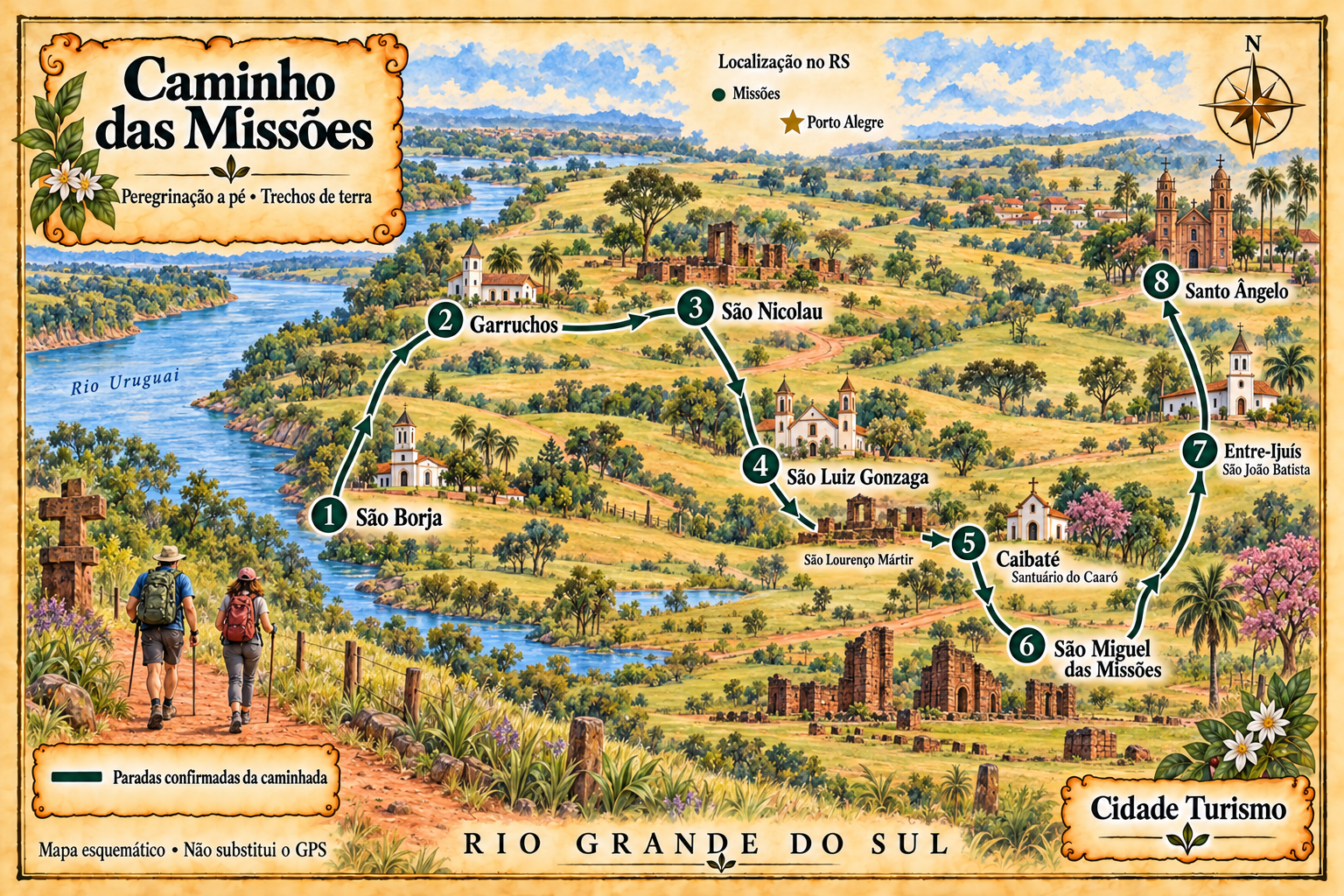
Região das Missões is on the Path of the Missions

Pilgrimage on foot between São Borja and Santo Ângelo, across fields and dirt roads, with stops at Jesuit–Guarani heritage sites.

Illustrative map, not to scale. Tap a city to open its page.
Illustrated map of Path of the Missions
Explore the Path of the Missions
Explore other destinations Search by state and city