Costa da Mata Atlântica

SP

Costa da Mata Atlântica

Praias, jardins à beira-mar e história portuária na Baixada Santista.

Sudeste

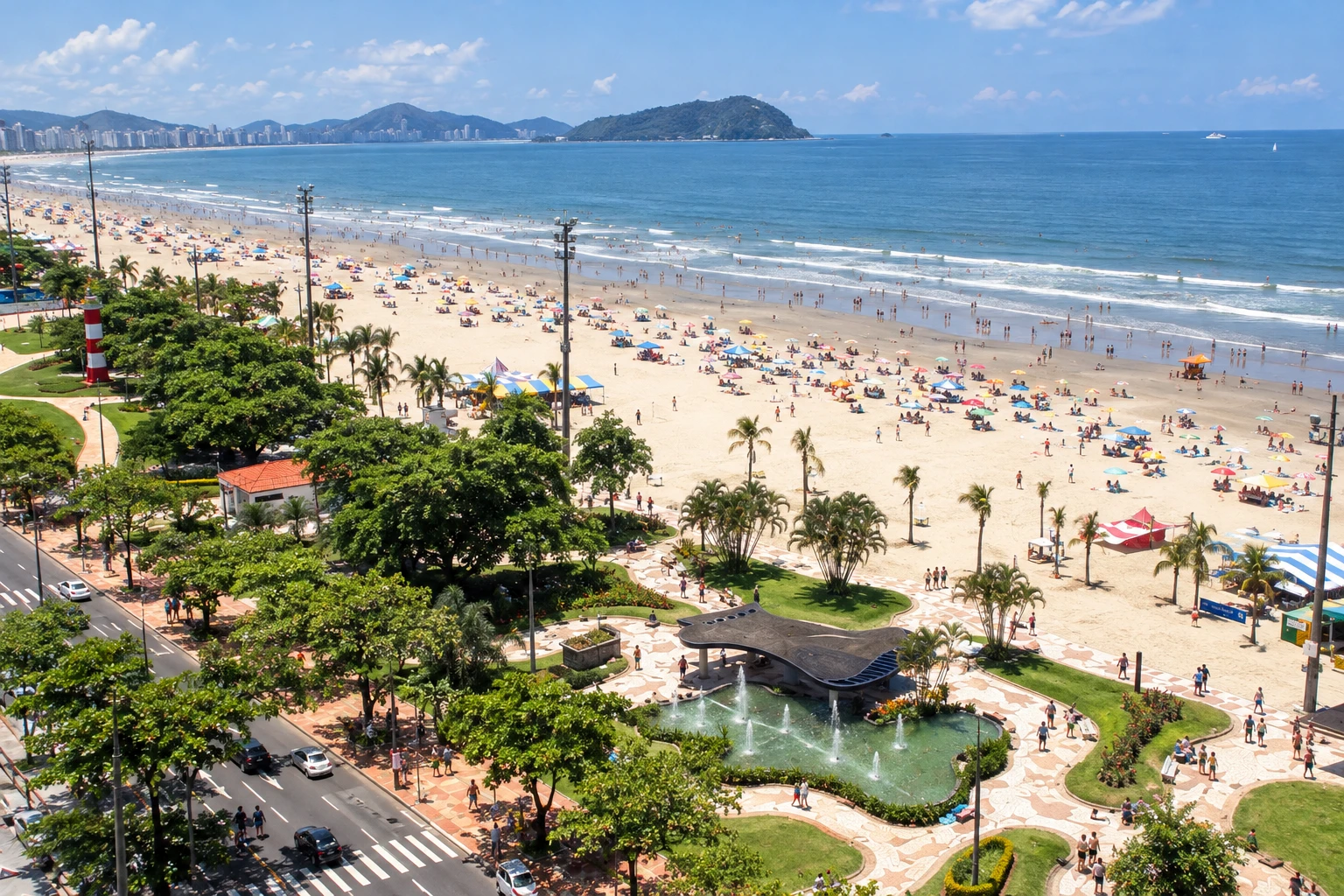
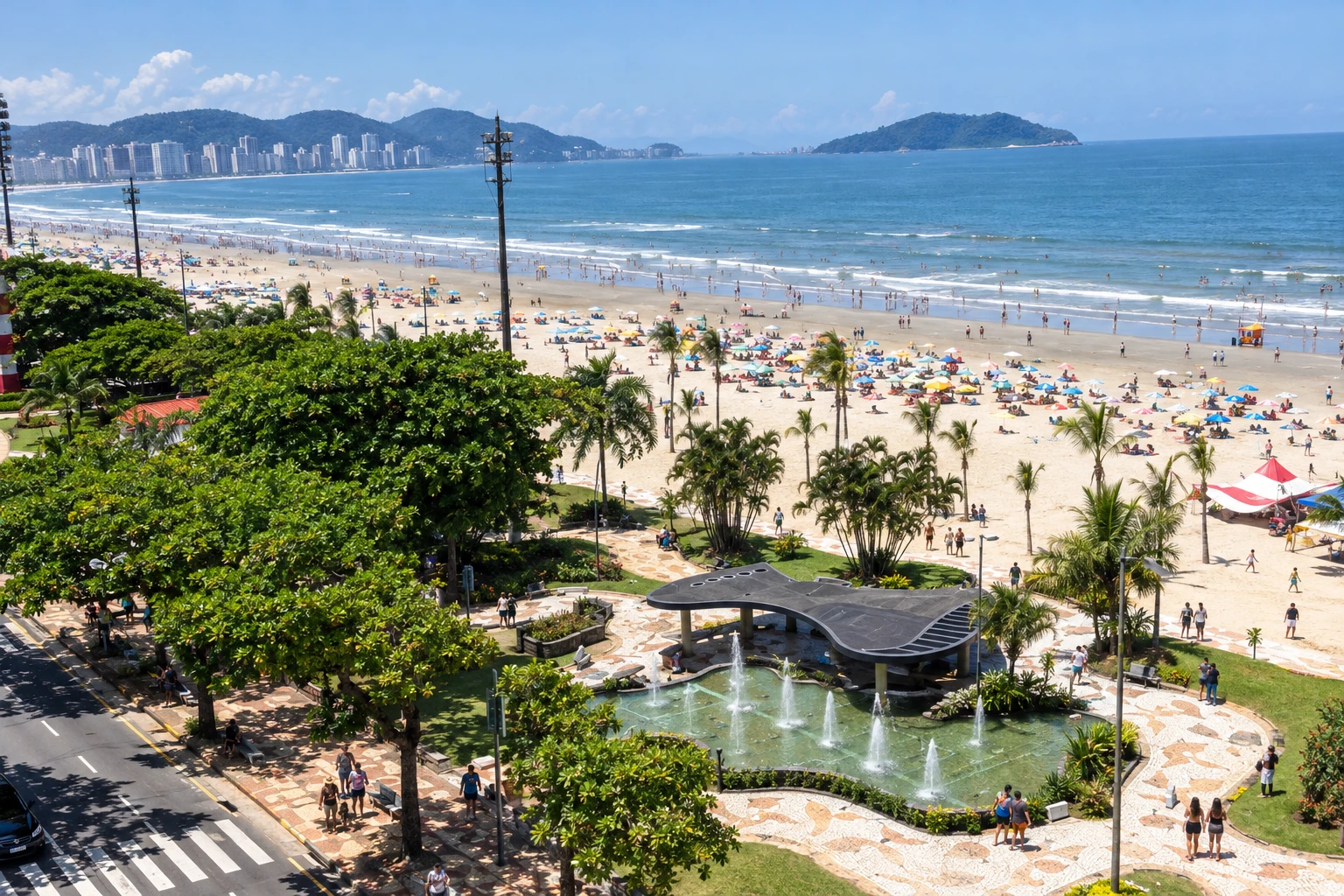
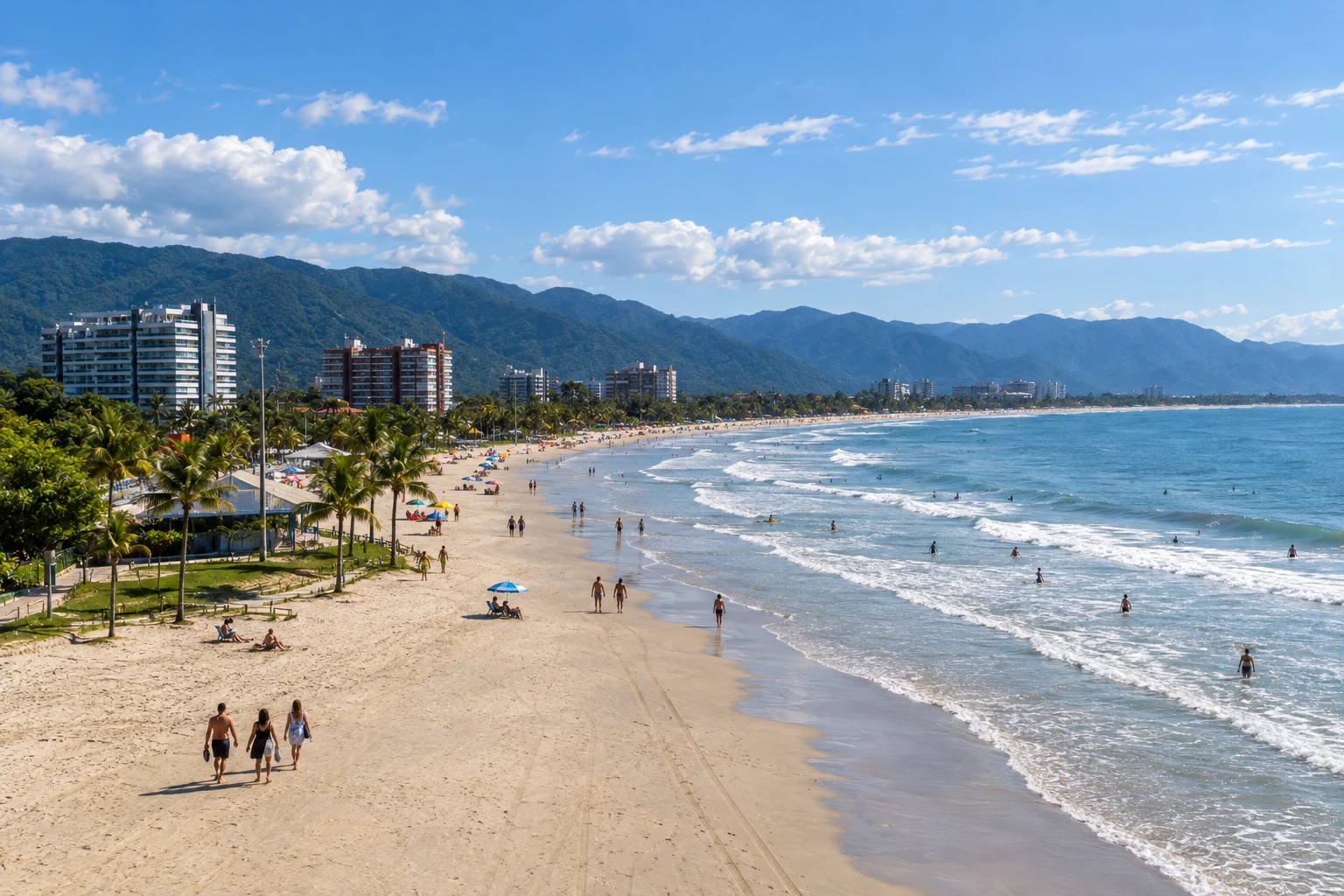
In the photo: Jardins da Orla de Santos, Santos (SP), Costa da Mata Atlântica

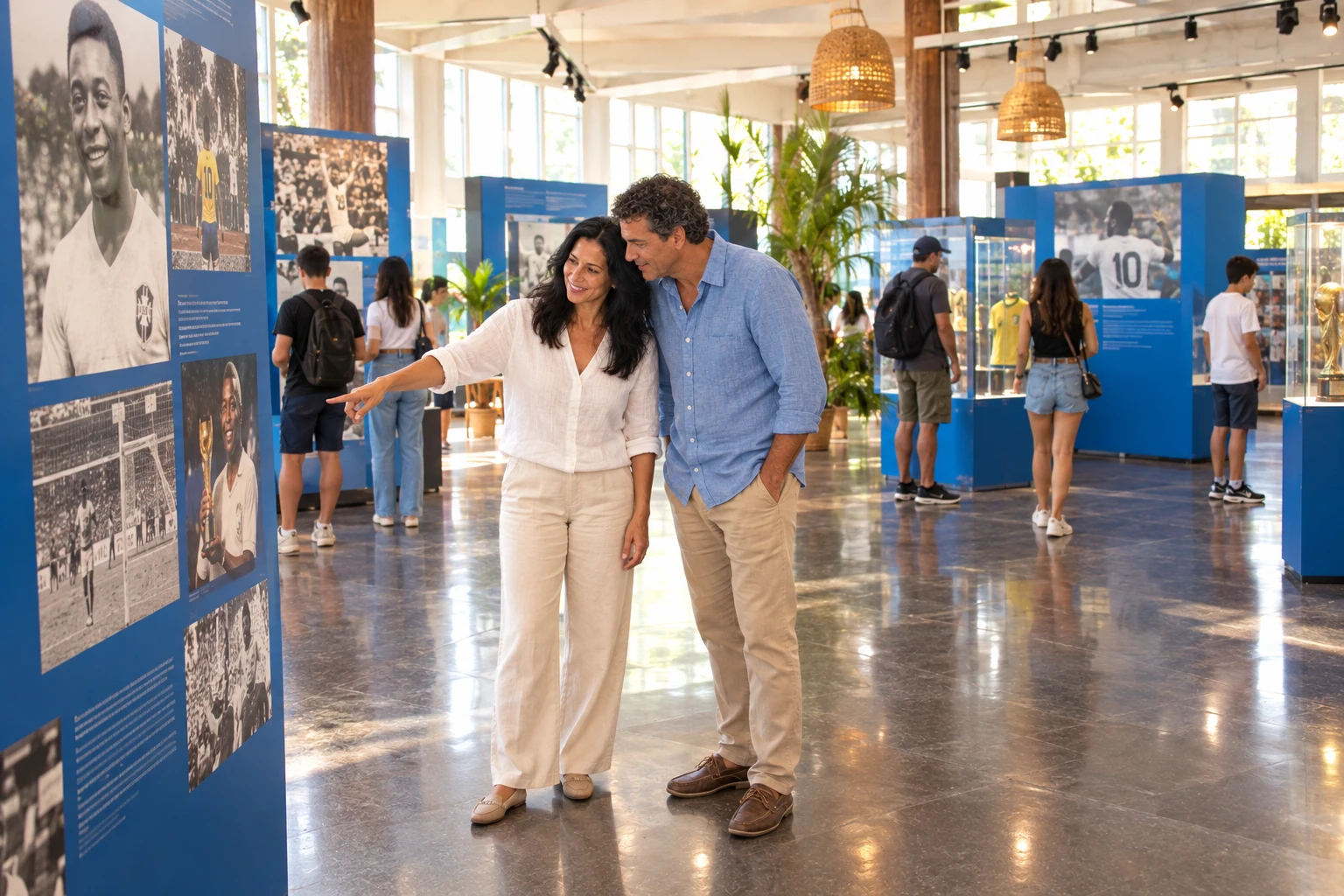
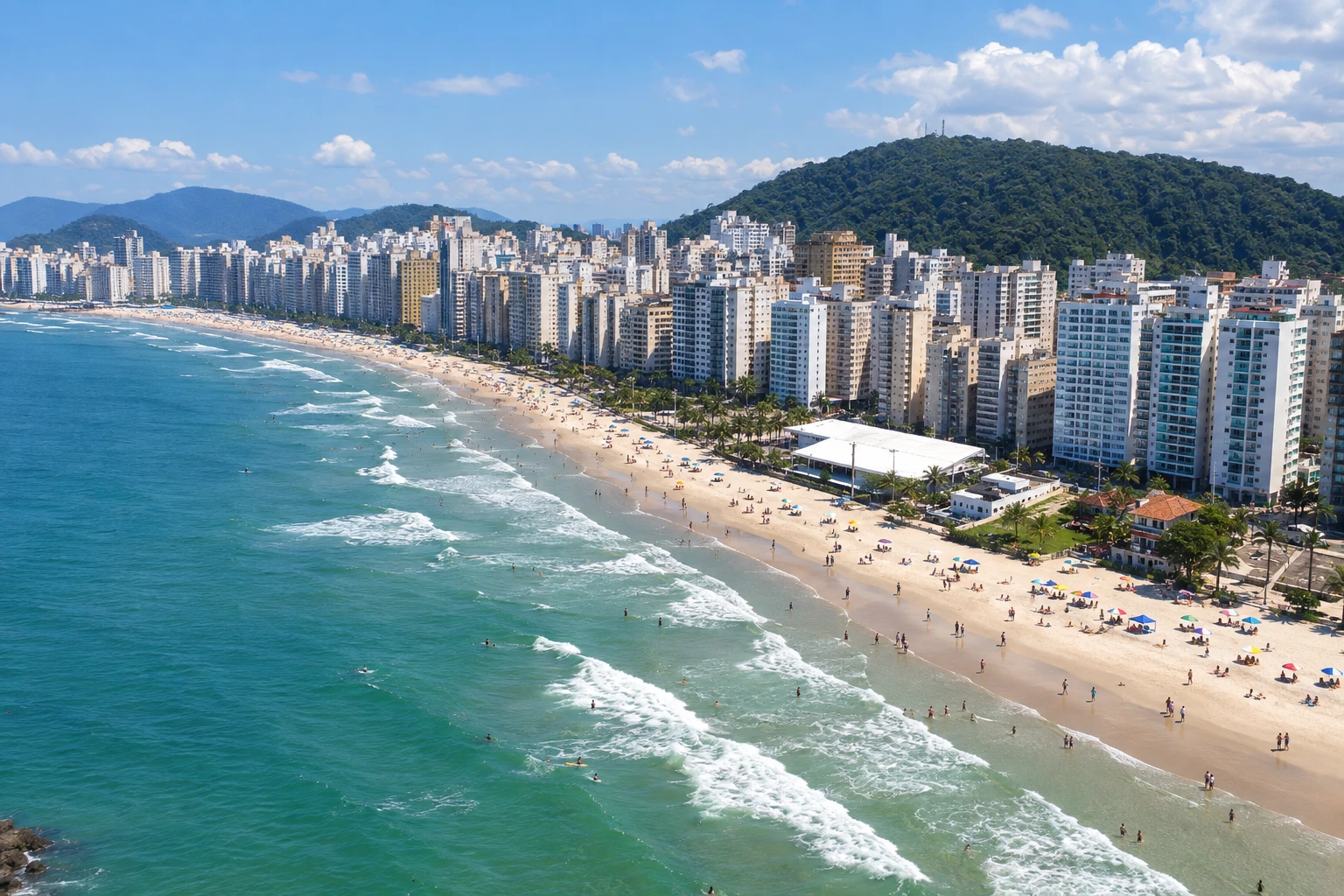
Illustrative images. The pictures in this guide are illustrations based on the real place, not photographs, and may differ from it.

Get to know the place

A region to enjoy
at your own pace.

Costa da Mata Atlântica convida a organizar uma viagem de lazer com tempo para conhecer a paisagem e o cotidiano das cidades. Neste recorte do guia, Santos e Guarujá apresenta opções para combinar passeios e descanso, sem transformar cada dia numa sequência de deslocamentos.

Santos combina museus no Centro Histórico e jardins da orla. Guarujá acrescenta praias como Pitangueiras, Enseada e Tombo, com propostas distintas para caminhar, observar o surfe e aproveitar a paisagem.

Escolha uma base que facilite os programas de maior interesse e distribua as visitas por áreas próximas. Reserve intervalos para refeições e descanso, confira as condições de acesso e mantenha uma alternativa para dias em que o tempo exigir mudanças no roteiro.

This destination brings together 3 cities: Santos, Guarujá, Bertioga.

Share: WhatsApp

Travelers' photos

Costa da Mata Atlântica through the eyes of those who went

Costa da Mata Atlântica
Illustrative image
Costa da Mata Atlântica
Illustrative image
Traveler, share your experiences through photos Up to 5 photos of each place you visited.

One destination, many paths

The cities on this trip

Start with one city or combine several in your itinerary.

Where Costa da Mata Atlântica is The star marks the nearest capital, São Paulo.
São PauloSantosGuarujáBertioga

Mapa: @svg-maps/brazil, CC BY 4.0

How to get there: Costa da Mata Atlântica

Aeroporto de São Paulo/Congonhas - Deputado Freitas Nobre (CGH), in São Paulo

Chegue a Santos pelo sistema Anchieta-Imigrantes. Uma opção aérea é Congonhas (CGH), em São Paulo, com continuação terrestre. De ônibus, consulte o Terminal Rodoviário Jaime Rodrigues Estrela Júnior, em Santos; para Guarujá, verifique a rodoviária municipal e a travessia de Santos.

Suggested arrival point: Santos

The local experience

Things to do in Costa da Mata Atlântica

Bertioga · SP · História e cultura

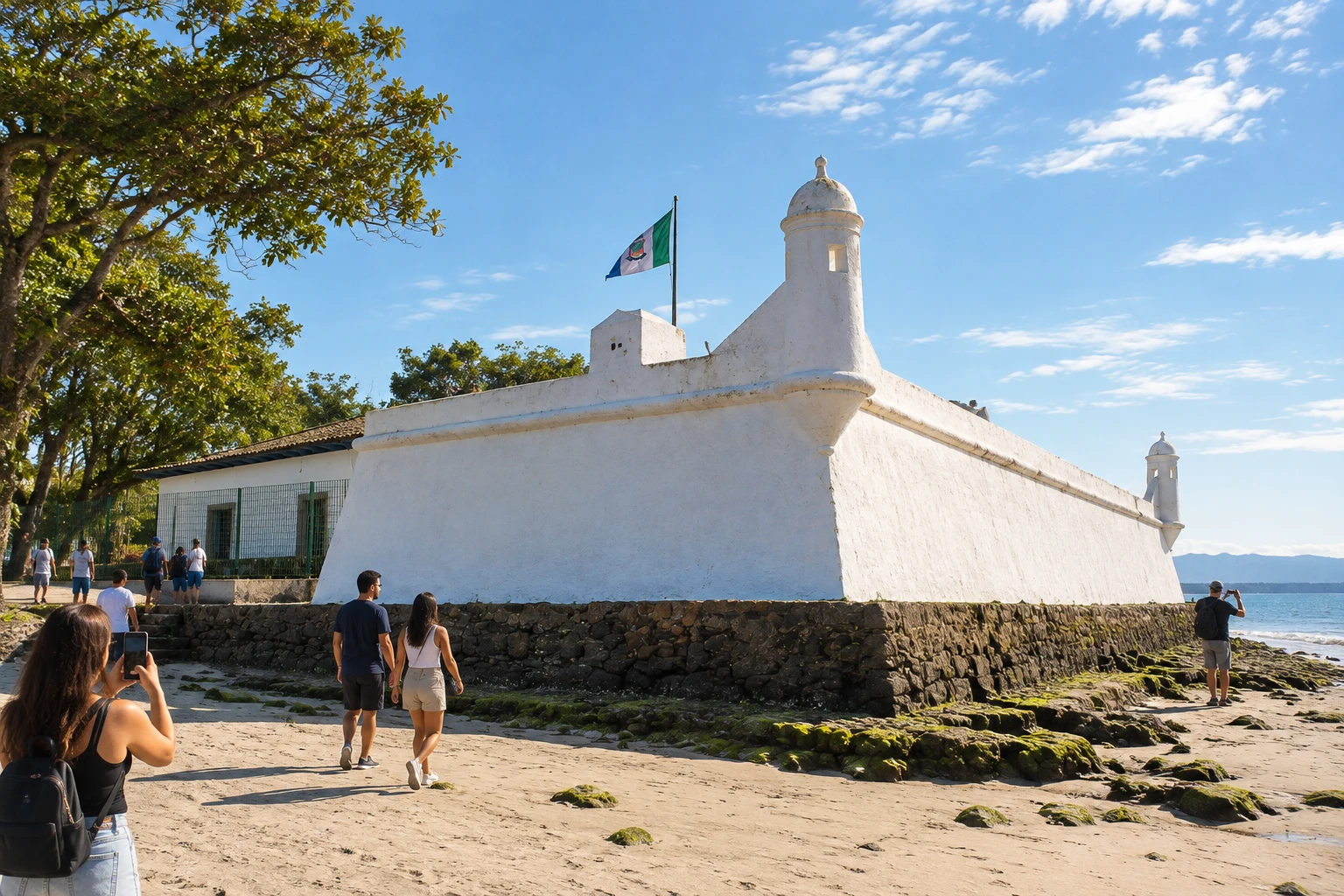
Forte São João

O Forte São João fica às margens do Canal de Bertioga. Sua construção em pedra e cal e a posição junto à barra contam parte da história da defesa do litoral.

Explore Forte São João

Santos · SP · Museu

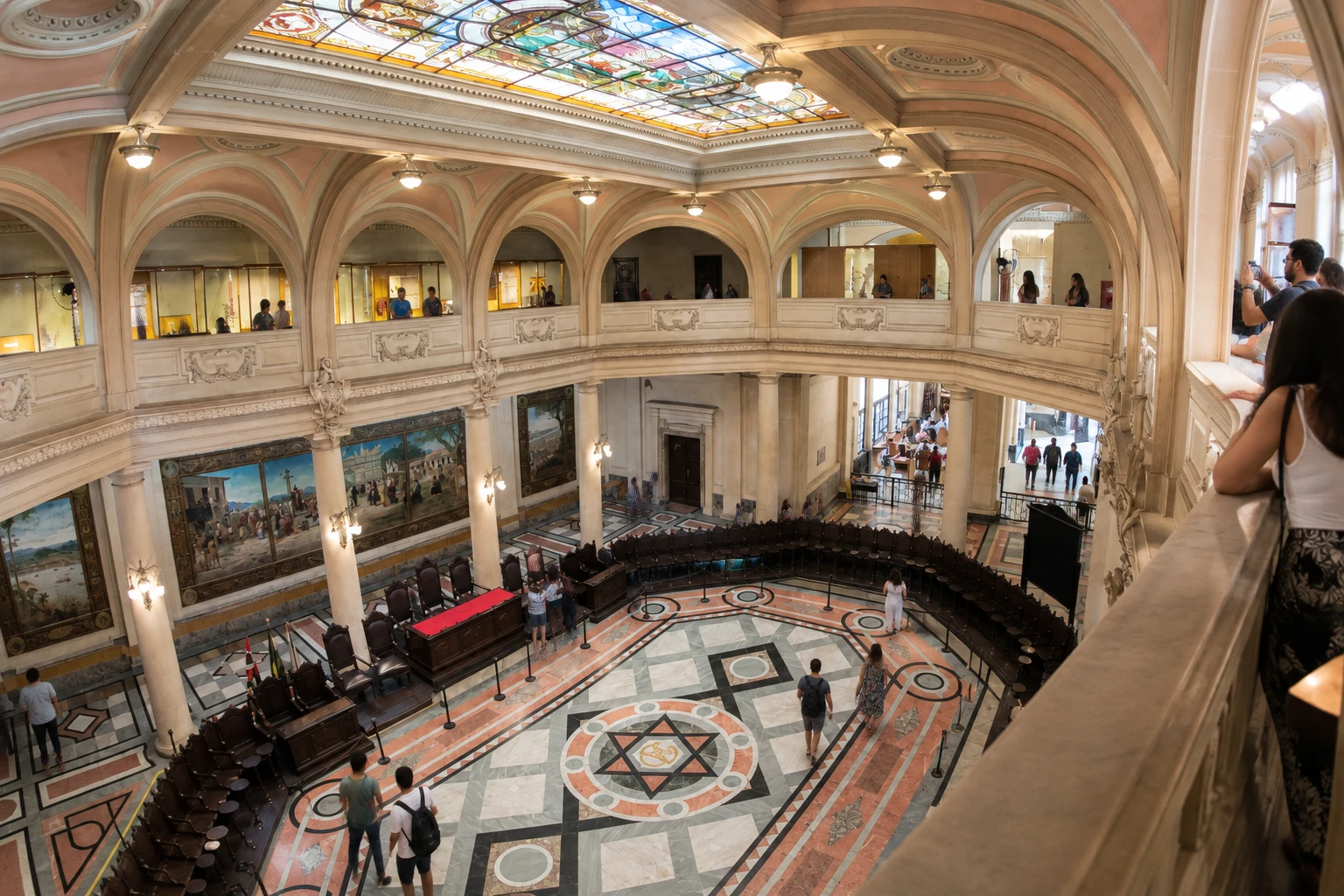
Museu do Café

O Museu do Café está instalado no edifício da antiga Bolsa Oficial de Café, no Centro Histórico de Santos. A visita aproxima o viajante da história do produto e de sua relação com a cidade e o país.

Explore Museu do Café

Guarujá · SP · Praia

Praia das Pitangueiras

A Praia das Pitangueiras fica na área central de Guarujá e reúne praia e movimento urbano. É uma opção para caminhar pela areia ou pela orla, fazer pausas e conhecer o cotidiano do centro.

Explore Praia das Pitangueiras

Santos · SP · Mirante

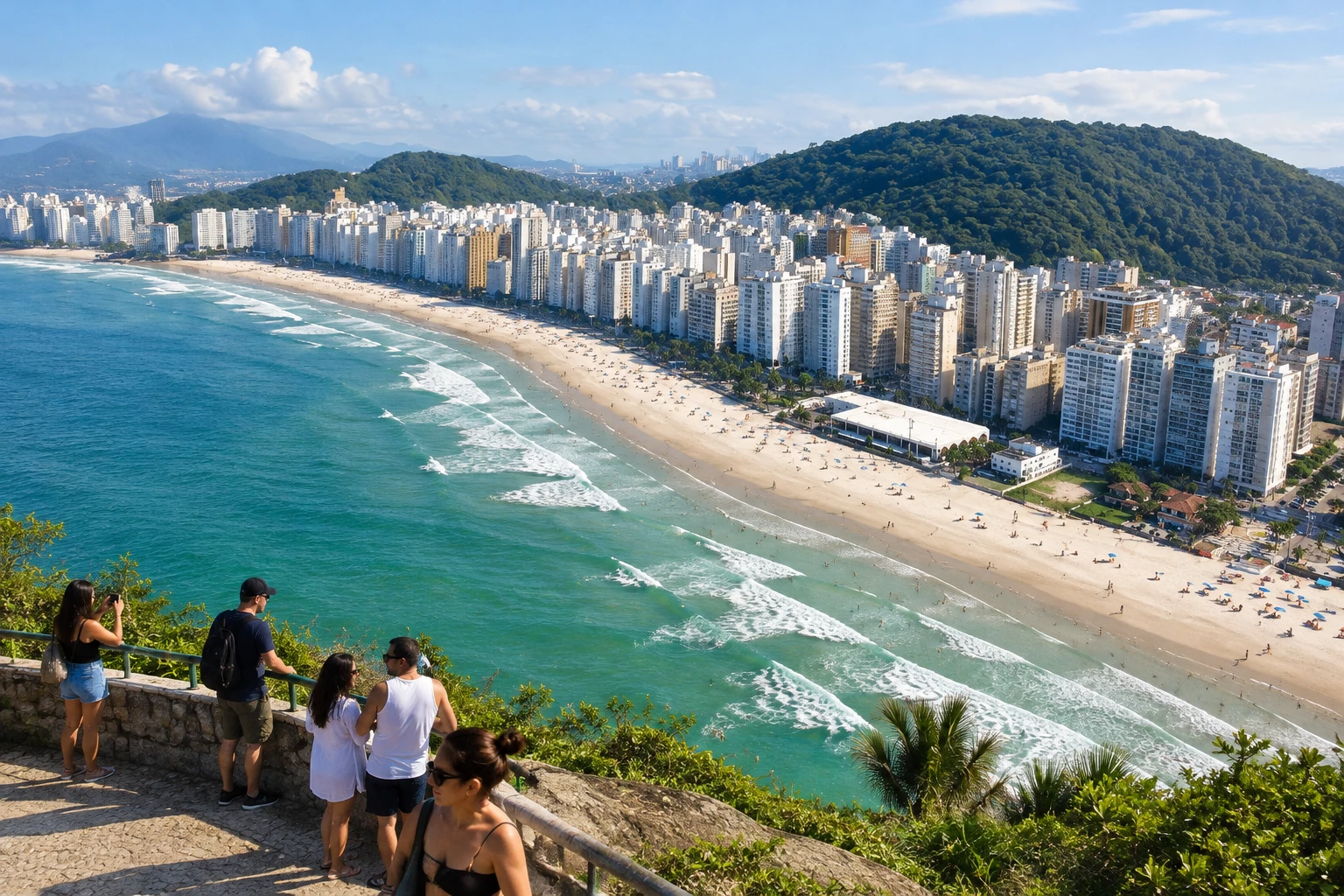
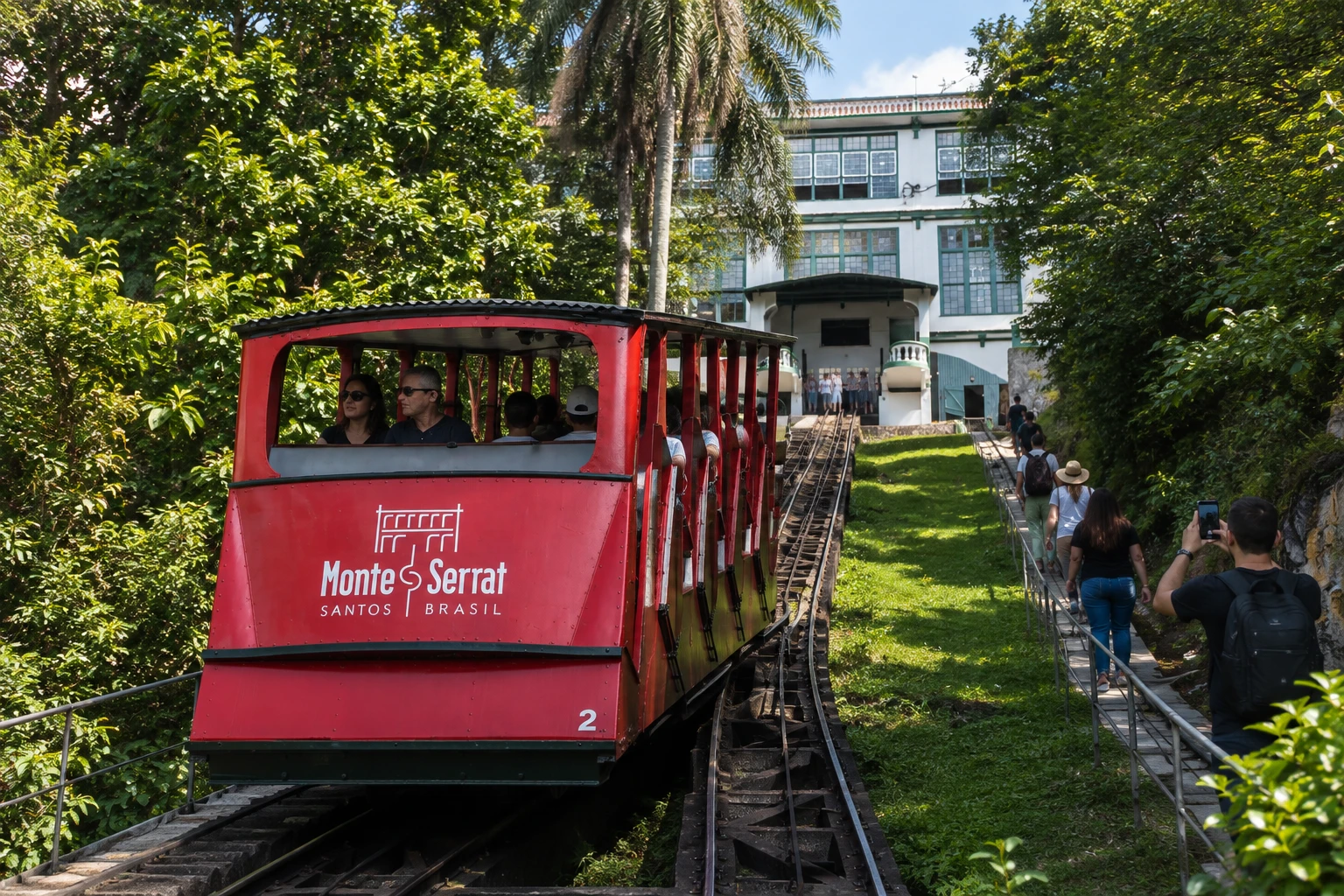
Monte Serrat

O Monte Serrat é um passeio panorâmico em Santos, com acesso por um sistema de bondinhos que percorre a encosta. A subida aproxima o visitante de um dos pontos de observação da paisagem urbana.

Explore Monte Serrat

See 19 more places in Costa da Mata Atlântica

To choose before you go

Tours in Costa da Mata Atlântica

Where each tour starts, how long it takes, how it is done, what is included and the price range.

Tourist tram of the Centro Histórico de Santos

From Estação do Valongo, Centro Histórico de Santos historic electric tram about 40 minutes morning or afternoon easy

The tour departs from Estação do Valongo, a 1867 building that housed São Paulo's first railway. Tickets are sold at the tram ticket office located in the Museu Pelé, a few steps from the boarding point. The vehicles are original electric trams from the 19th and 20th centuries, from countries such as Scotland, Portugal, Italy and Japan. The route goes through the Centro Histórico de Santos on a circuit of about 1.7 km, with an audio guide and Libras resources. At each segment the audio tells the history of the buildings and the squares. There are no stops to disembark and reboard: the tram completes the circuit and returns to Valongo. After the ride, it's worth visiting the Garagem de Bondes e Carros Ferroviários, which houses the trams under restoration and those in operation. The Museu Pelé and the Museu do Café are a short distance away and pair well with the tour on the same day.

Stops: Estação do Valongo, Museu Pelé, Centro Histórico de Santos, Garagem de Bondes e Carros Ferroviários.

Includes: Includes the tram circuit with audio guide and accessibility in Libras. There is half-price (meia-entrada) for students, teachers, people with disabilities and other groups provided for. Tickets are purchased at the ticket office at Museu Pelé. Parking nearby is paid separately. Check the current price table.

Tip: Arrive early on weekends and holidays, when there may be a line at the ticket office. Avoid heavy rain. Combine the visit with Museu Pelé and Museu do Café, both in the Centro Histórico, for a half-day walking itinerary.

Best time: Weekdays outside holidays usually have shorter lines. Morning or afternoon, in fair weather.

Agencies that run it: Salt & City Tours (SCS Turismo), Parceiros do Turismo.

R$7 · per person, full fare · official price

Monte Serrat: funicular and viewpoint in Santos

From Praça Correa de Melo, 33, Centro Histórico de Santos funicular (bondinho) or stairs on foot 1h30 to 2h, including the ascent morning or afternoon easy by bondinho; moderate on foot

The ticket office is at the base of the hill, on Praça Correa de Melo. The funicular, of German design, has two cars that ascend and descend in synchrony and takes about four minutes to cover the 147 meters of elevation along a 242-meter route up the slope. Each car holds up to 45 passengers. At the top are the Santuário de Nossa Senhora do Monte Serrat, patron saint of Santos, and the building of the former casino, which houses a café and event space. The viewpoint offers 360-degree views of the Centro, the Porto de Santos and parts of neighboring municipalities, including Guarujá. Those who prefer to walk can climb the 402-step staircase of the Caminho Monsenhor Moreira, which has niches with scenes of the Via Sacra, and descend by funicular paying only for that leg. There is no car access to the top.

Stops: Funicular do Monte Serrat, Santuário de Nossa Senhora do Monte Serrat, Casino Monte Serrat, Caminho Monsenhor Moreira staircase.

Includes: The ticket covers one ride up and one ride down on the funicular; there is a fare only for the descent. Prices may vary between weekdays and weekends or holidays. Reduced fares apply for seniors, students, teachers, regional public servants and people with disabilities; young children do not pay. Food is paid separately. Check the current price table.

Tip: Wear closed shoes if you plan to climb the stairs. Do the visit on a clear day to enjoy the view of the port. The Museu do Café is near the base of the hill, which makes it possible to combine both visits in the same outing.

Best time: Days with clear skies; morning or late afternoon, with softer light.

Agencies that run it: Renat Tour, Parceiros do Turismo.

Visit to the Museu do Café, in Santos

From Rua XV de Novembro, 95, Centro Histórico de Santos walking visit, at the museum about 1h30 morning or afternoon easy

The museum occupies the former Palácio da Bolsa Oficial de Café, an eclectic-style building inaugurated in 1922, in the Centro Histórico. The space opened as a museum in 1998 and is linked to the Secretaria de Cultura do Estado de São Paulo. The visit includes the exhibition about coffee in Brazil, the history of the exchange that traded the bean, and the Salão do Pregão, where deals were closed. At the entrance there is a café and a corner for vintage-style photos. The museum also offers a visit option with a coffee tasting and a program of workshops. It is a few minutes' walk from the Museu Pelé and from the tourist tram departure point. Allow about an hour and a half and prefer mornings on weekdays, when there tend to be fewer school groups.

Stops: Museu do Café, Salão do Pregão, Cafeteria do Museu.

Includes: Paid admission, with half-price tickets for students, teachers and seniors and free entry for some groups. There is a combined option with a coffee tasting, paid separately. The museum usually has one day a week with free admission: confirm which day. Check the current schedule.

Tip: Buy the ticket in advance on the museum's website during holiday periods. Confirm the day with free admission, which tends to be busier. When planning your visit, note that access for people with reduced mobility should be checked in advance.

Best time: Weekdays in the morning, outside holidays.

Agencies that run it: Salt & City Tours (SCS Turismo), Renat Tour, Parceiros do Turismo.

Visit to Museu Pelé in Santos

From Largo Marquês de Monte Alegre, 1, Valongo, Santos walking visit, at the museum about 1h30 morning or afternoon easy

Museu Pelé is housed in the former Casarões do Valongo, opposite Estação do Valongo, in the Centro Histórico. It opened in June 2014 and brings together a collection donated by Pelé himself: shirts, boots, balls, trophies, medals, photos, texts and films. The ground floor tells the player's story and curiosities, with original items and testimonies; the upper floors cover the World Cups of 1958, 1962 and 1970 and the titles and records. The suggestion is to take the elevator to the top floor and descend via the ramps. There are also temporary exhibitions, a café and an official shop. Admission is free and the museum is open Tuesday through Sunday. The ticket office for the tourist tram is inside the museum, which makes it easy to combine the two visits. Museu do Café is a few minutes' walk away.

Stops: Museu Pelé, Casarões do Valongo, Estação do Valongo.

Includes: Entrance to the museum is free. The café and the shop are paid separately. The tourist tram ticket, sold in the same building, is also paid separately.

Tip: Use the visit to start the day in the Centro Histórico and walk to the Museu do Café. Ask for the passaporte santista at the entrance, if available. The city hall also offers a virtual tour of the collection, useful for planning what to see.

Best time: Weekdays or early Sunday, outside holidays, tend to be quieter.

Agencies that run it: Salt & City Tours (SCS Turismo), Renat Tour, Parceiros do Turismo.

Schooner excursion around Baía de Santos and Guarujá

From Ponte Edgard Perdigão, Ponta da Praia, Santos schooner about 1 hour and 30 minutes morning or afternoon easy

Embarkation is at Ponte Edgard Perdigão, on Ponta da Praia, opposite Av. Almirante Saldanha da Gama. The schooner heads toward the channel mouth, passes near Fortaleza da Barra Grande in Guarujá, and skirts Ilha de Santo Amaro along the beaches of Góes, Cheira Limão and Sangava. Near Sangava and Ilha das Palmas there is a stop for a sea swim of about 15 to 20 minutes. On the return, the vessel passes closer to the orla de Santos and enters the Porto channel, where it is possible to see ships berthed at the terminals. During the trip, the crew recounts the history of the points visited. There is a bar on board and restrooms. Three companies operate the tour, each with its own schedules. Some operators offer onboard entertainment with a pirate theme.

Stops: Ponte Edgard Perdigão, Fortaleza da Barra Grande, Praia do Góes, Praia do Cheira Limão, Praia do Sangava, Ilha das Palmas, Orla de Santos, Terminais do Porto de Santos.

Includes: Includes the approximately 1.5-hour cruise with narration and a stop for swimming. Drinks and snacks from the onboard bar are paid separately. There is usually a reduced fare for children and seniors. Check each company's current price list.

Tip: Bring swimwear, a towel and sunscreen. If you are not a strong swimmer or are with children, use a life jacket when swimming, because at the stopping point the bottom is deep. During cruise season, the late-afternoon schedule often passes near the ships. Confirm days and times beforehand: outside high season, departures usually take place on weekends and holidays.

Best time: Days with calm seas and clear skies. In summer there are daily departures; outside of summer, on weekends and holidays.

Agencies that run it: Dougtour, TataTur Operadora.

Bike ride through the gardens of the orla de Santos

From Praça das Bandeiras (Gonzaga) or Novotel Santos, Av. Ana Costa, 473 bicycle, with a tour guide about 3 hours morning easy

The agency Parceiros do Turismo conducts a guided bicycle tour through the gardens of the orla, covering about 8 to 10 km and lasting two and a half to three hours. The meeting point is Praça das Bandeiras in Gonzaga, or Novotel Santos for those who rent bicycles. The ride reaches the Emissário Submarino at Quebra-Mar, then continues with stops at various points in the garden up to near Ponta da Praia. At each stop the guide presents monuments and curiosities of the orla. The pace is relaxed and the sporting aspect is secondary. The tour can be private or scheduled on a prearranged date to form a group; the route varies by date, so confirm with the agency. Those who prefer to cycle alone can rent a bike and use the orla's bike lane, about 7 km long, flat and signposted.

Stops: Praça das Bandeiras, Jardins da Orla de Santos, Emissário Submarino, Ponta da Praia.

Includes: The guided tour includes leadership by a licensed guide. Bicycle rental is usually arranged separately, with pickup at an agreed location. Food and drinks are the visitor's responsibility. Check the agency's current price list.

Tip: Cycle in the early morning or late afternoon to avoid the heat. Bring water, sunscreen and a cap. Book the guided ride in advance, as it depends on having a formed group on a given date.

Best time: Days with good weather, early morning or late afternoon.

See 10 more tours

Walking tour through the Centro Histórico de Santos

From Museu Pelé, Largo Marquês de Monte Alegre, Valongo on foot, with a guide about 1h30; confirm with the guide morning easy

The walking tour goes through the streets of the Centro Histórico with a tour guide, showing historic buildings and settings from films and TV programs filmed in the area. In previous editions publicized by the city hall, the meeting point was in front of Museu Pelé, in Valongo, near Estação do Valongo and the tourist tram departure. The activity is designed to be combined with other programs in the area: the tourist tram, Museu Pelé and Museu do Café are close to each other. Days, times and format change according to the municipality's and agencies' schedules, so confirm in advance whether there is a departure on your travel date. Since the route is on foot along city-center streets, wear comfortable footwear.

Stops: Museu Pelé, Estação do Valongo, Centro Histórico de Santos.

Includes: Includes accompaniment by a tour guide. The activity is usually paid separately, with its own fee. Museum admissions and the tram ticket are charged separately. Check the current price table.

Tip: Confirm the day, time and meeting point before you go. Combine the tour with the tourist tram and the Valongo museums for a day on foot in the Centro Histórico. Bring water and a cap.

Best time: On days with good weather, preferably in the morning.

Agencies that run it: Parceiros do Turismo.

Fortaleza de Santo Amaro da Barra Grande, em Guarujá

From Rua Messias Borges, 380, Guarujá, or boat at Ponta da Praia car or boat; short walk about 1 to 2 hours morning or afternoon easy

The fortification was built in 1584 to defend the town of Santos and is located in the access channel to the estuary of Porto de Santos, between Praia do Góes and Praia de Santa Cruz dos Navegantes. It was recognized as national historical heritage by Iphan in 1964 and is now administered by the Prefeitura de Guarujá. Inside it houses the Museu Fortaleza da Barra Grande, the city's first historical museum. There are two ways to reach it: by land, via Estrada Santa Cruz dos Navegantes, with a paved trail of about 1.2 km to the fortification and the small beach; or by boat, which departs from Ponte Edgard Perdigão, at Ponta da Praia, in a 10–15 minute crossing to a floating platform near the entrance. From above, there is a view of the entrance to Porto de Santos. Visits are free, with reduced days and hours on weekends.

Stops: Fortaleza de Santo Amaro da Barra Grande, Museu Fortaleza da Barra Grande, Praia da Fortaleza da Barra Grande, Praia do Góes, Praia de Santa Cruz dos Navegantes.

Includes: Museum admission is free. The boat crossing from Santos is paid separately. Groups should schedule the visit. Food is not included. Check opening days with the city hall.

Tip: Confirm days and times before going, as visits do not take place every day. By land, wear closed shoes for the trail. Those departing from Santos can combine the boat crossing with a schooner tour of the bay. Bring water.

Best time: Clear-sky days, morning or early afternoon, avoiding rainy days.

Acqua Mundo, the aquarium of Guarujá

From Av. Miguel Stéfano, 2001, Praia da Enseada, Guarujá walking visit at the aquarium 1 to 2 hours morning or afternoon easy

Acqua Mundo is a private aquarium on the seaside avenue of Praia da Enseada. It has 49 freshwater and saltwater exhibits, aquaterrariums and terrariums, with about 1.4 million liters of water and animals such as Magellanic penguins, sharks, rays and caimans. There is a snack bar, food court and children's area, and the site is accessible. A typical visit takes from half an hour to over an hour, depending on the children's interest. There are separate activities: a helmet dive of about half an hour, with around 15 minutes in the water; and dives with sharks and rays, for those over eight years old, with a liability waiver and not requiring swimming ability. Diving activities must be scheduled. It's a program for rainy days or rough seas.

Stops: Acqua Mundo, Praia da Enseada, Pinguinário, Shark and ray tank.

Includes: The ticket grants access to the exhibits. There are different prices for cash and card payments, half-price tickets for children aged 2 to 12 and seniors, family and group packages; children under 2 are free. Dives are paid separately and must be scheduled in advance. Check the current price table.

Tip: Compare the cash and card prices at the ticket office. Schedule dives in advance, as they depend on availability and signing a waiver. Check health restrictions for diving, such as colds or respiratory problems.

Best time: All year round; good as an alternative on rainy days.

Motorboat tour of the islands and beaches of Guarujá

From Marinas and piers of Guarujá, in Enseada or in the channel motorboat with a crewman from 1 to 7 hours, depending on the package morning, afternoon or full day easy

Nautical companies in Guarujá offer motorboat tours for small groups, with a sailor and life jacket. Departing from Enseada, the usual route goes by Enseada, Canto do Tortuga, Ilha das Cabras, the beaches of Éden and Sorocotuba and Praia do Pernambuco with Ilha do Mar Casado. The sea at Pernambuco forms, at low tide, a sandbank that links the island to the beach. Another route departs from the Guarujá–Bertioga channel, with stops at Praia Branca, Camburizinho and Iporanga. The route can be done partially, depending on the time booked and the size of the boat. Vessels carry from 7 or 8 people up to about 16. Swimming stops are made in more sheltered bays. The price is per boat and depends on the size of the vessel and the period; fuel may or may not be included, depending on the company.

Stops: Praia da Enseada, Ilha das Cabras, Praia do Éden, Praia do Sorocotuba, Ilha do Mar Casado, Praia do Pernambuco, Praia Branca, Praia do Iporanga.

Includes: Usually includes the motorboat, a sailor and life jackets. Fuel, drinks and food vary by company and are charged separately when not included. The price is per boat. Check each company's current rate list.

Tip: Agree in advance on the itinerary, the period and what is included. On days with rougher seas, the route may be changed. Bring sunscreen, a towel and swimwear. Compare more than one company and get everything in writing.

Best time: Calm-sea and stable-weather days; outside holidays there is more availability of boats.

Trail of the beaches Praia do Éden and Praia do Sorocotuba, in Guarujá

From Condomínio Sorocotuba, Estrada de Pernambuco, Guarujá car to the entrance and hike about 2 to 3 hours, including time on the beach morning moderate

Praia do Éden lies between the beaches of Enseada and Pernambuco (Mar Casado), inside the condomínio Sorocotuba area, on the SP-61, Estrada de Pernambuco. Access is via a steep trail through the Mata Atlântica, with about 110 irregular steps and roughly a 10-minute walk, of moderate difficulty. There is private parking before the trail and, according to travel guides, the parking lot usually offers an alternative access via a paved staircase. Along the way you can already see parts of the beach and hear the sea. The beach is small, with clear waters, and the sea can be rough. Those who want to walk more can combine the trail with the neighboring Praia do Sorocotuba. The spot is used for snorkeling, stand up paddle and contemplation. As infrastructure is minimal, bring water and a snack and take your trash with you.

Stops: Praia do Éden, Praia do Sorocotuba, Trilha do Sorocotuba, Estrada de Pernambuco.

Includes: There is no fixed operator: the trail is self-guided. Parking in the condominium is paid separately. Food, water and snorkel or board equipment should be brought.

Tip: Wear closed-toe shoes and bring water. Do the trail early, before the heat. If traveling by bus, check the municipal lines that run along Estrada de Pernambuco. Keep the beach clean and respect marine life.

Best time: Days of good weather and calm sea; avoid rain, which makes the trail slippery.

Prainha Branca trail, on the Guarujá–Bertioga border

From Guarujá–Bertioga ferry, end of Estrada de Pernambuco hike; boat from Bertioga about 30 minutes each way morning or full day easy to moderate

The trail starts practically next to the Guarujá–Bertioga ferry point, at a signposted gateway. It takes about half an hour at a comfortable pace, with uphill and downhill sections of the hill, and much of it is shaded by trees. The main path is paved with stones and is well marked; there is also an unpaved variant near the rocky headland. There is no car access to the beach. Near the ferry there are some parking lots, so it's worth arriving early. The arrival is in a sandy-floored village, with campsites, small houses and restaurants, where locals maintain caiçara traditions. Visitors staying in Bertioga can go by boat, in a short crossing that leaves from there. From the Prainha Branca side, another trail continues to Praia Preta. Bring water and sunscreen and plan your return time with plenty of margin.

Stops: Prainha Branca, Praia Preta, Balsa Guarujá–Bertioga.

Includes: The trail is self-guided. Parking near the ferry and the boat crossing are paid separately. Meals in the village are paid separately.

Tip: Arrive early to find parking and spend the day. Wear sneakers, not flip-flops, because of the stone surface. If coming by boat from Bertioga, arrange the return time. On rainy days the surface becomes more slippery.

Best time: Days with good weather; early morning avoids heat and full parking.

Agencies that run it: Desviantes (Belvitur Viagens e Turismo).

Viewpoints in Guarujá: Morro do Maluf, Caixa d'Água and Galhetas

From Praia das Pitangueiras and Praia da Enseada, Guarujá on foot or by car, on your own about 2 to 3 hours, covering all three spots late afternoon easy to moderate

Morro do Maluf, also called Morro da Campina, separates Praia da Enseada from Praia das Pitangueiras. The viewpoint overlooks Enseada and can be reached by car or by a roughly 15-minute uphill walk. The hill is used for rappelling and free-flight activities. Another spot is the Mirante da Caixa d'Água, with views over Praia do Tombo, reachable in less than a 20-minute walk or by car. From Tombo, known for surfing, you can see the open sea. On the left end of Praia das Pitangueiras is the Píer Tony Villela, overlooking Pitangueiras and Astúrias, from where surfers can also be seen riding the waves at that corner of the beach. The Mirante da Ponta das Galhetas, in the Enseada, has views toward Tombo. The viewpoints have free access and can be linked in a short circuit, with time for coffee or a snack along the waterfront.

Stops: Mirante do Morro do Maluf (Morro da Campina), Mirante da Caixa d'Água, Mirante da Ponta das Galhetas, Píer Tony Villela, Praia do Tombo.

Includes: Free access to the viewpoints and the pier. Parking, when available, and food are the visitor's responsibility. Activities such as rappelling and paragliding/hang-gliding are paid separately and organized by operators.

Tip: Go late in the afternoon to see the light on the sea and avoid the hottest hours. Wear comfortable shoes for the climbs. Check the weather conditions: on cloudy days the view is limited.

Best time: Clear-sky days; late afternoon.

Forte São João and Parque dos Tupiniquins, em Bertioga

From Av. Vicente de Carvalho, Centro de Bertioga guided walking tour short visit; reserve part of the morning or afternoon morning or afternoon easy

Forte São João is located between Praia da Enseada and the Canal de Bertioga, around Parque dos Tupiniquins. The first structure, a palisade, dates from 1532, and the masonry construction is from 1547. The fort is listed as a national heritage site and is on UNESCO's tentative list. The structure is a rectangular polygon, with sentry boxes at the corners and a terrace that serves as a lookout over the canal. Inside are cannons, armor, photographs, paintings and sculptures. Visits are guided and admission is free, according to city hall. The canal promenade, about 400 m long, links the Mercado Municipal de Pescados to the fort and is pleasant for a sunset walk. Nearby are the piers from which schooner excursions depart along the Canal de Bertioga.

Stops: Forte São João, Parque dos Tupiniquins, Calçadão do Canal de Bertioga, Praia da Enseada.

Includes: Guided visits with free admission. Parking nearby, meals and boat trips are paid separately. Hours vary by season; check with the city hall.

Tip: Confirm days and times before going, as they change between high season and other periods. Combine the visit with the promenade and a meal at the fish market. Group visits may require prior scheduling.

Best time: Morning or late afternoon; in summer there are extended hours.

Schooner tour along the Canal de Bertioga

From Municipal pier, near Forte São João, Bertioga schooner varies according to the itinerary; check with the operator morning or afternoon easy

The schooners are docked near Forte São João and depart via the Canal de Bertioga, in the town centre. The route published by local guides heads toward the southern coast, passing Forte São João and Forte São Luiz, Praia Branca, Praia Preta and Praia do Camburizinho, Ilha do Guará and Ilha Rasa, and reaches the beaches of Pinheirinho and Iporanga. The trip allows you to see mangroves, marinas, piers and the mouth of the Rio Itapanhaú. The route may change in case of bad weather. On some routes there are stops for swimming in the sea. The tour is one of the city's traditional activities and shows stretches of coastline that have no road access. Because the route, stops and schedules depend on the operator, confirm before booking.

Stops: Forte São João, Forte São Luiz, Praia Branca, Praia Preta, Praia do Camburizinho, Ilha do Guará, Ilha Rasa, Praia do Pinheirinho, Praia do Iporanga.

Includes: Usually includes the schooner trip and on-board narration. Drinks, food and any boarding fees are paid separately. Check the operator's current price list.

Tip: Ask about the day's itinerary, the swimming stops and the duration when booking. Bring sunscreen, a cap and swimwear. On rainy days or when the sea is rough, the tour may be rescheduled.

Best time: Days with stable weather; there are more departures in summer and on holidays.

Boat trip along the Itapanhaú and Jaguareguava rivers, in Bertioga

From Bertioga, shore of the Rio Itapanhaú (meeting point set by the agency) boat, with an option for a hike half day to full day, depending on the package morning and afternoon easy

The trip departs from the Rio Itapanhaú and crosses the mangrove, known as the sea's nursery, with its characteristic trees. Next the boat enters the Rio Jaguareguava, a clear-water tributary that in several stretches is covered by trees, forming vegetation tunnels, heading toward the valley of the Serra do Mar. A local agency, Via Eco Bertioga, described a fluvial nautical package including boat, boatman, parking and a typical lunch, recommended for children from 5 years old, with departures on Saturdays. Another option in the region is the Trilha d'Água: after the boat crossing, the walk continues through the forest to a natural pool, at an easy level. Packages vary depending on the agency and the date, and some trails pass through areas with specific rules. Therefore, book with a local agency and confirm what is included.

Stops: Rio Itapanhaú, Rio Jaguareguava, Manguezal do Itapanhaú, Trilha d'Água.

Includes: Packages usually include boat, boatman and, in some cases, parking and a typical lunch. Fees, drinks and extras vary by agency and are paid separately. Check the organizer's current rates.

Tip: Book with a local agency and confirm the date, minimum age, what's included and the meeting point. Bring swimwear, insect repellent and sunscreen. For the trail, wear footwear that can get wet.

Best time: Days of stable weather; avoid periods of heavy rain, which change the river level.

Day by day

3, 5 and 7-day itinerary in Costa da Mata Atlântica

Suggestions to plan the trip. Change the order of the days according to the weather and tour availability.

3 days · Santos and a crossing to Guarujá in 3 days

For First trip with limited time, unhurried and without a car · Based in Santos, near the waterfront or the Centro Histórico, with easy access to the tram, funicular and ferry crossing
  1. Day 1 · Centro Histórico: walking and museums

    Start in the morning with the walking tour or the tourist tram to understand the layout of the Centro Histórico. Then visit the Museu do Café, in the former building of the Bolsa Oficial de Café on Rua XV de Novembro. Take a break at the museum café. In the afternoon, go to the Museu Pelé, in the Valongo. Both museums usually close on Mondays. If you arrive on that day, swap the order with day 2. Check current ticket prices and tram information.

  2. Day 2 · Monte Serrat and the seafront gardens

    In the morning, take the funicular up Monte Serrat and visit the viewpoint, with views over the city and the port. Come down, have lunch and reserve early afternoon to rest. Then rent a bike and cycle along the seafront gardens, with a flat bike lane along the beach. Bring water and sunscreen. On a day of heavy rain, postpone the funicular and swap it for the Museu do Café or the Museu Pelé if you haven't visited them yet.

  3. Day 3 · Baía de Santos and Guarujá

    In the morning, take the schooner tour of the Baía de Santos and Guarujá. Confirm the boarding point and sea conditions with the operator. After lunch, cross to Guarujá by catraia (departure near the Mercado Municipal, to Vicente de Carvalho) or by ferry from Ponta da Praia. Visit the Fortaleza de Santo Amaro da Barra Grande and finish with a walk along the seafront of Pitangueiras beach. Check current crossing fares.

5 days · Santos and Guarujá in 5 days: city, sea and beaches
For For those who want to combine museums and boat trips, with free time for the beach · Based in Santos for the first three nights and Guarujá for the last two nights
  1. Day 1 · Centro Histórico de Santos

    In the morning, take the walking tour through the Centro Histórico and visit the Museu do Café. Have lunch in the area. In the afternoon, visit the Museu Pelé, in the Valongo. Both museums usually close on Mondays. If you arrive that day, start with the seafront gardens and leave the museums for the next day. Check current admission prices.

  2. Day 2 · Tram, Monte Serrat and the seafront

    Start with the tourist tram, which runs past points in the Centro Histórico. Then take the funicular up Monte Serrat and visit the viewpoint. In the late afternoon, cycle along the seafront gardens or walk on the sand. Bikes can be rented on the seafront itself. Allow a break between the funicular ride and lunch for the descent.

  3. Day 3 · Schooner cruise around the bay and crossing to Guarujá

    In the morning, take the schooner tour of the Baía de Santos and Guarujá. In the afternoon, pick up your luggage and cross to Guarujá by catraia near the Mercado Municipal, or by ferry at Ponta da Praia. If you're traveling by car, check the ferry waiting time before you leave. Book your transfer to accommodation before you arrive and end the day at Pitangueiras beach.

  4. Day 4 · Fortaleza and Acqua Mundo

    In the morning, visit the Fortaleza de Santo Amaro da Barra Grande, a historic fort on the edge of the barra de Santos. Check visiting days before you go. In the afternoon, go to Acqua Mundo, Guarujá's aquarium — an indoor activity that also works well on rainy days. If the weather is clear, leave time for praia da Enseada.

  5. Day 5 · Viewpoints and beaches of Guarujá

    In the morning, visit the viewpoints of Morro do Maluf, Caixa d'Água and Galhetas on a short drive or rideshare. In the afternoon, go to praia do Tombo, known for surfing, and watch the waves from the sand. If you prefer a longer hike, you can swap the viewpoints for the trail of praias do Éden e do Sorocotuba, starting early, with closed shoes and after checking trail conditions.

7 days · Santos, Guarujá and Bertioga in 7 days
For For those with a week who want to combine a historic city, trails and the rivers of Bertioga · Based in Santos for the first two nights, Guarujá for the next three and Bertioga for the last
  1. Day 1 · Centro Histórico de Santos

    In the morning, take the walking tour through the Centro Histórico and visit the Museu do Café. In the afternoon, go to the Museu Pelé, in the Valongo, near the old railway station. Both museums usually close on Mondays. In some summer months, the Museu Pelé opens on Mondays when a ship is in port, so check the calendar. Also check current admission prices.

  2. Day 2 · Tram, Monte Serrat and the seafront gardens

    In the morning, take the funicular up Monte Serrat and visit the viewpoint. After lunch, ride the tourist tram through the Centro Histórico if you didn't do it on day 1, or cycle along the seafront gardens in the late afternoon. Bring water and sunscreen. On a heavy rain day, reserve this period for rest and for the Museu do Café café.

  3. Day 3 · Schooner around the bay and arrival in Guarujá

    Do the schooner tour in the morning around the Baía de Santos and Guarujá, after checking sea conditions with the operator. In the afternoon, cross to Guarujá by catraia near the Mercado Municipal, or by ferry via Ponta da Praia. Visit the Fortaleza de Santo Amaro da Barra Grande and walk along the Pitangueiras waterfront. Book transfer to your accommodation before arriving.

  4. Day 4 · Speedboat to the islands and Acqua Mundo

    In the morning, take a speedboat tour of the islands and beaches of Guarujá. Check with the operator the route, duration and what is included, and bring sunscreen and a light jacket. In the afternoon, visit Acqua Mundo, Guarujá's aquarium. If the sea does not permit the boat to go out, reverse the order or leave the tour for day 5.

  5. Day 5 · Trilha do Éden and Sorocotuba, viewpoints and Tombo

    Leave early for the trail of praias do Éden e do Sorocotuba, with closed shoes, water and trail conditions checked beforehand. Preferably go with a local guide or agency. After lunch, visit the viewpoints of Morro do Maluf, Caixa d'Água and Galhetas. In the late afternoon, watch the surfing at praia do Tombo. Avoid the trail immediately after rainy days.

  6. Day 6 · Prainha Branca and Forte São João

    In the morning, do the trail to Prainha Branca, on the border between Guarujá and Bertioga, setting out early with closed shoes. Then head to Bertioga via the rodovia Guarujá–Bertioga and the canal ferry. There are also buses between the two cities. Check the current ferry schedule and waiting time. In the afternoon, visit Forte São João, Parque dos Tupiniquins and the central waterfront. Confirm visiting days beforehand.

  7. Day 7 · Canal and rivers of Bertioga

    Choose a boat trip depending on the time available: the schooner along the Canal de Bertioga or a boat along the Itapanhaú and Jaguareguava rivers, with mangrove and forest scenery. Confirm with the operator the boarding point, duration and the day's conditions. Leave plenty of extra time before returning, as departures from Bertioga can be busier on weekends and holidays.

Best time to go

When to go: Costa da Mata Atlântica month by month

Choose dates according to the activities you plan to do. Weekdays outside holidays usually make for a less crowded itinerary. For outdoor programs, check the forecast and confirm local conditions before you go.

The seasons shown are the most usual ones; nature doesn't always follow the calendar.

January High rain

High season · Summer showers

Hot, humid summer, with average highs around 30 °C and monthly rainfall between 230 and 290 mm, usually in heavy showers. Schooner and speedboat trips depend on sea conditions. It's vacation season: the waterfront, crossings and the Historic Center receive more visitors. Do museums and walks early in the day and book tours and transfers in advance. Bring sunscreen and water.

February High rain

Intense heat · Carnival

Month of high temperatures, with average highs around 31 °C and monthly rainfall in the 200–220 mm range. Showers can shorten outdoor tours, so keep a covered option like museums and the aquarium. Carnival holidays increase activity on the beaches, on the ferries and on the catraias. If possible, go on weekdays. Trails have wet ground.

March High rain

Humid heat · Muddy trails

Still warm, with average highs near 30 °C and monthly rainfall in the 210–230 mm range. After Carnival, weekdays usually have less activity. Boat tours depend on the sea and the wind, and Guarujá's trails become slippery after rain. Check the forecast and local conditions before heading out and keep a museum visit as an alternative.

April Some rain

Rainfall decreasing · Long holidays

Rain decreases, in the 140–180 mm per month range, and average highs are around 28 °C. There are more days of stable weather for trails, viewpoints and bike rides along the waterfront. Long holidays, such as Holy Week, concentrate visitors in Santos, Guarujá and Bertioga. If you go on those dates, book in advance and schedule crossings outside peak times.

May Some rain

Mild weather · Cold fronts

Average highs are around 26 °C and lows near 17 °C, with rainfall in the 125–135 mm range. Cold fronts can bring wind, rain and rougher seas, which affect schooners and motorboats. A good time to walk around the Centro Histórico and the waterfront with less heat. Bring a light jacket for the late afternoon and confirm boat tour departures.

June Low rain

Less rain · Cooler days

It's among the months with the least rain, in the 90–100 mm range, with average highs near 25 °C and lows around 16 °C. Cooler days favor trails, viewpoints and cycling. Sea water is cold and swimming is less popular. The Corpus Christi holiday, when it falls on a weekday, can increase activity. Confirm boat departures, as they depend on the wind.

July Low rain

Colder days · School holidays

Month of lower temperatures, with average highs near 24 °C, lows around 15 °C and rainfall in the 100–120 mm range. With drier weather, trails are in better condition but still require caution. School holidays increase demand for museums, Acqua Mundo, schooners and crossings. Book in advance and bring warm clothing for boat trips.

August Low rain

Low rainfall · Wind and rough seas

It's among the months with the least rain, in the 75–100 mm range, with average highs near 24 °C and lows around 16 °C. Wind and rougher seas can alter or cancel schooner and motorboat departures. A good time for trails, viewpoints and urban walks. On weekdays, activity is usually lower. Always check sea conditions with the operator.

September Some rain

Unstable weather · Spring

Spring begins with variable weather: rainfall in the 135–145 mm per month range, average highs near 25 °C and lows around 17 °C. You can have alternating clear and cloudy days, with drizzle or showers. Keep an alternative plan with museums and the aquarium. Activity is usually moderate, except on holidays. Check the forecast before trails and boat trips.

October Some rain

Rain returns · October 12 holiday

Temperatures rise, with average highs near 26 °C and lows around 19 °C. Rain increases again, about 170–175 mm for the month, usually in showers. The October 12 holiday, which often creates a long weekend, concentrates visitors on the coast. On other days the pace is calmer. Check the forecast before trails and boat departures.

November Some rain

Heat returns · November holidays

The heat returns, with average highs around 27 °C and lows near 20 °C. Rainfall is in the 180–190 mm range for the month, in showers, often in the late afternoon. November holidays can add extra activity to the beaches, crossings and the Centro Histórico. Do outdoor tours in the morning and save museums and the aquarium for the afternoon.

December High rain

Summer begins · Year-end

Summer begins, with average highs near 29 °C, lows around 21 °C and monthly rainfall in the 185–240 mm range, in downpours. Activity increases with Christmas, New Year's Eve and school holidays, at beaches, crossings and boat tours. Book accommodation, tours, transfers and schooner departures in advance. Avoid peak times on the ferries and check sea conditions before boarding.

Plan the journey

How to get there: Costa da Mata Atlântica

By plane: Congonhas (CGH) and continuation by land

No city in the region has a commercial airport. Air access is via São Paulo. The Aeroporto de Congonhas is the closest option, and from there you continue by bus or rental car.

From Congonhas to Santos is about 70 km by road (50 km in a straight line). By car or app ride, the trip takes roughly 1 hour to 1 h 20, depending on traffic. Guarujá is about 90 km from the state capital.

By bus, there are lines from Congonhas to Santos operated by Expresso Luxo, Ultra/Rápido Brasil and Viação Cometa. The drop-off is at the rodoviária de Santos. For Guarujá, continue afterward via the ferry crossing or by highway.

There are also private transfer companies on that route. CHM Transportes, for example, lists the Congonhas–Santos link. Book the transfer before arrival and check the fare with the company.

For Bertioga, those arriving via Guarulhos usually take the Mogi–Bertioga route. Those coming from Congonhas follow the Sistema Anchieta-Imigrantes.

By bus: rodoviária de Santos and lines to Guarujá

From São Paulo, buses to Santos depart from the rodoviária do Jabaquara, in the south zone of the capital. The trip takes about 1 h 10 via Anchieta, and the lines are operated by Expresso Luxo, Cometa, Ultra and Rápido Brasil. On heavy-traffic days, travel time increases.

The destination in Santos is the Terminal Rodoviário Jaime Rodrigues Estrela Júnior, at Praça das Andradas, 45, in the Centro. The terminal is managed by the Prefeitura de Santos and serves passengers all day. From there there are also lines to Rio de Janeiro, Curitiba, Campinas and Belo Horizonte.

For Guarujá, Viação Ultra operates buses from Jabaquara. Another option is to get off at the rodoviária de Santos and cross the ferry on foot (see the section on the crossing). Check schedules and fares directly with the companies.

For Bertioga, two companies serve the city, with schedules from São Paulo and Santos: Pássaro Marron and Litorânea.

We did not find an up-to-date, comparable fare table in three sources. Check the price when buying the ticket.

By car: Anchieta, Imigrantes and highway to Guarujá

From São Paulo, access to Santos is via the Sistema Anchieta-Imigrantes: Anchieta (SP-150) or Imigrantes (SP-160). It is 76.8 km via the Imigrantes, taking about 1 h 20. Without traffic, the descent on Imigrantes takes less than 1 hour. Via Anchieta, with many trucks, it can exceed 2 hours. Traffic jams are common in bad weather and on long holiday weekends. The system has tolls: check the operator’s current table.

For Guarujá (about 90 km from the capital), take the Anchieta or Imigrantes to the Rodovia Cônego Domênico Rangoni. That stretch is 33 km and is known as Piaçaguera–Guarujá. Another option is to continue to Santos and cross by ferry.

Coming from Rio de Janeiro, the route is the Rio-Santos.

For Bertioga there are two routes: the Rangoni and the Rodovia Doutor Manoel Hipólito Rego, or the Rodovia Ayrton Senna and the Mogi–Bertioga. It is also possible to go from Guarujá to Bertioga by the Guarujá–Bertioga ferry.

On the routes mentioned, the ferry only appears on the Santos–Guarujá and Guarujá–Bertioga connections. Those driving to Guarujá should check the municipal fee described below.

Ferry crossing between Santos and Guarujá

The ferry links the two cities and carries pedestrians, cyclists, motorcycles and cars. In Santos, boarding is at Praça Almirante Gago Coutinho, in Ponta da Praia. In Guarujá, it is at Avenida Ademar de Barros, 3300. The ferry operates 24 hours, with frequent departures. The crossing takes about 15 minutes. Waiting time in the queue varies by day and hour.

Payment is made in only one direction. Payment applies only on the Guarujá–Santos leg; the crossing from Santos to Guarujá is not charged. Payment is in cash or via automatic toll systems (Sem Parar, ConectCar, Move Mais, Veloe and Taggy), not by credit or debit card. Cyclists do not pay. Pedestrians and other vehicles have their own fare. There is a provision for free passage for pedestrians. Check the current table before you go.

There is also a time-slot reservation option, charged separately. For those going on foot, the rodoviária de Santos is in the Centro, and the crossing can be combined with urban buses.

R$12.30 · per car or pickup, per crossing (charge only in the Guarujá–Santos direction) · official price

How to get around Santos and Guarujá: you can do without a car

In Santos, the Centro Histórico and the waterfront can be done without a rental car.

The city has municipal buses and the VLT, which runs through 15 stops to São Vicente. There are shared bikes (Bike Santos), the city is flat and has bike lanes. Taxis and ride‑hailing apps also operate.

The city government runs the Visite Santos tourist line. It has a yellow route (waterfront and Centro Histórico), blue (waterfront) and green (points linked to Pelé and Santos Futebol Clube), operated by the Central de Receptivo. With the wristband, passengers can hop on and off at stops and change lines. The line operates on weekends. The ticket is paid, with a reduced fare for seniors. Check the current fare table.

The Bonde Turístico departs from Largo Marquês de Monte Alegre, in Valongo. The site has no parking; prefer public transport.

By car in Santos, outside high season traffic is calm and it's usually possible to find street parking.

In Guarujá, municipal buses complement the ferry. Between beaches such as Pitangueiras, Enseada and Tombo, use bus, taxi or app. A car gives more freedom, but it incurs the municipal fee described below.

Taxa de Preservação Ambiental (TPA) of Guarujá

Guarujá created the Taxa de Preservação Ambiental (Lei Complementar nº 346). It applies to vehicles that enter and remain in the municipality. Revenue goes to the Fundo Municipal de Turismo Sustentável. The fee is charged per vehicle, not per person.

Rates: a passenger car (up to 8 seats) pays 4 UFG per day, which in 2026 corresponds to the amount indicated in this item. Vans, light commercial vehicles, pickups and minibuses pay higher amounts, also in UFG. The limit is 15 daily charges per month.

Who pays: the vehicle owner, with joint responsibility of the driver. Vehicles that stay less than four hours in the city are exempt.

Exemptions: ambulances, official vehicles, police vehicles and authorized public transport. With registration, also residents (up to 4 vehicles per residence), property owners, workers with an active employment link and vehicles from cities in the Baixada Santista. Registration is prior or may be done within 72 hours after entry.

How to pay: via app, website, QR Code or accredited points, within up to 30 days after entry. Plate reading is electronic. Late payment incurs a fine.

Implementation depends on regulation and the charging system. Before traveling, check the city hall page to see whether the charge is already in operation.

R$19.44 · per passenger vehicle (up to 8 seats), per day of stay · official price

Who takes you

Tour agencies in Costa da Mata Atlântica

Only agencies with an active registration in Cadastur, the official registry of Brazil's Ministry of Tourism, are listed. The order is not a ranking: compare the tours and book directly with the agency.

Cidade Turismo reviews its information regularly, but something may have changed. Check with the place before planning your trip.

Packages from São Paulo (with transfer)

Salt & City Tours (SCS Turismo)

São Paulo
Active Cadastur

Tour operator with departures from São Paulo. The Santos and Guarujá itinerary includes Museu do Café, the historic tram, Museu Pelé, Vila Belmiro, waterfront gardens, Porto de Santos and Guarujá. The website shows the CNPJ and indicates Cadastur registration. Page available in English.

Tours: Tourist tram of the Centro Histórico de Santos, Visit to the Museu do Café, in Santos, Visit to Museu Pelé in Santos.

Cadastur checked in October 2026

Renat Tour

São Paulo
Active Cadastur

Company offering city tours and private day trips departing from São Paulo. The Santos Day Tour includes hotel pick-up and drop-off in the capital. The itinerary includes Monte Serrat, Museu Pelé and Museu do Café. The website states a Cadastur-licensed guide.

Tours: Monte Serrat: funicular and viewpoint in Santos, Visit to the Museu do Café, in Santos, Visit to Museu Pelé in Santos.

Cadastur checked in October 2026

Dougtour

São Paulo
Active Cadastur

Agency offering round trips from São Paulo to Santos, with departures from metro stations in the capital. The package includes executive transport, an accredited guide and a schooner tour of the Baía de Santos, with a route along Guarujá’s beaches, the Santos waterfront and the port. There is a stop for swimming and time at Praia da Aparecida. Lunch not included.

Tours: Schooner excursion around Baía de Santos and Guarujá.

Cadastur checked in October 2026

TataTur Operadora

São Paulo
Active Cadastur

Operator with online booking and day use in Santos, offering a 1 h 30 schooner trip along Guarujá’s beaches, the Santos waterfront and the port. The package includes a stop for swimming and time at Praia da Aparecida, returning to São Paulo in the late afternoon. Lunch not included. Departure scheduled for October 2026.

Tours: Schooner excursion around Baía de Santos and Guarujá.

Cadastur checked in October 2026

Desviantes (Belvitur Viagens e Turismo)

São Paulo
Active Cadastur

Nature tour operator departing from São Paulo. The hike along Guarujá’s beaches starts at Prainha Branca and continues on a more rustic trail. The package includes transport in an executive van, monitoring staff, a Cadastur-registered guide and a lifeguard. The website shows the CNPJ and the Cadastur number.

Tours: Prainha Branca trail, on the Guarujá–Bertioga border.

Cadastur checked in October 2026

Agencies in Santos

Parceiros do Turismo

Santos
Active Cadastur

Inbound tour agency that runs private city tours in Santos and São Vicente, starting in Santos and lasting 4, 6 or 8 hours. The itinerary can include Museu do Café, Museu Pelé, Monte Serrat and the historic tram. It also offers a walking tour of the Historic Center with a tour guide. Transport ranges from car to bus depending on group size.

Tours: Tourist tram of the Centro Histórico de Santos, Monte Serrat: funicular and viewpoint in Santos, Visit to the Museu do Café, in Santos, Visit to Museu Pelé in Santos, Walking tour through the Centro Histórico de Santos.

Cadastur checked in October 2026

Do you run an agency or work as a tour guide Costa da Mata Atlântica? Get listed on Cidade Turismo.

Your base to explore

Where to stay and where to eat

Before you go

Practical information

A little planning leaves more time to enjoy the journey.

When to go

Choose dates according to the activities you plan to do. Weekdays outside holidays usually make for a less crowded itinerary. For outdoor programs, check the forecast and confirm local conditions before you go.

The seasons shown are the most usual ones; nature doesn't always follow the calendar.

How many days to stay

We suggest three to five days to see the main sights with breaks. On a short trip, choose one city as a base and reduce transfers. Allow extra days if you want to combine other cities in the region.

Which city to stay in

Use Santos as a base for museums in the historic center and walks along the waterfront gardens; in Guarujá, compare accommodations near Pitangueiras, Enseada or Tombo depending on the beach you choose.

Respect the place

Take your trash with you, follow the signs and support local businesses. In natural areas, follow the visiting guidelines.

Beyond the guide

Your questions

Frequently asked questions about Costa da Mata Atlântica

Como organizar uma primeira viagem?

Escolha uma base, selecione os passeios de maior interesse e distribua os deslocamentos em dias diferentes.

É preciso carro?

O carro facilita a combinação de cidades e programas afastados. Em um roteiro concentrado, confira transportes locais e a volta antes de sair.

Quantos dias reservar?

Sugerimos de três a cinco dias, ajustando a duração ao número de cidades e ao ritmo da viagem.

Como planejar atividades ao ar livre?

Confira o tempo e as condições de acesso. Escolha passeios compatíveis com a mobilidade e experiência do grupo.

Como ir de Santos ao Guarujá sem carro? Preciso de documento para a travessia?

Há duas opções a pé. A balsa liga a Ponta da Praia, em Santos, ao Guarujá. O trecho tem cerca de 400 metros e leva de 5 a 7 minutos. Funciona 24 horas por dia e recebe pedestres, ciclistas e veículos. A outra opção é a catraia, que sai da Praça Iguatemy Martins, perto do Mercado Municipal de Santos, e vai ao bairro de Vicente de Carvalho, no Guarujá. A viagem dura cerca de 8 minutos e o pagamento costuma ser feito ao barqueiro. A balsa não exige documento, exceto para comprovar atendimento prioritário. A cobrança é feita no embarque no Guarujá e vale para a ida e a volta. Ciclistas não pagam. As regras de tarifa podem mudar, então confira a tabela atual no site do operador.

A balsa Santos–Guarujá costuma ter fila? Como evitar a espera?

Pode ter, principalmente em feriados e na alta temporada. Em dias úteis, o movimento é maior no início da manhã e no fim da tarde. Aos sábados, a ida para o Guarujá costuma encher pela manhã. Aos domingos, o retorno a Santos concentra a fila no fim da tarde e à noite. Há câmeras em pontos da travessia que mostram a fila em tempo real, e painéis eletrônicos indicam a estimativa de espera. O serviço Hora Marcada permite agendar a travessia, com cobrança adicional. Quem vai de carro também pode ir pela rodovia Cônego Domenico Rangoni (SP-055), uma volta de quase 50 km. Se estiver a pé, a catraia pode ser mais rápida. Os banheiros ficam só nas embarcações, não nas plataformas.

A entrada do Museu Pelé é paga? Quais dias o museu abre?

Segundo a Prefeitura de Santos, a entrada é gratuita. O museu fica no Largo Marquês de Monte Alegre, no Valongo, em frente à antiga Estação do Valongo, no Centro Histórico. Funciona de terça a domingo e fecha às segundas-feiras. O acervo foi doado pelo próprio Pelé e mostra sua trajetória, da infância em Bauru à carreira no Santos e na seleção. Há audioguia, uma cafeteria e uma loja de lembranças. A prefeitura também oferece uma visita virtual ao acervo. Regras de entrada e de funcionamento podem mudar. Confira a informação atual antes de ir, sobretudo em feriados.

Como funciona o bonde turístico de Santos? Onde compro o ingresso e dá para descer nas paradas?

O bonde sai da Estação do Valongo, prédio de 1867 que foi da primeira ferrovia paulista. O trajeto passa pelo Centro Histórico e leva cerca de 30 minutos. Há duas paradas, na Praça Mauá e no Outeiro de Santa Catarina. Quem desce pode explorar o entorno e voltar em outro bonde, desde que haja assento livre. O ingresso é vendido na bilheteria do bonde, que fica no Museu Pelé. Há meia-entrada para estudantes, professores, pessoas com deficiência e maiores de 60 anos, com comprovação. Confira na bilheteria a tabela atual e as regras para crianças. O passeio tem audioguia e recursos em Libras. Os dias de circulação variam, então confirme antes de ir.

Vale subir o Monte Serrat a pé ou de funicular? Quanto tempo leva?

Os dois são possíveis. A escadaria tem 402 degraus e 14 nichos com cenas da Via Sacra. Subir a pé não tem custo. O funicular vence 147 metros de desnível em cerca de quatro minutos. São dois vagões sincronizados, com capacidade para 45 passageiros cada. A bilheteria fica na Praça Correa de Melo, no Centro Histórico. O ingresso do funicular é pago, com meia-entrada para alguns grupos, e o valor pode variar conforme o dia da semana. Confira a tabela atual. No alto ficam o santuário, o antigo cassino, uma cafeteria e um mirante com vista de 360° da cidade e do porto. Reserve cerca de duas horas para o conjunto, mais se quiser descer pela escadaria.

O Forte São João, em Bertioga, cobra entrada? Como é a visita?

Segundo a Prefeitura de Bertioga, a entrada é gratuita e as visitas são monitoradas. O forte fica dentro do Parque dos Tupiniquins, na Avenida Vicente de Carvalho, entre a Praia da Enseada e o Canal de Bertioga. A prefeitura o apresenta como a fortaleza militar mais antiga do Brasil. Foi tombado como patrimônio nacional. A estrutura tem terraço usado como mirante. Por dentro há canhões, armaduras, fotos e esculturas sobre a história do país. O parque ao lado tem estátuas ligadas à história de Bertioga. A visita costuma ser curta e combina bem com um passeio pelo canal. Horários e regras de visitação mudam em feriados e na alta temporada, então confirme antes de ir.

Quais passeios de Santos são adequados para crianças?

O funicular do Monte Serrat costuma agradar famílias, porque a subida é curta e o alto tem mirante e cafeteria. A prefeitura já divulgou, no espaço do antigo cassino, um playground de madeira e brinquedos infláveis para crianças de 2 a 10 anos. Os infláveis são pagos à parte. As atrações de lazer podem mudar, então confirme antes de ir. O funicular tem condições especiais para crianças pequenas e meia tarifa para faixas maiores, com comprovante. Confira a tabela atual. O bonde turístico também é uma boa opção, com percurso de cerca de 30 minutos e audioguia. Para atravessar para o Guarujá, passageiros com criança de colo têm prioridade de embarque na balsa.

Dá para ver Museu Pelé, bonde e Monte Serrat num só dia?

Em geral, sim, desde que você não tente incluir tudo. Os três ficam no Centro Histórico de Santos. O Museu Pelé fica em frente à Estação do Valongo, de onde sai o bonde, e a bilheteria do bonde funciona no próprio museu. O funicular do Monte Serrat tem a bilheteria na Praça Correa de Melo, também no Centro Histórico. Uma sequência possível é o museu e o bonde pela manhã, almoço no Centro e o Monte Serrat à tarde. Confirme antes os dias e períodos de funcionamento, porque o museu fecha às segundas-feiras. Verifique também o trajeto entre as atrações no mapa e deixe tempo para o deslocamento. Se quiser fazer o Centro a pé com guia, o walking tour do guia é uma alternativa.

Há prioridade de embarque e recursos de acessibilidade nos passeios de Santos e Guarujá?

Na balsa Santos–Guarujá, há prioridade de embarque para idosos, pessoas com deficiência, gestantes, lactantes e passageiros com criança de colo. O documento pode ser pedido para comprovar a condição. O bonde turístico de Santos tem audioguia e recursos em Libras. O Museu Pelé também oferece audioguia. A Prefeitura de Bertioga informou obras no Parque dos Tupiniquins, onde fica o Forte São João, voltadas à acessibilidade. Cada atrativo tem suas limitações: o funicular do Monte Serrat usa vagões históricos, e a escadaria do morro tem centenas de degraus. Antes de ir, confirme diretamente com o atrativo as condições de acesso para cadeira de rodas e mobilidade reduzida.

Brazilian routes

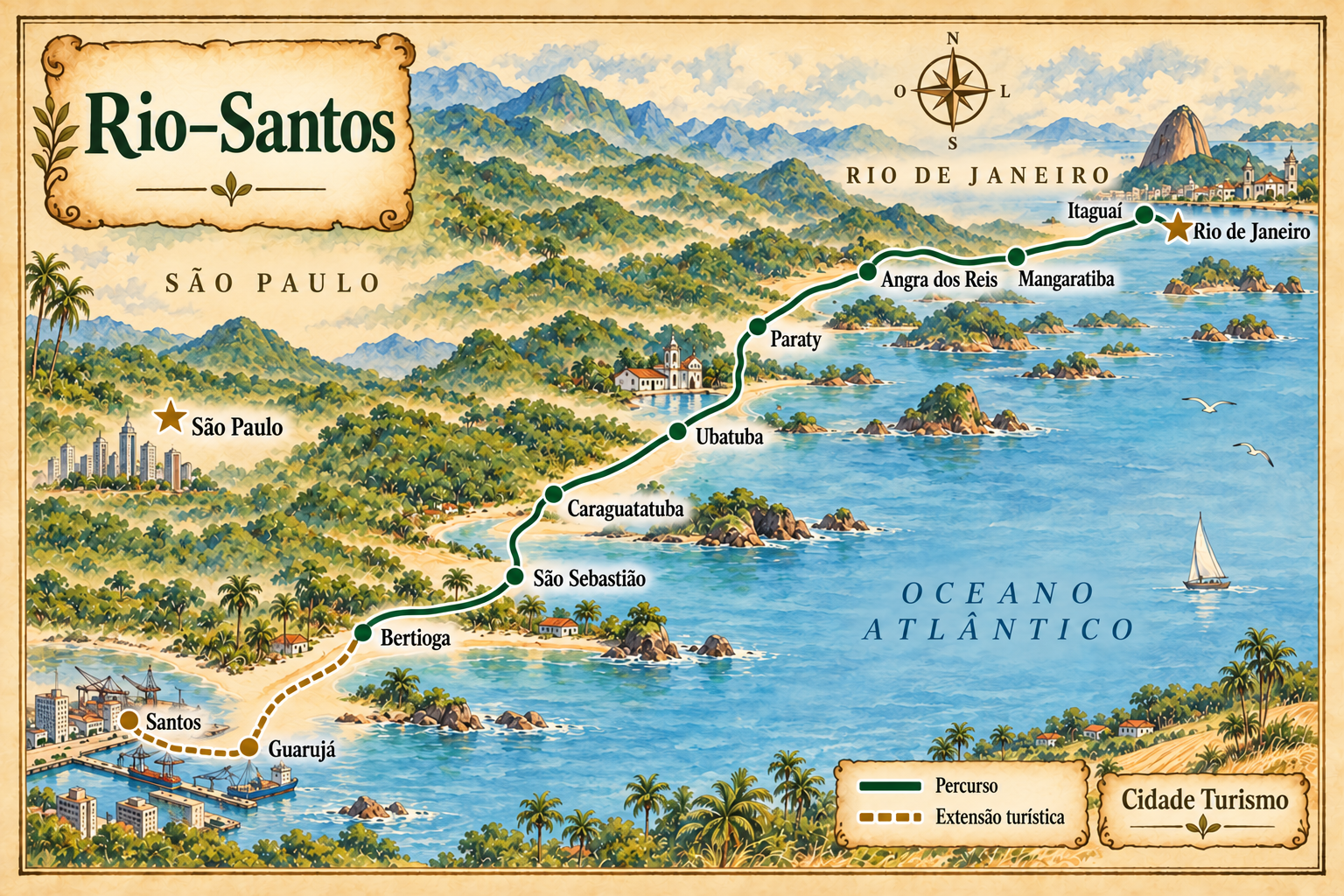
Costa da Mata Atlântica is on the Rio–Santos

From the Costa Verde to the São Paulo coast, with beaches, heritage and an extension via Guarujá to Santos.

Illustrative map, not to scale. Tap a city to open its page.
Illustrated map of Rio–Santos
Explore the Rio–Santos
Explore other destinations Search by state and city