

 Brazil
 Antarctica
 Argentina
 Chile
 Colombia
 Ecuador
 Falkland Islands (Malvinas)
 French Guiana
 Guyana
 Paraguay
 Peru
 Suriname
 Uruguay
 Venezuela
 Austria
 Belgium
 Croatia
 Denmark
 Finland
 France
 Germany
 Greece
 Hungary
 Iceland
 Ireland
 Italy
 Luxembourg
 Norway
 Poland
 Portugal
 Slovakia
 Slovenia
 Spain
 Sweden
 Switzerland
 the Czech Republic
 the Netherlands
 the United Kingdom
 Turkey
 Bermuda
 Canada
 Greenland
 Mexico
 Saint Pierre and Miquelon
 the United States
 the Dominican Republic
 Japan
 Egypt
 South Africa
 Australia
 Fiji
 New Zealand
 Papua New Guinea
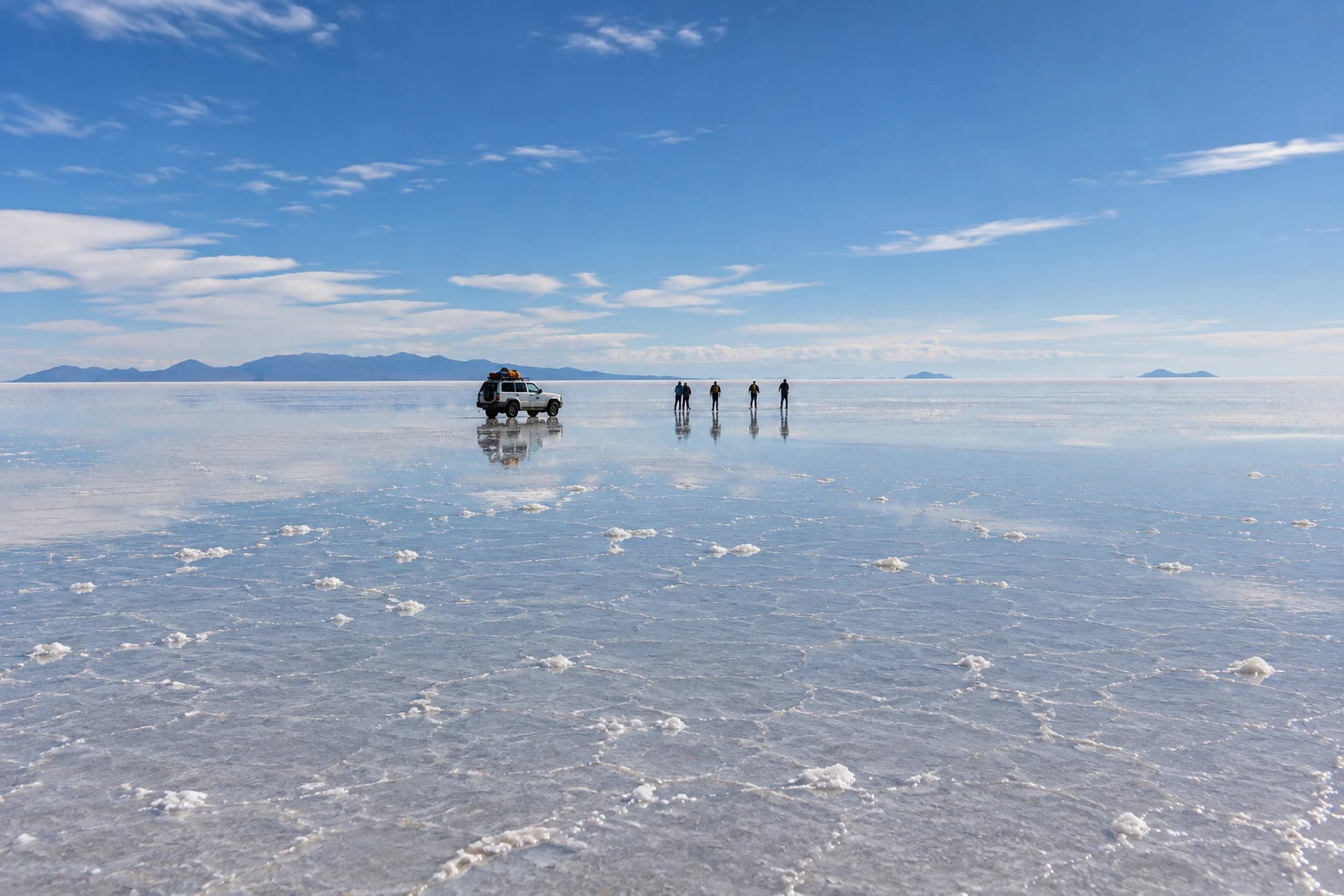
Landscape · Uyuni, Bolivia
Uyuni Salt Flats
Salt desert of more than 10,000 km² at about 3,660 m, flat and white, with salt hexagons in the dry season and the water mirror that usually appears from January to March. Visit with a local agency, in 4x4.
Illustrative images. The pictures in this guide are illustrations based on the real place, not photographs, and may differ from it.

Discover
About Uyuni Salt Flats
The Salar de Uyuni covers about 10,500 km² of the Bolivian Altiplano, at roughly 3,660 meters above sea level, and is the largest salt desert in the world. It is what remains of large prehistoric lakes that evaporated thousands of years ago, leaving a crust of salt several meters thick in some places. The surface is so flat that the change in elevation across the whole area is less than one meter.
In the dry season, the crust forms a pattern of hexagons and polygons, and the white stretches to the horizon with no reference points. That is what makes perspective photos possible, in which people and objects seem to have impossible sizes. In some spots, small holes called ojos de agua reveal the salty water bubbling beneath the crust.
In the rainy season, generally from January to March, a thin layer of water often covers parts of the salar and reflects the sky, clouds and mountains, creating a mirror effect. The extent of the mirror depends on the rainfall each year, and on some days excess water blocks stretches to vehicle traffic. Beneath the crust lies a brine with one of the largest lithium reserves on the planet.
The tour is done with a local agency, in 4x4 vehicles, with drivers who know the routes across the salt; driving alone is not recommended. The sun’s reflection on the white is intense: wear sunglasses, sunscreen and a hat, even on cold days.
Before you go
Practical information
Cidade Turismo reviews its information regularly, but something may have changed. Check with the place before planning your trip.
How much time to set aside
A full day on the classic tour, about 8 to 10 hours; three- or four-day itineraries include the salar and the southern lagoons.
Best time
For the water mirror, the rainy season, usually January to March. For the dry white and the hexagons, April to December. Sunset and sunrise over the salt are the most sought-after times.
How to get there
The eastern edge of the salar is about 22 km from Uyuni, next to the village of Colchani. Uyuni agencies depart from the center in the morning in 4x4s and return after sunset.
Tip
Bring objects for perspective photos, like dolls and bottles. In the rainy season, ask the agency for rubber boots and save late afternoon for the sunset reflection.
Your questions
Frequently asked questions about Uyuni Salt Flats
Is the reflective water mirror guaranteed in the rainy season?
No. It typically appears in parts of the salar from January to March, but it depends on the rains each year and on the location within the salar.
How large is the Salar de Uyuni?
About 10,500 km², at roughly 3,660 meters of elevation. It is the largest salt desert in the world.
Can you drive on the salar by yourself?
It is not recommended. Tracks across the salt change with water and there is no signage. Tours are done with a local agency in a 4x4.
What is the salar's lithium?
It's a metal used in batteries, found in the brine beneath the salt crust. The salar contains one of the world's largest known lithium reserves.