

 Brazil
 Argentina
 Chile
Chile Colombia
 Peru
Peru Uruguay
 Belgium
 Spain
Spain France
 Greece
 the Netherlands
 Ireland
 Italy
Italy Portugal
 the United Kingdom
 Switzerland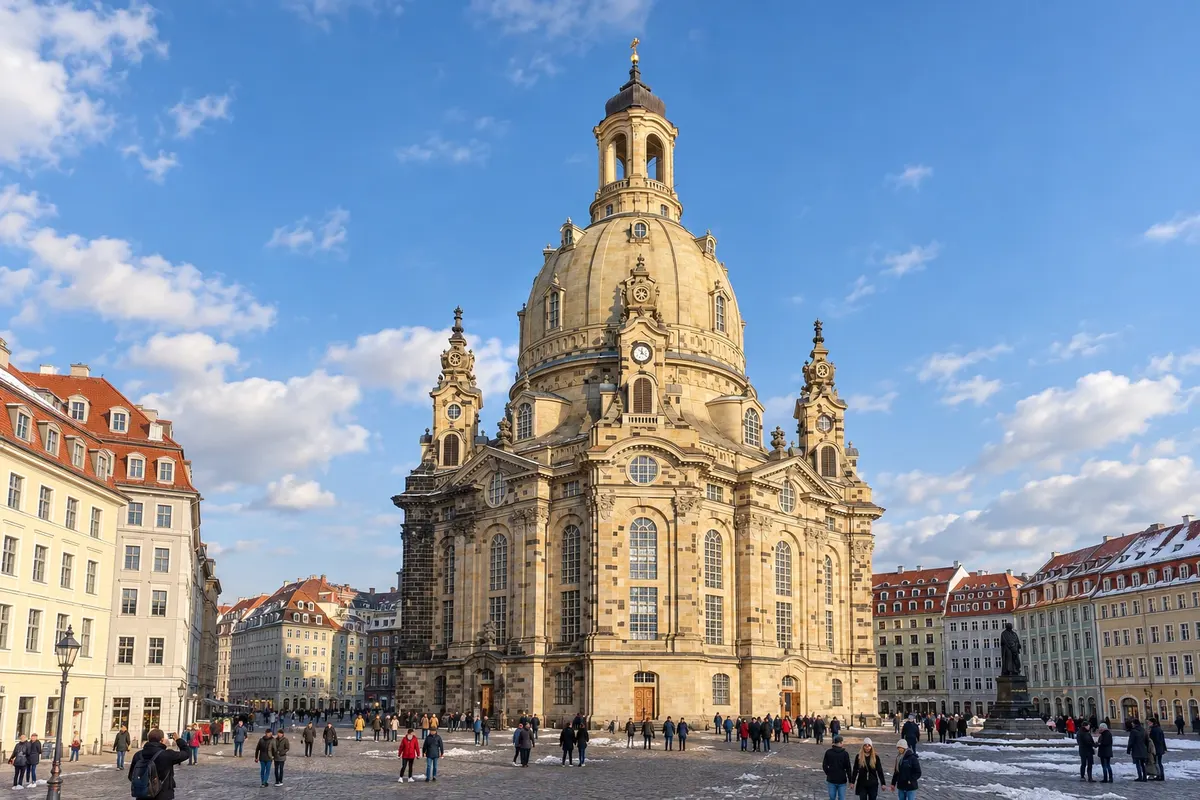
Before you go
Your trip to Dresden.
Illustrative images. The pictures in this guide are illustrations based on the real place, not photographs, and may differ from it.

Dresden – Saxônia Destination Dresden and the Suíça Saxônica Capital
How to get there
-
Flughafen Dresden (DRS) 12 km
-
Dresden Hauptbahnhof 1 km
Approximate road distances. Check flights and bus schedules before you travel.
Check before buying. From Dresden Airport (DRS), the S-Bahn takes you to Hauptbahnhof (central station) in about 20 minutes. Many arrive via Berlin (BER) and continue by train in about 2 hours, or via Prague, a little over 2 hours along the Elbe valley. There are also trains from Frankfurt and Munich, with longer journeys.
How many days
Two days allow you to see the old town, the main museums and the Neustadt at a relaxed pace. With three days, include Schloss Pillnitz and one more museum. Adding Saxon Switzerland requires one or two extra days.
When to go
From May to September the days are long and the city fills with people along the Elbe. September and October are usually quieter and mild. Winter, from December to February, is cold and it gets dark early, but it's the season of the Striezelmarkt, which typically runs from the end of November to Christmas Eve. The Semperoper season usually runs from September to July.
The seasons shown are the most usual ones; nature doesn't always follow the calendar.
Do you need a car?
No. The old town is walkable, and trams and integrated buses take you to the Neustadt, Pillnitz and the central station. For Saxon Switzerland, the S-Bahn does the job. Dresden has an environmental zone (Umweltzone) for cars, and parking in the center is expensive and difficult. Validate your ticket in the machine when it prompts you.
Suggested itinerary
An order that works
Built with the places on this page. No rush: it's paced so you have time to see them.
One day in Dresden
-
Morning
Frauenkirche, Neumarkt and Fürstenzug
Start at the Frauenkirche, preferably at opening, and climb to the dome if the sky is clear. Walk around the Neumarkt and follow Augustusstraße to see the Fürstenzug, the porcelain frieze depicting the rulers of Saxony.
-
Afternoon
Residenschloss and Zwinger
Enter the Residenzschloss at the time slot reserved for the Historisches Grünes Gewölbe. Then cross over to the Zwinger, explore the courtyard and galleries, and allow at least an hour for the Sistine Madonna and the masters of the Gemäldegalerie Alte Meister.
-
Late afternoon
Theaterplatz and Brühlsche Terrasse
Pass by the Semperoper and the Hofkirche, on Theaterplatz and Schlossplatz, and climb the steps up to the Brühlsche Terrasse to view the Elbe in the glow of late afternoon.
-
Evening
Opera or dinner in the Neustadt
If you have a ticket, attend a performance at the Semperoper. If not, cross the Augustusbrücke, view the lit-up old town from the opposite bank and dine in the Äußere Neustadt.
2 days in Dresden
Day 1
-
Morning
Frauenkirche and Neumarkt
Visit the Frauenkirche at opening, climb the dome and stroll through the rebuilt Neumarkt. Continue along Augustusstraße to see the Fürstenzug.
-
Afternoon
Residenzschloss and Grünes Gewölbe
Devote the afternoon to the Residenzschloss: the Historisches Grünes Gewölbe in its reserved time slot, the Neues Grünes Gewölbe and the Rüstkammer. In season, climb the Hausmannsturm.
-
Late afternoon
Hofkirche and Brühlsche Terrasse
Enter the Hofkirche, the cathedral, and ascend to the Brühlsche Terrasse. Walk to the Albertinum with views over the Elbe and the Neustadt on the opposite bank.
-
Evening
Semperoper or illuminated Altstadt
Attend an opera or concert at the Semperoper, or dine in the old town and see the Frauenkirche and Theaterplatz illuminated.
Day 2
-
Morning
Zwinger and Gemäldegalerie Alte Meister
Start at the Zwinger courtyard before the tour groups and enter the Gemäldegalerie Alte Meister to see the Sistine Madonna, Rembrandt and Vermeer. If you have time left, visit the porcelain collection.
-
Afternoon
Neustadt and Pfunds Molkerei
Cross the Elbe, pass the Goldener Reiter and the Hauptstraße, explore the courtyards of the Kunsthofpassage in the Äußere Neustadt and continue to the Pfunds Molkerei on Bautzner Straße.
-
Late afternoon
Kreuzkirche and Altmarkt
Return to the center and climb the Kreuzkirche tower to see the Altmarkt from above. On a Saturday, stay for vespers with the Kreuzchor; in Advent, stroll through the Striezelmarkt.
-
Evening
Dinner in the Äußere Neustadt
End in the Äußere Neustadt, on Alaunstraße and Louisenstraße, with bars and restaurants of various cuisines open late.
Check before you go. Opening hours and days change, and places may close for renovations, holidays or events. This itinerary is a suggestion from Cidade Turismo, not a commitment: plan yours by checking directly with each place you intend to visit.
Before you go
Frequently asked questions
Is Dresden very far from Berlin?
No. The train between Berlin and Dresden takes about 2 hours, with departures throughout the day. You can even do a day trip, but ideally spend at least one night in Dresden.
Is it true that Dresden was entirely rebuilt?
Much of the old center was destroyed in the February 1945 bombings and rebuilt in the following decades. The Zwinger and the Semperoper were rebuilt in East Germany; the Frauenkirche and the Neumarkt after reunification. The Fürstenzug and parts of the Neustadt survived better.
Do I need to book Dresden's museums?
The Historisches Grünes Gewölbe, in the Residenzschloss, operates with timed-entry tickets and limited capacity: book in advance. Other state museums sell tickets on site, but in high season it's worth buying ahead. There are combination tickets that include several museums.
Is it possible to go from Dresden to Prague?
Yes. The train along the Elbe valley takes just over 2 hours to Prague and stops at Bad Schandau, the gateway to Saxon Switzerland. Many travelers combine the two cities on the same itinerary.
What's the best time to visit Dresden?
From May to September to enjoy the river and the gardens with long days. September and October are usually quieter. In winter it's cold, but the Striezelmarkt, which typically runs from the end of November to Christmas Eve, draws many visitors.