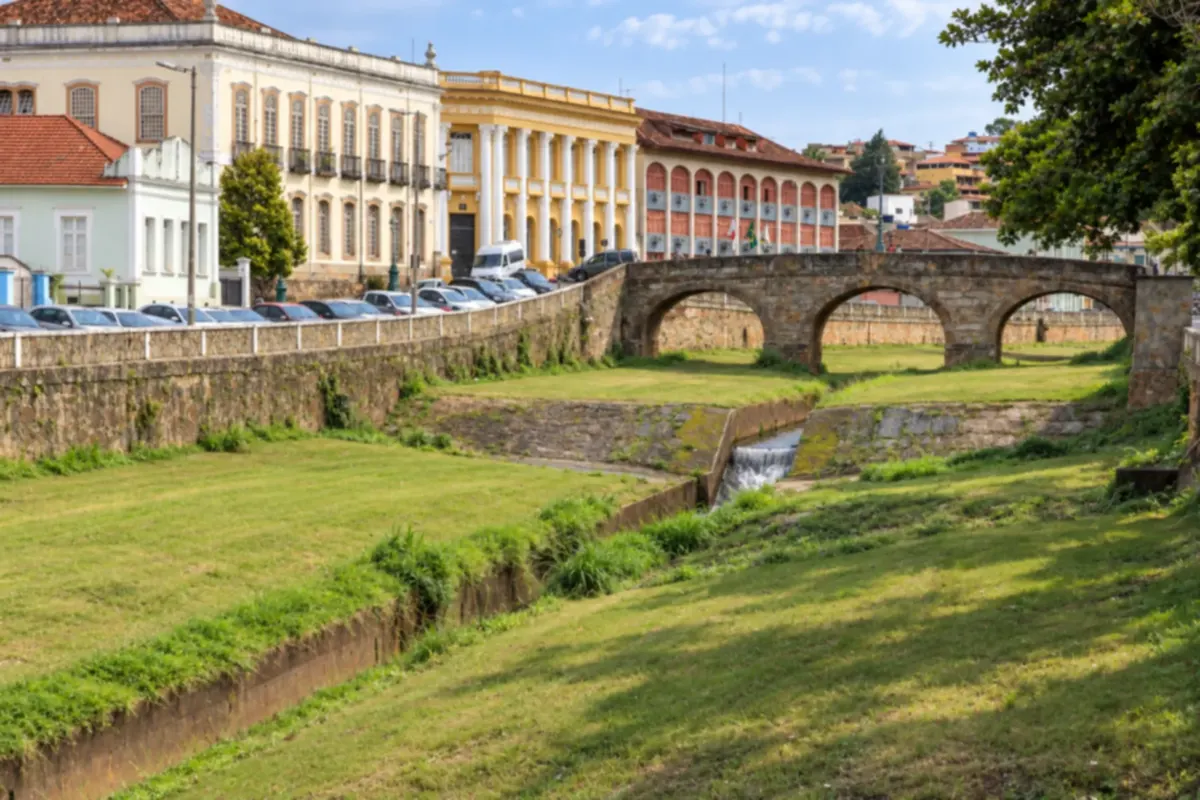
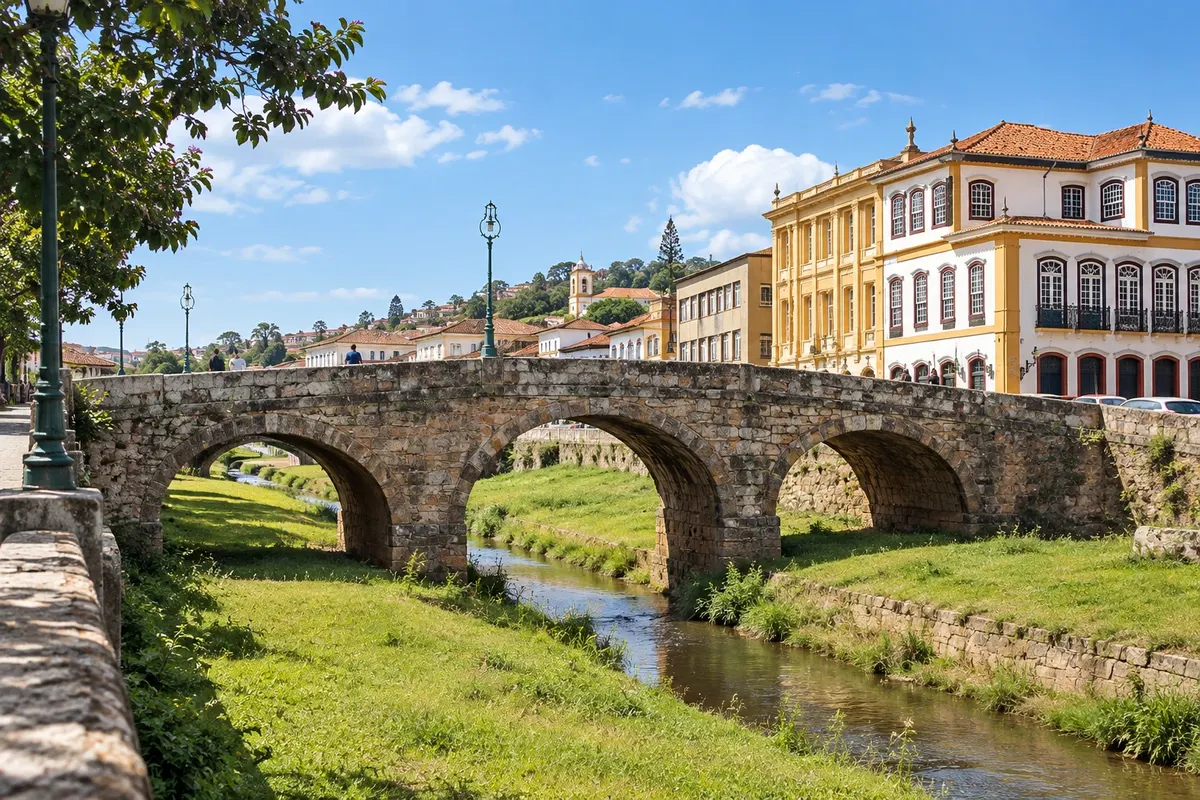
Córrego do Lenheiro: stone bridges, former Câmara and Regional Museum
Odhod: Railway station or city hall on foot about 2 hours, including the museum morning or afternoon easy
The center of São João del-Rei is arranged along the Córrego do Lenheiro, a channel between two avenues. It’s the natural starting point for those arriving by train, since the station is a few minutes’ walk away.
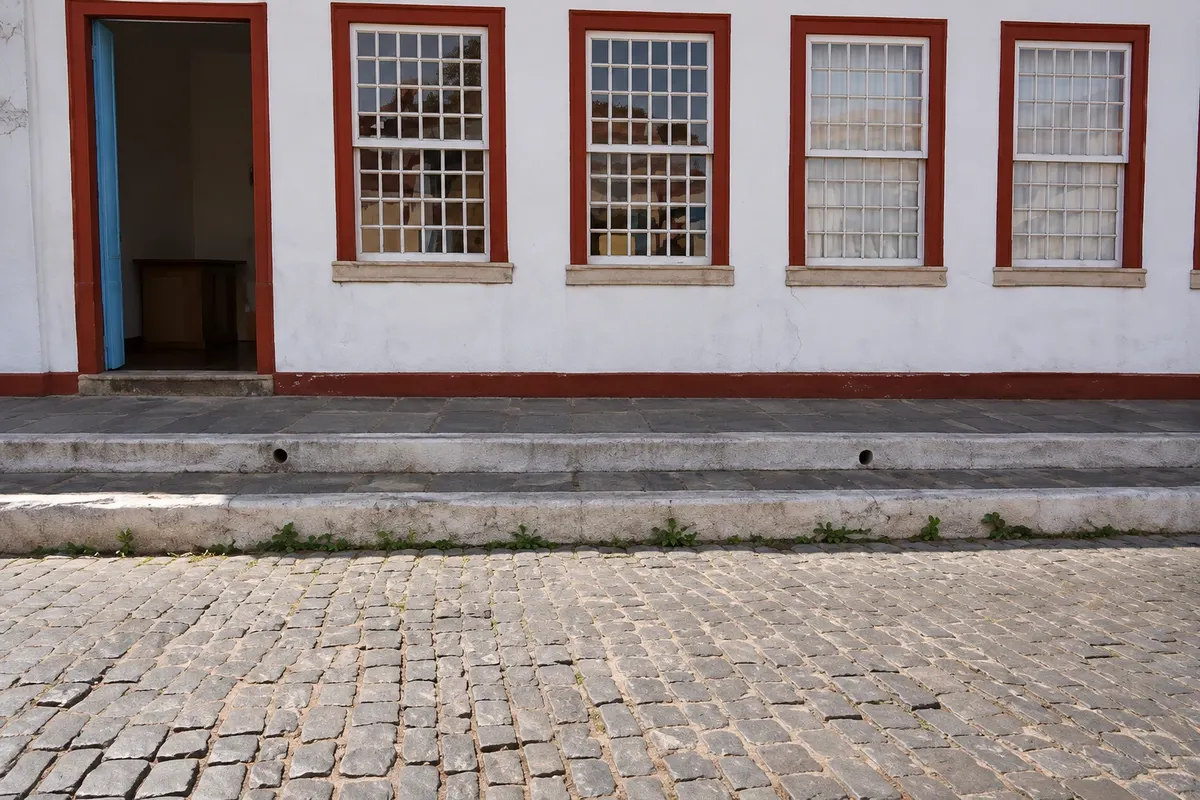
The most familiar sight in the area is the Ponte da Cadeia, a stone arched bridge from the late 18th century. It was commissioned after a wooden bridge that stood there collapsed during a procession, and it was originally called Ponte Nova. Its current name comes from the neighboring building, which was built to house the Câmara on the upper floor and the jail below. That building now holds the city hall. From the middle of the bridge you can see the houses on both banks and the church towers.
In this area the old town mixes with everyday commerce, with shops, banks and restaurants. It’s the busiest part of the city.
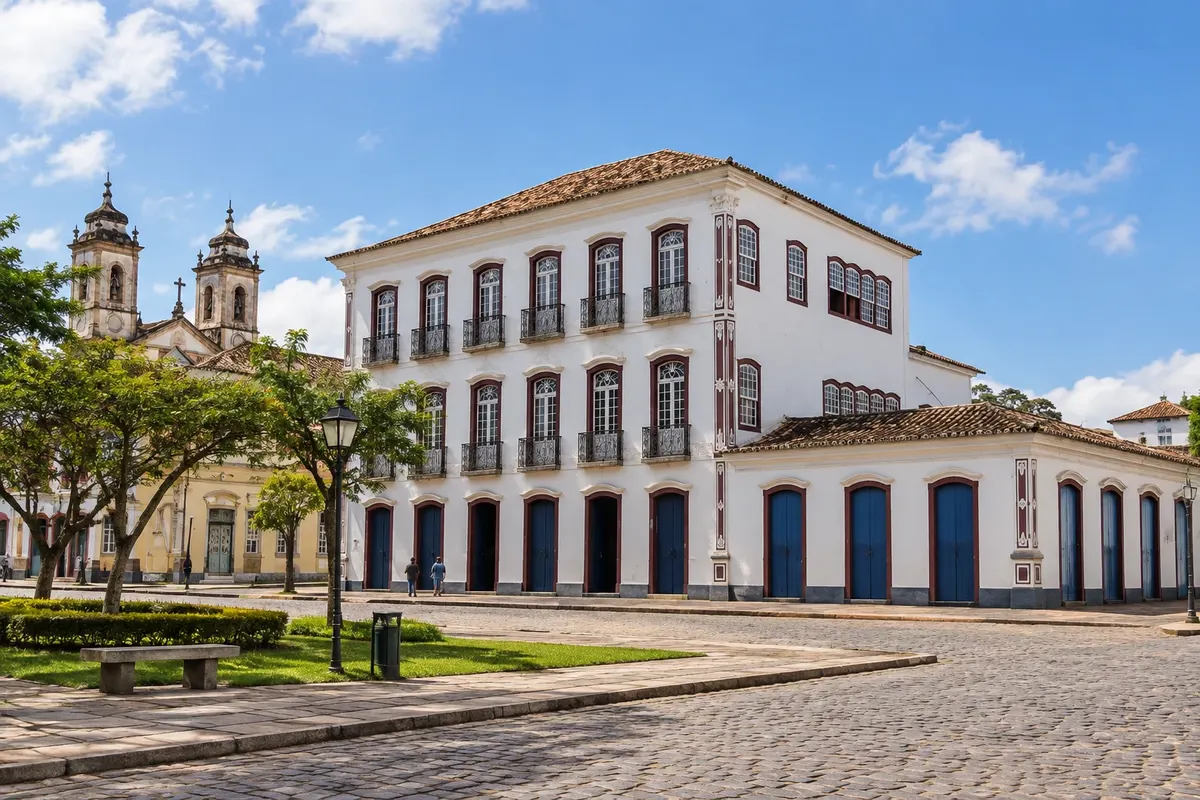
Following the stream leads to the Regional Museum, in a three-story townhouse built in 1859 for commander João Antônio da Silva Mourão, a wealthy merchant. The ground floor was the shop; above was the family’s home. The collection shows Minas Gerais daily life in the 18th and 19th centuries, with furniture, means of transportation, work objects, sacred art and images of saints from several cities in Minas. The museum also hosts temporary exhibitions, recitals and lectures.
Completing the center’s list are the Chafariz da Legalidade, from the 19th century, rebuilt after demolition, and the Municipal Theater.
Kraji na poti: Córrego do Lenheiro, Ponte da Cadeia, Former Câmara and Jail (city hall), Regional Museum of São João del-Rei, Chafariz da Legalidade, Municipal Theater.
Vključuje: Self-guided walk. The Regional Museum charges a small admission fee: check the current rates.
Nasvet: The Regional Museum is closed on Mondays and has stairs between floors; visitors with reduced mobility should check access in advance. Do this section right after arriving by train or before departing.
Najboljši čas za obisk: All year round.
Getúlio Vargas Street: Carmo, Pilar, Rosário and Rua das Casas Tortas
Odhod: Chain Bridge on foot, on your own 3 to 4 hours, including visits morning or afternoon easy, with an uphill to Mercês
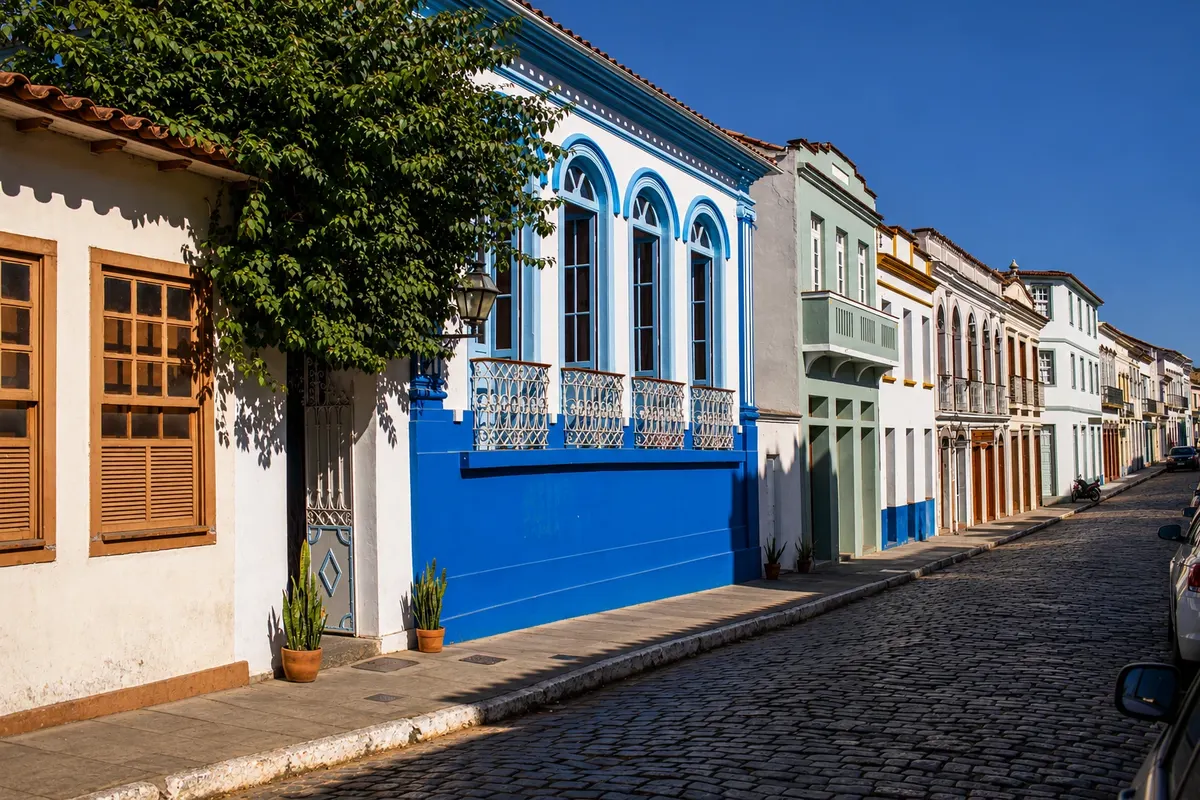
Once you cross the Chain Bridge, two short blocks lead to Getúlio Vargas Street, where the historic center truly begins. The street is narrow and paved with stone, lined with preserved colonial houses, and contains three churches within a few minutes' walk. There are signs for visitors without a guide.
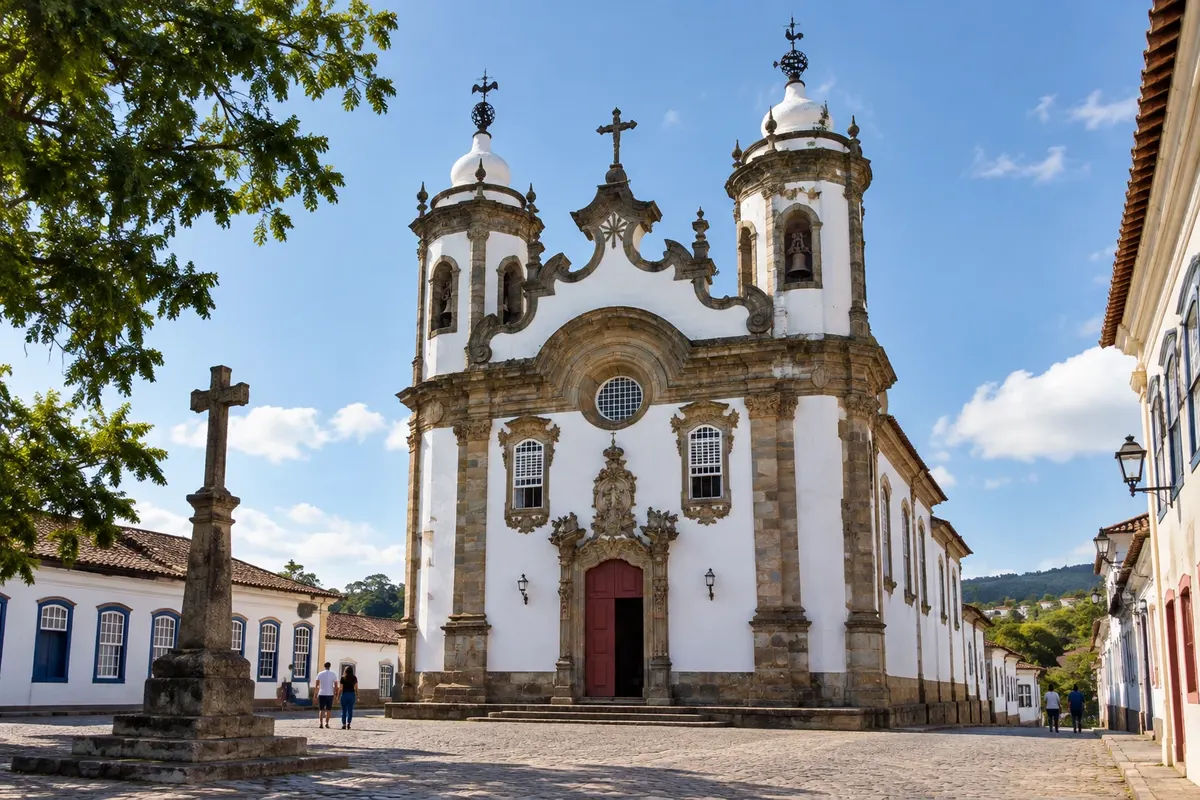
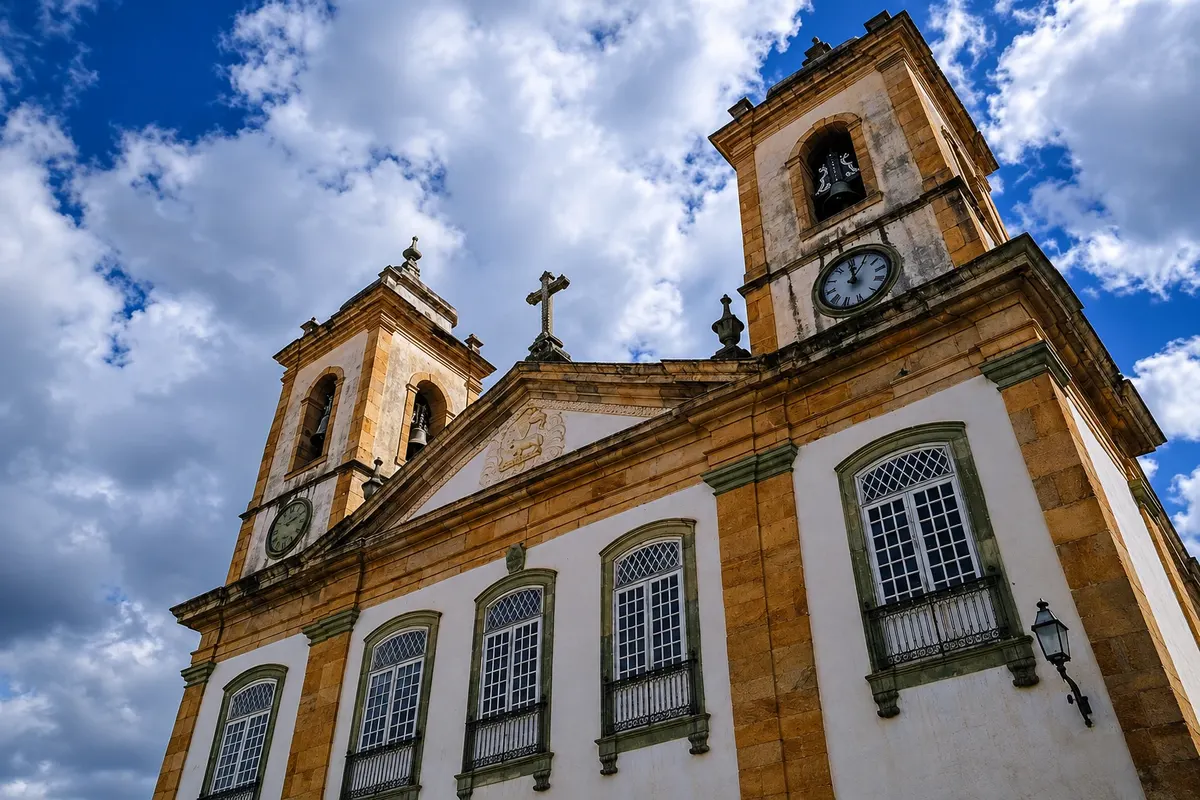
At one end is the Church of Our Lady of Mount Carmel, begun in the 1730s, with a rococo façade, a carved portal, and recessed octagonal towers. The interior is entirely white. In the square in front there are bars, cafés, and a university cultural center.
Returning along the same street brings you to the Cathedral-Basilica of Our Lady of the Pillar, from the early 18th century and the seat of the diocese. Inside, gilded baroque covers the altars. It is the setting for the main celebrations of Holy Week. Ahead is the Museum of Sacred Art.
The street ends at Rosário Square. The Church of Our Lady of the Rosary is one of the city’s oldest. Opposite stands the Solar dos Neves, the mansion of Tancredo Neves’s family; it does not receive visitors but forms part of the square. Through the narrow lane beside the church you enter Santo Antônio Street, nicknamed Crooked Houses Street because of the curious alignment of the walls of the colorful little houses. It is one of the city’s oldest streets and houses the headquarters of two orchestras founded in the 18th century.
Nearby, the Tancredo Neves Memorial occupies an 18th-century mansion and preserves photos, documents, letters, and newspapers of the politician.
To finish, go behind the Cathedral and climb to the Church of Our Lady of Mercês at the top of a staircase. From there you can see the entire historic center. Largo da Cruz, with one of the Stations of the Cross, is along the way.
Kraji na poti: Church of Our Lady of Mount Carmel, Carmo Square, Cathedral-Basilica of Our Lady of the Pillar, Museum of Sacred Art, Church of Our Lady of the Rosary, Solar dos Neves, Santo Antônio Street, Tancredo Neves Memorial, Church of Our Lady of Mercês, Largo da Cruz.
Vključuje: Self-guided walk. Carmo and Pilar charge a visitation fee paid at the door; museums have their own tickets. Check the current fee schedule.
Nasvet: Churches close at lunchtime and open at different times: start early and confirm in advance. The Tancredo Neves Memorial is open only part of the week, generally Friday to Sunday. When climbing to Mercês, go at late afternoon for the view.
Najboljši čas za obisk: All year. During Holy Week, processions pass along these streets.
Church of Saint Francis of Assisi and Bárbara Heliodora House Museum
Odhod: Frei Orlando Square on foot or a short taxi ride 1 to 2 hours morning easy
The Church of Saint Francis of Assisi is the best-known church in São João del-Rei and stands on the bank of the stream opposite the one by Rua Getúlio Vargas, the same stream as the railway station. You can walk there from the city center.
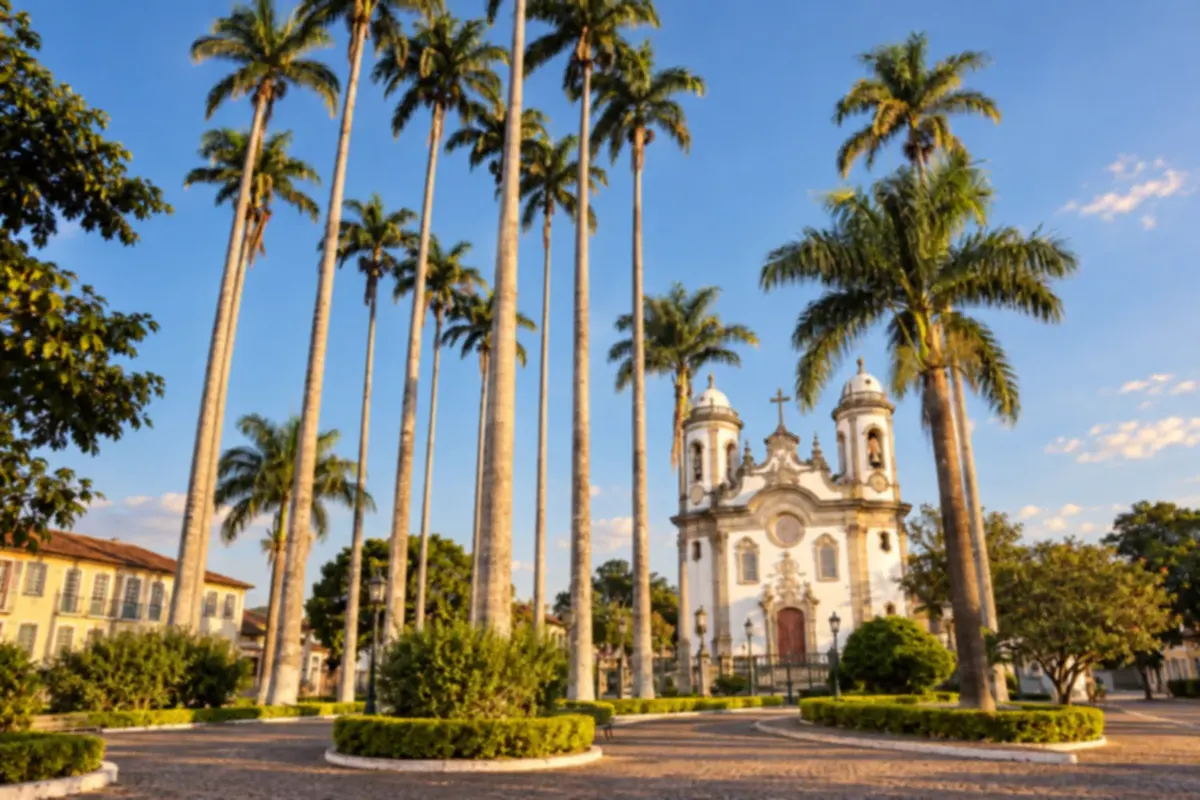
Construction began in 1774 and took about thirty years. The design is attributed to Aleijadinho and was executed, with modifications, by Francisco de Lima Cerqueira. The façade has a soapstone carved portal, and the interior shows the influence of the rococo style. In front, Praça Frei Orlando has a garden with rows of royal palms that frame the church and form one of the city’s postcards.
Behind the church is the order’s cemetery, where the tomb of Tancredo Neves is located. Elected president in 1985, he fell ill on the eve of his inauguration and died without taking office.
On Sundays there is usually a mass with Baroque music. It’s one of the simplest ways to hear this repertoire in the place for which it was written.
Next door, on the same square, the Bárbara Heliodora House Museum occupies the manor where the poet was born; she was married to the inconfidente Alvarenga Peixoto, who died in exile in Angola. The house offers guided visits.
Kraji na poti: Church of Saint Francis of Assisi, Frei Orlando Square, Cemetery of the Third Order, Tomb of Tancredo Neves, Bárbara Heliodora House Museum.
Vključuje: The church charges an admission fee; guided visits are available—check the current rates. There is no entrance fee at the Bárbara Heliodora House Museum.
Nasvet: The church closes at lunchtime. For the mass with orchestra, confirm the time the day before and arrive early; during the service you may not move around the nave. Morning light hits the façade.
Najboljši čas za obisk: All year. From May to August clear skies favor photos of the square.
the language of the bells and the church orchestras
Odhod: Historic center on foot, among the churches about 1 hour per service morning, late afternoon or evening easy
In São João del-Rei a bell does more than call people to mass. There are different peals to announce a feast, a procession, who will celebrate and in which church, a serious illness of a brotherhood member and a death. In the funeral peal, those who know the code can tell whether a man, woman or child died. That is why the town is called the land where the bells speak.
The bell peals and the trade of bell-ringing in Minas Gerais are recognized as intangible heritage of Brazil. A study by the national heritage body in 2009 visited nine historic towns and concluded the tradition is best preserved in São João del-Rei. There are at least thirty bells in the historic center alone. More than forty distinct peals were recorded, with a well-defined structure. It is also the town where the bell-ringer has a daily role in the churches.
There is no ticketed tour for this: the way to experience it is to be on the street at the right time. The bells ring every day, tied to masses and ceremonies, and much more frequently during religious festivals, especially in Lent and Holy Week. The squares of Carmo, Rosário and São Francisco and the Mercês churchyard are good places to listen.
Music is part of the same tradition. Rua Santo Antônio is home to two orchestras founded in the 18th century, Lira Sanjoanense and Ribeiro Bastos, which still accompany masses and processions. Attending a mass with orchestra is worthwhile even for those who are not Catholic.
Kraji na poti: Catedral Basílica de Nossa Senhora do Pilar, Igreja de Nossa Senhora do Carmo, Igreja de São Francisco de Assis, Igreja de Nossa Senhora das Mercês, Rua Santo Antônio.
Vključuje: There is no fee: the bells are heard from the street, and masses are open to anyone who wishes to attend.
Nasvet: Ask at your lodging or at the churches which weekday mass will feature an orchestra. During the service keep silent and do not photograph. Do not climb the towers without authorization: they are workplaces of the bell-ringers.
Najboljši čas za obisk: Year-round; the peak is from Lent to Holy Week, in March or April.
Steam train from São João del-Rei to Tiradentes, including Railway Museum and Roundhouse
Odhod: São João del-Rei Railway Station, Avenida Hermílio Alves steam train about 40 minutes each way; 1 extra hour for the railway museum morning or afternoon easy
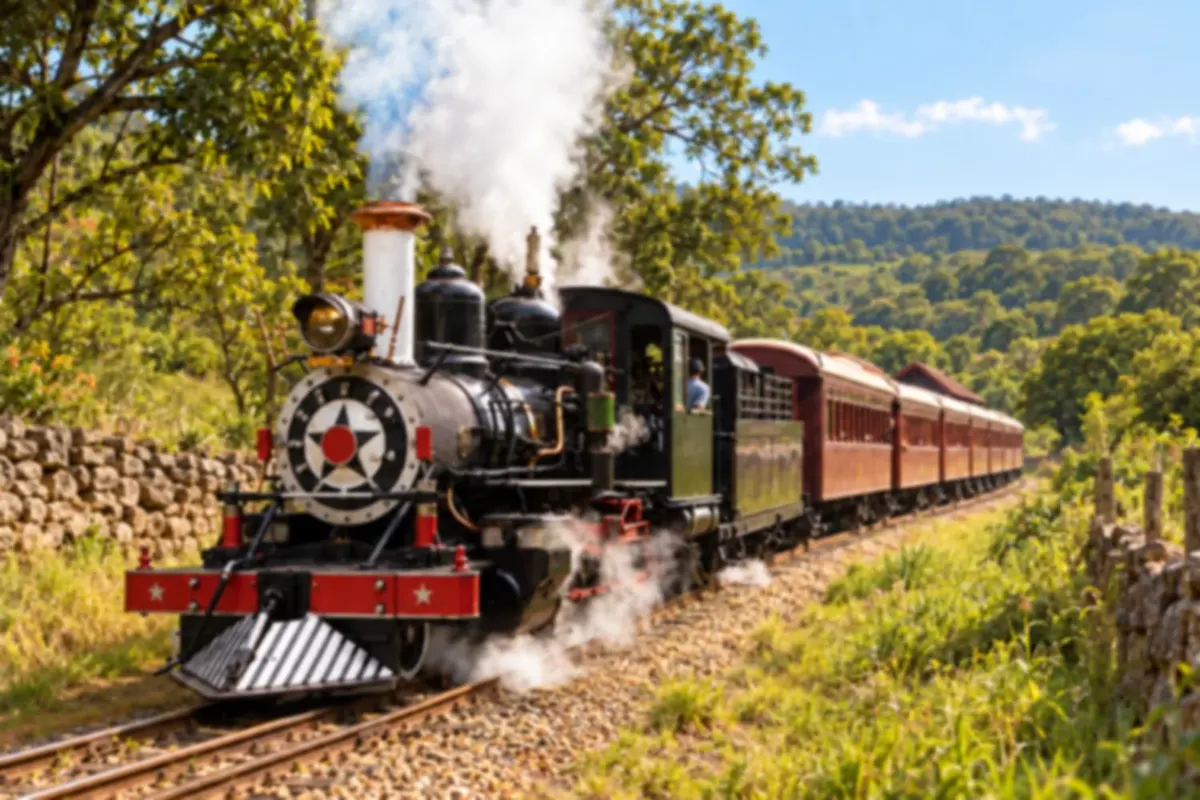
São João del-Rei station, on Avenida Hermílio Alves, is the main terminus of the oldest tourist train still operating in Brazil. The line was opened by Dom Pedro II on August 28, 1881, and was part of the Estrada de Ferro Oeste de Minas. The tracks have a 76-centimeter gauge, much narrower than standard railways, and the locomotives are steam.
Before boarding, allow time for what’s beside the platform. The Railway Museum houses locomotives, carriages, clocks, bells, telephones and tools, including the railway’s first locomotive and a luxury coach. The Roundhouse is a circular building where 25 tracks converge on a manually operated turntable at the center.
The route to Tiradentes is 12.8 km and takes about 40 minutes. The train follows the Rio das Mortes, with the Serra de São José in the background, and passes old farms. The cars are divided into three classes and seating is unreserved: seats are taken on a first-come, first-served basis. In Tiradentes the locomotive is uncoupled and turned on a turntable for the return trip.
Tickets are sold per leg, and each direction is purchased separately. You can go by train, spend a few hours in Tiradentes and return by bus or taxi, or travel both ways by rail, with less time in the neighboring town.
The train runs on Fridays, Saturdays and Sundays, with extra departures on public holidays and during vacation periods. There are fewer departures on Sundays. Station ticket offices open on operation days, and tickets are also sold online. Children up to 5 years old travel free if they do not occupy a seat.
Kraji na poti: São João del-Rei Railway Station, Railway Museum, Roundhouse, Rio das Mortes, Serra de São José, Tiradentes Station.
Vključuje: One-way train ride from São João del-Rei to Tiradentes. The return trip requires a separate ticket. Half-price tickets are available for students, people aged 60 or over, and people with disabilities. The Railway Museum is visited separately: check the current schedule.
Nasvet: Buy in advance for holidays, the July school break, and Holy Week. Arrive early at the platform to choose your seat: leaving São João del-Rei, the left side usually has the clearest view of the mountain range. The Tiradentes station is a bit removed from that town’s historic center.
Najboljši čas za obisk: All year. From May to August the weather is more stable; during school vacations and public holidays there are more departures.
R$ 80 do R$ 110 · per person, per leg, full fare (3rd to 1st class)· uradna cena
Serra do Lenheiro: quartzite outcrops and rock paintings
Odhod: São João del-Rei city center, with a guide or agency on foot, on a trail half a day morning moderate
The Serra do Lenheiro is the rocky ridge that closes one side of the town and gives its name to the creek in the center. It is formed of quartzite, with large blocks called outcrops and many other stones scattered across the terrain.
Part of the area is protected as a small municipal ecological park, about 2 km². There are rock paintings on the stones, made by peoples who lived in the region thousands of years before the mining period. The cliffs are used as a training field for vertical techniques by the mountain infantry battalion based in the town.
The outing is a hike along the ridge, with visits to the painted panels. Because the paintings are in spots that are not obvious and the trails have little signage, it is recommended to book the tour with a guide or a local agency. The ridge is very close to the center, which allows doing the trail in the morning and returning for lunch.
This is an activity for those staying more than one day who want to see a side of the town that isn’t just the churches.
Kraji na poti: Serra do Lenheiro, Parque Municipal Ecológico da Serra do Lenheiro, Quartzite outcrops, Rock paintings.
Vključuje: Combined tour with a guide or agency, paid separately: check what is included.
Nasvet: Leave early, with water, hat, sunscreen and shoes with good grip. Do not touch the paintings. Avoid the ridge after heavy rain, when the rock becomes slick.
Najboljši čas za obisk: From May to September, during the dry season.


 Antarktika
 Argentina
 Bolivija
 Čile
 Kolumbija
 Ekvator
 Gvajana
 Francoska Gvajana
 Falklandski otoki (Malvini)
 Paragvaj
 Peru
 Surinam
 Urugvaj
 Venezuela
 Nemčija
 Avstrija
 Belgija
 Hrvaška
 Danska
 Slovaška
 Slovenija
 Španija
 Finska
 Francija
 Grčija
 Nizozemska
 Madžarska
 Irska
 Islandija
 Italija
 Luksemburg
 Norveška
 Poljska
 Portugalska
 Združeno kraljestvo
 Češka
 Švedska
 Švica
 Turčija
 Bermudi
 Kanada
 Združene države Amerike
 Grenlandija
 Mehika
 Sveta Peter in Mihael
 Dominikanska republika
 Japonska
 Južnoafriška republika
 Egipt
 Avstralija
 Fidži
 Nova Zelandija
 Papua Nova Gvineja