

 Brazil
 Argentina
 Chile
Chile Colombia
 Peru
Peru Uruguay
 Germany
 Belgium
 France
 Greece
 the Netherlands
 Ireland
 Italy
Italy Luxembourg
 Portugal
 the United Kingdom
 Switzerland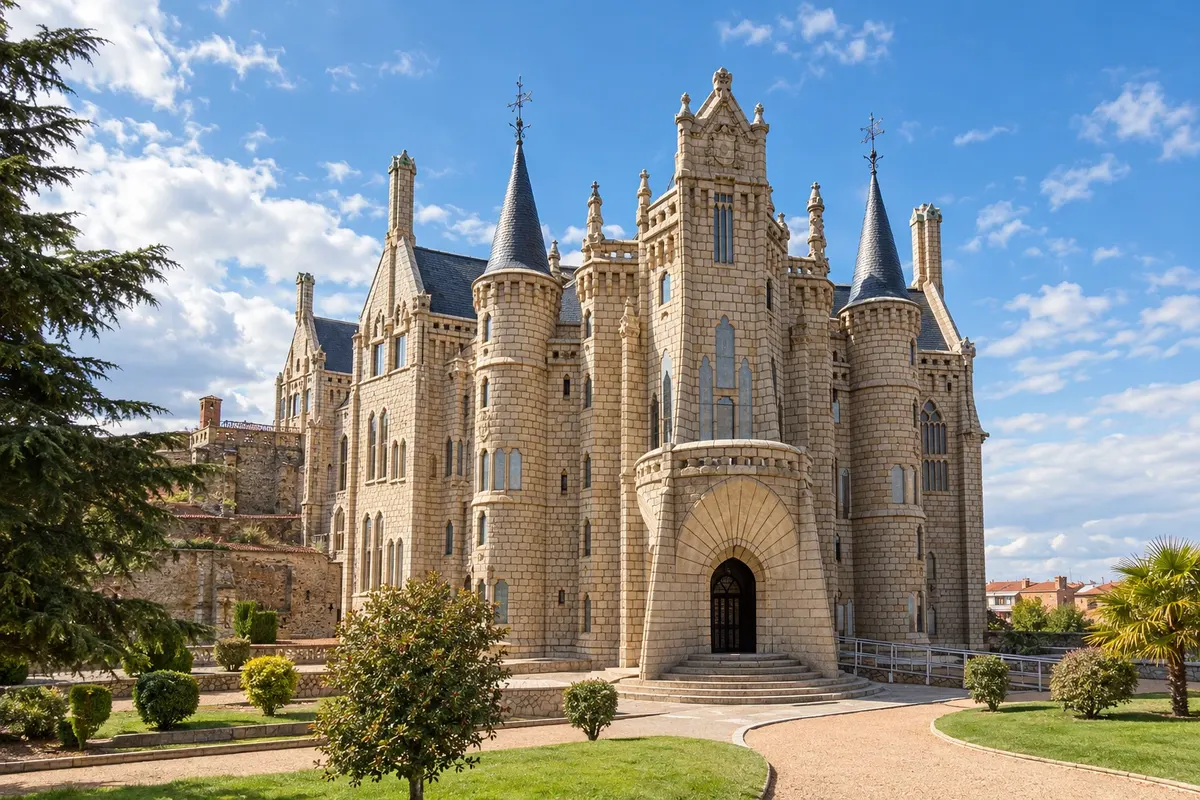
Before you go
Your trip to Astorga.
Illustrative images. The pictures in this guide are illustrations based on the real place, not photographs, and may differ from it.

Astorga – Castela e Leão Destination Burgos and León
How to get there
-
Aeroporto de Madri-Barajas (Aeropuerto Adolfo Suárez Madrid-Barajas) (MAD) Madri · 330 km
-
Aeroporto de León (Aeropuerto de León) (LEN) La Virgen del Camino · 45 km
-
Estação de trem de Astorga (Estación de Astorga) 1 km
-
Rodoviária de Astorga (Estación de Autobuses de Astorga) 1 km
Approximate road distances. Check flights and bus schedules before you travel.
Check before buying. International flights arrive at Madri; from there, high-speed train (AVE) to León and regional train or bus to Astorga, about 50 km from León. Astorga station has trains to León and Ponferrada, and the bus station has services to León, Ponferrada and other towns. By car, take the A-6 motorway, which links Madri to Galicia.
How many days
One day is enough for the Palácio de Gaudí, the cathedral, the Roman museum, the wall, the Plaza Mayor and the chocolate museum. With an overnight stay you can have the cozido maragato for lunch and spend an afternoon in Castrillo de los Polvazares.
When to go
From May to October the days are long. Summer is warm by day and cool at night, and winter is cold with frosts. At the end of August the Astúricos and Romanos festivals recreate the town's Roman history.
The seasons shown are the most usual ones; nature doesn't always follow the calendar.
Do you need a car?
Not within the town—Astorga is walkable inside the walls. For Castrillo de los Polvazares, 5 km away, a car or taxi helps; it's also reachable on foot. Trains and buses link Astorga with León and Ponferrada.
Suggested itinerary
An order that works
Built with the places on this page. No rush: it's paced so you have time to see them.
One day in Astorga
-
Morning
Palácio de Gaudí and cathedral
Start at the Palácio Episcopal de Gaudí, which houses the Museu dos Caminhos, then continue to the cathedral next door, with the altarpiece by Gaspar Becerra.
-
Afternoon
Cozido maragato and Roman museum
Have lunch on cozido maragato, served the other way around: first the meats, then the chickpeas and the kale, and the soup at the end. Then visit the Roman museum, in the ergástula, and some points of the Roman route.
-
Late afternoon
Plaza Mayor and the city wall
In Plaza Mayor, wait for the hour to see the maragato figures strike the town-hall bell. Finish with a walk along the promenade on the wall, with views of the Montes de León.
-
Evening
Chocolate and mantecadas
Try the hot chocolate and the mantecadas, typical small cakes of the town, in one of the cafés in the centre.
Check before you go. Opening hours and days change, and places may close for renovations, holidays or events. This itinerary is a suggestion from Cidade Turismo, not a commitment: plan yours by checking directly with each place you intend to visit.
Before you go
Frequently asked questions
What to see in Astorga?
The Palácio Episcopal de Gaudí, the cathedral, the Roman museum, the city wall, Plaza Mayor with the maragato clock figures and the chocolate museum.
What is cozido maragato?
It is the typical dish of the Maragatería, served backwards: first the meats, then the chickpeas with kale and, finally, the soup.
How to get from León to Astorga?
By regional train or bus in about 45 minutes, or by car about 50 km via the A-6.
Why is Astorga known for chocolate?
At the end of the 19th century and the beginning of the 20th, the town had dozens of chocolate factories. Some are still operating, and there is a museum about that history.
Is Astorga on the Caminho de Santiago?
Yes. Astorga is a point on the Caminho Francês and the place where it meets the Via da Prata, which comes from Sevilha.