By plane: Aeroporto de Ilhéus (Jorge Amado)
Aeroporto Jorge Amado (IOS) is in Ilhéus, about 3 km from the center. It is the main air gateway to the Costa do Cacau and also serves Itacaré and Maraú. The airlines operating at the airport are Azul, Gol and LATAM. Regular connections depart from São Paulo (Guarulhos and Congonhas), Campinas (Viracopos), Belo Horizonte (Confins) and Salvador. Routes and frequencies change with the season, so check with the airline.
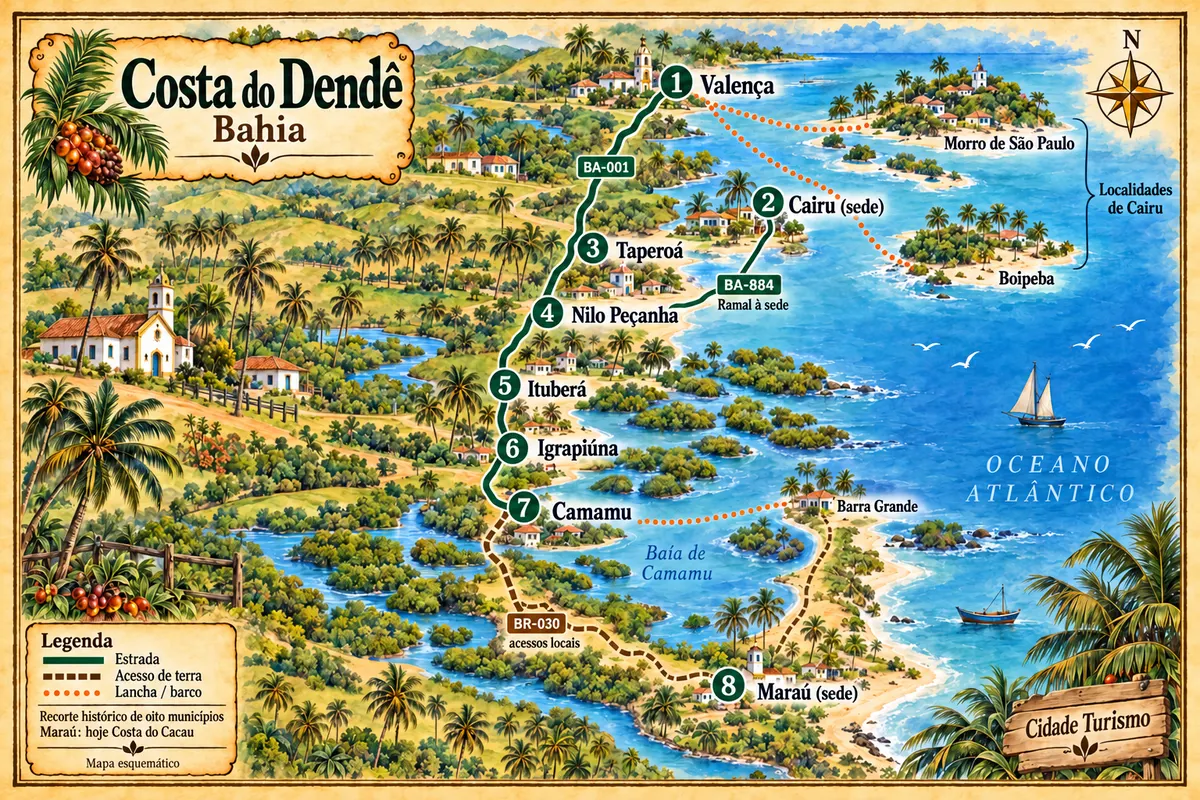
Distances from Ilhéus: Itacaré is about 70 to 75 km via the BA-001. Camamu, from where launches to Barra Grande (Maraú) depart, is about 115 km.
Salvador (SSA) is the nearest international airport to the region. From there, the final leg to Itacaré or Camamu is by land and includes a ferry-boat crossing or a long road stretch.
Barra Grande has a small airstrip used by charter air taxis. There are no regular commercial flights to the peninsula.
By bus, van or shuttle
Ilhéus to Itacaré: Rota Transportes operates the line, with regular departures throughout the day from the Ilhéus Bus Terminal, which is about 5.5 km from the aeroporto. The trip takes around 1h40. The ticket is paid separately; check the company's current fare table.
Salvador to Itacaré: cross by ferry-boat to Bom Despacho on Ilha de Itaparica. From there, companies Águia Branca and Cidade Sol operate buses to Itacaré, a journey of about 4 to 5 hours. Check schedules before you travel.
To Maraú: buses from Itaparica, Ilhéus and Itacaré arrive in Camamu. From Camamu's port, the crossing to Barra Grande is by boat or launch.
Transfers: agencies in Itacaré offer transfers between Ilhéus, Itacaré and Salvador. There are also taxis and private transfers from the Aeroporto de Ilhéus. Book transfers before you arrive, especially on holidays and in high season.
By car: BA-001, ferry-boat and unpaved sections
Ilhéus to Itacaré: the BA-001 connects the two towns along the coast, about 70 to 75 km. The stretch is paved but may have potholes. Allow between 1h20 and 2h, depending on rain, traffic and stops.
From Salvador: the most used route combines the ferry-boat to Bom Despacho (Ilha de Itaparica) and the BA-001 to Camamu and Itacaré. The route by road only, without the ferry, is over 350 km. The crossing can be delayed in high season.
From the south (Porto Seguro, Trancoso): take BR-367 to Eunápolis, continue on BR-101 toward Itabuna and then to Ilhéus. In Ilhéus, take BA-001 toward the northern beaches and Itacaré.
To Maraú by land: from the BA-001 it is about 46 km of dirt road via BR-030 to Barra Grande, passing Taipu de Fora. Access is via a roundabout after Itacaré toward Camamu. The road can become impassable in rainy periods. Ask pousadas and drivers about conditions before leaving.
Alternative: leave the car in a private parking lot in Camamu (charged per day) and take the boat crossing to Barra Grande. Camamu is about 55 km from Itacaré, 115 km from Ilhéus and 195 km from Salvador.
For Maraú: boat/launch from Camamu to Barra Grande
For most travelers, the most predictable route to Barra Grande goes through Camamu. Arrive in Ilhéus or Salvador, travel by road to Camamu and board a fast boat at the town's pier.
From Ilhéus, the land stretch to Camamu takes about 1h30 to 2h. The crossing across Baía de Camamu takes 30 to 40 minutes. There are departures throughout the day until late afternoon. Operations are run by Camamu Adventure and the Associação Marítima de Camamu, as well as independent boats and launches hired directly at the port. The ticket price is paid separately and varies by vessel; check before boarding.
Plan to arrive in Camamu with extra time so you don't miss the last departure of the day. Route apps do not always account for the real condition of the roads.
From Barra Grande's quay, walk or take a taxi to your pousada. Those heading to Algodões, Saquaíra or Cassange can assess land access depending on road conditions and the location of their accommodation.
How to get around the destination and whether you need to rent a car
The three towns are some distance apart and travel is by road or, in Maraú, by boat. Renting a car is not mandatory, but it gives more freedom for part of the itinerary.
Ilhéus: the city center, Baía do Pontal and the coastal beaches are in areas separated by bridges and traffic routes. Use taxi, transfer or car rather than relying on long walks between them. A rental car helps for beaches farther from the center.
Itacaré: the beaches da Concha, Tiririca and Resende are close to the urban area. Itacarezinho is more distant and requires taxi, transfer or an organized tour. Those who stay only in town can do without a car.
Maraú: the village of Barra Grande concentrates bars, restaurants, shops and pharmacies. At low tide, some accommodations allow walking or cycling along the beach to the village. For Taipu de Fora, Algodões and Cassange, the option is taxi, transfer or a booked tour. If you go by car, consider the condition of the dirt road.
To rent a car, the Aeroporto de Ilhéus is a possible pick-up point. Book in advance in high season.
Package with transfer or on your own
There are two ways to organize arrival.
Package with transfer: agencies and operators sell packages that can include airfare, accommodation and transfer between the Aeroporto de Ilhéus and Itacaré or Barra Grande. For Maraú, the transfer usually includes the car segment to Camamu and the boat to the peninsula. Advantages: coordinated schedules, meet-and-greet on arrival and fewer decisions during the trip. Check what is included, such as baggage, boarding and local fees.
On your own: buy the flight to Ilhéus and arrange the final leg yourself. Options: Rota Transportes bus to Itacaré, taxi, private transfer arranged through a local agency or rental car. For Barra Grande, add the boat in Camamu. Advantages: flexibility of dates and itinerary. Requires checking bus and boat schedules.
In both cases, book the transfer before you arrive and plan to reach Camamu before the last boat of the day. Prices vary by operator, season and vehicle type; check with each company.
Visitor fee in Maraú (TAMMAR)
The Tariff for the Maintenance of Maraú (TAMMAR) was created by municipal law. The funds are directed to the preservation and maintenance of roads, squares and gardens and to promoting the destination. The amount is set by the Prefeitura and may be adjusted by decree. Therefore, check the current table on the Prefeitura de Maraú before traveling. This sheet does not list the amount.
Who pays: non-residents who use the peninsula for tourist purposes. Vehicles also pay, depending on type (car, motorcycle, trailer, cargo or passenger vehicles).
Who is exempt: residents or domiciliaries in the municipality, those who are there for work, researchers of fauna, flora and ecosystems, small children and elderly people within the age bracket defined by the Prefeitura.
Reduced rate (half-price): students, people with disabilities and those registered in CadÚnico. Bring documentation to prove eligibility.
How to pay: at the Central de Atendimento ao Turista when disembarking at the hydroterminal. Those arriving by land pay on the access road. It is also possible to buy the voucher in advance on a tourism site indicated by the Prefeitura.
This fee applies to Maraú. For Ilhéus and Itacaré, check with the municipalities before traveling.


 Antarktika
 Argentina
 Bolivija
 Čile
 Kolumbija
 Ekvator
 Gvajana
 Francoska Gvajana
 Falklandski otoki (Malvini)
 Paragvaj
 Peru
 Surinam
 Urugvaj
 Venezuela
 Nemčija
 Avstrija
 Belgija
 Hrvaška
 Danska
 Slovaška
 Slovenija
 Španija
 Finska
 Francija
 Grčija
 Nizozemska
 Madžarska
 Irska
 Islandija
 Italija
 Luksemburg
 Norveška
 Poljska
 Portugalska
 Združeno kraljestvo
 Češka
 Švedska
 Švica
 Turčija
 Bermudi
 Kanada
 Združene države Amerike
 Grenlandija
 Mehika
 Sveta Peter in Mihael
 Dominikanska republika
 Japonska
 Južnoafriška republika
 Egipt
 Avstralija
 Fidži
 Nova Zelandija
 Papua Nova Gvineja