

 Brazil
 Argentina
 Chile
Chile Colombia
 Peru
Peru Uruguay
 Germany
 Belgium
 Spain
Spain France
 Greece
 the Netherlands
 Ireland
 Italy
Italy Portugal
 the United Kingdom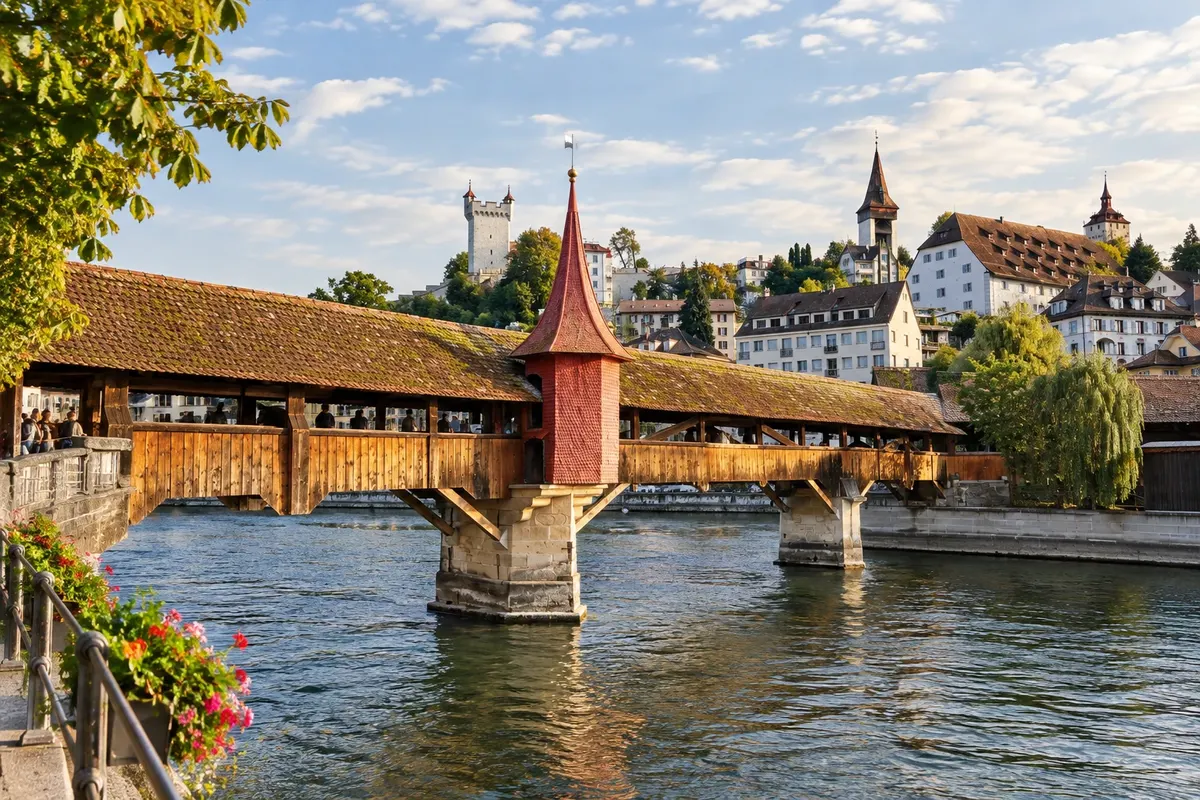
Historic monument · Lucerna, Lucerna
Spreuerbrücke
Lucerne’s second covered bridge, 81 m long, with the Totentanz (Dance of Death) painting series made in the 17th century by Kaspar Meglinger and a small chapel in the middle.
Illustrative images. The pictures in this guide are illustrations based on the real place, not photographs, and may differ from it.

Discover
About Spreuerbrücke
The Spreuerbrücke crosses the Reuss downstream from the Kapellbrücke, near the point where the Musegg wall drops to the water. There was already a crossing there in the 13th century; the link to the left bank was completed in 1408. A flood in 1566 took part of the bridge, which was rebuilt in the following decades.
The name comes from Spreu, straw: only from here was it permitted to throw straw and mill residues into the river. The bridge is 81 m long and is covered, like its neighbour.
Under the roof are the panels of the Totentanz, the Dance of Death, painted by Kaspar Meglinger and his workshop in the early 17th century. In each scene Death appears beside people of every class, from the pope to the peasant. Of the 67 original panels, 45 have been preserved. In the middle of the bridge there is a chapel dedicated to Mary.
Next to it is the Reusswehr, the timber needle weir that regulates the lake level and is still operated by hand.
Before you go
Practical information
Cidade Turismo reviews its information regularly, but something may have changed. Check with the place before planning your trip.
How much time to set aside
About 20 minutes.
Best time
At any time of day; it has far fewer visitors than the Kapellbrücke. Combine it with the Museggmauer, which starts just above, from April to October.
How to get there
It is about a 10-minute walk from the station, following the Reuss downstream, or 5 minutes from the Weinmarkt.
Tip
Read the panels in order: the theme repeats, but the costumes and scenes show how people lived in Lucerne in the 17th century.
Get your questions answered
Frequently asked questions about Spreuerbrücke
What is the Dance of Death on the Spreuerbrücke?
A series of 17th-century panels by Kaspar Meglinger, in which Death accompanies people of all professions and ages. 45 of the original 67 remain.
What is the difference between the Spreuerbrücke and the Kapellbrücke?
The Kapellbrücke is longer and displays the city's history; the Spreuerbrücke is smaller, calmer and contains the Dance of Death series.
Why is the bridge called Spreuerbrücke?
Spreu means chaff: this was the place from which chaff and mill leftovers could be thrown into the river.