

 Brazil
 Argentina
 Chile
Chile Colombia
 Peru
Peru Uruguay
 Germany
 Belgium
 Spain
Spain France
 Greece
 the Netherlands
 Ireland
 Portugal
 the United Kingdom
 Switzerland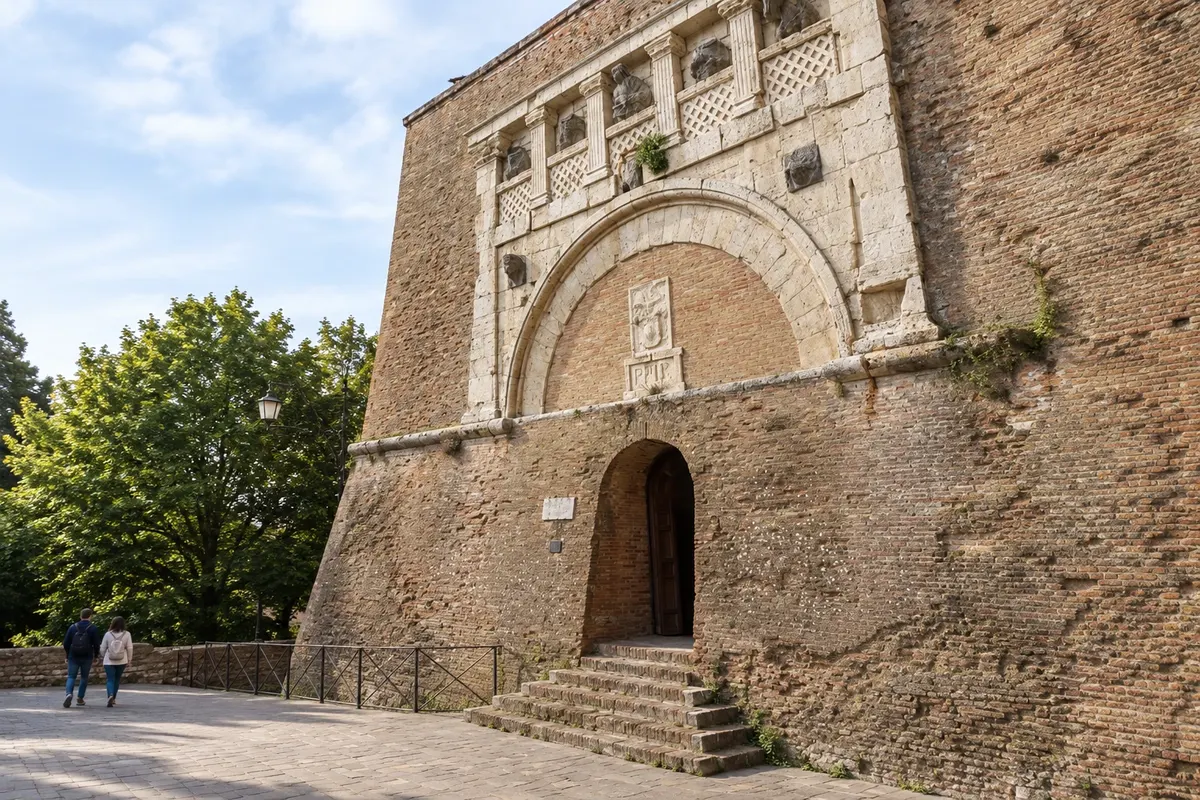
Historical site · Perúgia, Úmbria
Rocca Paolina
Remains of the 16th-century papal fortress that swallowed an entire medieval neighborhood. Escalators run through the covered old streets, linking the lower part to Piazza Italia.
Illustrative images. The pictures in this guide are illustrations based on the real place, not photographs, and may differ from it.

Discover
About Rocca Paolina
The Rocca Paolina was built between 1540 and 1543 by order of Pope Paul III, after Perúgia rebelled against the salt tax. The design was by Antonio da Sangallo the Younger. To build it, the pope ordered the houses, towers and streets of the Baglioni family and the Santa Giuliana neighborhood to be covered and buried.
For three centuries the fortress was the symbol of papal power over the city. After Perúgia's annexation to the Kingdom of Italy in 1860, the upper part was demolished, and Piazza Italia, the Giardini Carducci and 19th-century buildings were created in its place.
What remains is below. The Via Bagliona, a medieval street covered by the fortress's vaults, still has house facades, doors and wells. The escalators that rise from Piazza Partigiani cross these spaces, and many people pass through the Rocca without realizing they are inside a 15th-century neighborhood.
On the outside, on Via Marzia, is the Porta Marzia, an Etruscan gate from the 3rd century BC that Sangallo incorporated into the wall. Some rooms host exhibitions.
Before you go
Practical information
Cidade Turismo reviews its information regularly, but something may have changed. Check with the place before planning your trip.
How much time to set aside
About 30 minutes to walk the Via Bagliona and the passageways.
Best time
At any time the escalators are operating. In summer heat, the interior is cooler.
How to get there
By the escalators that start at Piazza Partigiani, where the bus terminal and a large parking lot are, up to Piazza Italia. From Piazza Italia, go down the escalators or enter via Via Marzia.
Tip
Passage via the escalators and Via Bagliona is free. Use this route to reach the center from the Piazza Partigiani car park without facing the uphill walk.
Get your questions answered
Frequently asked questions about Rocca Paolina
Why does the Rocca Paolina have streets inside?
To build the fortress, Pope Paul III ordered an entire medieval neighborhood to be covered over. The streets and houses ended up under the vaults and today form the Via Bagliona.
Do you have to pay to enter?
The passage via the escalators and the Via Bagliona is free. Exhibitions in the rooms may have an admission fee.
Do the escalators operate all day?
They operate for much of the day and night, but stop in the early hours. Check the schedule if you plan to use them late at night.