

 Brazil
 Argentina
 Chile
Chile Colombia
 Peru
Peru Uruguay
 Germany
 Belgium
 Spain
Spain France
 Greece
 the Netherlands
 Ireland
 Portugal
 the United Kingdom
 Switzerland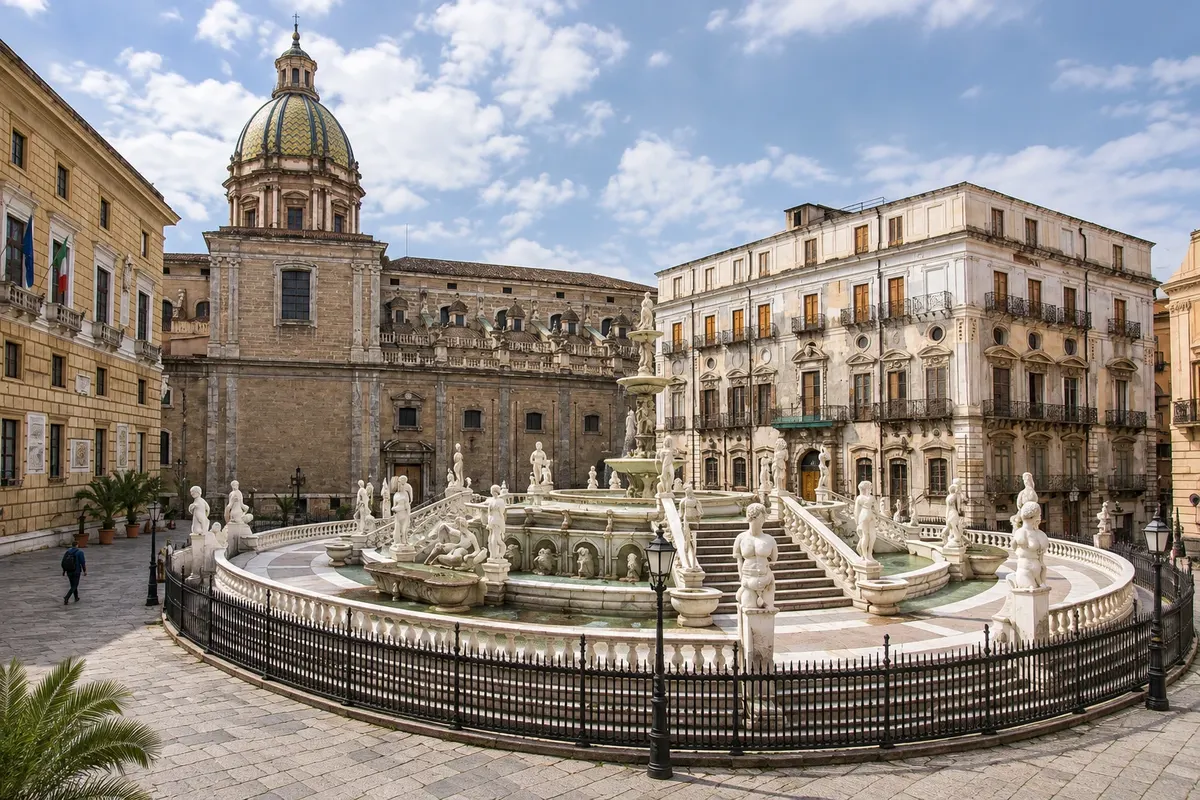
Square · Palermo, Sicília
Piazza Pretoria
Square next to the Quattro Canti featuring the Fontana Pretoria, a Renaissance marble fountain with dozens of statues, made in Florence in the 16th century and reassembled in Palermo.
Illustrative images. The pictures in this guide are illustrations based on the real place, not photographs, and may differ from it.

Discover
About Piazza Pretoria
Piazza Pretoria is a few steps from the Quattro Canti and is almost entirely occupied by the Fontana Pretoria. The fountain was carved in Florence by Francesco Camilliani in 1554 for the villa of a Tuscan noble. Sold to the Senate of Palermo, it was dismantled into hundreds of pieces and reassembled here from 1574.
There are four stairways, several levels of basins and dozens of statues of gods, nymphs, tritons and animal heads. The nude figures earned the square the popular nickname Piazza della Vergogna, square of shame, also connected to the political disputes of the time.
Around it stand the Palazzo delle Aquile, seat of the town hall, and the side of the church of Santa Caterina, whose Baroque interior is covered in colourful marbles, with a monastery and terrace open to visitors. The Martorana and San Cataldo are in the neighbouring Piazza Bellini.
Before you go
Practical information
Cidade Turismo reviews its information regularly, but something may have changed. Check with the place before planning your trip.
How much time to set aside
About 15–20 minutes for the square; another half hour for Santa Caterina.
Best time
Early in the morning to see the fountain with fewer people, or in the evening when it’s lit up.
How to get there
It's next to the Quattro Canti, down Via Maqueda heading toward the station.
Tip
The fountain is surrounded by a railing and access to the central basin is not always allowed. Combine the visit with the Martorana and San Cataldo, in Piazza Bellini right behind.
Get your questions answered
Frequently asked questions about Piazza Pretoria
Why is it called Piazza della Vergogna?
Because of the naked statues of the fountain, which shocked part of the population, and also as a political provocation against the city's senate.
Is the fountain original to Palermo?
No. It was made in Florence in 1554 and brought to Palermo in pieces starting in 1574.
What to see in the surroundings?
The Palazzo delle Aquile, the church of Santa Caterina and, in the adjacent square, the Martorana and San Cataldo.