

 Brazil
 Argentina
 Chile
Chile Colombia
 Peru
Peru Uruguay
 Germany
 Belgium
 Spain
Spain France
 Greece
 the Netherlands
 Ireland
 Portugal
 the United Kingdom
 Switzerland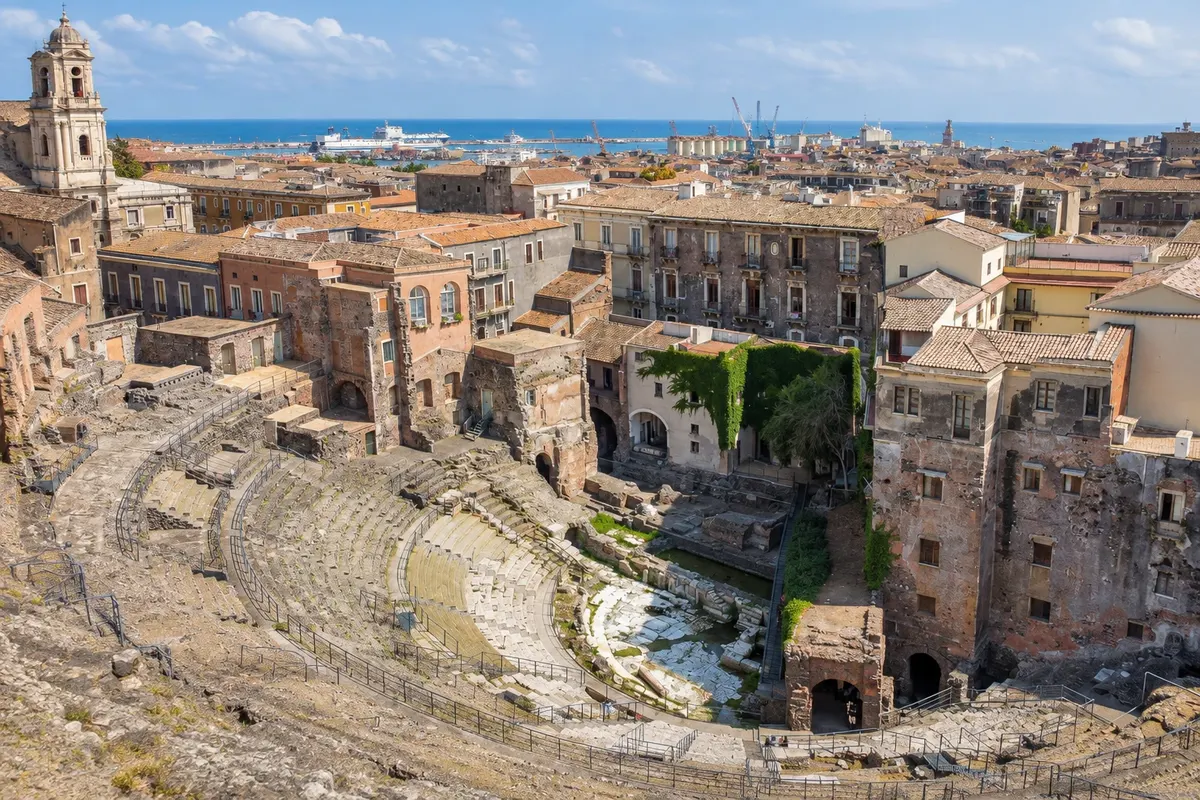
Archaeological site · Catânia, Sicília
Teatro romano di Catania
Greco-Roman theatre in the middle of the historic centre, with lava stone seating surrounded by houses, and the small Odeon next to it.
Illustrative images. The pictures in this guide are illustrations based on the real place, not photographs, and may differ from it.

Discover
About Teatro romano di Catania
The Roman theatre of Catania is on Via Vittorio Emanuele, hidden behind the façade of an ordinary building. It was built on top of an earlier Greek theatre and the current form dates to the Roman period, between the 1st and 2nd centuries AD. The auditorium held several thousand spectators.
The seating and passageways are made of lava stone, and what is most striking is how the theatre is fitted into the city: for centuries it was covered by houses, which still surround the cavea on all sides.
At the lower part, the water of the Amenano river, which runs beneath the centre, often floods the orchestra area. Beside it is the Odeon, a smaller semicircular theatre used for music and rehearsals.
The site also has a small exhibition area with pieces found on location. It is a short visit that shows the Roman city beneath Baroque Catania.
Before you go
Practical information
Cidade Turismo reviews its information regularly, but something may have changed. Check with the place before planning your trip.
How much time to set aside
Between 30 minutes and 1 hour.
Best time
In the morning, combined with the Monastero dei Benedettini, which is a few minutes' walk away. Check opening times before you go.
How to get there
On Via Vittorio Emanuele, about a 5-minute walk from the Piazza del Duomo, on the way to the Monastero dei Benedettini.
Tip
Notice the water of the Amenano at the lower part of the theatre. Combine the visit with the Benedictine monastery and Via dei Crociferi, all in the same stretch of the centre.
Get your questions answered
Frequently asked questions about Teatro romano di Catania
Is the theatre Greek or Roman?
Both: it was built over a Greek theater and the form visible today is Roman, from the 1st and 2nd centuries AD.
Why are there houses around the theatre?
For centuries the theatre was covered by houses. Some were removed in excavations, but many still surround the seating.
What is the Odeon?
A smaller theater next to the main one, used in Antiquity for music and rehearsals.