

 Brazil
 Argentina
 Chile
Chile Colombia
 Peru
Peru Uruguay
 Germany
 Belgium
 Spain
Spain France
 Greece
 the Netherlands
 Ireland
 Portugal
 the United Kingdom
 Switzerland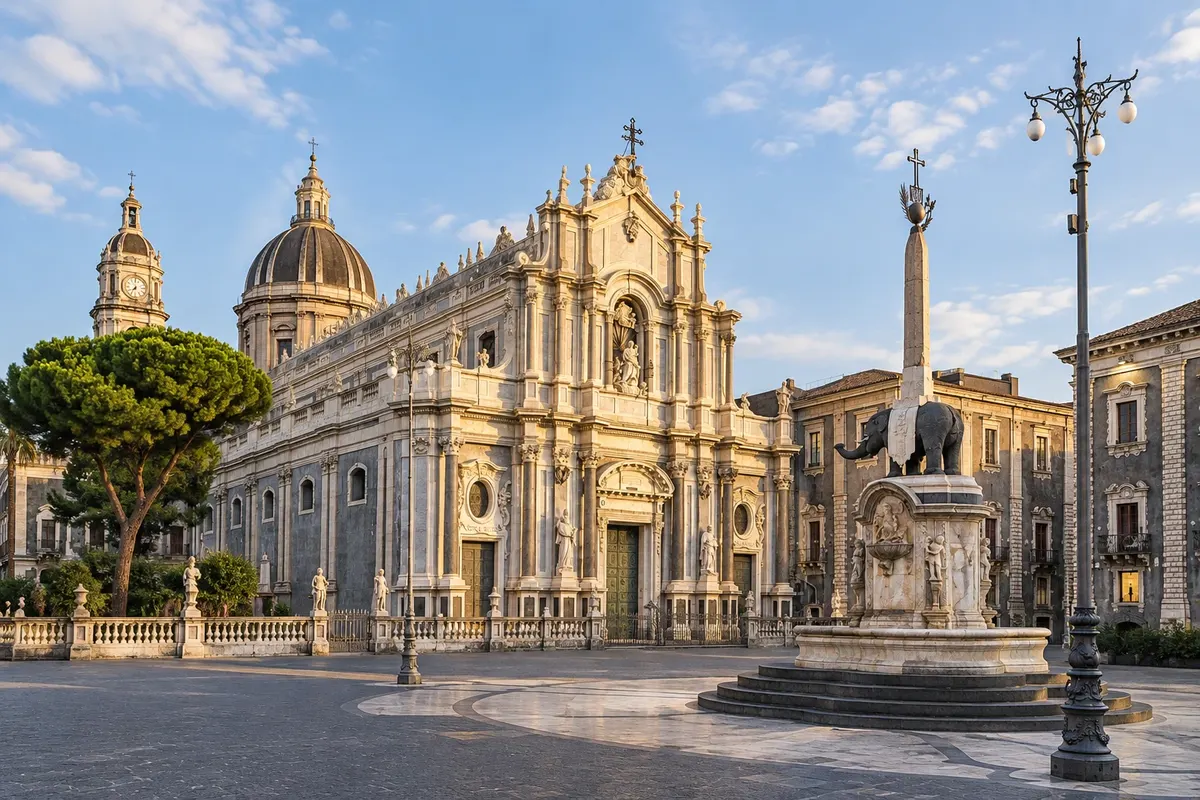
Square · Catânia, Sicília
Piazza del Duomo e Fontana dell'Elefante
The main square of Catânia, surrounded by Baroque buildings, with the Fontana dell'Elefante, the lava-stone elephant that is the symbol of the city.
Illustrative images. The pictures in this guide are illustrations based on the real place, not photographs, and may differ from it.

Discover
About Piazza del Duomo e Fontana dell'Elefante
The Piazza del Duomo is the heart of Catânia. It was redesigned after the 1693 earthquake, which destroyed the city, and acquired a Baroque ensemble in which dark lava stone and pale limestone are mixed. Around it are the Cattedrale di Sant'Agata, the Palazzo degli Elefanti, the city hall, and the Porta Uzeda, which leads to the port area.
In the centre is the Fontana dell'Elefante, erected between 1735 and 1737 by the architect Giovanni Battista Vaccarini. The elephant is an ancient basalt statue of uncertain date that the people of Catânia call u Liotru. On its back it carries a granite obelisk with figures in an Egyptian style, crowned by a globe and a cross.
Before you go
Practical information
Cidade Turismo reviews its information regularly, but something may have changed. Check with the place before planning your trip.
How much time to set aside
Half an hour for the square and the fountain; another half hour if you go into the cathedral.
Best time
In the early morning, before the bustle, or at the start of the evening, with the buildings lit. In February, during the Sant'Agata festival, the square gets crowded.
How to get there
On foot through the historic center. From Catania Centrale station it's about a 20-minute walk or a few minutes by bus. Via Etnea ends at the square.
Tip
Combine it with the Pescheria, which is just behind the Fontana dell'Amenano, and with the cathedral. In crowded places like this square, watch your belongings.
Get your questions answered
Frequently asked questions about Piazza del Duomo e Fontana dell'Elefante
Why is the elephant the symbol of Catânia?
The lava statue is ancient and has been connected to the city for centuries; the people call it u Liotru. Vaccarini placed it in the center of the square in the 18th century, and it became Catânia's emblem.
Who made the fountain?
The architect Giovanni Battista Vaccarini, between 1735 and 1737, during the reconstruction after the 1693 earthquake. He reused the ancient elephant statue and a granite obelisk.
Is there an entrance fee for the square?
No. It's a public space, open at all times.