

 Brazil
 Argentina
 Chile
Chile Colombia
 Peru
Peru Uruguay
 Germany
 Belgium
 Spain
Spain France
 Greece
 the Netherlands
 Ireland
 Portugal
 the United Kingdom
 Switzerland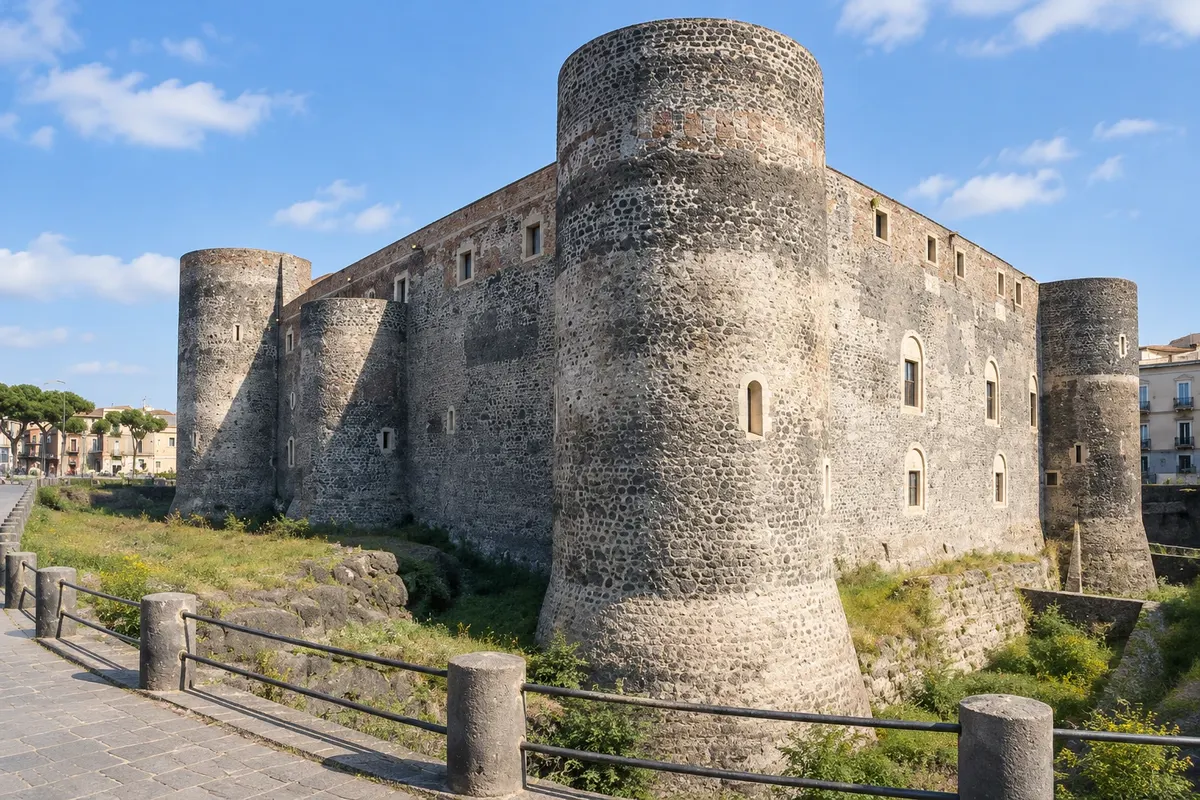
Castle · Catânia, Sicília
Castello Ursino
Castle built by Frederick II in the 13th century, surrounded by the lava of 1669. It houses the Museo Civico, with archaeology, sculptures and paintings.
Illustrative images. The pictures in this guide are illustrations based on the real place, not photographs, and may differ from it.

Discover
About Castello Ursino
The Castello Ursino was built between 1239 and 1250 at the command of Emperor Frederick II of Swabia, as part of the defence of Sicily's eastern coast. It has a square plan, four round towers at the corners and thick walls of lava stone.
When it was erected, the castle stood on a cliff by the sea. The 1669 eruption of Etna changed the landscape: lava surrounded the fortress and extended over the sea, and the castle was left far from the water, as it is today. Part of that lava can be seen around it.
The castle served as the royal residence of the Aragonese in the 14th century and later as a prison and barracks. Today it houses the Museo Civico, with Greek and Roman archaeological pieces, sculptures, weapons and paintings that largely came from the collections of the Monastero dei Benedettini and of noble families of the city.
The square in front, the Piazza Federico di Svevia, is in an old, popular neighbourhood of Catania, a few minutes from the Pescheria.
Before you go
Practical information
Cidade Turismo reviews its information regularly, but something may have changed. Check with the place before planning your trip.
How much time to set aside
Allow 1 to 1.5 hours for the castle and museum.
Best time
Late afternoon, after visiting the historic centre, or on a very hot day, since it is an indoor visit. Check opening times before you go.
How to get there
About a 10-minute walk from the Piazza del Duomo, heading south via Via Auteri or Via Transito.
Tip
Walk around the outside of the castle to see the 1669 lava next to the walls. Temporary exhibitions may change the museum route.
Get your questions answered
Frequently asked questions about Castello Ursino
Why is the castle no longer by the sea?
It used to be. The lava from the 1669 Etna eruption surrounded the castle and advanced over the sea, and the shoreline moved away.
What's inside the castle?
The Museo Civico de Catânia, with Greek and Roman archaeology, sculptures, arms and paintings.
Who built the castle?
Emperor Frederico II, between 1239 and 1250.
Is it far from the center?
No. It's about a 10-minute walk from the Piazza del Duomo.