

 Brazil
 Argentina
 Chile
Chile Colombia
 Peru
Peru Uruguay
 Germany
 Belgium
 Spain
Spain France
 Greece
 the Netherlands
 Ireland
 Portugal
 the United Kingdom
 Switzerland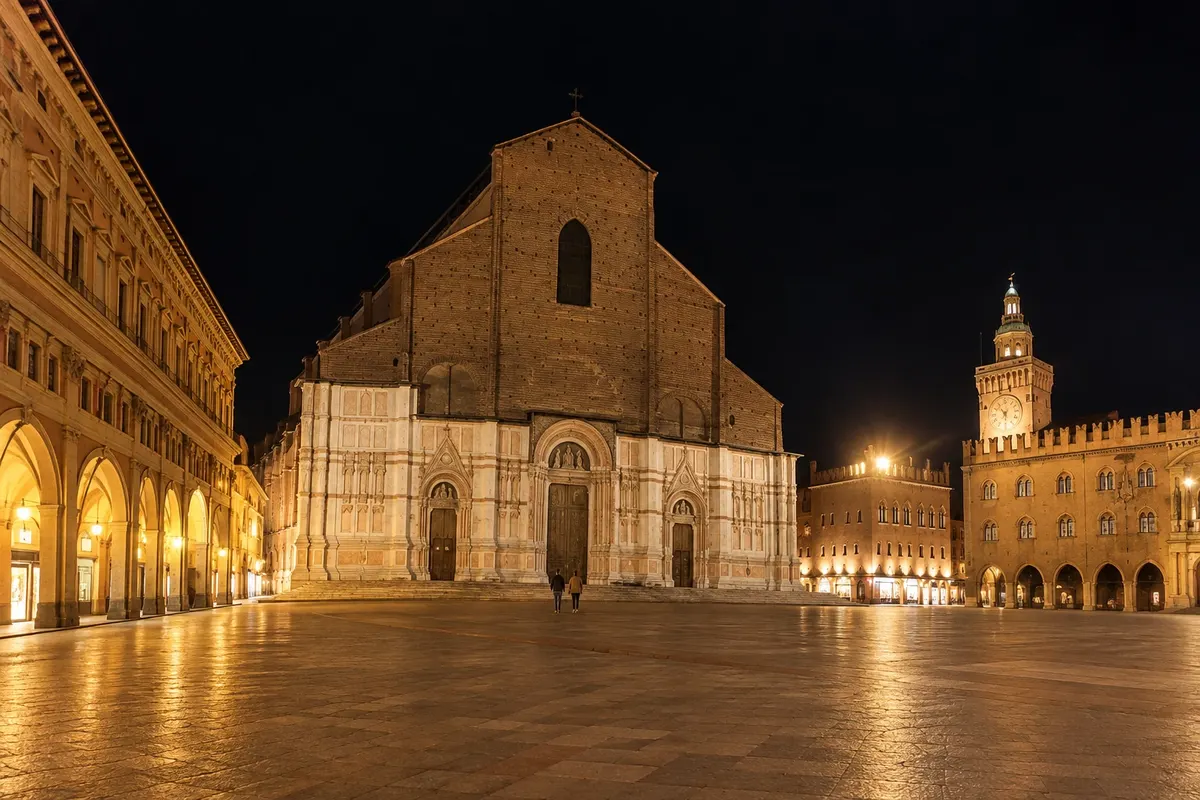
Square · Bolonha, Emília-Romanha
Piazza Maggiore
The main square of Bolonha, surrounded by the Basilica di San Petronio, the Palazzo d'Accursio and the Palazzo del Podestà. Beside it is the Fontana del Nettuno by Giambologna.
Illustrative images. The pictures in this guide are illustrations based on the real place, not photographs, and may differ from it.

Discover
About Piazza Maggiore
Piazza means plaza, and the Piazza Maggiore has been Bologna's meeting point since the Middle Ages. Around it are the buildings of civil and religious power: the Basilica di San Petronio to the south, the Palazzo d'Accursio, the town hall, to the west, and the Palazzo del Podestà to the north, with the portico of the Palazzo dei Banchi on the east side.
In the nearby Piazza del Nettuno is the Fontana del Nettuno, completed in 1566. The bronze sea god is the work of Giambologna, and the ensemble was designed with Tommaso Laureti at the request of the papacy, which then ruled the city. Bolognesi call the statue il Gigante. On the wall of the Palazzo d'Accursio opposite are photos of the partigiani, members of the resistance who died in the Second World War.
Under the Palazzo del Podestà, the Voltone forms a covered crossing with a curious effect: someone who speaks quietly facing one corner can be heard clearly at the opposite corner. Just behind the square begins the Quadrilatero, a network of medieval alleys where the craft guilds once operated and where today there are stalls selling cold cuts, cheeses, fresh pasta, fishmongers and small restaurants.
In summer, the square often hosts open-air film screenings, and on several weekends the surrounding streets are closed to cars. The Biblioteca Salaborsa, in the former courtyard of the Palazzo d'Accursio, has a glass floor over Roman ruins and an entrance from the Piazza del Nettuno.
Before you go
Practical information
Cidade Turismo reviews its information regularly, but something may have changed. Check with the place before planning your trip.
How much time to set aside
30 minutes to 1 hour for the square and the fountain. Add about 1 hour to walk through the Quadrilatero.
Best time
Early in the morning the square is quieter and good for photos. In the late afternoon and evening it fills with people sitting on the steps of San Petronio. The stalls in the Quadrilatero operate mainly in the morning and early afternoon; some close on Sundays.
How to get there
It is in the exact centre of the city, about a 20-minute walk from Bologna Centrale station via the Via dell'Indipendenza. Several city buses stop on the nearby streets. The area is pedestrianised.
Tip
Test the Voltone del Podestà effect with another person: each stand at a corner, speaking softly towards the wall. In the Quadrilatero, ask for mortadella sliced to order and a piece of parmigiano to taste. Keep an eye on your belongings in crowded places.
Get your questions answered
Frequently asked questions about Piazza Maggiore
What is the Quadrilatero?
It is the cluster of medieval lanes just east of Piazza Maggiore, between Via Rizzoli and Via Farini. There are food stalls, small grocers and family-run restaurants, and it's where you buy mortadella, cheeses and fresh pasta.
Who made the Fontana del Nettuno?
The bronze statue of Neptune is by Giambologna, a Flemish sculptor who worked in Italy. The fountain was completed in 1566, with a design made in collaboration with Tommaso Laureti.
Can you sit in the square?
Yes. The steps of the Basilica di San Petronio are commonly used as a meeting point, and there are cafés with tables under the surrounding porticoes. Bear in mind that sitting on the church steps during services is frowned upon.