

 Brazil
 Argentina
 Chile
Chile Colombia
 Peru
Peru Uruguay
 Germany
 Belgium
 Spain
Spain France
 Greece
 the Netherlands
 Ireland
 Luxembourg
 Portugal
 the United Kingdom
 Switzerland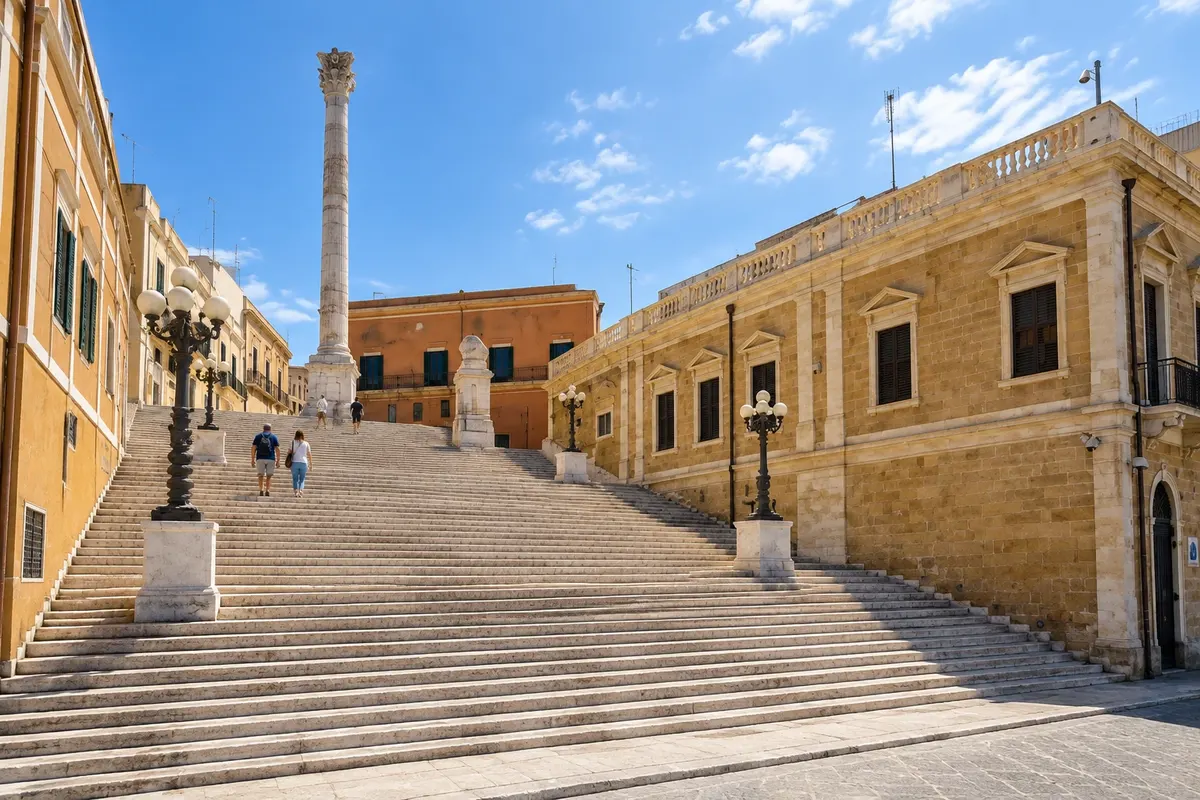
Historic monument · Brindisi, Apúlia
Colonne Romane e Scalinata Virgiliana
The Roman column at the top of the harbour stairway, which by tradition marks the end of the Via Ápia, the road that connected Rome to Brindisi.
Illustrative images. The pictures in this guide are illustrations based on the real place, not photographs, and may differ from it.

Discover
About Colonne Romane e Scalinata Virgiliana
The Via Ápia, the road the Romans opened from 312 BC, began in Rome and ended in Brindisi, the port from which ships sailed to Grécia and the East. At the top of the stairway down to the harbour there stood two marble columns, and tradition says they marked the road's end point.
One of the columns fell in 1528. In 1666 the pieces were donated to the city of Lecce, where the column was reassembled and still supports the statue of Santo Oronzo in the main square. The other remains in Brindisi. It was dismantled and restored at the end of the 20th century; the original capital, decorated with figures of gods and tritons, is now on display at the Palazzo Granafei-Nervegna in the centre, and a copy crowns the top of the column.
The stairway that climbs from the harbour up to the columns is the Scalinata Virgiliana. The name recalls the poet Virgílio, author of the Eneida, who died in Brindisi in 19 BC while returning from Grécia; tradition points to a house near the stairway as the place.
From the top of the stairway you can see the inner harbour, with the Monumento ao Marinheiro on the other side. From there, the Via Colonne rises to the cathedral square, a few minutes away.
Before you go
Practical information
Cidade Turismo reviews its information regularly, but something may have changed. Check with the place before planning your trip.
How much time to set aside
15 to 30 minutes; an extra 20 minutes to see the original capital in the Palazzo Granafei-Nervegna.
Best time
In the late afternoon, when the light hits the stairway and the waterfront fills with people. Early in the morning the place is quieter.
How to get there
It is on the waterfront, about a 15-minute walk from the train station, down Corso Umberto and Corso Garibaldi to the harbour. The cathedral square is about a 3-minute walk away along the Via Colonne.
Tip
To see the original capital of the column, with figures of Jupiter, Neptune and tritons, enter the Palazzo Granafei-Nervegna on Corso Garibaldi. The missing column is in Lecce, 40 km away: it's worth looking for when you go there.
Get your questions answered
Frequently asked questions about Colonne Romane e Scalinata Virgiliana
Is the column of Brindisi original?
The column shaft is Roman. The original capital was removed during restoration and is on display at the Palazzo Granafei-Nervegna; there is a copy at the top of the column.
Where is the second Roman column of Brindisi?
In Lecce. It fell in 1528 and in 1666 was donated to that city, where it supports the statue of Santo Oronzo in the main square.
Why is the stairway called Virgiliana?
Because of the poet Virgil, who died in Brindisi in 19 BC. Tradition points to a house near the stairway as the place.