

 Brazil
 Argentina
 Chile
Chile Colombia
 Peru
Peru Uruguay
 Germany
 Belgium
 Spain
Spain France
 the Netherlands
 Ireland
 Italy
Italy Luxembourg
 Portugal
 the United Kingdom
 Switzerland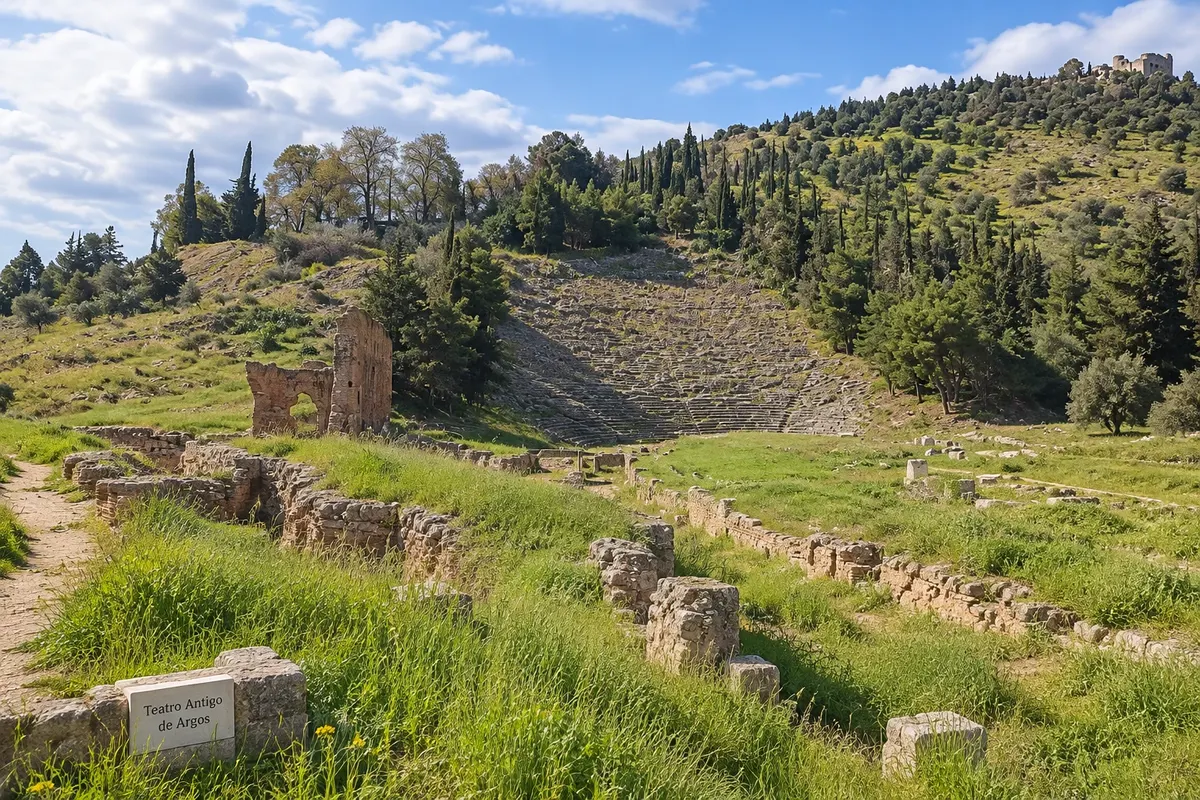
Theatre · Náuplia, Peloponeso
Teatro Antigo de Argos
3rd-century BC theatre excavated into the slope of the Larissa hill in Argos, seating 20,000, next to the ancient agora and Roman baths, in a city inhabited for seven thousand years.
Illustrative images. The pictures in this guide are illustrations based on the real place, not photographs, and may differ from it.

Discover
About Teatro Antigo de Argos
Argos is one of the longest continuously inhabited cities in Europe, with a Neolithic settlement of about 7,000 years at the foot of the Aspida hill. In Antiquity it rivalled Sparta and Corinto, and Homer calls the Greeks argives. Today it is a market town on the plain, 12 km from Náuplia, where ruins appear among the houses.
The ancient theatre was cut directly into the rock of Larissa hill in the 3rd century BC, replacing an older one beside it. With 81 tiers and capacity for around 20,000 spectators, it was larger than Epidauro's, though less well preserved. In 1829 Ioannis Kapodistrias convened the Fourth National Assembly of newly independent Greece there. In summer the theatre again hosts performances.
Beside it are the Roman baths, with brick walls still standing high, an odeon and, across the street, the ancient agora, with the bouleuterion and the sanctuary of Apolo Lício. At the top of Larissa hill, at 289 metres, the medieval castle—built over ancient ramparts and reinforced by Byzantines, Franks and Venetians—overlooks the plain and can be reached by car. On Wednesdays and Saturdays the town’s street market fills the streets around the central square.
Before you go
Practical information
Cidade Turismo reviews its information regularly, but something may have changed. Check with the place before planning your trip.
How much time to set aside
45 minutes to 1 hour for the theatre and the agora; another hour to climb to Larissa castle.
Best time
In the morning, on Wednesdays or Saturdays, to combine the street market with the theatre. The theatre is in the sun; in summer avoid midday. The castle is windy and lacks shade.
How to get there
Argos is 12 km from Náuplia, a 15-minute drive or served by frequent KTEL buses. The theatre is on the town’s exit toward Trípoli, a 10-minute walk from the central square. There is a road up to Larissa castle.
Tip
Argos is not as pretty as Náuplia, but it is the true town of the plain. Stop for the theatre and the market, climb the castle for the views and then head to Micenas, 11 km to the north. The Archaeological Museum of Argos, in Saint Peter's square, may be under renovation; check before you go.
Get your questions answered
Frequently asked questions about Teatro Antigo de Argos
Is the theatre of Argos larger than that of Epidauro?
In terms of capacity, yes: about 20,000 seats versus 13,000. But Epidauro's is much better preserved; in Argos, much of the seating was cut into the rock and has worn away.
Is it worth going up to the castle of Larissa?
It's worth it for the view over the Argos plain, the gulf and Náuplia in the distance. There's a road up to the top. The walls combine ancient blocks with Byzantine, Frankish and Venetian towers.
Is Argos far from Náuplia?
No. It's 12 km and about a 15-minute drive, with frequent KTEL buses between the two towns. Micenas is 11 km further to the north.