

 Brazil
 Argentina
 Chile
Chile Colombia
 Peru
Peru Uruguay
 Germany
 Belgium
 Spain
Spain France
 the Netherlands
 Ireland
 Italy
Italy Luxembourg
 Portugal
 the United Kingdom
 Switzerland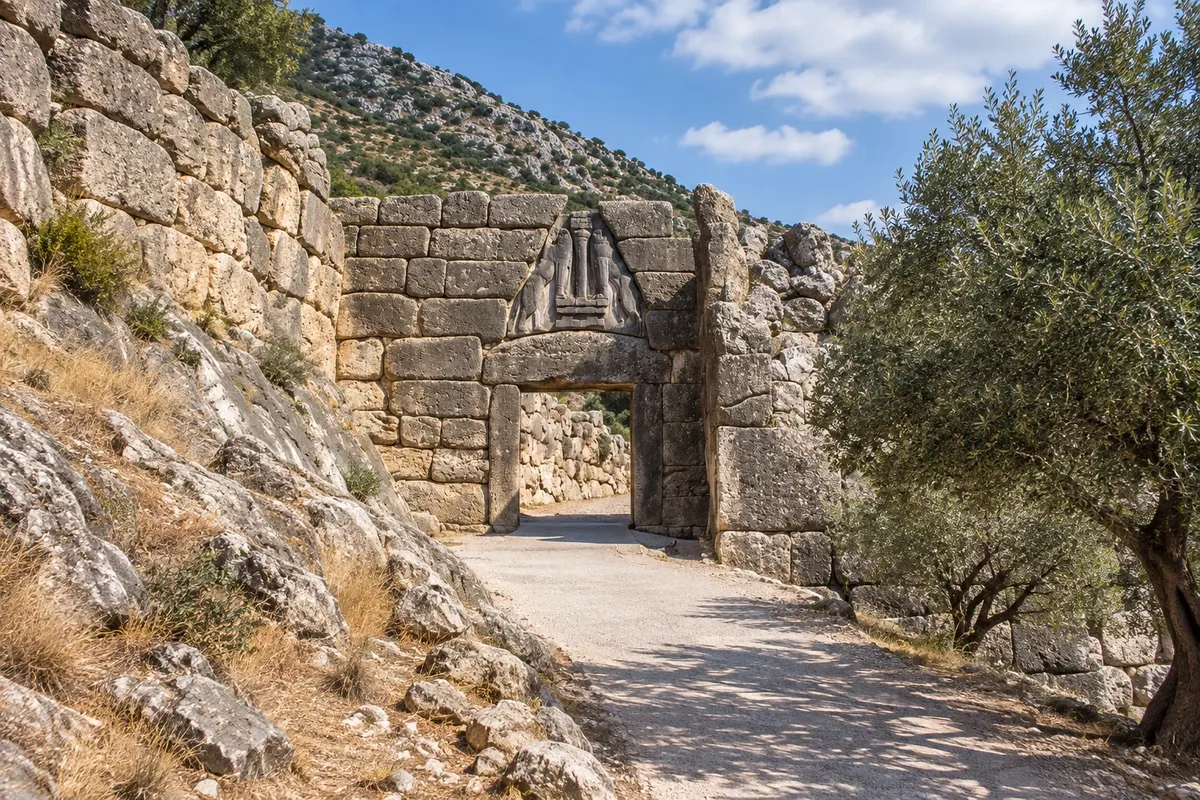
Archaeological site · Náuplia, Peloponeso
Micenas (Mykines)
The citadel of King Agamemnon of the Iliad: cyclopean walls, the Lion Gate from 1250 BC, the royal tombs where Schliemann found the gold mask and the Treasury of Atreus, with a museum on site.
Illustrative images. The pictures in this guide are illustrations based on the real place, not photographs, and may differ from it.

Discover
About Micenas (Mykines)
Micenas gave its name to an entire civilization. Between 1600 and 1100 BCE, the citadel on a hilltop between two mounds controlled the plain of the Argólida, and from there, according to Homer, Agamemnon's ships set out for Troy. Heinrich Schliemann excavated here in 1876 looking for the king's tomb and found, in the Circle of Tombs A, the gold masks that are now in the Museu Arqueológico Nacional de Atenas, including the one he called the Mask of Agamemnon, three centuries older than the Trojan War. The site has been a World Heritage Site since 1999, together with Tirinto.
The visit begins at the Porta dos Leões, from about 1250 BCE, with two lionesses carved into a triangular stone above the lintel — the oldest monumental sculpture in Europe. Around it are the cyclopean walls, built of blocks so large that later Greeks thought only the Cyclopes could have raised them. Inside, the path climbs past the Circle of Tombs A up to the palace at the top, and descends to the underground cistern, a dark stairway that drops 18 meters into the rock.
Outside the walls, 500 meters away, is the Tesouro de Atreu, a beehive-shaped tomb 13 meters high, with an entrance passage and a lintel of 120 tons; the name is old and mistaken, because it was never a treasury but a royal tomb from the 13th century BCE. The site's museum, modern and small, displays pottery, figurines, jewelry and a replica of the gold mask, and helps make sense of what you see up on the hill.
Before you go
Practical information
Cidade Turismo reviews its information regularly, but something may have changed. Check with the place before planning your trip.
How much time to set aside
2 to 3 hours for the citadel, the Tesouro de Atreu and the museum.
Best time
At opening, early in the morning: the hill has no shade and the midday heat is strong from June to September. In the late afternoon the light comes through the Porta dos Leões. Spring, with fields of poppies, is the nicest season.
How to get there
It's about 25 km north of Náuplia, via the road through Argos and Fichti: roughly a 30-minute drive. KTEL buses from Náuplia and Argos reach the village of Mykines, 2 km from the entrance, with only a few departures per day. Tours from Athens often combine Micenas with Epidauro and Náuplia.
Tip
Bring a flashlight or use your phone's light to go down to the cistern, and wear sturdy shoes: the path stones are smooth. Visit the Tesouro de Atreu on the way out with the same ticket, as it's on the return road. Be sure to go into the museum: it shows where each object was found.
Get your questions answered
Frequently asked questions about Micenas (Mykines)
Is the Mask of Agamemnon in Micenas?
No. The gold mask discovered by Schliemann in 1876 is in the Museu Arqueológico Nacional in Atenas. The museum of Micenas displays a replica and other finds from the site.
What is the Tesouro de Atreu?
A royal beehive-shaped tomb from the 13th century BC, 13 metres high and with a side chamber. The name comes from ancient tradition, but it was never a treasure. It lies 500 metres from the citadel, on the access road, and is included on the same ticket.
How long does it take from Náuplia to Micenas?
About 30 minutes by car, 25 km via the Argos road. By bus, there are KTEL lines to the village of Mykines, 2 km from the site, with few departures per day.
Why are the walls called cyclopean?
Because later Greeks could not believe that men could have moved such large blocks and attributed the work to the Cyclopes, one‑eyed giants. The blocks are several metres in size and the walls reach 8 metres in thickness.