

 Brazil
 Argentina
 Chile
Chile Colombia
 Peru
Peru Uruguay
 Germany
 Belgium
 Spain
Spain France
 the Netherlands
 Ireland
 Italy
Italy Luxembourg
 Portugal
 the United Kingdom
 Switzerland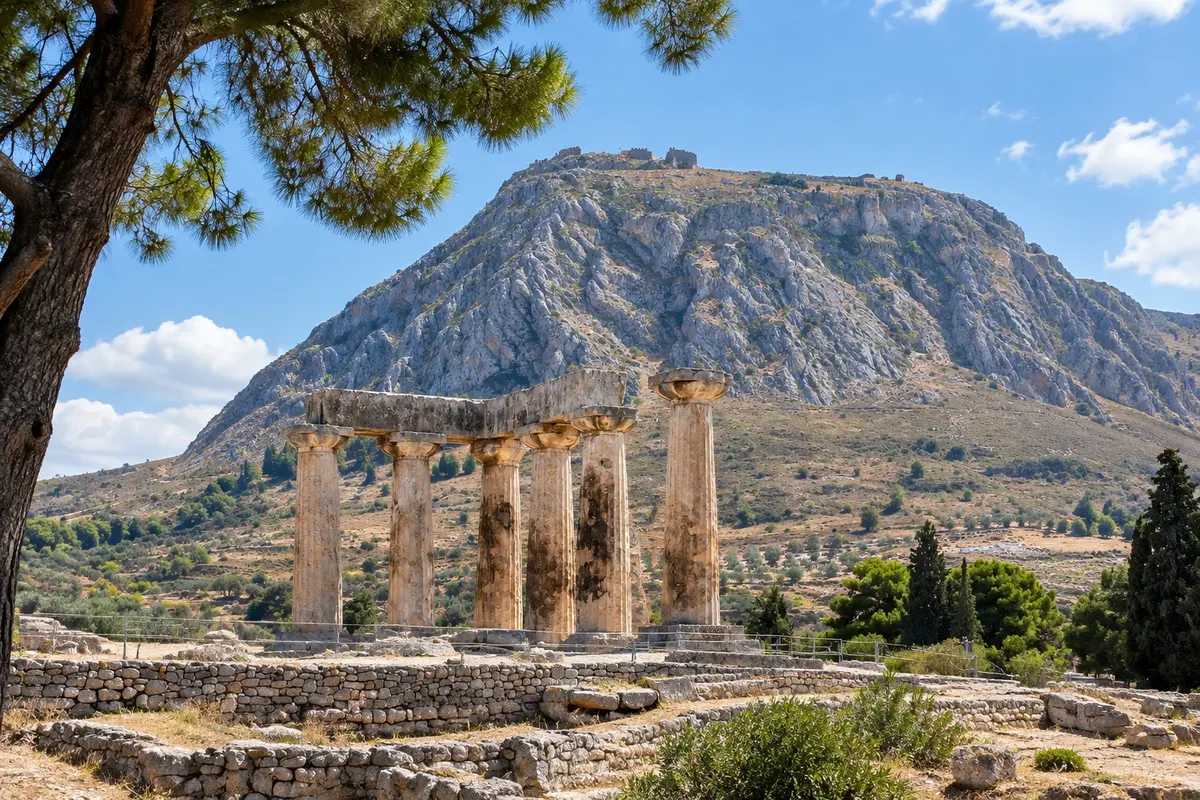
Archaeological site · Náuplia, Peloponeso
Corinto Antiga (Archaia Korinthos)
The commercial city of Antiquity that received the apostle Paul, with the seven columns of the Templo de Apolo from the 6th century BCE, the Roman forum, the Pirene fountain and a museum with mosaics and sculptures.
Illustrative images. The pictures in this guide are illustrations based on the real place, not photographs, and may differ from it.

Discover
About Corinto Antiga (Archaia Korinthos)
Corinto Antiga lies 7 km from modern Corinto, at the foot of the Acrocorinto rock. Controlling the isthmus between two seas, the city grew wealthy through trade and, in the 7th century BCE, built the Diolkos, a stone trackway to drag ships from one gulf to the other. In 146 BCE the Romans destroyed it; Julius Caesar refounded it in 44 BCE, and it became the capital of the province of Achaia. It was in that Roman Corinto that the apostle Paul lived for about a year and a half and founded the community to which he wrote two New Testament letters.
The site is dominated by the seven monolithic columns of the Templo de Apolo, from around 550 BCE, each carved from a single stone, among the oldest standing Doric columns in Greece. Below them spreads the Roman forum, with shops, the basilica, the Bema, the speaker's platform where, by tradition, Paul was brought before the proconsul Gallio, and the Pirene fountain, where mythology says Pegasus drank. The paved Lequeu street led down to the harbor on the Gulf of Corinto.
The museum inside the site houses Roman mosaics, sculptures, Corinthian pottery with animal figures and a room of terracotta ex-votos from the sanctuary of Asclépio, with arms, legs and organs offered by healed patients. The excavation has been conducted by the American School of Classical Studies at Athens since 1896 and continues.
Before you go
Practical information
Cidade Turismo reviews its information regularly, but something may have changed. Check with the place before planning your trip.
How much time to set aside
1½ to 2½ hours, including the museum.
Best time
At opening, before the groups that come from Atenas, or in the late afternoon. Combine with Acrocorinto on the same day; preferably Acrocorinto first, in the morning, when it's cooler for the climb.
How to get there
From Náuplia it's about 65 km via the A7, 1 hour by car. From Atenas, 85 km via the A8, about 1 hour 15 minutes, or suburban train to Corinto and taxi to the village of Archaia Korinthos, 7 km away. The entrance and parking are in the village.
Tip
The site ticket includes the museum; Acrocorinto is separate. In the village there are tavernas for lunch with views of the columns. Those traveling for religious reasons usually also stop at Lequeu (Lechaio), the old port, and in modern Corinto, at the church of São Paulo.
Get your questions answered
Frequently asked questions about Corinto Antiga (Archaia Korinthos)
Is Corinto Antiga the same city as Corinto?
No. Modern Corinto, beside the canal, was founded in 1858 after an earthquake. The archaeological site is 7 km away, in the village of Archaia Korinthos, at the foot of Acrocorinto.
What does Saint Paul have to do with Corinto?
Paul lived in Corinto for about a year and a half, around 50–52 AD, working and preaching, and later wrote two letters to the Corinthians. In the forum is the Bema, the platform where, by tradition, he was brought before the proconsul Gálio.
Can Corinto be visited as a day trip from Atenas?
Yes. It's about 85 km by motorway, a little over an hour, and day tours usually combine the Canal de Corinto, the site and Acrocorinto. The suburban train reaches modern Corinto; from there a taxi is needed.
What is the Pirene spring?
A monumental fountain in the forum, fed by a natural spring, with six chambers and a Roman façade. According to mythology, it was there that Pegasus, the winged horse, drank.