

 Brazil
 Argentina
 Chile
Chile Colombia
 Peru
Peru Uruguay
 Germany
 Belgium
 Spain
Spain France
 the Netherlands
 Ireland
 Italy
Italy Luxembourg
 Portugal
 the United Kingdom
 Switzerland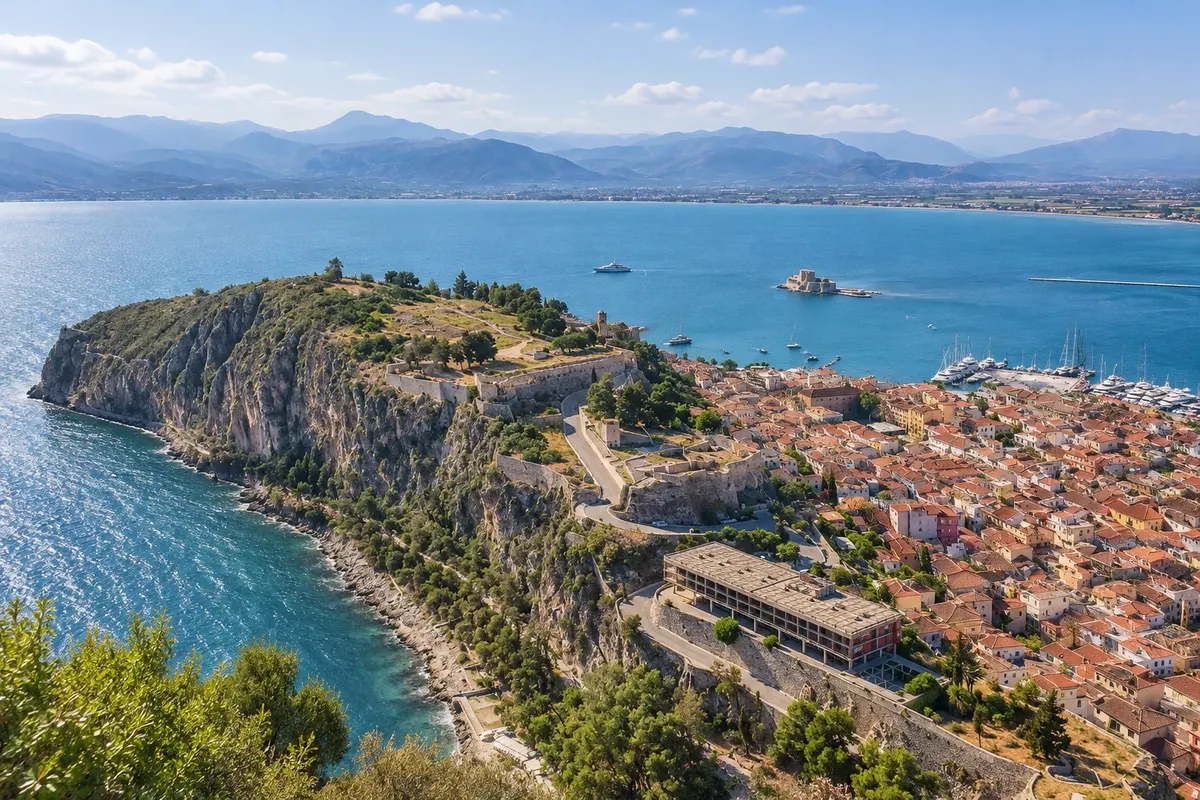
Fortress · Náuplia, Peloponeso
Acronáuplia (Akronafplia)
Náuplia's oldest rocky promontory, with walls dating from Antiquity through the Venetians, three linked castles, the Porta de Terra and views over the old town and the praia de Arvanitia.
Illustrative images. The pictures in this guide are illustrations based on the real place, not photographs, and may differ from it.

Discover
About Acronáuplia (Akronafplia)
Akronafplia (Acronáuplia) is the oldest part of the town: a promontory about 80 metres high that juts out into the sea, south of the old town. Until the 13th century it was a walled town in its own right, and the polygonal blocks from the 4th century BC still appear on the west face. Franks, Venetians and Ottomans added walls, gates and bastions, and the Turks called it Iç Kale, the inner castle.
The promontory is divided into three castles. The Castelo dos Gregos, to the west, was reserved for Greek inhabitants and houses the small church of Agioi Theodoroi, from the 11th century, at the highest point. The Castelo dos Francos, in the middle, was the administrative centre of the medieval town. The Castelo de Toro, to the southeast, has a large circular bastion and the gate with the Leão de São Marcos. In the late Venetian period, the Grimani bastion reinforced the east side, and the Porta de Terra (Pyli tis Xiras), dated 1708, became the only land entrance to the town.
In the 20th century the area became a prison and later hosted hotels; one of them still operates at the top. Access is free, via an asphalt road or the staircase beside the Catholic church, and it's worth it for the walk: from above you can see the roofs of the old town, the Bourtzi and the Palamidi. On the south side, a coastal promenade skirts the promontory down to the praia de Arvanitia, the town's small pebble beach.
Before you go
Practical information
Cidade Turismo reviews its information regularly, but something may have changed. Check with the place before planning your trip.
How much time to set aside
From 45 minutes to 1½ hours, plus the time for the coastal walk to Arvanitia.
Best time
Early in the morning or late in the afternoon, when the light is softer and the heat is lower. The coastal promenade to Arvanitia is pleasant at sunset, which usually falls behind the mountains of Arcádia.
How to get there
From Syntagma Square, head south to the Porta de Terra, near the car park, and go up by the road or by the steps beside the Catholic church. You can also reach it by the hotel's elevator when it is operating, or by the trail that starts at Arvanitia.
Tip
Combine with Arvanitia: walk down the coastal promenade, take a dip at the pebble beach and return via the Palamidi stairway, which starts nearby. Bring water; there are no shops at the top.
Get your questions answered
Frequently asked questions about Acronáuplia (Akronafplia)
Do you have to pay to go up Akronafplia?
There is no entrance fee. The promontory is open, accessible by road or via the staircase beside the Catholic church in the old town.
What is the Porta de Terra?
The Pyli tis Xiras, built by the Venetians in 1708, was the town’s only entrance from the mainland. It stands between the old town and the car park, at the foot of Akronafplia.
Can you swim near the old town?
Yes, at Arvanitia beach, a rocky cove on the south side of Akronafplia, with sunbeds and a café in summer. A coastal promenade links the beach to the harbour.