

 Brazil
 Argentina
 Chile
Chile Colombia
 Peru
Peru Uruguay
 Germany
 Belgium
 Spain
Spain France
 the Netherlands
 Ireland
 Italy
Italy Luxembourg
 Portugal
 the United Kingdom
 Switzerland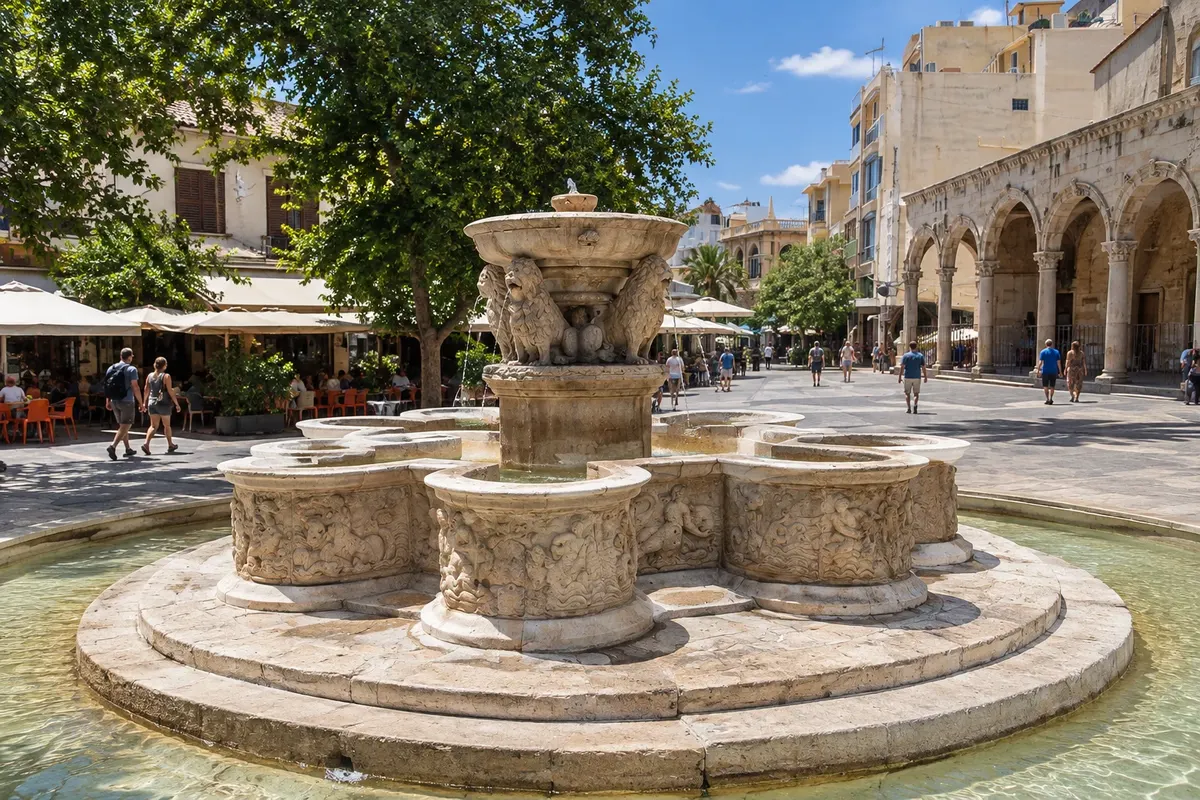
Square · Heraclião, Creta
Praça dos Leões e Fonte Morosini (Plateia Liontarion)
The centre of Heraclião: the praça da fonte veneziana dos quatro leões, from 1628, with the Loggia beside it and rua 1866, the market street, which descends to praça Kornarou.
Illustrative images. The pictures in this guide are illustrations based on the real place, not photographs, and may differ from it.

Discover
About Praça dos Leões e Fonte Morosini (Plateia Liontarion)
The praça Eleftheriou Venizelou is known to everyone as the praça dos Leões (Plateia Liontarion), because of the Morosini fountain, built in 1628 by the Venetian governor Francesco Morosini. Four lions support the main basin, and the water came by a 15 km aqueduct from monte Giouchtas. It was the first work to bring running water to the city, and to this day it is Heraclião's meeting point, surrounded by cafés with outdoor tables.
A few steps away is the Loggia, the two-storey Renaissance-style building where the Venetian nobles met, built between 1626 and 1628 and now housing the city hall. Directly below is the basilica of São Marcos, from the 13th century, used as an exhibition gallery.
From the square departs rua 1866, the market street, named for the year of the great Cretan revolt. It is narrow and full of stalls selling fruit, herbs, cheeses, honey, olive oil and raki, as well as leather shops and souvenirs. It ends at praça Kornarou, where the Venetian Bembo fountain and an Ottoman kiosk turned café are located. It’s the stroll to see the city’s everyday life.
Before you go
Practical information
Cidade Turismo reviews its information regularly, but something may have changed. Check with the place before planning your trip.
How much time to set aside
Half an hour for the praça; one hour including rua 1866 and praça Kornarou.
Best time
In the morning, when the market on rua 1866 is busiest, or in the late afternoon, when the cafés' tables fill up. At night the square is lit and lively.
How to get there
It is in the heart of the centre, at the junction of the streets 25 de Agosto, Dikaiosinis and 1866. From the porto antigo it's about a 10-minute walk up rua 25 de Agosto; from the Museu Arqueológico, 5 minutes.
Tip
Try the bougatsa, a pastry filled with cheese or custard, at the cafés in the square—a Heraclião morning tradition. On rua 1866, compare prices before buying olive oil and herbs: the shops at the end of the street are usually cheaper.
Get your questions answered
Frequently asked questions about Praça dos Leões e Fonte Morosini (Plateia Liontarion)
Why is the square called Praça dos Leões?
Because of the Morosini fountain, from 1628, whose four lions support the water basin. The official name is Praça Eleftheriou Venizelou, but almost nobody uses it.
What is Rua 1866?
Heraclião's market street, which runs from Praça dos Leões down to Praça Kornarou, with stalls selling food, herbs, olive oil and souvenirs. The name recalls the year of the great Cretan revolt against the Ottomans.
What is the Loggia of Heraclião?
A Venetian building from 1626–1628, in Renaissance style, where the nobility gathered. Today it's the town hall and stands beside Praça dos Leões.