

 Brazil
 Argentina
 Chile
Chile Colombia
 Peru
Peru Uruguay
 Germany
 Belgium
 Spain
Spain Greece
 the Netherlands
 Ireland
 Italy
Italy Luxembourg
 Portugal
 the United Kingdom
 Switzerland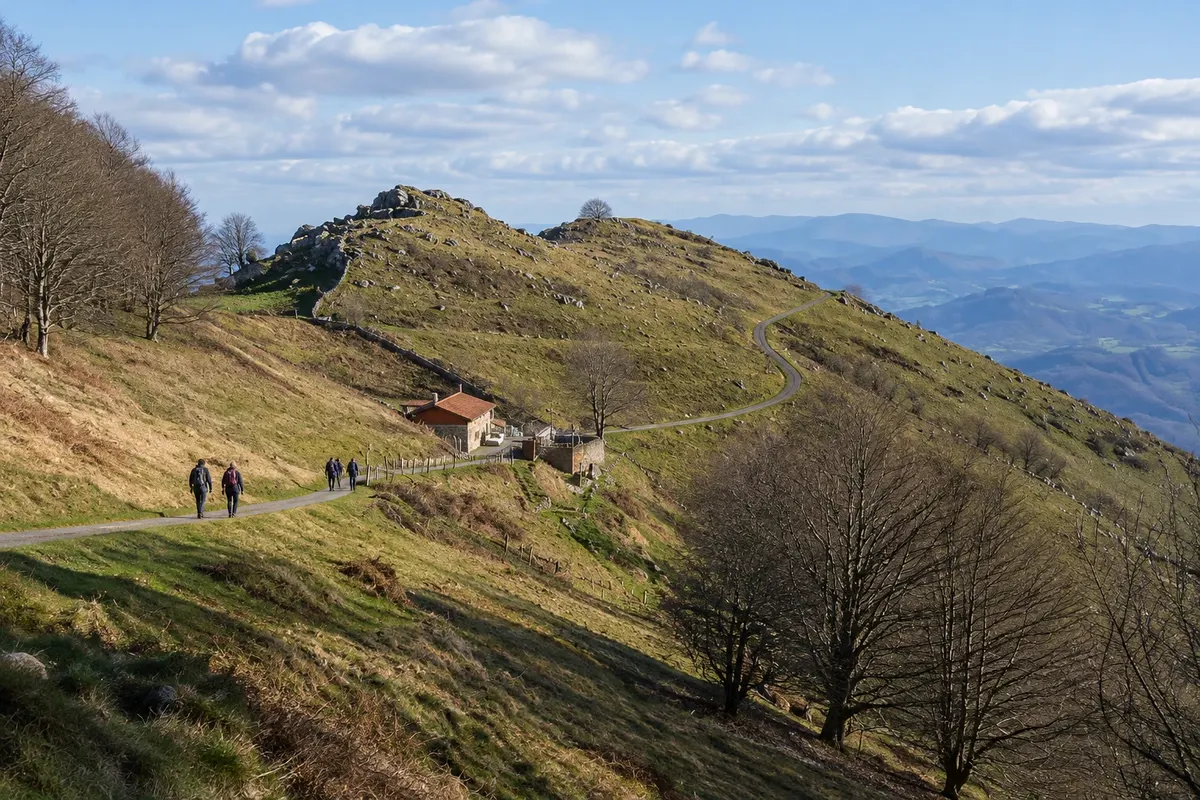
Trail · Saint-Jean-Pied-de-Port, Nova Aquitânia
Route Napoléon et Vierge d'Orisson
The first stage of the Camino Francés, via the high road of the Pyrenees to Roncesvalles, with the image of the Virgin of Orisson marking the ascent.
Illustrative images. The pictures in this guide are illustrations based on the real place, not photographs, and may differ from it.

Discover
About Route Napoléon et Vierge d'Orisson
The first stage of the Camino Francés to Santiago leaves Saint-Jean-Pied-de-Port and crosses the Pyrenees to Roncesvalles in Spain over about 25 km. The high route, called Route Napoléon, climbs along narrow roads and mountain trails up to around 1,400 metres, passing the Col de Lepoeder before descending to Roncesvalles. The name recalls Napoleon's troops, who used the pass in the early 19th century.
The climb is long and steady from the town's exit. After the Orisson hostel, about 8 km in, the route reaches a point marked by an image of the Virgin on a rock, the Vierge d'Orisson, or Virgin of Biakorri, from where you can see the valley, the pastures with sheep and free-roaming horses and the Basque mountains. For many who will not do the entire Camino, the walk to the Virgin and back is a day trip.
The ascent runs through open pastures, with vultures soaring over the valleys. There is little shade for most of the route and the weather changes quickly in the mountains, with fog, wind and rain.
The high route is closed to pilgrims in winter, generally from November to March, for safety; in that period the Camino follows the lower valley road of Valcarlos.
Before you go
Practical information
Cidade Turismo reviews its information regularly, but something may have changed. Check with the place before planning your trip.
How much time to set aside
About 5 to 7 hours round trip from the village to the Vierge d'Orisson; about 7 to 9 hours for the entire stage to Roncesvalles.
Best time
From April to October, starting early. Before leaving, check the weather forecast and the pass conditions at the pilgrims' welcome office. In winter the high route is closed.
How to get there
The walk starts at the Porte d'Espagne, after the old bridge over the Nive, and follows the Caminho markings. In season there are taxi services that take you to Orisson or Roncesvalles and backpack transport; ask at the pilgrims' office.
Tip
Carry water, food, warm clothing and a raincoat, even in summer: there are few support points up high and the weather changes quickly. Respect the route closure in winter.
Get your questions answered
Frequently asked questions about Route Napoléon et Vierge d'Orisson
What is the distance from Saint-Jean-Pied-de-Port to Roncesvalles?
About 25 km via the Route Napoléon, the high route of the Pyrenees, with an ascent up to around 1,400 meters.
Can you do just a section of the Route Napoléon?
Yes. Many people go up to the Vierge d'Orisson and return to the village in a 5 to 7 hour outing.
Does the Route Napoléon close in winter?
Yes. Generally from November to March the high route is closed to pilgrims for safety, and the route follows the road through Valcarlos.
What to bring on the first stage of the Caminho?
Water, food, warm clothing and a raincoat. There are few support points up high and the weather changes quickly in the mountain.