

 Brazil
 Argentina
 Chile
Chile Colombia
 Peru
Peru Uruguay
 Germany
 Belgium
 France
 Greece
 the Netherlands
 Ireland
 Italy
Italy Portugal
 the United Kingdom
 Switzerland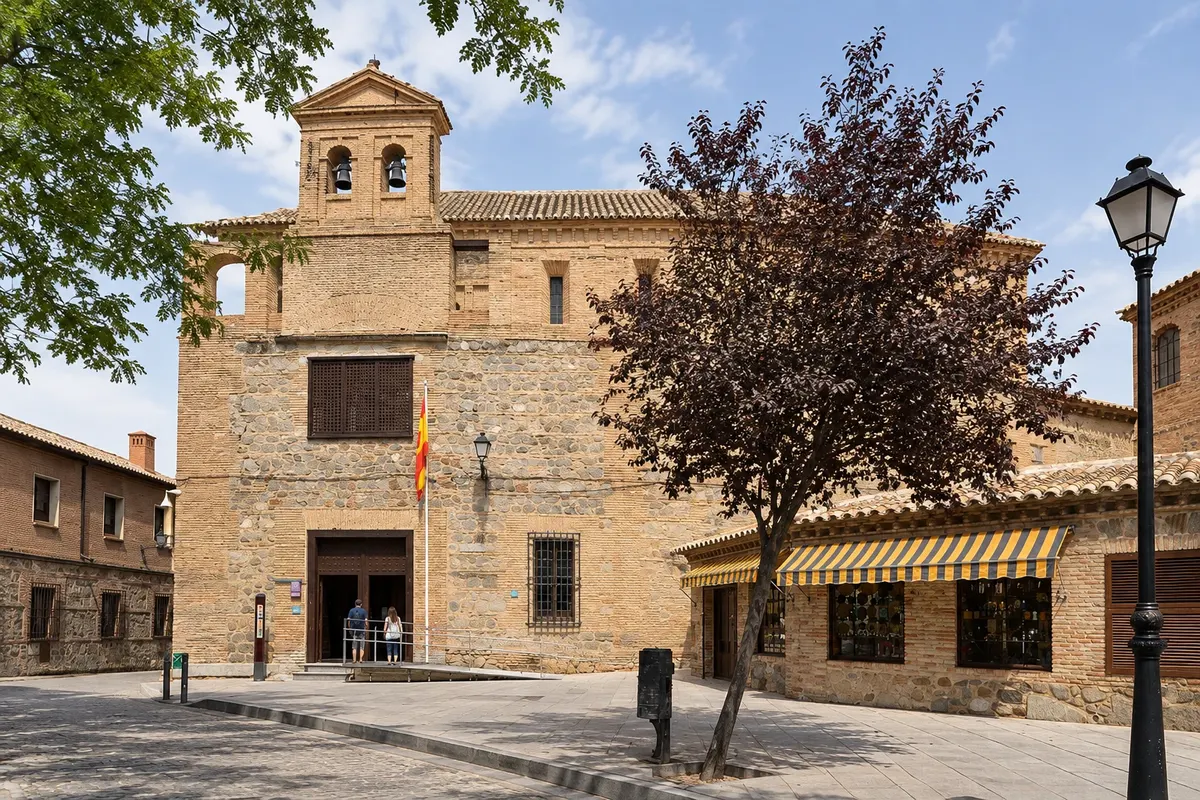
Synagogue · Toledo, Castela-Mancha
Sinagoga del Tránsito (Museo Sefardí)
Mudéjar synagogue dated to 1357, commissioned by Samuel ha‑Leví, treasurer to King Pedro I. The prayer hall features carved plasterwork with inscriptions in Hebrew and Arabic. It houses the Museo Sefardí.
Illustrative images. The pictures in this guide are illustrations based on the real place, not photographs, and may differ from it.

Discover
About Sinagoga del Tránsito (Museo Sefardí)
Inscriptions on the building itself state that it was constructed between 1355 and 1357. The work was funded by Samuel ha-Leví, a member of the Jewish community and treasurer to Pedro I de Castela, who authorized the construction at a time when the law forbade new synagogues.
The large prayer hall has a wooden roof with a par y nudillo framework and walls covered with carved plaster, featuring vegetal and geometric motifs, inscriptions in Hebrew and Arabic, and the coats of arms of the Crown of Castile. Small arched windows high up let in the light.
After the expulsion of the Jews from Spain in 1492, the building became a church, and that is where the name Tránsito comes from, linked to the devotion to Nossa Senhora do Trânsito. Since 1964 it has housed the Museo Sefardí, a state museum attached to the Ministry of Culture.
The museum tells the story of the Jews on the Iberian Peninsula and of the Sephardim, their descendants scattered around the world after 1492, with tombstones, ritual objects, clothing and books. The visit also goes through the rooms annexed to the synagogue and the garden.
Before you go
Practical information
Cidade Turismo reviews its information regularly, but something may have changed. Check with the place before planning your trip.
How much time to set aside
About an hour for the synagogue and the museum.
Best time
In the morning, combined with the Museo del Greco, which is a few meters away. Check opening days before you go, because state museums often close one day a week.
How to get there
It is on Calle Samuel Leví, in the old judería, next to the Paseo del Tránsito, about a 15-minute walk from the Plaza de Zocodover.
Tip
Look closely at the plaster bands near the ceiling, where the Hebrew inscriptions are. There is a combined ticket with the Museo del Greco; ask at the ticket office.
Official website
Get your questions answered
Frequently asked questions about Sinagoga del Tránsito (Museo Sefardí)
Who commissioned the construction of the Sinagoga del Tránsito?
Samuel ha-Leví, treasurer to King Pedro I of Castile, between 1355 and 1357, according to the inscriptions on the building itself.
What is the Museo Sefardí?
It is the state museum, opened in 1964 inside the synagogue, which tells the story of the Jews on the Iberian Peninsula and of the Sephardim after the expulsion of 1492.
What is the difference from Santa María la Blanca?
Santa María la Blanca, dating from 1180, has horseshoe arches on pillars and is only a monument. The Tránsito, from 1357, is a single hall with decorated plasterwork and houses a museum.
Can you see both synagogues in the same day?
Yes. They are about a five-minute walk from each other, on the same street in the Jewish quarter.