

 Brazil
 Argentina
 Chile
Chile Colombia
 Peru
Peru Uruguay
 Germany
 Belgium
 France
 Greece
 the Netherlands
 Ireland
 Italy
Italy Portugal
 the United Kingdom
 Switzerland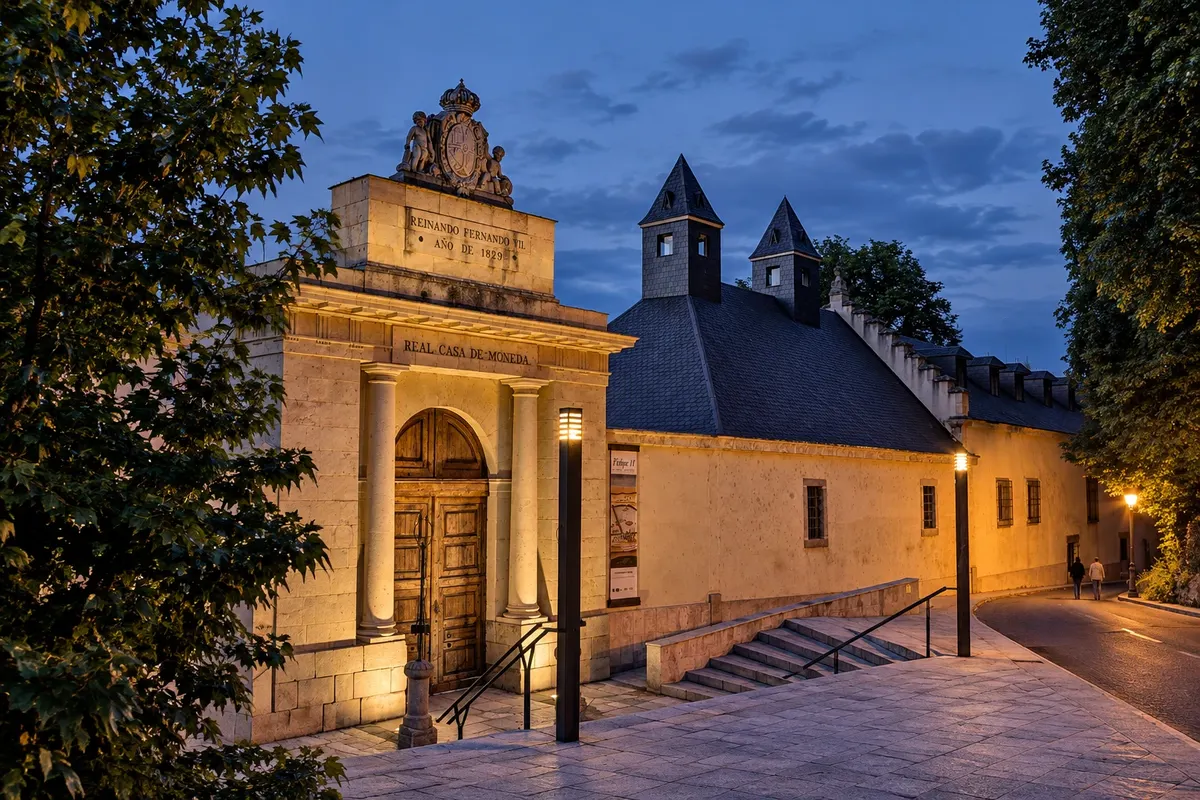
Museum · Segóvia, Castela e Leão
Real Casa de Moneda de Segovia
Coin factory commissioned by Filipe II between 1583 and 1588, designed by Juan de Herrera, on the banks of the Eresma. Today it is a museum, with a hydraulic wheel and the Centro de Interpretación del Acueducto.
Illustrative images. The pictures in this guide are illustrations based on the real place, not photographs, and may differ from it.

Discover
About Real Casa de Moneda de Segovia
In 1583, Filipe II decided to establish a mechanized mint in Segóvia, the first in Spain. The building was constructed between 1583 and 1588 on the banks of the Eresma river, to designs by Juan de Herrera, the architect of El Escorial. It is considered one of the oldest industrial buildings in Europe.
The technique came from central Europe: hydraulic wheels powered rollers that rolled the metal and struck the coins. The machines were brought from Hall, in the Tirol, in Austria. The first coin was produced in 1586, a silver real, and the first gold coins were struck in 1607. In 1771 the roller system was replaced by the screw press.
The museum traces that history, displays the hydraulic wheel and explains how coinage was made. The same ticket gives access to the Centro de Interpretación del Acueducto, with models and information about the construction of the Roman Aqueduto. There is also the original image of the Virgin that was in the high niche of the Aqueduto.
The complex includes the Jardín del Rey, by the river, with a view of the Alcázar.
Before you go
Practical information
Cidade Turismo reviews its information regularly, but something may have changed. Check with the place before planning your trip.
How much time to set aside
Allow 1 to 1½ hours for the museum and the Centro de Interpretación del Acueducto.
Best time
Combine it with the guided visit to El Parral, on the other side of the road. The museum is not open every day of the week and its hours change with the season: confirm before you go.
How to get there
It is on Calle de la Moneda, in the Eresma valley, below the Alcázar. From the Aqueduto, go down Calle de San Juan and follow through the San Lorenzo neighborhood; it's about a 15-minute walk. The return to the upper town is uphill.
Tip
The admission usually includes an audio guide. There are guided tours in Spanish at certain times; check at reception. From the Jardín del Rey you have a view of the Alcázar from below, on the north side.
Official website
Get your questions answered
Frequently asked questions about Real Casa de Moneda de Segovia
What can be seen at Segóvia's Casa de Moneda?
The 16th-century industrial building, the water wheel and the history of coin minting in the city. In the same entrance is the Centro de Interpretación del Acueducto.
Who designed the Casa de Moneda?
Juan de Herrera, architect of Philip II and author of the monastery of El Escorial, with technicians brought from Austria.
Until when were coins minted there?
Coining with water-driven rollers began in 1586. In 1771 the system was replaced by the beam press, a more modern technology.