

 Brazil
 Argentina
 Chile
Chile Colombia
 Peru
Peru Uruguay
 Germany
 Belgium
 France
 Greece
 the Netherlands
 Ireland
 Italy
Italy Portugal
 the United Kingdom
 Switzerland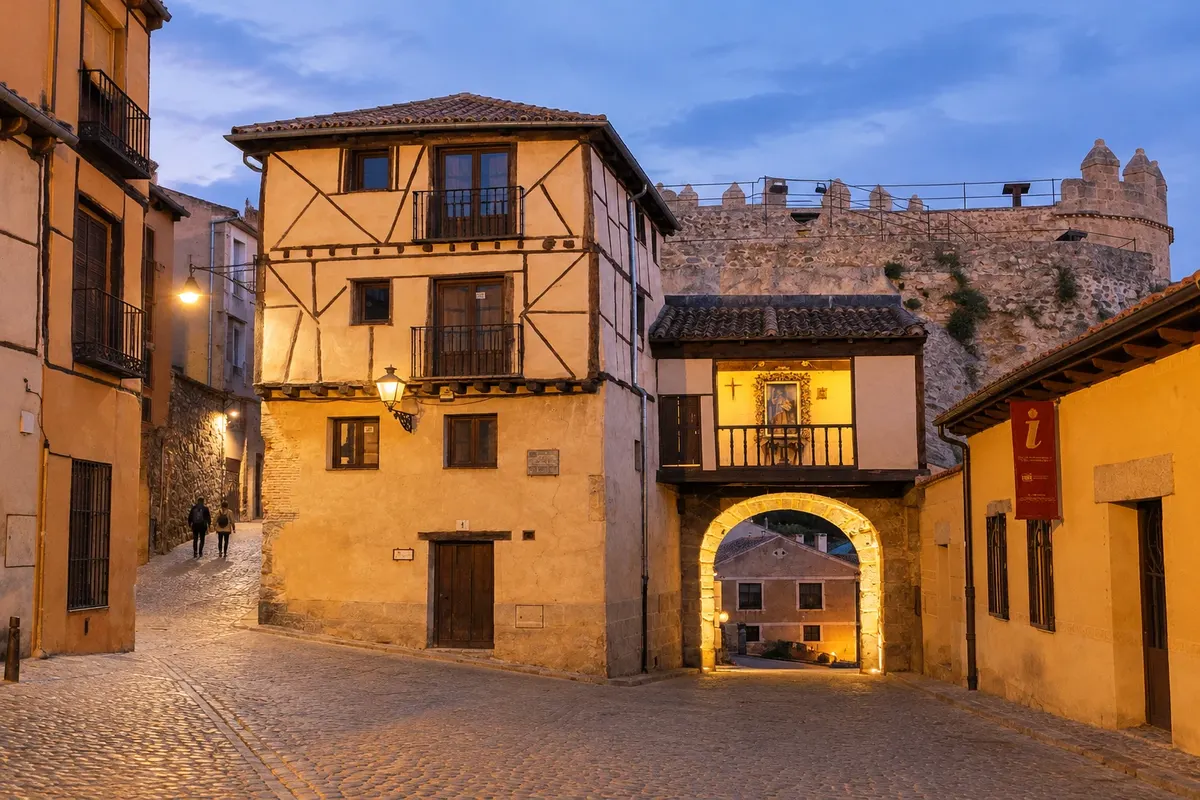
Historic neighborhood · Segóvia, Castela e Leão
Judería de Segovia
Former Jewish quarter in the southern part of the historic centre, between the Cathedral and the city wall. It has narrow streets, the old Sinagoga Mayor and the Puerta de San Andrés, one of the medieval gates of the city.
Illustrative images. The pictures in this guide are illustrations based on the real place, not photographs, and may differ from it.

Discover
About Judería de Segovia
The Jewish community lived in Segóvia from at least the 12th century until the 1492 expulsion decreed by the Catholic Monarchs. It became one of the richest and most populous in Castile. The quarter lies in the southern part of the walled centre, between the Plaza del Corpus Christi and the Canonjías area, and the main street was the present Calle Judería Vieja.
The neighbourhood once had five synagogues. The old Sinagoga Mayor, next to the Plaza del Corpus Christi, was taken from the community in 1410 and converted into a church. In 1481 the Catholic Monarchs ordered the quarter to be closed with seven brick‑arched gates. Among the best known residents was Abraham Senior, chief rabbi of Castile.
At the southern end of the quarter stands the Puerta de San Andrés, also called Puerta de la Judería. It has two towers, one square and the other polygonal, battlements and coats of arms, and overlooks the Clamores valley. Beside it is a tourist information point dedicated to the wall, from where tours depart. The medieval wall ran about 3,400 metres around the city, and much of it still stands.
In the same area, the Centro Didáctico de la Judería tells the history of the community. The Jewish cemetery was on the other side of the Clamores, on the El Pinarillo hill.
Before you go
Practical information
Cidade Turismo reviews its information regularly, but something may have changed. Check with the place before planning your trip.
How much time to set aside
Allow 45 minutes to 1.5 hours to walk the streets, see the Puerta de San Andrés and visit an interpretive centre.
Best time
In the morning or mid‑afternoon, when the visitable sites are open. The streets remain quiet even on busy days at the Alcázar and the Plaza Mayor.
How to get there
It is located behind the Catedral, on the south side. From the Plaza Mayor, go down Calle Isabel la Católica to the Plaza del Corpus Christi and continue along Calle Judería Vieja. The Puerta de San Andrés is at the end of the neighborhood, about a 10-minute walk away.
Tip
The town hall organizes guided tours of the Judería and the city wall; check the schedule at the tourist office. The streets have steps and slopes, like Calle Judería Nueva. Visiting hours for sites vary by season: confirm before you go.
Official website
Get your questions answered
Frequently asked questions about Judería de Segovia
Until when were there Jews in Segóvia?
The community is documented at least since the 12th century and lived in the city until 1492, when the Catholic Monarchs decreed the expulsion of Jews who did not convert.
Can you see any synagogue?
The old Sinagoga Mayor, next to the Plaza del Corpus Christi, was turned into a church at the beginning of the 15th century and still exists. The other neighborhood temples disappeared or were heavily altered.
What is the Puerta de San Andrés?
It is one of the gates of Segóvia's medieval wall, on the south side, with a square tower and another polygonal one. It was also called Puerta de la Judería. Beside it is the information point dedicated to the wall.
Does Segóvia's wall still exist?
Yes, for the most part. It had about 3,400 meters of perimeter, with an average height of 9 meters, and surrounds the historic center from the Alcázar. Gates such as San Andrés and Santiago still stand.