

 Brazil
 Argentina
 Chile
Chile Colombia
 Peru
Peru Uruguay
 Germany
 Belgium
 France
 Greece
 the Netherlands
 Ireland
 Italy
Italy Portugal
 the United Kingdom
 Switzerland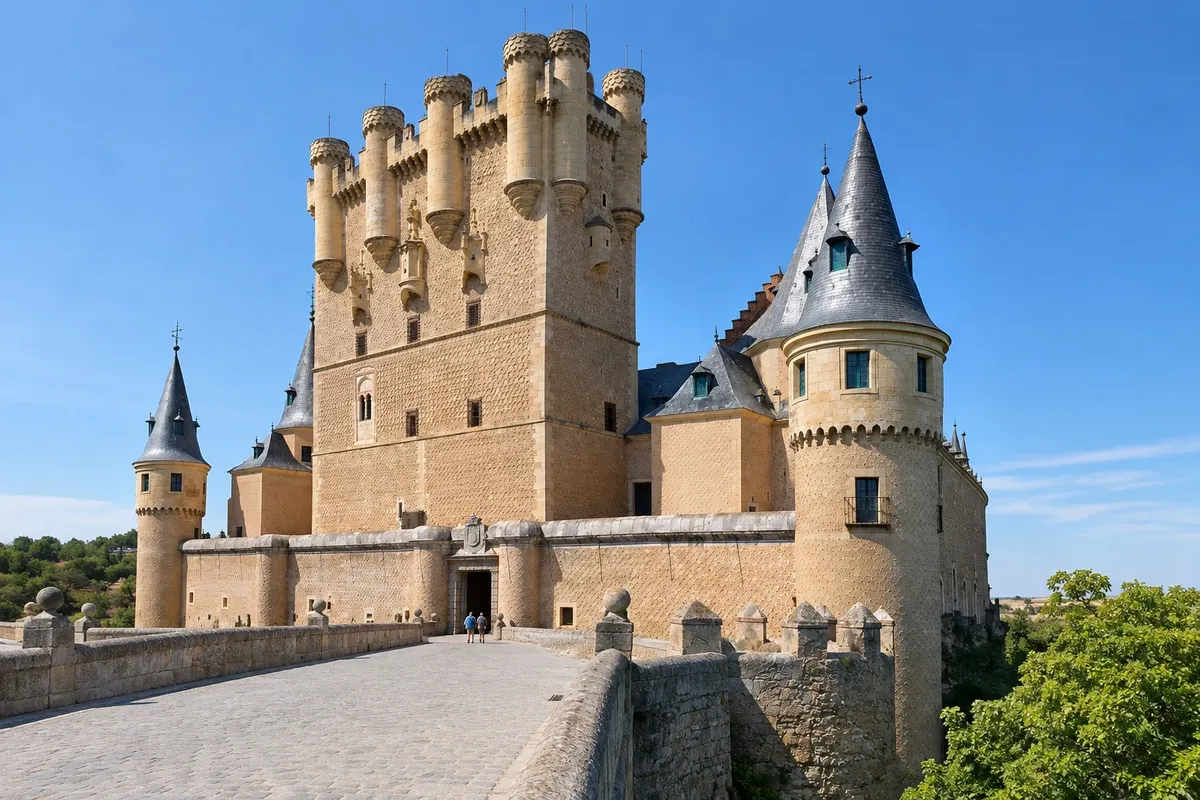
Castle · Segóvia, Castela e Leão
Alcázar de Segovia
Castle-palace on the rocky spur of Segóvia, between the Eresma and Clamores valleys. It was a residence of the kings of Castile, a state prison and the Real Colegio de Artillería, and it has the Torre de Juan II open to visitors.
Illustrative images. The pictures in this guide are illustrations based on the real place, not photographs, and may differ from it.

Discover
About Alcázar de Segovia
The Alcázar occupies the western tip of the rock on which Segóvia stands, above the confluence of the Eresma and Clamores rivers. The first documentary record is from 1125, shortly after the Christian conquest of the city. Over the centuries it has been a fortress, royal palace, treasury of the Crown, state prison, military college and archive.
It was one of the preferred residences of the kings of Castile. Alfonso X convened the Cortes there in 1256, and Queen Catherine of Lancaster began reforms in 1412 that gathered momentum under Henry IV. The pointed slate roofs, which give the castle its familiar silhouette, were ordered by Philip II in the 16th century.
In 1764 Charles III installed the Real Colegio de Artillería in the building. A fire in 1862 destroyed the ceilings of the noble rooms, which were rebuilt based on engravings from 1839. Since 1898 the General Military Archive has been housed on the ground floor. The visit includes the Sala del Trono, the Sala de la Galera with its inverted-ship-hull ceiling, the Sala de las Piñas, the Sala de los Reyes, the chapel and the museum of the Colegio de Artillería.
The Torre de Juan II was erected between 1440 and 1465 and features sgraffito decoration on the façade. The ascent is by a narrow spiral staircase of 152 steps, and from the top you can see the entire city, with the Cathedral rising above the roofs. The castle was also used by Orson Welles in "Falstaff" (1965).
Before you go
Practical information
Cidade Turismo reviews its information regularly, but something may have changed. Check with the place before planning your trip.
How much time to set aside
About 1 hour for the palace and museum. The climb to the Torre de Juan II adds about 25 to 30 minutes.
Best time
Right at opening time or in the mid-afternoon. Visitor numbers tend to be higher late in the morning when day trips arrive. To photograph the castle from outside, the late afternoon light coming from the west illuminates the façade seen from the valley well.
How to get there
It is at the western end of the historic centre, on the Plaza de la Reina Victoria Eugenia. From the Plaza Mayor it is about a 10-minute walk, passing by the Cathedral along Calle Daoíz.
Tip
Entry is limited and the Alcázar recommends buying tickets in advance from the official seller, especially on weekends and holidays. The tower ascent is sold together as a separate option. The 152 steps of the spiral staircase are not recommended for those with mobility difficulties. Opening times vary by season: check before you go.
Official website
Get your questions answered
Frequently asked questions about Alcázar de Segovia
Can you climb the Alcázar tower?
Yes. The Torre de Juan II has access with a specific ticket, which includes the climb. There are 152 steps in a narrow spiral staircase. The view covers the whole city, the Cathedral and the Eresma valley.
Did the Alcázar of Segóvia inspire Disney?
It's a frequently made association, and the silhouette of pointed towers resembles the castles in the films. What is documented is the use of the castle as a set by Orson Welles in 'Falstaff' (1965).
Why are the roofs pointy and grey?
They are slate roofs commissioned by Philip II in the 16th century, in a style more common in northern Europe than in Castile.
Is the interior original?
Partly. A fire in 1862 destroyed the ceilings of the noble rooms. They were rebuilt later, based on engravings made in 1839.