

 Brazil
 Argentina
 Chile
Chile Colombia
 Peru
Peru Uruguay
 Germany
 Belgium
 France
 Greece
 the Netherlands
 Ireland
 Italy
Italy Portugal
 the United Kingdom
 Switzerland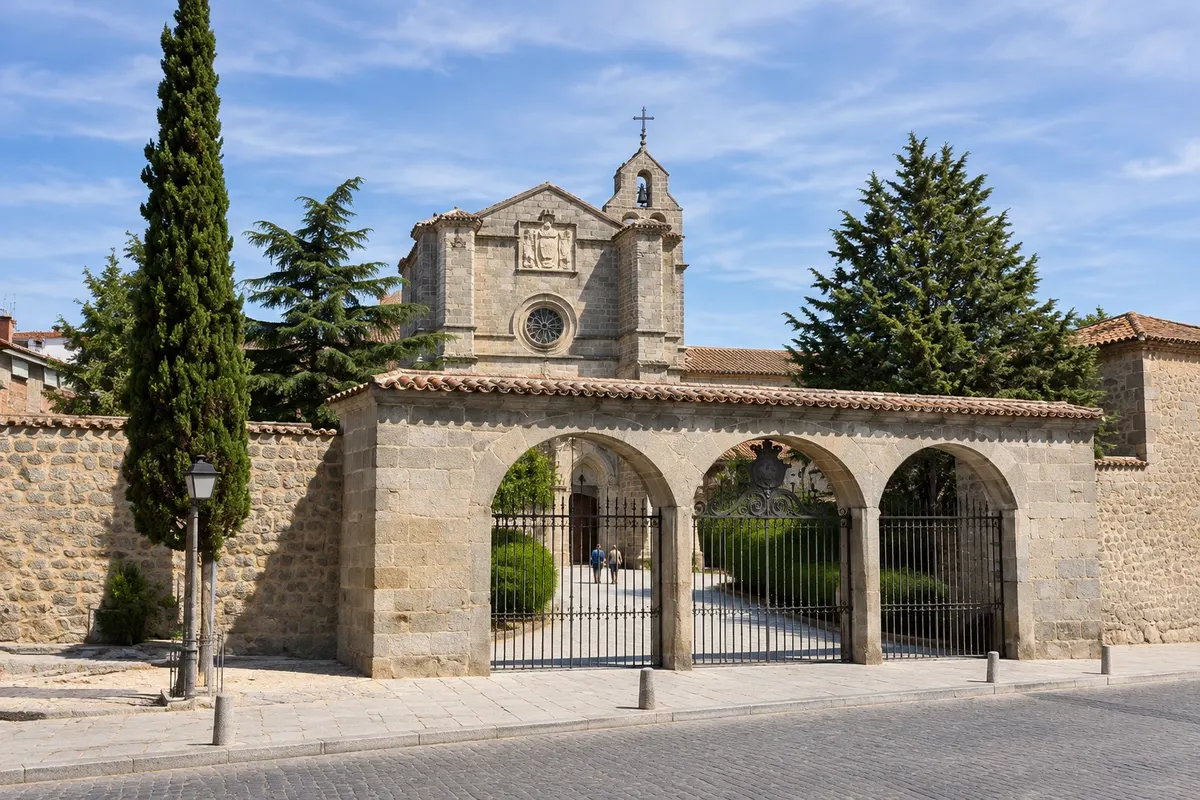
Monastery · Ávila, Castela e Leão
Real Monasterio de Santo Tomás
Gothic Dominican monastery from 1482 to 1493, associated with the Reyes Católicos and Torquemada. It has three cloisters, the tomb of Prince Dom João and a church with a façade sculpted by Gil de Siloé.
Illustrative images. The pictures in this guide are illustrations based on the real place, not photographs, and may differ from it.

Discover
About Real Monasterio de Santo Tomás
The Dominican monastery of Santo Tomás was founded in 1480 by Hernán Núñez de Arnalte, treasurer to the Reyes Católicos, through his wife María Dávila and the friar Tomás de Torquemada. The works, directed by Martín de Solórzano, took place from 1482 to 1493. The Reyes Católicos chose it as a summer residence and commissioned a palace to be built around one of the cloisters.
The monastery was the seat of the Inquisition. Torquemada spent his final years there and died in the convent on September 16, 1498. Between 1576 and 1807 it also functioned as a university.
There are three cloisters. The Noviciate cloister is austere, with 20 arches. The Silence cloister, where the friars were buried, has rich decoration on the upper floor. The Reyes cloister, the largest, organized the rooms of the royal palace. On the church façade, a large depressed arch, a rose window and the coat of arms of the Reyes Católicos combine with ten statues by Gil de Siloé.
In the church transept is the tomb of Prince Dom João, heir to the Reyes Católicos, who died in 1497, made by Domenico Fancelli in 1510. In one of the chapels is the Christ before whom Santa Teresa confessed. The former palace houses a museum of Oriental art and another of natural sciences.
Before you go
Practical information
Cidade Turismo reviews its information regularly, but something may have changed. Check with the place before planning your trip.
How much time to set aside
About 1 to 1.5 hours for the church, the cloisters and the museums.
Best time
In the morning or afternoon, outside worship times, since the church also serves as a parish. Visiting hours are set by the monastery itself: check before you go.
How to get there
It is outside the wall, southeast of the center, on Plaza de Granada. From Plaza de Santa Teresa it is about a 10-minute walk, descending along Calle Duque de Alba and Calle Jesús del Gran Poder. From the train station, about 10 minutes.
Tip
It is a little off the main wall circuit, so it usually has fewer visitors. It’s worth combining the visit with arrival or departure via the train station, which is nearby. The ÁvilaCard grants access to the monastery.
Official website
Get your questions answered
Frequently asked questions about Real Monasterio de Santo Tomás
Who is buried in the Monastery of Santo Tomás?
Prince Don Juan, son of the Catholic Monarchs, who died in 1497. The tomb, by Domenico Fancelli, is located in the church's crossing.
What is Torquemada's connection to Santo Tomás?
The inquisitor Tomás de Torquemada took part in the foundation of the monastery, which was a seat of the Inquisition, and died there in 1498.
How many cloisters does the monastery have?
Three: the Novitiate cloister, the Cloister of Silence and the Cloister of the Kings, the latter connected to the former palace of the Catholic Monarchs.