

 Brazil
 Argentina
 Chile
Chile Colombia
 Peru
Peru Uruguay
 Germany
 Belgium
 France
 Greece
 the Netherlands
 Ireland
 Italy
Italy Portugal
 the United Kingdom
 Switzerland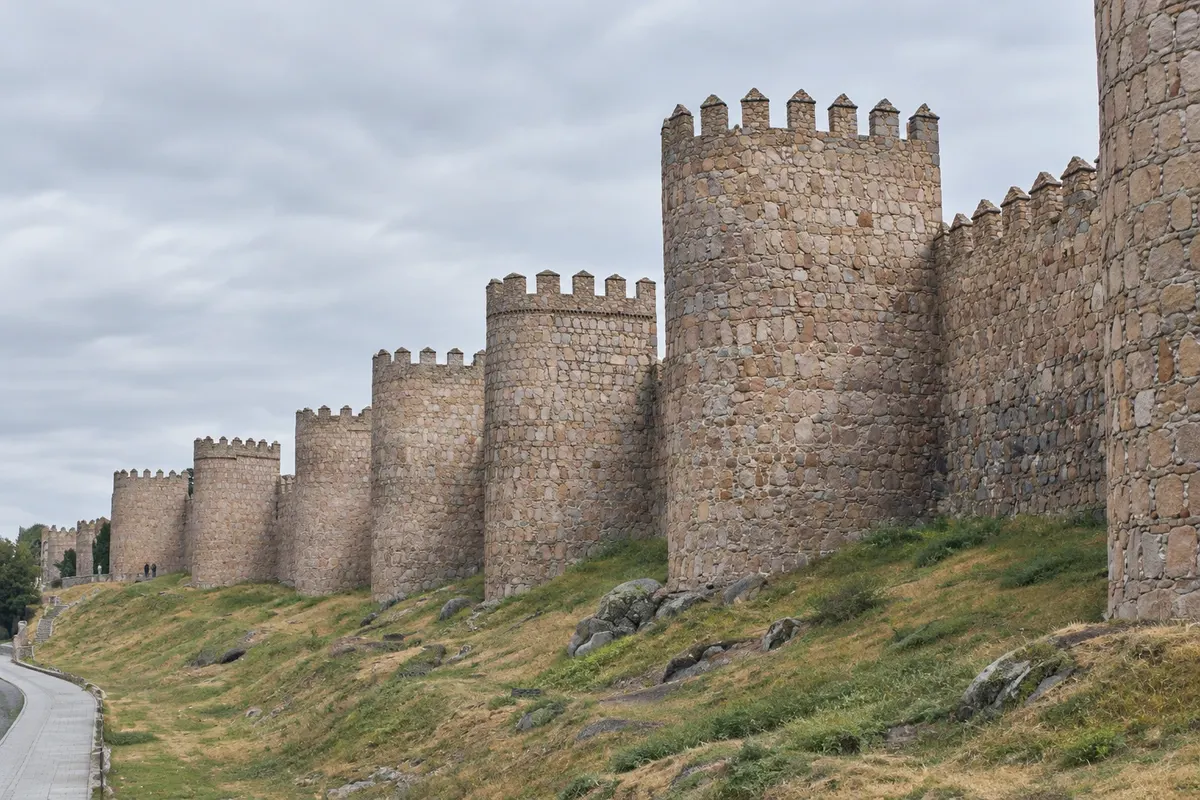
Wall · Ávila, Castela e Leão
Muralla de Ávila
Medieval wall enclosing the historic center, with 2,515 meters of perimeter, 87 towers and 9 gates. Several sections of the adarve, the walkway along the top of the wall, are open to visitors.
Illustrative images. The pictures in this guide are illustrations based on the real place, not photographs, and may differ from it.

Discover
About Muralla de Ávila
The wall of Ávila completely surrounds the old town, in a rectangle of about 33 hectares oriented east–west. It has 2,515 meters of perimeter, 87 semicircular towers, called cubos, about 2,500 battlements and 9 gates. The walls average 12 meters in height and 3 meters in thickness, built of granite.
Excavations show that there was already a Roman wall on the same alignment in the 1st century. The work seen today is medieval: it was rebuilt after the conquest of Toledo by Alfonso VI and underwent further work under Alfonso VIII in the second half of the 12th century. Stones from the Roman necropolis and older walls were reused in the construction.
The most fortified gates are on the east side, the flattest and most exposed: the Puerta del Alcázar and the Puerta de San Vicente. In front of the Puerta del Alcázar lies the Plaza de Santa Teresa, also called Mercado Grande, dominated by the Iglesia de San Pedro, Romanesque, mentioned in a document from 1103. In the 16th century, noble houses attached to the wall became palaces, and the cathedral's apse is part of the east side itself.
The route along the adarve, the patrol path on top of the wall, is made in separate sections, with access points at the Puerta del Alcázar, the Casa de las Carnicerías, the Arco del Carmen and the Puerta del Puente by the Adaja river. The wall and the historic center, with the churches outside the walls, have been a UNESCO World Heritage Site since 1985.
Before you go
Practical information
Cidade Turismo reviews its information regularly, but something may have changed. Check with the place before planning your trip.
How much time to set aside
About 1.5 to 2 hours to walk the adarve sections. A walk around the outside, circling the wall, takes about 1 hour.
Best time
Early in the morning or late in the afternoon, avoiding the strong sun. In the European winter, from November to March, the adarve usually closes on Mondays and closes earlier; in summer it is open every day. Cold winds are common from December to February because of the altitude.
How to get there
The main access to the adarve is at the Puerta del Alcázar, beside the Plaza de Santa Teresa. From the train station it's about a 20-minute walk via Avenida de José Antonio and Calle Duque de Alba.
Tip
The ticket is valid for the different sections of the adarve on the same day; keep your ticket. The ÁvilaCard, the city's tourist card, includes the wall. To see the whole ensemble from afar, go to the viewpoint of Los Cuatro Postes. At night the wall is usually illuminated. Opening times change by season: check before you go.
Official website
Get your questions answered
Frequently asked questions about Muralla de Ávila
Can you walk on top of the wall of Ávila?
Yes. Several sections of the adarve, the walkway along the top of the wall, are open to visitors, with access at Puerta del Alcázar, Arco del Carmen, Casa de las Carnicerías and Puerta del Puente. You cannot walk the entire circuit along the top.
How large is the wall of Ávila?
It has a perimeter of 2,515 metres, 87 towers, about 2,500 crenellations and 9 gates. The walls average 12 metres in height and 3 metres in thickness.
When does the wall date from?
There was already a Roman wall on the same alignment in the 1st century. The current one is medieval, rebuilt after the conquest of Toledo in 1085 and reinforced in the second half of the 12th century.
Does the wall ever close?
In winter hours, between late October and late March, it usually closes on Mondays except public holidays. In summer it is open every day. Check before you go.